At a glance
- Solid hardwood (beech, walnut, red oak) outlasts MDF in handling, humidity and time
- MDF edges chip, swell in moisture and cannot be refinished
- For daily-use organizers, real wood is the only material worth buying
When you pick up a ring holder, a desk tray or a small wall shelf, you are picking up something you will touch every day for years. The material it is made from is not a detail. It determines whether the piece looks better at five years than it did at five weeks, or whether it chips at the corners, swells in a bathroom, and goes straight into the bin when you move.
Most small home goods — organizers, holders, trays, stands — are marketed with photographs that make all materials look equally good. Solid hardwood and MDF both photograph as "wood." The difference shows in use, not in a product image. This guide is about that difference: what each material actually is, how each behaves over time, and why it matters specifically for the kind of objects you put on a dresser, a nightstand or a bathroom shelf.
The short answer is that solid wood — red oak, walnut, beech — and MDF are not interchangeable. One is a natural material with grain, weight and resilience. The other is a composite of compressed fibers and resin that is designed to be cheap, smooth and disposable. Knowing which is which lets you buy once instead of twice.
At a glance
- Solid hardwood (beech, walnut, red oak) outlasts MDF in handling, humidity and time
- MDF edges chip, swell in moisture and cannot be refinished
- For daily-use organizers, real wood is the only material worth buying
What solid wood and MDF actually are
The confusion starts with how both materials are marketed. Both are made from trees; both come in flat boards; both can be stained, painted or waxed. But the resemblance ends at appearance.
Solid wood is a plank sawn directly from a log and dried. The grain you see on the surface runs all the way through the piece. Red oak has a bold, open grain you can trace with a fingertip; walnut has a fine, tight grain with a color that ranges from caramel to near-black; beech has a pale, even texture with tiny rays that give it a subtle shimmer in raking light. The hardness of all three is rated by the Janka scale — red oak sits at 1,290 lbf, walnut at 1,010 lbf, beech at 1,300 lbf. These numbers mean the surface resists denting and scratching under normal daily use. More practically, they mean a ring sliding on and off a cone holder hundreds of times over several years will not wear grooves into the wood.
MDF — medium-density fiberboard — is a manufactured board. Wood fibers (often scraps and sawdust) are broken down, mixed with resin binders and pressed at high temperature into flat panels. The result is extremely smooth on the face and very uniform — which is why MDF became standard for painted cabinet doors and flat-pack furniture. It machines cleanly, accepts paint without grain showing through, and costs a fraction of solid hardwood per square foot. What it does not have is grain running through it, structural resilience in the edges, or any ability to handle moisture.
The practical consequence is straightforward. In an object you set on a shelf and never touch, MDF versus solid wood matters mostly on principle. In an object you handle daily — a ring holder, a desk organizer, a tray you slide things in and out of — the difference is visible within months and definitive within two years.
The humidity question — the one where MDF fails completely

Humidity is the condition that separates the two materials most cleanly. Standard MDF is catastrophically bad in humid environments. The compressed fibers absorb moisture vapor, swell at the edges first, then across the face. Paint or varnish on the surface slows this process but does not stop it — any chip, any small scratch, any drilled hole exposes the fiber core to moisture absorption. A bathroom shelf in MDF will show edge swelling within one or two years of normal use. A nightstand in a humid climate will show corner lifting on any veneer applied over MDF within a similar timeframe.
Moisture-resistant MDF (sold as "green board" or MR-MDF) performs better — the resin binders are hydrophobic — but it is not waterproof, and at the end of its life it fails by the same mechanism, just more slowly.
Solid hardwood sealed with wax or oil is in a different category. The wood cell structure is intact; the finish closes the pores on the surface. Seasonal humidity changes cause minor expansion and contraction — wood is a living material and moves a little with the seasons — but this is normal, not damage. A waxed walnut ring holder left in a bathroom environment for ten years will still be flat, still be smooth, and will look as good as it did at purchase with occasional maintenance. The same object in MDF would not survive two.
This is the decisive factor for any home good placed near a bathroom, kitchen, or any room with seasonal humidity swings. Solid hardwood is the only material that handles it without compromise.
Edge integrity and daily handling — where MDF shows its limits first
Before humidity becomes an issue, edges do. MDF has a specific structural weakness: its edges are made of the same compressed fiber as the face, but without the surface resin layer that gives the face its smoothness. Under impact — a corner knocked against another surface, a ring dropped at an angle, a holder moved across a marble surface — MDF edges chip and crumble. The damage is not recoverable. Sanding an MDF edge exposes more fiber; painting over a chipped edge never fills it cleanly.
Solid hardwood edges are end grain, and end grain in hardwoods is among the hardest surfaces on the piece. A walnut cone ring holder has hardwood at every edge; a beech tray can be knocked and slid across surfaces without marking because the structure is continuous and resilient throughout. The edge of a ring holder is also exactly where a ring is placed and removed — which is precisely the point of highest repetitive stress on the object. Solid wood handles this. MDF does not.
The handling frequency of a ring holder is worth emphasizing. If you remove and replace your rings every morning and evening, that is somewhere between 700 and 1,000 interactions per year. Over three years, the edge of a cone holder has been contacted thousands of times. Beech and walnut are built for this. MDF is not.
Weight, density and what they tell you
One reliable way to distinguish solid wood from MDF without cutting into a piece is to pick it up and feel its weight relative to its volume. This surprises most people: MDF is denser and heavier than solid hardwood per unit volume. A small MDF organizer can weigh more than a solid walnut version of the same size. This is because MDF is compressed at very high pressure during manufacture, packing wood fibers into a board that is heavier than the equivalent natural wood.
Why does this matter? It matters for stability on a dresser or shelf (heavier is not always better — a base-heavy ring holder can tip), and it matters for the decision matrix when comparing products of similar size at similar price. If you pick up two ring holders of the same size and one is noticeably heavier, that is often — not always, but often — the MDF piece. The lighter piece in the same size is typically solid hardwood with a lower density per volume.
Solid beech, walnut and red oak have densities of approximately 720, 640 and 770 kg/m³ respectively. MDF is 750–800 kg/m³. In small objects — a ring cone, a small tray — the difference in absolute weight is minor, but the feel is different: solid wood feels solid because the weight is consistent throughout; MDF can feel oddly heavy at the base where the panel is thickest and light at thin protrusions.
What happens over years — the aging comparison

The ten-year view is the most useful frame for evaluating home goods. At year one, a well-made MDF piece with a good finish can look close to solid wood — the photography is convincing, the paint is intact, the edges have not yet chipped. At year three to five, divergence is visible. At year ten, the trajectories have separated completely.
Solid walnut develops a patina — the surface deepens in color and character with exposure to light and handling oils. Antique dealers call this "honey color" in oak, "chocolate" in walnut. A ring holder used daily for ten years has oils from hands worked into its surface. It looks used in the way a good leather wallet looks used: not worn out, worn in. It can be lightly sanded and re-oiled in an afternoon to restore its surface or change its finish.
MDF cannot be refinished. Sanding removes the paint layer and exposes the fiber mat underneath, which absorbs stain and finish unevenly and cannot be brought to the same surface quality as the original. The only legitimate option when MDF furniture shows its age is replacement. This is, of course, the business model of flat-pack furniture at its fullest specialementsion: the piece is designed to be replaced, not maintained.
Solid hardwood furniture — and solid hardwood small goods, including ring holders and organizers — does not depreciate on a replacement schedule. It appreciates in familiarity and can be passed along. Walnut and red oak pieces made in the 1960s sell at estate sales and on secondary markets above their original price. This is not nostalgia; it is a property of the material.
The three ring holders from our studio
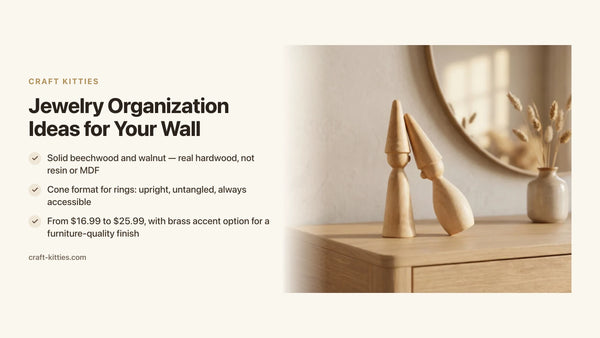
Our ring holder collection is built entirely in solid wood — beech, walnut and red oak — with the surface choices (wax coat, brass base, paired sets) designed around daily handling rather than showroom photography. The three pieces below represent the range of the lineup, from the entry-level set to the statement piece for a dressed dresser.

Description
The Beechwood Ring Holder Cone Set is the starting point of the lineup. Two solid beech cones in different heights keep rings separated and within reach. Beech is one of the hardest commercially available European hardwoods — Janka 1,300 lbf — and its pale, fine grain gives it a clean, unobtrusive presence on any surface. The pair is sized for a dresser or nightstand, light enough not to dominate the surface, solid enough to last years of daily handling. At $16.99, it is the most direct answer to the solid-wood-versus-MDF question at the point of purchase: same price as many MDF alternatives, entirely different material.

Description
The Walnut Wood Ring Holder with Solid Brass Base is the piece that changes the dresser. Solid walnut — deep brown, fine grain, naturally warm — on a brushed brass base that keeps it stable and adds a considered material accent. Walnut is the most sought-after wood in contemporary home décor precisely because it photographs beautifully and looks even better in person. The brass base is not decorative in the superficial sense: it anchors the cone so it stays where it is placed through daily ring-removal without sliding on the surface. At $25.99, this is the piece that settles the upgrade question.

Description
The Wooden Ring Holder Set of 2 in Walnut pairs two solid walnut cones for a symmetrical display — two rings, two sides of the dresser, one visual decision. Natural wax finish closes the grain and makes the surface smooth to the touch. The set works as a couple's pair (each person's side of the dresser) or as a single display with rings sorted by size or occasion. At $18.99, it gives walnut's character in a set, at a price close to the beech entry point.
Comparison table
| Model | Price | Wood | Finish | Best for |
|---|---|---|---|---|
| Beechwood Cone Set | $16.99 | Solid beech | Natural wax | Entry price, couples, light interiors |
| Walnut Cone Set of 2 | $18.99 | Solid walnut | Natural wax | Symmetric display, walnut aesthetic |
| Walnut with Brass Base | $25.99 | Solid walnut | Wax + brass base | Statement dresser piece, gift |
Decision matrix — which organizer for which situation
| Your situation | The right pick |
|---|---|
| Light interior, Scandinavian or minimal aesthetic | Beechwood Cone Set |
| Two people sharing a dresser or nightstand | Walnut Set of 2 or Beechwood Cone Set |
| One dresser centerpiece, warmer aesthetic | Walnut with Brass Base |
| Gift for a partner or housewarming | Walnut with Brass Base |
| First solid wood piece, tight budget | Beechwood Cone Set at $16.99 |
Three mistakes people make when buying home organizers
Trusting the product photo over the material description. MDF with a walnut-print veneer and solid walnut look identical in a white-background photograph. The material is declared in the product description, not the image. Before purchasing any ring holder or small organizer, look for the words "solid" (solid oak, solid walnut, solid beech) rather than "wood-look," "wood-effect," "engineered wood" or any variant that avoids naming the core material.
Optimizing for price per unit instead of cost over time. An MDF ring holder at $9 that chips within eighteen months and goes in the bin costs more per year than a solid beech holder at $16.99 that lasts ten years and still looks clean. The calculation is trivially simple; the instinct to choose the lower sticker price is powerful and almost always wrong in the category of daily-use home goods.
Choosing the material that photographs well instead of the material that handles well. High-gloss lacquered MDF looks spectacular in a product shot and under harsh overhead light. It shows every fingerprint in daily use, cannot be spot-repaired, and develops micro-scratches in the lacquer within months of regular contact. Waxed solid wood shows handling gracefully — the patina deepens, the surface becomes smoother — and a single pass with a wax cloth restores it. The two materials optimize for entirely different audiences: one for the studio, one for the dresser.
How to care for solid wood organizers
The care routine for a solid wood ring holder or organizer is close to no routine at all. A dry or slightly damp cloth removes dust and light fingerprints. Avoid leaving standing water on the surface — the wax finish handles humidity and splashes, not a pooled liquid. A light application of beeswax or furniture wax once or twice a year, buffed in with a soft cloth, keeps the finish intact and the wood hydrated.
Scratches and small marks in waxed solid wood are not permanent. Light surface scratches close with a pass of 0000-grade steel wool followed by wax. Deeper marks can be addressed with fine sandpaper (220-grit) along the grain, then re-waxed. Neither operation is possible on MDF — scratching MDF exposes fiber and paint, and sanding it reveals the raw board underneath, which absorbs finish unevenly and cannot be matched to the original surface.
The implication is simple: a waxed solid wood organizer requires occasional attention to stay in excellent condition, and that attention restores it to new. An MDF organizer requires no maintenance and cannot be restored when it deteriorates.
What "solid" means on a product label — and how to verify it
The word "solid" on a product label has a specific meaning: the piece is made of wood throughout, with no MDF or particleboard core. "Solid oak," "solid walnut" and "solid beech" mean just that. The term is legally meaningful in furniture labeling in most markets.
Watch for the alternative terms that indicate MDF or engineered wood: "engineered wood," "wood composite," "wood-tone," "MDF with wood veneer," "laminate," "high-gloss panel." These are all legitimate descriptions of legitimate products — but they are not solid wood, and they should not be priced or expected to perform like solid wood.
The three tests in the field: look at an exposed edge for end grain (rings and rays = solid wood, uniform gray mat = MDF); run a fingernail across a corner (solid wood resists, MDF fiber gives slightly under pressure); smell the piece — solid wood has a faint natural wood scent that MDF's resin binders do not replicate.
Why the solid-wood premium on small goods is smaller than you think
The price gap between solid wood and MDF at the small-goods scale — ring holders, desk organizers, small trays — is narrower than at the furniture scale. A solid wood dining table costs two to five times a comparable MDF piece because the material cost scales with volume. A small ring holder in solid beech at $16.99 versus a comparable MDF version at $9.99 is a seven-dollar difference — less than the cost of replacing the MDF version once.
This is the most practical argument for solid wood in small home goods: the premium is modest in absolute terms, and it buys a different category of object. The solid beech cone does not need to be replaced. The MDF cone will. Over a five-year window, the solid wood piece is nearly always the cheaper option as well as the better one.
FAQ — solid wood vs MDF for organizers and home goods
1 — Is solid wood stronger than MDF? Yes, in most conditions that matter at home. Solid hardwood — red oak, walnut, beech — resists impact, bending and repeated handling better than MDF, which is a compressed board of wood fibers and resin. MDF is dense but chips at the edges and swells in moisture. Solid wood, properly finished, handles the same conditions without structural change.
2 — Does MDF hold screws as well as solid wood? Not as reliably. MDF holds screws well in the flat face but is weak at the edges — the compressed fibers separate under lateral screw stress. Solid wood holds screws in any direction and allows re-screwing without stripping. For small organizers and holders that need to anchor firmly, solid wood is the safer material.
3 — Can MDF be used in humid areas like a bathroom or bedroom? Standard MDF cannot. It swells and eventually delaminates in persistent humidity, even when painted. Moisture-resistant MDF handles some humidity but still falls short of sealed solid wood over years of daily use. Solid hardwood with a wax or oil finish remains stable in bathroom-level humidity and wipes clean without risk of swelling.
4 — Which is better for a ring holder — solid wood or MDF? Solid wood, for two reasons. A ring holder is handled daily — the repeated contact rewards hardwood and punishes MDF edges, which chip and dent. And the grain of real wood — beech's fine texture, walnut's deep tone — is genuinely beautiful where MDF requires a veneer or paint to look presentable.
5 — How do you tell solid wood from MDF furniture? Three tests: look at the edge (solid wood shows end grain; MDF shows a gray fiber mat); lift it (MDF is heavier per volume in small pieces); run a thumbnail along an edge (solid wood is hard and smooth; MDF has a slightly grainy texture that dents under pressure).
6 — Does solid wood furniture hold its value over time? Far better than MDF, and some species appreciate. Walnut pieces from decades past sell on secondary markets above their original price. MDF furniture has no second-hand value because it cannot be repaired, refinished or restored. Solid wood can be sanded, re-oiled and passed on — its cost-per-year is a fraction of what MDF's apparent lower price suggests.
7 — Is walnut or beech better for small home goods? Both are excellent hardwoods; the choice is visual. Walnut is deep brown with a fine grain and a quiet luxury feel. Beech is pale honey-toned with an even texture that suits lighter interiors and Scandinavian aesthetics. In hardness and durability for everyday handling, both are comparable and far above MDF.
8 — Can MDF be refinished or repaired? No, not meaningfully. Sanding MDF removes the paint-sealed surface and exposes the raw fiber mat underneath, which absorbs finish unevenly and cannot be re-coated cleanly. Chips and dents in MDF are permanent. Solid wood can be sanded, re-stained, re-oiled or repainted as many times as needed.
9 — What does a wax finish do on solid wood? It closes the pores of the wood surface, making it moisture-resistant and smooth to the touch. It does not build a hard film on top of the wood the way lacquer does — it penetrates and seals from within. This means it can be refreshed with a new coat of wax rubbed in by hand, unlike lacquer, which requires stripping and re-application when it fails.
10 — Is solid wood worth the extra cost for small pieces like ring holders? Yes, because the premium is smaller than most people expect. At the small-goods scale, solid beech or walnut adds a few dollars to the price — not multiples. Over a five-year window, the solid wood piece that never needs replacing is almost always cheaper than the MDF piece replaced once or twice. It is also the one that looks better at year five than it did at year one.
Where to go next
The ring holders above are part of our broader ring holder collection, which gathers every piece in the lineup — from the entry-level Beechwood Cone Set at $16.99 to the Walnut with Brass Base for the dressed dresser. Every piece in the collection is solid wood, every finish is wax or oil, and every edge is hardwood throughout — the same material standard across the range. Our studio has over 243 reviews on Etsy from customers who chose solid wood once and did not go back.
Conclusion — buy the material, not the price
The solid wood versus MDF question resolves cleanly at the point of use. For objects that sit on a shelf and are rarely touched, the distinction matters less — both survive. For objects you interact with daily, the distinction is everything: edge integrity, humidity resistance, aging character, and the ability to refinish rather than replace. A solid beech or walnut ring holder is not a premium for its own sake. It is the correct material for the job.
The three principles that carry over to any purchase decision in this category: verify the material in the description, not the photo; compare cost over a five-year window, not sticker price; and choose the material that improves with handling rather than the one that tolerates it.