At a glance
- Solid wood = grain continues through edges and underside; veneer = thin face over a different core
- Red oak, walnut and beech are the three hardwoods worth knowing: all rated 1000–1300 lbf Janka
- A veneer scratch is irreparable; a solid wood scratch can be sanded out — that is the practical difference
There is a version of every small wooden object that looks identical in a photo but falls apart in two years, and a version that still sits on the same dresser decades later. The difference is almost never the design. It is what the piece is actually made of.
"Solid wood" and "veneer" are not synonyms for expensive and cheap. They are two entirely different construction methods — each with legitimate uses, each with a specific failure mode — and the furniture industry's habit of using them interchangeably in listings does buyers a genuine disservice. The question matters most for the objects you handle every day: a ring holder you pick up every morning, a desk accessory you move to dust, a tray that lives under a glass of water. These are the pieces where material integrity either holds or quietly fails.
This guide is a working reference for anyone who has looked at two ring holders side by side and wondered why one costs $12 and another $25, or who has bought a "wood" piece that started peeling at the edges within six months. By the end you will know how to identify solid wood from veneer with a glance, which species to choose and why, and what to expect from each over the long term.
What "solid wood" actually means — and what it does not
Solid wood means the piece is cut from a single, continuous piece of timber, or from boards of the same species edge-glued together. The grain you see on the surface runs all the way through the piece: turn it over, look at the underside, examine a raw edge — it is the same material throughout. No layers, no hidden substrate, no core of something cheaper topped with something prettier.
That continuity has two practical consequences. First, a scratch or dent on solid wood is repairable: you sand back to clean material and refinish. Second, solid wood ages differently from a layered product — the surface develops a patina rather than delaminating, and the piece becomes more itself over time rather than less.
What solid wood is not: the phrase "solid wood construction" appearing on a listing without species and grade information is marketing language, not a guarantee. "Solid pine" can mean construction-grade softwood; "solid hardwood" without species can still be low-density poplar. The useful information is the species name — red oak, walnut, beech — and whether the piece shows continuous grain at its edges.
What veneer is — and where it works
Veneer is a thin layer of real wood — typically 0.5 mm to 3 mm — bonded to a core material. The core is usually MDF (medium-density fiberboard), particleboard, or in higher-end applications, plywood. The face veneer is real wood, so the grain pattern is authentic. Everything underneath is not.
Veneer has legitimate uses. Fine furniture makers have used it for centuries to achieve stable, wide panels in rare or figured species that would be prohibitively expensive as solid stock. A veneer over quality Baltic birch plywood is structurally sound and dimensionally stable. The problem in mass-market furniture is not veneer in principle; it is veneer over MDF, which introduces specific failure modes:
- Edge exposure: MDF edges are porous and soft. The veneer terminates at the edge, often with a thin matching strip that chips or peels with repeated contact.
- Moisture: MDF swells uniformly when it absorbs humidity, causing the face veneer to bubble or crack where expansion is uneven.
- Impact damage: A dent that penetrates the face layer reveals a different-colored MDF core that cannot be invisibly repaired.
For small objects handled daily — ring holders, desk accessories, trays — these failure modes are not theoretical. They are the reason a "wood" ring holder bought at a department store looks worn within a year.

How to tell solid wood from veneer in thirty seconds
You do not need to take a piece apart to know what it is. Four quick tests cover almost every situation.
The edge test is the most reliable. Solid wood shows continuous grain running around every edge — the pattern you see on the face follows through to the side. Veneer stops at the surface: the edge either reveals the core directly (a lighter, fibrous material without grain) or is covered by a separate edge-banding strip in a slightly different tone. Look at a corner where two surfaces meet. If the grain pattern breaks rather than flowing around the corner, you are looking at veneer.
The weight test is the fastest. Pick it up. A solid red oak or walnut piece of any meaningful size is noticeably heavier than a comparably sized MDF-core piece. This is partly why solid wood ring holders feel different the moment you handle them — the weight signals material substance before anything else registers.
The underside test applies to objects like trays, holders and organizers. Turn it over. Solid wood shows the same material — grain, color — on every surface. Veneer pieces often expose the substrate on the back panel or base: a smooth, uniform surface without visible grain, frequently lighter than the face, sometimes with visible saw marks in the fiber.
The grain uniformity test distinguishes real wood veneer from printed film and resin. Real wood grain varies — the pattern shifts, knots appear in unexpected places, the tone is not perfectly uniform. A printed film repeats: look carefully across a large surface and the pattern tiles. A resin "wood-effect" piece is worse — the grain is often too perfect, too evenly distributed, with no natural variation at all.
Red oak, walnut and beech: the three species that matter

For ring holders and small desktop accessories, three hardwoods cover the full range of what you might want.
Red oak scores 1290 lbf on the Janka hardness scale, which is the industry standard measure of resistance to surface denting. It has a light honey-brown tone and a bold, open grain that is easy to read at arm's length. On a dark dresser or walnut nightstand it reads as contrast; against a white or light surface it brings warmth without overwhelming the space. It is the most versatile species in the lineup: it works in traditional rooms and in minimal, Scandinavian-influenced interiors.
Walnut sits at 1010 lbf — slightly softer than oak but still firmly hardwood by any classification. Its defining characteristic is color: deep brown, with a fine, tight grain that photographs quietly. On a dresser top, a walnut ring holder reads like a piece of furniture in miniature rather than a jewelry accessory. It flatters gold, rose gold and copper tones, and it has enough visual weight to anchor a styled surface without cluttering it. Among the three species, walnut consistently draws the highest demand in home décor — partly because of the color and partly because of the associations with quality furniture.
Beech scores 1300 lbf — the hardest of the three. Its color is pale cream to very light tan with a fine, uniform grain and a subtle warmth. It is the most understated species and the one that suits silver, white gold and mixed-metal jewelry collections best: the neutrality of the wood lets the jewelry lead. In a bright, minimal bedroom or a bathroom counter where the space is already rich in texture, beech recedes appropriately rather than competing.
All three species are genuine hardwoods with structural integrity that no MDF-core product matches at any price. The choice between them is aesthetic, not one of durability.
Why material integrity matters more for small objects than for large furniture
This is the counterintuitive part. You might expect that the material difference matters most for a dining table or a bookcase — large, expensive, structural. In practice, the opposite is often true for small everyday objects.
A large piece of veneered furniture that sits in a cool, stable interior, never gets wet and is never moved may last decades without showing its failure modes. A small object like a ring holder is handled multiple times a day, exposed to humidity from a nearby bathroom, placed on surfaces that vary in temperature, and sometimes knocked over. Every use cycle stresses the edge joints, the base, the finish. Solid wood responds to that use by developing character — a slight patina on a waxed beech cone, a deepening of color in the walnut grain. Veneered MDF responds by revealing its construction: edge chipping at the base contact points, surface bubbling near a humidifier, a crack at the face-to-edge joint where the glue has cycled through too many expansions.
The $12 price difference between a veneered ring holder and a solid beech one is not about margin. It is about what the material does under daily use over a year — and whether the piece on your dresser looks better in year three than it did in month one, or whether it has been quietly replaced twice.
The five ring holders from our studio
Each piece below is solid wood — red oak, walnut or beech — finished with a wax or wax-oil coat. No veneer, no MDF core, no printed grain film. The grain you see on the face runs around every edge and through the base.

Description
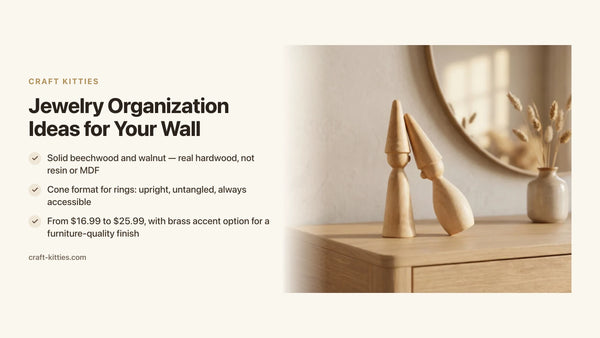
The beechwood cone set is built for couples and for anyone who keeps more than one ring on the dresser — the two cones are sized to stack rings at different heights so each piece stays accessible without tangling. Solid beech throughout: the light, fine-grained wood suits silver, white gold and platinum tones particularly well, and the natural wax finish gives the surface a quiet matte warmth that does not compete with the jewelry it holds. At $16.99 for the set, it is the starting point for a dresser that takes the material seriously.

Description
The walnut and brass ring holder is designed around a single piece of jewelry that deserves a dedicated display. Solid walnut — deep brown, fine grain — is machined into a cone profile and set on a base of solid brass rather than plated zinc: the difference matters over time, because solid brass develops a living patina while plating wears through to a cheaper metal underneath. The combination of dark walnut and warm brass flatters gold and rose gold rings in particular, and the weighted brass base means the holder stays put even on a glass or lacquered surface. At $25.99, it is the version you buy once.

Description
The walnut set of two is the same solid-walnut construction in a matched pair — one for each ring, each cut from the same walnut board so the grain character is consistent across both pieces. The cones sit stable on a flat base, and the continuous walnut grain on every surface is the fastest proof that this is not a veneered product: run your finger around the edge of the base and you feel a single, uninterrupted piece of wood. At $18.99 for the pair, it is the practical choice for an engagement set or a couple's display.
Description
The single beech cone is the same piece from the set above, available on its own for nightstands, bathroom counters or any surface where you want exactly one holder rather than two. The waxed beech finish wipes clean with a dry cloth and does not need re-oiling on any schedule. Set it next to a walnut tray and the contrast between the pale beech and dark walnut grain reads as intentional rather than mismatched — the two species are complementary, not competing.
Description
A note on the walnut and brass model for styled surfaces: the brass base is solid, not hollow, which matters when the surface is glass or a high-gloss lacquer. Hollow bases concentrate weight unevenly and rock slightly; solid brass distributes it. For a nightstand shelf with a lamp, a small plant and a ring holder in a tight arrangement, the stability difference is noticeable the first time you reach for the piece in the dark.
Comparison table — ring holders by species and construction
| Model | Price | Wood | Janka | Best for |
|---|---|---|---|---|
| Beechwood Cone Set (pair) | $16.99 | Solid beech | 1300 lbf | Silver, white gold, couples display |
| Walnut Cone Set (pair) | $18.99 | Solid walnut | 1010 lbf | Gold, rose gold, warm dresser tones |
| Walnut + Solid Brass Base | $25.99 | Solid walnut + solid brass | 1010 lbf | Single statement ring, glass surfaces |
Decision table — which ring holder for your situation
| Your situation | The right pick |
|---|---|
| Couples display, budget-conscious, light dresser | Beechwood Cone Set — $16.99 |
| Couples display, walnut dresser or dark tones | Walnut Cone Set — $18.99 |
| Single important ring — engagement, wedding band, heirloom | Walnut + Brass Base — $25.99 |
| Gift for a couple, meaningful and tactile | Beechwood Cone Set or Walnut Cone Set depending on their tones |
| Glass shelf or lacquered nightstand surface | Walnut + Solid Brass Base (weighted, stable) |
| Mixed-metal jewelry collection, minimal bedroom | Beechwood Cone Set (neutral, does not compete) |
The long-term case for solid wood: what ten years looks like
A well-finished solid walnut or beech piece does not age the way furniture ages in the popular imagination — it does not wear out. The surface develops a patina: the wax catches a slightly warmer tone, the high-contact points (the tip of the cone, the base edge) develop a smoother feel from handling. This is not degradation; it is what wood does when it is used. The Japanese concept of wabi-sabi describes it well — objects become more themselves as they age, more particular, more legible as real things rather than manufactured representations of things.
A veneered piece ages differently. The first two years often look fine; by year three, the edge-banding has started to lift at one corner; by year five, a chip at the base has revealed the particleboard core underneath. The piece has not aged — it has deteriorated. The replacement cost, spread over that period, typically exceeds what the solid hardwood version would have cost at the outset.
This is the genuine argument for solid wood, and it is not a premium-brand argument. It is a value argument: the $25 solid walnut piece that sits on your dresser in ten years, looking better than it did when you bought it, is cheaper over time than the $12 veneered piece you replace three times.
Mistakes buyers make when choosing between solid wood and veneer
Trusting the word "wood" in a listing title. The word wood appears in listings for everything from solid walnut to PVC with a wood-print film. It carries no legal or material guarantee. Look past the title to the material description — and if the material description is absent, that absence is information.
Assuming price reflects material. Solid wood and veneer can sit at similar price points depending on the seller's margin, brand and sourcing. A $20 solid beech ring holder from a studio that mills its own stock can be real hardwood; a $30 "premium wood accent" from a mass retailer can be MDF. Price is a rough heuristic, not a guarantee. The edge test is more reliable than the price tag.
Overlooking the base and underside. Most buyers examine the top surface. The bottom is where veneer construction is hardest to hide: an exposed particleboard base, a thin liner glued over MDF, or a hollow cavity where solid wood would be a continuous piece. If a listing shows only top-down photos and no edge or underside view, request one before purchasing.
Choosing grain tone from a screen photo without considering the surface it sits on. A walnut ring holder photographed against a white studio background looks rich and dark. Against a walnut dresser top, it disappears. Against a light-maple nightstand, it stands out. The grain tone of the holder and the tone of the surface it sits on are a pair — choose for contrast if you want the object to register, for match if you want it to recede.
Caring for a solid wood ring holder
The maintenance ask for a waxed solid hardwood piece is modest. Dust with a dry cloth when you clean the surface it sits on. If the surface picks up a ring mark from a glass left nearby, a single pass with a barely damp cloth removes it without affecting the finish. Do not leave the piece in standing water or in direct sun for extended periods — sustained UV exposure bleaches the grain over time, which is reversible by a light oil application but best avoided.
Once a year, if the finish starts to feel dry rather than smooth, a thin coat of natural beeswax or furniture wax rubbed in with a soft cloth and buffed off restores the surface to its original condition. This is the sum total of care that solid hardwood asks for. There is no stripping, no sanding ritual, no re-lacquering cycle unless you want to change the finish entirely.
Compare that to veneer care: because the face layer is thin, any sanding to address a scratch removes the veneer itself, exposing the core. The practical maintenance instruction for veneered furniture is "do not scratch it" — which is less a care instruction than an acknowledgment that the material has no repair path.
Where to find real solid wood ring holders
Our full ring holder collection is organized by species — beech, walnut and red oak — with every piece cut from solid hardwood. The Beechwood Ring Holder Cone Set at $16.99 is the starting point for anyone who wants to hold two rings without investing more than a dinner out. The Walnut Wood Ring Holder with Solid Brass Base at $25.99 is the right choice when one ring deserves a dedicated display that ages alongside it.
If you are building out a styled dresser or nightstand, the jewelry and desk accessories collection gathers pieces in matching wood families — ring holders, trays and organizers that read as a set because they are made from the same species and finished in the same studio.
Over 243 verified customers on Etsy have noted specifically what made the difference: the weight, the grain at the edges, the way the wax feels versus a laminated surface. Those details are what solid wood is.
FAQ — solid wood versus veneer
1 — What is the easiest way to tell solid wood from veneer? Look at the edges and the bottom. Solid wood shows the same continuous grain all the way through — grain on the face continues visibly around every corner and onto any unpainted edge. Veneer stops at the surface: the edge reveals a different, often lighter core material such as MDF or particleboard. Weight is the fastest additional check: solid hardwood is noticeably heavier than a veneered board of the same size.
2 — Is veneer furniture always low quality? Not inherently — high-end cabinetry has used veneer over quality plywood for centuries. The problem in mass-market pieces is veneer over MDF or particleboard, which swells with humidity, chips at edges and cannot be sanded back. For small objects handled daily, solid wood is the more durable and repairable choice.
3 — Does solid wood scratch more easily than veneer? No. Solid hardwoods like red oak, walnut and beech are more scratch-resistant than MDF-core products, and a scratch in solid wood can be sanded out and refinished. A scratch that penetrates a veneer face layer is typically unrepairable, because the substrate underneath is a different color and texture.
4 — Which is harder — red oak, walnut or beech? Beech scores 1300 lbf on the Janka scale, red oak 1290 lbf, walnut 1010 lbf. All three are hardwoods; the practical difference in daily use is negligible. The choice is aesthetic — tone and grain character — not about durability.
5 — Can a solid wood ring holder sit on a dresser without scratching the surface? Yes. Our holders are finished on the base with felt pads or a smooth wax-oil coat. The cone shape distributes weight evenly with no single pressure point.
6 — Does solid wood expand and contract with humidity? Real wood moves slightly with humidity — that is a property of natural fiber. For small objects in normal indoor conditions, the movement is imperceptible. The wax finish slows moisture exchange and keeps the wood stable across seasons.
7 — Is walnut or beech better for a ring holder? Both are excellent hardwoods with virtually identical durability. Walnut — deep brown, fine grain — suits gold, rose gold and copper tones. Beech — pale cream, fine uniform grain — suits silver, white gold and mixed-metal collections. Choose by contrast with the surface you are placing it on.
8 — How do I care for a solid wood ring holder? A dry or barely damp cloth for dust. A thin coat of natural wax once a year if the finish feels dry. No sanding, no re-oiling ritual, no stripping. That is the complete maintenance requirement.
9 — Why do some ring holders look like wood but cost very little? Because they are not wood. Printed resin, wood-effect plastic and PVC with a photographic grain film can mimic the look at very low cost. Real wood grain varies across a piece and wraps around edges; printed grain repeats in a pattern and stops cleanly at every edge. Weight is the fastest check.
10 — Are the ring holders from Craft Kitties actually solid wood? Yes. Every piece in our lineup is cut from solid red oak, walnut or beech — no veneered MDF, no wood-effect resin. The grain you see on the face runs continuously around every edge and through the base. That is the one test that cannot be faked.