At a glance
- Solid wood = same material all the way through, refinishable, lasts decades
- Veneer = thin wood slice on MDF — looks similar, edges fail with moisture
- Laminate = printed photo of grain, no real wood at all
- The gap in price is $8 to $26 — the gap in lifespan is one year to a lifetime
Every time someone searches "solid wood vs veneer vs laminate," they have already held something in their hands that looked like wood but felt wrong. The surface was convincing. The edge was not. Or the piece arrived, sat on the dresser for a year, and the corner started to lift. The gap between these three materials is not just technical — it shows up in the objects you own and how long they stay with you.
This guide is written from the perspective of a studio that makes only solid wood pieces. That is not a disclaimer, it is context: we have strong opinions about this material distinction because it is the entire reason we build the way we build. What follows is an honest breakdown of what separates solid wood from veneer and laminate — how to identify each one, where each performs well, where each fails, and why it matters specifically for the objects that sit on your dresser or nightstand every day, like a ring holder.
The decision matrix at the end converts all of it into a single-line recommendation for each buyer profile.
What solid wood actually means — and what it does not
The term "solid wood" is used so loosely in product descriptions that it has almost lost meaning. Furniture labeled "solid wood" can legally contain plywood cores in many jurisdictions. An accessory called "solid oak" might mean an oak veneer over MDF with oak dowel joints. The only definition that matters is the practical one: a piece is truly solid wood when every millimeter of the structural material is the same species all the way through, from surface to back, from edge to interior.
For a ring holder cone, this means the beech or walnut you see on the outside is beech or walnut all the way to the base. You could plane the surface down, sand through the finish, and still find the same wood. You could chip a corner and see the same grain inside. That continuity is what enables refinishing, repair, and multi-decade longevity. It is also what you feel when you pick the piece up — solid hardwood has a density that veneered MDF simply cannot replicate.
There is a secondary meaning worth knowing: "solid wood" does not imply unfinished. Our beech and walnut pieces are sealed with a natural wax coat before they leave the studio. The wax closes the grain, stabilizes the surface against humidity, and gives the characteristic low-sheen warmth of a well-made wooden object. The wood is solid; the finish is what protects it.
How veneer is made and where it fails

Veneer starts as a genuine log. A rotary lathe or a slicer peels extremely thin sheets — typically between 0.5 and 3 millimeters — from the log, and those sheets are then glued onto a core of MDF or particleboard. The result looks like wood on the surface because it is wood on the surface. The grain is real. The color is real. The texture is real. What is not real is the material underneath.
The failure modes are predictable once you understand the construction. Edges are the first problem: the core material — MDF or particleboard — is exposed at every cut edge, and it absorbs moisture readily. Place a veneered piece anywhere near a bathroom, a kitchen or even a window with condensation cycles, and the edges begin to swell and delaminate within months. A solid wood edge takes the same moisture exposure without structural compromise.
Sanding is the second problem. You cannot repair a surface scratch on a veneered piece by sanding it, because the veneer layer is so thin that sanding through the finish takes you straight through the wood layer into the core material below. The repair becomes visible immediately. A solid wood surface can be sanded, refinished and returned to like-new condition as many times as needed.
Adhesive failure is the third. Veneer is held to its core by glue, and glue degrades under repeated thermal cycling (warm room to cold porch) and moisture. A veneer piece that looks perfect at purchase can develop a bubbled, lifting surface within two or three years of normal indoor use, particularly at corners and edges where stress concentrates.
None of this means veneer is worthless. For large flat panels — a dining table top, a cabinet door — veneer over a stable core is an engineering choice that controls warping in wide boards and reduces cost significantly. For small objects handled daily, like a ring holder or a desk accessory, the failure modes outweigh the benefits.
What laminate is — and what it is not
Laminate is the category that is most often confused with the other two, because the word "wood-look laminate" has been used so extensively in furniture advertising. To be precise: laminate contains no wood fiber in its surface layer. The visual is a photographic print — a high-resolution scan of a wood grain — embedded in a resin layer and pressed onto fiberboard under heat and pressure. The result can be extraordinarily convincing to the eye at a distance. It fails completely on contact.
The surface of a laminate piece cannot be sanded. It cannot be refinished. It cannot be repaired when chipped or scratched, because there is no material below the print layer to work with — there is only fiberboard. The photographic grain also fades under UV exposure, so a laminate piece kept near a sunny window will visibly lose its color within a year or two.
The case for laminate is price. For a piece of furniture that functions as a temporary or disposable object — a rental apartment dresser, a studio prop, a seasonal display — laminate performs its visual job adequately at the lowest possible cost. For an object you will handle every single day and expect to keep for years, it is the wrong choice.
A ring holder that you reach for twice a day — morning to slip the rings on, evening to place them back — is handled somewhere between 700 and 730 times a year. The material distinction matters precisely because of that frequency.
How to identify each material without a label

The three-second identification test works for any wood-look object before you buy, or when you are assessing something you already own.
Look at the edges. On a solid wood piece, the grain runs continuously around corners — you can trace the same line from the surface face to the edge and to the back. On a veneer piece, you will see a seam or a change of material: the core (usually gray or light brown MDF) is visible at the cut edge, sometimes covered by a thin edge banding in a matching color. On a laminate piece, the edge shows the fiberboard directly, often with a plastic or foil banding applied.
Look at the grain closely. Solid wood grain has depth — it does not repeat. You can see the variation between growth rings, the subtle color differences between earlywood and latewood, the occasional mineral streak or figure. Laminate grain is a photograph: it may look realistic at arm's length, but up close the repeat pattern becomes visible, and the grain lacks the three-dimensional variation of real wood fiber.
Pick it up. Solid hardwood is dense. A walnut ring holder cone that weighs only a few ounces will be noticeably heavier than a same-size laminate version — the density of hardwood fiber has no equivalent in fiberboard. For small objects, this weight difference is one of the most reliable quality signals you have.
Try the fingernail test. Press a fingernail into an inconspicuous spot. Solid hardwood resists — you will leave no mark. Soft veneered MDF can dent slightly under pressure. Laminate over fiberboard will flex slightly.
Why the species matters: beech, walnut and red oak compared
Not all solid wood is the same. For ring holders and jewelry display pieces, the species choice affects three things: visual character, surface hardness, and the warmth of the color over time.
Beechwood is the workhorse of fine woodworking. Its Janka hardness of 1300 lbf places it among the harder domestic hardwoods, which means it resists the tiny scratches and dings that come from daily ring placement better than softer alternatives. Its grain is fine, regular and subtle — it reads as a clean, understated backdrop rather than a statement piece. Beech is traditionally used for tools and furniture where durability is the primary requirement; it takes a wax finish beautifully and develops a gentle honey warmth over time.
Walnut (black walnut, Juglans nigra) sits at 1010 lbf on the Janka scale — slightly softer than beech, still firmly in hardwood territory. Its visual signature is unmistakable: deep chocolate brown with a fine, tight grain that shifts from straight to slightly wavy across a single board. Against the light materials that dominate most bedrooms and dressers — white paint, light marble, natural linen — walnut reads as a deliberate, grounding presence. It pairs naturally with brass and gold metals, which is why a walnut ring holder with a brass base reads as a considered set rather than an accessory.
Red oak (Quercus rubra, 1290 lbf) is the boldest of the three. Its grain is open and clearly readable — the growth rings are wide, and the medullary rays create fleck patterns that catch light differently depending on the cut angle. It is lighter in color than walnut, closer to a warm honey, and brightens a dark or cluttered surface rather than adding depth. Against dark dresser tops or nightstands, red oak provides contrast. Alongside neutral tones, it brings warmth.
All three species are hardwoods that will survive decades of daily handling when properly finished. The choice is purely visual — which character you want the piece to have.
Our ring holders, in detail
Five products from our ring holder collection, all in solid hardwood, chosen for different counter heights, display styles and budgets.

Description
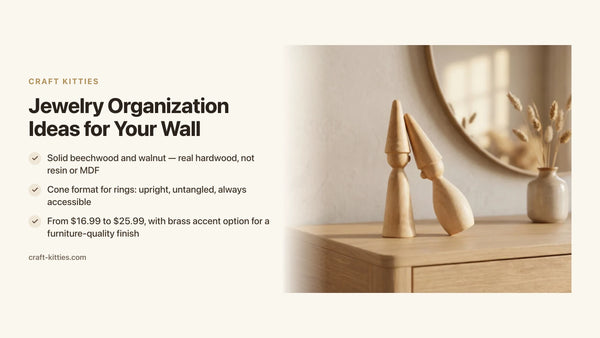
The beechwood cone set is the entry point to solid wood display. Two cones in genuine beechwood — the taller for cocktail rings and statement pieces, the shorter for bands and delicate rings — finished with natural wax and steady enough on any flat surface to handle daily one-handed ring placement. The grain is fine and understated: the cones disappear into the dresser top and let the jewelry lead.

Description
Solid walnut paired with a solid brass base: the combination that makes this piece read as furniture rather than an accessory. The weighted brass base eliminates the tipping that plagues lightweight ring holders, so the piece stays exactly where you set it even on a slightly uneven dresser surface. The walnut grain — deep brown, fine, with the characteristic variation of Juglans nigra — holds its color over years without fading. At $25.99, it is the piece you buy once.

Description
The walnut two-cone set solves the pairing problem: a single-cone display works for a small collection, but when two people share a dresser or a collection spans a wide range of ring sizes, two cones at different heights give each piece its own place. Matching walnut grain across both cones unifies the display — the set reads as a considered arrangement rather than two separate objects placed side by side. Available from the ring holder collection.
Comparison table
| Model | Price | Wood | Base | Best for |
|---|---|---|---|---|
| Beechwood Cone Set | $16.99 | Solid beech (1300 lbf) | Wood base | Clean, understated pair display |
| Walnut + Brass Base | $25.99 | Solid walnut (1010 lbf) | Solid brass — weighted | Statement piece, no tipping |
| Walnut Cone Set of 2 | $18.99 | Solid walnut (1010 lbf) | Wood base | Couples display, wide collections |
Decision matrix — which material and which piece
| Your situation | The right pick |
|---|---|
| You want solid wood at the lowest price point | Beechwood Cone Set — $16.99 |
| You want the piece to read as décor, not just a holder | Walnut + Brass Base — $25.99 |
| Two people share a dresser or you have 10+ rings | Walnut Cone Set of 2 — $18.99 |
| You have light-colored surfaces and want contrast | Walnut — the darkest option in the lineup |
| You prefer a subtle, understated grain | Beech — fine, regular, does not compete with the jewelry |
| Gift for someone who notices materials | Walnut + Brass Base — the most clearly intentional piece |
Why the ring holder is the best test of material quality
A ring holder is a useful case study in this material comparison because it fails the alternatives so quickly. Consider what happens in daily use: you place a ring on the cone with one hand, often without looking, once every morning and every evening. That is a small impact, repeated 700 times a year, always at the same point on the cone tip where the ring rests. On a laminate piece, the surface print begins to show wear at that contact point within months — you can see the fiberboard beneath the image layer before the first year is out. On a veneer piece, the same contact point eventually breaks through the thin wood layer, and the exposed core material darkens and stains.
On solid beech or solid walnut, the same contact point is still the same wood five years later. You can sand the tip lightly if you want to restore the finish, apply a touch of wax, and the piece looks new. That is the practical meaning of "solid wood" — it is not a marketing claim, it is a description of what happens over time.
The second quality signal specific to ring holders is tipping. A lightweight laminate or thin veneer cone is top-heavy by construction, because the ring resting on the tip creates a lever arm. Solid hardwood has enough mass at the base to resist this; a solid brass-weighted base eliminates it entirely. The Walnut Wood Ring Holder with Solid Brass Base is weighted specifically because we built prototypes in lighter materials first and watched them tip.
Caring for a solid wood ring holder
Solid wood does not require a maintenance routine. It requires two things: keeping standing water off it, and an occasional wipe.
The wax finish applied to our pieces closes the grain against normal ambient humidity — the kind of humidity variation you get in a bedroom between summer and winter, or from a window left open in the rain. That level of moisture exposure does not harm the wood. What it cannot handle indefinitely is pooled liquid left in contact: a dripping water glass set on a wooden surface overnight, or a jewelry cleaning solution applied directly to the cone and left to sit.
For cleaning, a dry cloth or a barely damp cloth is everything you need. No polish, no oil treatment, no special products. If the surface ever feels dry after years of use — which is uncommon for a display piece handled gently — a small amount of natural wax worked in with a cloth and buffed off will restore it. That is the complete maintenance calendar for a well-made solid wood piece: nothing scheduled, occasional wiping.
What veneer and laminate cost you long-term
The price comparison at the point of purchase tends to favor veneer and laminate. A mass-market laminate ring holder can be found for $8 to $12. A veneer piece might sit at $13 to $16. Our solid beech option starts at $16.99 — a difference of $5 to $9 at the moment of purchase.
The comparison looks different after two years. A laminate piece that has been handled daily shows visible wear at the contact point, often with exposed fiberboard at the edge. A veneer piece may be lifting at the base edge if it ever sat near a glass of water. The replacement purchase resets the cycle. If you replace a $10 laminate holder every two years, you spend $10 every two years, indefinitely. A $16.99 beechwood cone that still looks presentable after ten years has a cost of $1.70 per year.
This is not an argument that solid wood is "worth it" as an abstraction — it is a statement about what the objects you keep around you actually cost over the time you use them.
Common mistakes when buying wood-look objects online
Trusting product titles over product descriptions. "Wood ring holder" and "wooden ring holder" are used for solid wood, veneer and laminate pieces alike in most online marketplaces. The distinction is almost never in the title — it is buried in the materials section, if it appears at all.
Equating weight with quality without context. A heavy laminate piece (MDF is not light) can weigh more than a thin solid wood piece. Weight is a useful signal when you are comparing objects of similar size and construction; it is not an absolute indicator.
Buying from the product photo alone. Laminate grain can be photographed to look indistinguishable from solid wood. The edge view is always the more honest photograph — any retailer confident in their material will show an edge shot.
Assuming "natural wood finish" means solid wood. The phrase refers to the finish color (unstained, close to the natural wood tone), not the material underneath. A "natural wood finish" laminate is still laminate.
FAQ — solid wood, veneer and laminate for jewelry display
1 — What is the real difference between solid wood and veneer? Solid wood is the same material all the way through — every millimeter is hardwood. Veneer is a thin slice of real wood (0.5–3 mm) glued to an MDF or particleboard core. The surface is identical at a glance; the edges and the long-term behavior are not. Solid wood can be sanded, refinished and repaired. Veneer cannot.
2 — Is laminate ever real wood? No. The surface layer of laminate is a photographic print embedded in resin — there is no wood fiber in it. The grain is an image, not a material.
3 — Can I identify solid wood without cutting it? Yes. Check the edges for continuous grain wrapping around the corner. Pick it up — solid hardwood is noticeably heavier than veneered MDF. Look at the grain up close for the depth and variation of real wood fiber versus the repeat pattern of a printed image.
4 — Does solid wood warp or crack? Unsealed solid wood moves with humidity changes, yes. Finished and waxed solid wood — like our ring holders — is stabilized for normal indoor use. No special humidity control is needed.
5 — Which wood is harder — beech, walnut or red oak? Beech (1300 lbf Janka) and red oak (1290 lbf) are nearly identical and slightly harder than walnut (1010 lbf). All three are hardwoods that resist daily handling. Walnut's slightly lower hardness is offset by its tighter grain, which makes it less prone to surface checking.
6 — Is a solid wood ring holder worth the price over laminate? At $16.99 for solid beech versus $8–12 for a laminate alternative, the difference is $5–9 at purchase. A laminate piece that shows wear within one to two years and needs replacing inverts that math quickly. A solid wood piece handled daily will still look presentable after a decade.
7 — What does wax-finished mean and do I need to maintain it? Wax finish closes the wood grain and provides light moisture resistance with a low-sheen surface. For an indoor display piece, no scheduled maintenance is required — a dry cloth when needed, and a light wax application if the surface ever looks dry after years of use.
8 — Are solid wood cones safe for all ring metals? Yes. Smooth wax-finished wood is inert — no abrasive surfaces, no metal contacts, no reactive coatings. Gold, silver, platinum, titanium and coated rings all rest safely on a waxed beech or walnut cone.
Where to go next
The material question — solid wood, veneer or laminate — comes up for every wood-look object on a dresser or nightstand. The answer is the same across all of them: solid beech, walnut or red oak outlasts the alternatives and continues to look the way it looked on the first day.
Our ring holder collection brings together the pieces from this guide — the beechwood cone set at $16.99, the walnut cone set of 2 at $18.99, and the walnut with brass base at $25.99 — alongside other solid wood jewelry display options in the same material family.
If you have encountered our pieces on Etsy (243 reviews and counting), you will find the full collection here, with the same materials and the same finish standards.
Conclusion
The three materials in this comparison are not three versions of the same thing at different price points. They are three different objects that happen to look similar in a product photograph. Solid hardwood — beech, walnut, red oak — is a material that improves with handling, can be repaired, and lasts indefinitely. Veneer is real wood at the surface and a moisture-sensitive core underneath, with a lifespan measured in years before edge failure. Laminate is a photograph of wood grain pressed onto fiberboard, with no refinishing possible and a visible degradation timeline.
For a ring holder you will reach for twice a day, the choice that makes sense is solid wood. The beechwood cone set is where that starts at $16.99. The walnut with brass base is where it ends at $25.99, for the piece that reads as décor rather than function.