At a glance
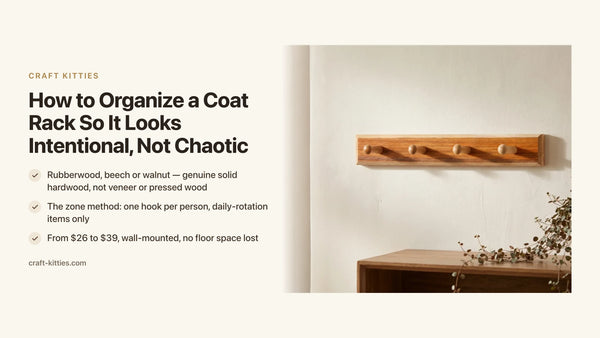
- Solid beech and walnut — real hardwood, not veneer or pressed fiber
- Swivel hooks, magnetic hooks, carved profile hooks — matched to how your entry actually works
- From $5 to $26, one hook to a full two-hook row
The entryway is the room you see twice a day and design once in a decade. Most of the time it inherits a row of metal hooks from a previous tenant, and those hooks stay there indefinitely — not because they work well, but because replacing them feels like a project. It is not. A solid wood wall mounted coat rack swaps in an afternoon and changes the character of an entry in a way that is disproportionate to the effort. The trick is choosing the right piece for the wall you have, the coats you carry and the space between the door and everything else.
This guide covers the decisions that matter before you buy: wood species and what they look like side by side, hook mechanics (swivel versus fixed, magnetic versus peg), load and wall anchoring, height and spacing, and the details that determine whether the rack still looks good in three years. Then it presents the five pieces from our studio — prices, dimensions, and the profile of buyer each one fits — a comparison table, a decision matrix and answers to the questions we field most often.
One thing up front: every piece in this guide is solid wood. Beech, walnut or a two-tone combination of both — milled from real timber, not veneered particleboard or fiber composite. The distinction matters on a coat hook more than almost anywhere else in the home, because the load is dynamic and daily. Solid wood holds screws properly; veneered board does not, and you notice the difference the first winter you hang a wet parka on it.
Why wood species matters more than style

The species you choose is the first visible decision, and it sets everything downstream. Beech is the workhorse of European woodworking: pale, with a fine, tight grain that recedes into the background and lets the form speak. It suits light-painted walls, white subway tile and Scandinavian interiors — the hook reads as a quiet addition, not an accent. It is also one of the most dimensionally stable hardwoods, which is why furniture makers have used it for joints and frames for centuries.
Walnut sits at the opposite end of the palette. Deep brown, fine-grained and quietly rich, it reads as the more formal choice and makes a real statement against a lighter wall. It is the wood buyers reach for when they want the hook to be part of the room's visual story rather than a utility object. In a narrow entry painted white or light gray, a walnut hook anchors the wall the way a framed print would.
Two-tone beech and walnut — where the peg or block is one species and the base or rail is the other — gives you the warmth of walnut and the brightness of beech in the same piece. It is the most furniture-like of the three readings, and the one that scales best to a more deliberate, designed entry.
On every structural criterion the species are close. Beech and walnut are both dense hardwoods that hold fasteners firmly and resist denting under daily use. Neither warps with normal indoor humidity swings. The choice is visual: contrast with your wall, the warmth you want, the formality of the room.
Swivel versus fixed: the mechanism that decides your entryway's flexibility
A fixed hook is a peg. It extends from the wall at a set angle, takes one item at a time, and clears the wall cleanly when empty — minimal, almost invisible. It is the right choice when you have generous wall width, can space hooks 10 or 12 inches apart and do not need the same hook to accommodate two items at once.
A swivel hook rotates on its mount. When you push it aside to hang a second coat, it swings out of the way; when both arms are in use, they spread apart and prevent the bundling that makes a row of fixed hooks look buried under outerwear. In a narrow entry — or any wall where you have fewer feet of rail than you have coats — swivel mechanics do real work. The rotation also makes the hook effectively invisible when it folds flat, which matters if your entry doubles as a corridor or a room you pass through often.
Neither mechanism is objectively better; the question is how many items share a single hook and how much clearance the wall allows between positions.
The magnetic hook — the missing piece in most entryways

Keys are the object you misplace most and search for last. The solution everyone knows — "always hang them in the same place" — requires a specific physical destination that most entryways do not provide. A magnetic wall hook is that destination: a solid beech block with a flush-set magnet strong enough to hold a full keyring, a carabiner or a set of scissors at eye level, where they are visible and reachable from the door.
It is not a replacement for a coat hook; it is the piece that completes one. Hang it beside the coat peg, at the same height, and the entry starts to work as a system rather than a collection of separate objects. Everything that belongs near the door — coat, bag, keys — has a fixed address.
The five pieces from our studio
These five pieces cover the main buyer profiles in the wall-hook category: the entry-level single hook for a studio or rental, the carved decorative hook that doubles as a wall object, the swivel hook for a working family entry, the magnetic key hook for daily-carry items and the premium two-hook row that can furnish a proper mudroom corridor.

Description
The boot-profile hook is cut from a single piece of solid beech into a rounded, boot-like form — a shape that reads as both functional object and wall sculpture. The silhouette has enough visual weight to anchor a bare wall and enough restraint to disappear once you hang a coat on it. The beech is left with its natural grain visible and lightly finished, which means it will deepen in tone slightly with age. At $12 it is the entry point to a real-wood hook that looks deliberately chosen rather than default hardware-store.

Description
The magnetic hook is a solid beech block with a magnet set flush into the surface and a standard peg beneath it — one object that handles both a coat and a keyring. The magnet is strong enough for a full set of keys, and the peg takes a light bag or a jacket. At $6.90 it is the least expensive piece in the lineup and the one that solves an annoyance most buyers have lived with for years without realizing it had a simple fix.

Description
This hook is carved from solid natural wood with a rounded, organic profile that sits closer to craft object than to hardware. The swivel mount lets it rotate outward when a second item needs to hang, then fold flat again when empty — which keeps the wall looking clean between uses. At $9 it brings the swivel mechanism into the entry-level price range, paired with a hand-carved character that stands out in a rustic, farmhouse or Japandi interior.

Description
If the brief is "one hook, solid wood, uncomplicated" this is the answer. A single swivel peg in solid wood at $5, with a clean cylindrical profile that suits any entry style — minimal, rustic or transitional. The swivel keeps it from reading as fixed hardware, and the wood keeps it from reading as a commodity. It is the right hook for a studio, a rental or a wall where one well-placed hook is more useful than a row of them.

Description
The two-hook row combines solid beech and walnut in a single rail — pale wood and dark wood in the same piece, the contrast doing the visual work that styling usually requires. Two hooks on a shared base means one set of holes in the wall, one installation, and a result that reads as furniture rather than hardware. At $26 it is the piece that transitions a plain entryway into something that looks considered. It is also the natural starting point for a mudroom or a hallway where you want a line of hooks that feel like they belong.
Comparison table
| Model | Price | Wood | Mechanism | Best for |
|---|---|---|---|---|
| Boot-profile beech hook | $12.00 | Solid beech | Fixed | Wall sculpture + coat hook, rustic rooms |
| Magnetic beech hook | $6.90 | Solid beech | Fixed + magnet | Keys + coat on one piece |
| Swivel carved hook | $9.00 | Solid natural wood | Swivel | Rustic / farmhouse, tight spacing |
| Minimal swivel hook | $5.00 | Solid wood | Swivel | Entry price, studio or rental |
| Two-tone 2-hook row | $26.00 | Solid beech + walnut | Fixed, 2-hook rail | Mudroom, corridor, gift |
Decision matrix — which hook for which situation
| Your situation | The right pick |
|---|---|
| One hook, minimal budget, just needs to work | Minimal swivel hook ($5) |
| Keys always misplaced — want a fix that works daily | Magnetic beech hook ($6.90) |
| Rustic or farmhouse entry, want a hook with visual character | Swivel carved hook ($9) or boot-profile hook ($12) |
| Minimal or Scandinavian entry — hook as wall object | Boot-profile beech hook ($12) |
| Two people sharing a small entry or corridor | Two-tone 2-hook row ($26) |
| Housewarming gift, designed entry or mudroom | Two-tone 2-hook row ($26) |
How to install a wall-mounted coat hook properly
The hook is rarely what fails. The wall anchor is. Getting installation right takes fifteen minutes and prevents the single bad outcome — a hook that pulls free mid-winter with a wet coat on it.
Step 1 — Choose the wall location by use, not by where it is convenient to drill. The ideal spot is within arm's reach of the door, at the height where your hand naturally goes when you walk in. Mark the spot while standing in the entry with a coat in your hand; do not measure from a floor plan.
Step 2 — Find a stud or choose the right anchor. A stud finder is worth the two minutes it takes. Coat hooks carry dynamic load — not just the weight of the coat but the pull of someone grabbing it while moving — and solid-wood-into-stud is the only installation that never fails. When studs are not where you need them, use toggle bolts or hollow-wall anchors rated for at least 25 lb per hook. The small plastic anchors that come in generic hardware packs are sized for picture frames, not outerwear.
Step 3 — Get the height right before drilling. Standard coat hook height is 60 to 66 inches from the floor for an adult-only household. In a mixed household, a two-tier approach — one row at 40 inches for children, one at 64 for adults — works better than a compromise height that works for neither. Hang a coat from a temporary nail first, step back, and verify the hem clears the floor before committing to the anchor holes.
Step 4 — Level the base plate. A hook that tilts even a few degrees looks wrong every day. Use a spirit level or the level app on your phone; the two seconds it takes to check are worth it. With a two-hook rail like the beech-walnut row, leveling the base before driving the second screw is especially important — a tilted rail makes both hooks hang at an angle.
Step 5 — Torque the screws to firm, not tight. Over-tightening compresses the wood grain around the screw head and reduces holding strength over time. Firm is the target: the hook should feel immovable by hand without the screw pulling the surface.
What makes a solid wood hook last — and what shortens its life
Solid beech and walnut hooks need almost no maintenance to look good for years. The wood is dense enough to resist denting from daily use, and its natural oils give it a degree of moisture resistance that veneered alternatives never have. But a few habits extend the life considerably.
Keep static loads reasonable. A hook mounted into a stud holds 30 to 40 lb comfortably for its entire life. The failure mode is not weight — it is impact load: a bag thrown onto the hook at speed, or a child swinging from it. Neither is the hook's fault, but both are worth accounting for in how you use it.
Wipe the wood occasionally, not constantly. A damp cloth once a month removes the oils and fine debris that build up where a coat collar rests against the peg. The goal is to prevent that buildup from becoming a sticky patch — not to deep-clean the wood, which strips its natural oils.
Oil or wax once a year in dry climates. In a dry home — especially with forced-air heating in winter — the wood loses moisture and can develop fine surface checks over years. A thin coat of beeswax or linseed oil rubbed in once per year prevents that. In a normal humid climate it is unnecessary.
Match the hook to the items you hang. The single most common mistake is hanging a hook designed for coats at a spot where bags are the primary item. Bags put their load at a different angle than coats, and a hook profiled for coat collars may not grip the strap as securely. The swivel hooks in this lineup handle both; the boot-profile hook is optimized for the collar-and-shoulder hang.
Mistakes that undercut a good choice
Picking the species from a product photo against a white background. A pale beech hook that looks striking in a studio shot can read as too light against an off-white wall — both blend into each other. Take the photo of your actual wall with you when you choose.
Spacing hooks too close because the wall is short. Eight inches between hook centers is the minimum; less than that and two coats bunch against each other and the entry looks cluttered regardless of how good the individual hooks are. A single well-positioned hook is better than three hooks packed into insufficient space.
Mounting at the old hook's holes without questioning the position. Previous occupants picked a location for their own reasons, possibly wrong ones. Re-do the reach test before inheriting their anchor points.
Mixing wood tones and hardware finishes with no connecting thread. A beech hook next to a pine shelf next to a dark walnut frame on the wall reads as accidental. The pieces in our wall hooks collection are designed to work beside each other — pick two or three from the same palette and the entry reads as considered.
FAQ — solid wood wall mounted coat racks
1 — What is the difference between solid wood and manufactured wood for wall hooks? Solid wood — beech, walnut, red oak — is milled from a single piece of real timber. It holds screws firmly, develops character over time and does not swell or delaminate at the edges. Manufactured wood (MDF, particleboard) holds screws less securely, making it a real concern on a hook that bears the weight of a winter coat or a wet bag every day.
2 — How much weight can a wood wall hook hold? That depends more on the wall anchor than on the hook itself. A solid wood hook installed into a stud or with a proper wall anchor rated for 20–30 lb handles coats, bags and keys without issue. Into drywall with a plastic anchor only, keep the load light — one coat, no wet winter jacket.
3 — Beech or walnut — which wood looks better in an entryway? Beech is pale and warm-toned with a fine, understated grain — it suits white, light gray and Scandinavian-style walls well. Walnut is deep brown with a tighter, quieter grain — it reads as more formal and stands out beautifully against lighter paint. The reliable rule is contrast: match the darker wood to a lighter wall.
4 — Can a swivel hook hold more than one coat at once? Yes. A swivel hook rotates outward to create clearance, so a second item can hang on the same arm without bunching. It is especially useful in a narrow entry where you cannot space hooks as far apart as you would like.
5 — What is a magnetic wall hook used for? A magnetic hook holds metal objects — keys, keychains, scissors — at eye level, eliminating the daily search. Combined with a wooden peg for coats, it means everything hangs in the same spot. The Beech Wood Magnetic Wall Hook is solid beech with a flush-set magnet strong enough for a full keyring.
6 — How far apart should wall hooks be spaced? A minimum of 8 inches between hook centers prevents coats and bags from piling onto each other. For a family entryway, 10–12 inches per person is more comfortable. If wall space is short, swivel hooks that rotate outward compensate for tighter spacing.
7 — Do I need to find a stud to mount a coat hook? For a hook that will carry a full winter coat or a heavy bag daily, a stud is the most reliable anchor. When studs are not where you need them, use toggle bolts or hollow-wall anchors rated for at least 25 lb — not the small plastic anchors that come with generic hardware.
8 — What height should a coat hook be mounted at? A standard guideline puts coat hooks between 60 and 66 inches from the floor for adults. In a mixed household, a two-row arrangement at 40 inches and 64 inches is practical. The test is simple: hang a coat, step back and see whether the hem clears the floor.
9 — Are wood wall hooks suitable for bathrooms and kitchens? Solid beech and walnut handle ambient humidity well. In a bathroom or kitchen, avoid placing a hook directly above a splashing source unless the wood has been oiled or waxed for moisture resistance. A light coat of food-safe oil once a year keeps the grain looking fresh in higher-humidity rooms.
10 — How do I clean and maintain a solid wood wall hook? Wipe with a barely damp cloth and dry immediately — no soaking, no abrasive cleaners. Once or twice a year, a thin coat of beeswax or linseed oil refreshes the surface and deepens the grain. The hook will lighten or darken slightly with time and use; that is patina, not damage.
Where to go next
A coat hook is usually where a considered entry begins — not where it ends. Our wall hooks collection gathers the full range: from the entry-level Solid Wood Wall Hooks and Beech Magnetic Hook to the furniture-grade Two-Tone Beech & Walnut Wall Coat Hooks — all in real hardwood, designed to work together on the same wall.
We sell these pieces on Etsy too, where 243 customers have left their feedback — a useful read if you are deciding between species or sizes.
Conclusion — the right hook is the one that fits how you actually leave the house
If this guide leaves you with one method: choose the species by contrast with your wall, choose the mechanism by how many items share each hook, and install into a stud or a proper anchor. The Two-Tone Beech & Walnut Wall Coat Hooks is the answer for a shared entry or a wall that needs a furniture-level presence; the Beech Wood Magnetic Wall Hook solves the key problem in one $6.90 piece; and the Minimal Swivel Hook opens solid wood at $5 with no compromises on the material that matters.