At a glance
- Spring cleaning works room by room, not all at once
- Declutter before buying any organizer — always
- A ring holder on the nightstand ends the tangled-jewelry problem permanently
Every year, the same sequence: the weather turns, the impulse arrives, and three hours later the living room is reorganized but the bedroom drawer has not been touched since November. Spring cleaning fails most often not because of effort but because of order. You pull things out faster than you can put them back, buy storage containers before deciding what stays, and mistake rearranging for actually clearing.
This guide is a room-by-room spring cleaning and organizing checklist that follows a specific sequence for a reason. Bedroom first, because it resets the space where you start and end every day. Bathroom next, because it is the smallest room with the most concentrated clutter. Entryway after, because it controls what comes in. And throughout, the one thing that makes the difference between a clean house that holds and one that slides back in two weeks: a place for everything, starting with the smallest objects — the ones that scatter first.
If you have been looking for a spring cleaning checklist that is actually usable and not a forty-item wall of stress, this is it.

Why the order matters more than the effort
Most spring cleaning guides present the house as a single undifferentiated space. The result is a checklist of forty tasks with no logic between them, where you end up vacuuming the hallway, then cleaning the bathroom mirror, then going back to fold bedroom clothes, then wondering where the afternoon went.
The room-by-room sequence here follows a different logic: start where the stakes are highest for your daily reset (bedroom), move to the smallest high-density space (bathroom), address the gateway (entryway), and work your way through living areas last. The rationale is practical. Finishing your bedroom and bathroom before anything else means the two rooms you actually use every morning are already clean by the time you open a second bag of donations. Psychologically, that matters — a finished bedroom makes the rest of the house feel more tractable.
There is a second principle embedded in the sequence: declutter before you organize, and organize before you shop. Buying drawer dividers before you know what will stay in the drawer is how you end up with three organizers that do not fit the things you actually kept. Empty first, edit second, buy third.
The bedroom: clearing surfaces, then going deeper
The bedroom is where the most objects accumulate without permission — receipts, coins, charging cables, books from three months ago, the piece of jewelry you meant to put away. The spring clean starts here because cleaning it first gives you a neutral space to retreat to when the rest of the house is mid-chaos.
Surfaces first. Clear the nightstand, dresser top, and any chair that functions as a second closet. Do not sort as you go; pull everything off into a temporary pile, wipe the surface clean, then return only what has an assigned purpose. The nightstand should hold a lamp, a book, water — and nothing else by default.
The closet. Pull everything out of one section at a time. The question for each item is not "do I like this?" but "did I wear this in the last twelve months?" Anything that went unworn through an entire seasonal cycle in that time is a candidate for donation. Same for duplicates — three black cardigans is one or two cardigans too many.
Under the bed. If you store things under the bed, this is the moment to pull them out and reckon with whether they actually need to be in the bedroom at all. Under-bed storage works for extra linens, luggage, or seasonal items in flat bins — not for the random overflow that migrates there because it has nowhere else to go.
Jewelry. This is the category that escapes most spring clean lists and then undoes them. Rings, earrings, and delicate chains pile up on the dresser, tangle in the drawer, and end up generating fifteen minutes of searching before every occasion. The fix is structural, not behavioral: a dedicated holder that stays on the surface makes putting jewelry away the path of least resistance instead of the effortful one.

Description
The bathroom: vertical space and a ruthless counter edit
The bathroom is the room that gives most spring cleaners the most satisfaction per hour, because it is small, every surface is wipeable, and the clutter is finite. The three moves here are: pull everything out, clean the space, put back only what earns its place.
The cabinet and under-sink. This is where expired products, duplicate sunscreens from different summers, and single-use hotel toiletries collect indefinitely. Pull everything out, throw away anything expired, and group what remains by category — skincare, haircare, first aid, cleaning supplies. If something lives under the sink and you have not reached for it in three months, it does not need to be in the bathroom.
The counter. The only things that belong on a bathroom counter are the objects you reach for every single day. For most people that is four to six items: hand soap, toothbrush cup, a face cleanser, maybe a daily moisturizer. Everything else can live in a cabinet. A cleared bathroom counter does not require a larger bathroom or better storage — it requires putting back less than you took out.
Vertical space. In small bathrooms, the instinct is to fill the available counter and cabinet space. The better instinct is to go up. A small shelf above the toilet, a mounted organizer beside the mirror, a hook on the back of the door — these reclaim wall space that most bathrooms leave completely unused. A bathroom can effectively double its usable storage without a renovation.
Linens. Pull towels and washcloths off the shelf or out of the closet and assess honestly. A set of six towels per person is comfortable; anything beyond that is inventory. Worn, thin, or stained towels are not spares — they are clutter in disguise.
The entryway: the gatekeeper room
The entryway is the most consequential space in the house and the least treated as such. Everything that enters the home passes through it, which means every organizing failure in the entryway gets distributed through every room. A coat that does not have a hook ends up on a chair. Keys without a dedicated spot end up on the counter, the nightstand, and then lost. Mail without a tray spreads across three surfaces.
Hooks. The first thing most entryways need is more hooks — or hooks at all. A rack with four to six hooks at realistic heights for coats, bags, scarves, and dog leashes solves the chair-as-coat-rack problem permanently. The placement rule: hooks should be close enough to the door that hanging a coat is the natural action when you walk in, not an effort.
Shoes. A bench with a lower shelf, a small shoe rack, or even a tray by the door defines the boundary between outdoor and indoor — and makes putting shoes away automatic instead of a decision. The maximum number of shoes stored in the entryway is the number of pairs you might wear in a week; seasonal shoes belong in the closet.
A landing zone. Keys, sunglasses, lip balm, cards — the small essentials that need to be findable in thirty seconds. A small tray or bowl by the door gives them a permanent spot. Without it, they wander.
Mail and paper. If mail enters through the front door, it needs a processing station at the front door: a single tray for things requiring action, and a recycling bin immediately to the right for everything that does not. Paper that gets carried into the house "to deal with later" accumulates for months.
Jewelry organization: the section that gets skipped
Jewelry is the category that gets systematically omitted from spring cleaning checklists — and it is the one whose disorder is most visible every day. A tangled ring on the dresser is not a minor inconvenience; it is the thing you encounter at 7 a.m. when you are already running late.
The principle is the same as the entryway: the right storage makes the right behavior automatic. A ring holder on the nightstand means rings land there when you take them off at night, without a decision. A drawer organizer that you have to open and actively deposit jewelry into requires a behavior that is easy to skip.

Description
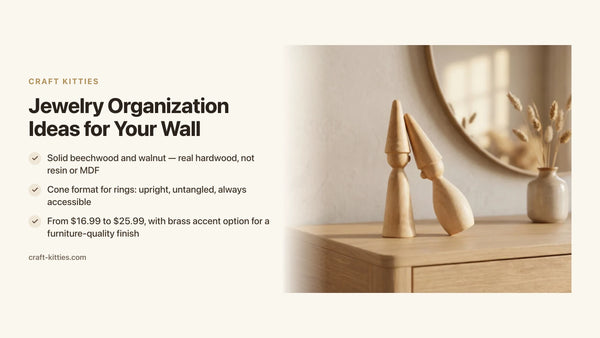
The materials matter here more than most people expect. A walnut cone with a brass base is the kind of object that rewards being placed prominently on a nightstand — it is attractive enough that putting it away feels like a design choice rather than a chore. Beechwood, lighter and more neutral, fits seamlessly on a white or light-toned dresser. Both are solid hardwood; both last indefinitely with no maintenance.
For anyone with more than a few rings, a set of two cones is the right format: one for everyday rings, one for occasional or delicate ones, or one for each partner.

Description
Comparison: ring holder formats for the reorganized bedroom
| Model | Price | Wood | Format | Best for |
|---|---|---|---|---|
| Beechwood Cone Set | $16.99 | Solid beechwood | 2 cones, no base | Couples, shared nightstand, light décor |
| Walnut + Brass Base | $25.99 | Solid walnut | Single cone, brass base | Statement piece, warm or dark décor |
| Walnut Cone Set of 2 | $18.99 | Solid walnut | 2 cones, matched pair | Couples who want matching pieces in walnut |
Decision matrix: which ring holder fits your space
| Your situation | The right pick |
|---|---|
| Shared nightstand, two people's rings to store | Beechwood Cone Set (2 cones, light and neutral) |
| Dresser with warm tones or dark wood furniture | Walnut + Brass Base |
| Two people, want matching walnut pieces | Walnut Cone Set of 2 |
| Light, Scandinavian or minimalist bedroom | Beechwood Cone Set |
| One person, want a small elegant display | Walnut + Brass Base |
Living areas and common spaces: the maintenance mindset
By the time you reach the living room and kitchen, you have already tackled the three spaces where clutter originates and accumulates fastest. The living areas tend to be less cluttered by small objects and more cluttered by visual noise — too much on surfaces, too many throw pillows, too many items on the coffee table that do not belong there.
The living room. Clear every surface — the coffee table, the side tables, the console behind the sofa — completely. Then put back only one or two deliberate objects per surface. An empty coffee table with a single candle reads as calm and considered. A coffee table with eight objects on it reads as cluttered regardless of how clean each object is.
Books and media. Go through bookshelves with the same question as the closet: did you use this in the last year? If a book will not be re-read and is not genuinely beautiful or meaningful, it is occupying shelf space that could hold air. Thinning a bookshelf by a third makes the remaining books easier to find and the shelf more visually rested.
The kitchen. Spring cleaning a kitchen deserves its own day. Pull everything out of cabinets by category, throw away expired items (which are invariably more numerous than expected), and return things to the spot where they are actually used rather than where they originally landed when you moved in. The pan you use every morning should not be buried under three pans you use twice a year.
Cords and cables. Every common space has a tangle of charging cables, power strips, and orphaned connectors. This is the one moment to deal with it: anything without a device to match goes in the trash. Cables in use get a dedicated spot — wrapped, labeled if necessary.

The mistakes that make a spring clean temporary
Organizing before decluttering. The most common mistake. If you buy a shoe rack before culling your shoes, you fit your collection to the rack instead of fitting the rack to the collection you actually want. Always decide what stays first.
Buying containers to solve a behavioral problem. A drawer divider does not make a person who drops things into a drawer start categorizing. The behavior changes when the path of least resistance changes — which means the organizer has to require less effort than not using it. A ring holder that sits on the nightstand surface clears that bar; a jewelry box in the second drawer does not.
Setting a standard you will not maintain. If the spring version of your bedroom requires twenty minutes of active tidying to reproduce every day, it is not a system — it is a one-time event. The right level of organization is the one that can be reset in five minutes on an ordinary Tuesday evening.
Skipping the small items. Coins, hair ties, charging pucks, forgotten earrings — these are the category that moves fastest and settles deepest into the static layer of clutter. They need assigned homes as much as furniture does, and those homes need to be on surfaces, not inside drawers, for the assignment to stick.
A room-by-room spring cleaning checklist, condensed
Bedroom:
- Clear nightstand and dresser top completely, wipe surfaces, return only essentials
- Edit closet section by section — one year unworn means donation
- Pull out under-bed items and assess whether they belong in the bedroom
- Set up a ring holder or tray for daily jewelry before putting anything back
Bathroom:
- Empty cabinet and under-sink, dispose of expired products, group by category
- Edit the counter to daily-use items only — five to six objects maximum
- Use vertical wall space: shelf above toilet, hook behind door
- Edit linens — functional set per person, everything else out
Entryway:
- Add hooks at realistic height for coats, bags, and scarves
- Define a shoe zone — one week's worth of pairs maximum
- Install a small tray or bowl for keys, cards, and daily essentials
- Set up a single mail tray and a recycling bin immediately adjacent to it
Living areas:
- Clear every surface, return one or two deliberate objects per surface
- Thin bookshelves — unused books to donate, no exceptions
- Organize kitchen cabinets by use pattern, dispose of expired food and products
- Resolve every orphaned cord and cable
Where to go next
For anyone reorganizing the bedroom this season, the ring holder collection is the simplest starting point — solid beechwood and walnut pieces that solve the scattered-jewelry problem with one object, no drawer required. The Beechwood Ring Holder Cone Set is the entry point for couples or for anyone who wants a neutral, light tone that works with most bedroom palettes. For a darker or warmer nightstand, the Walnut Wood Ring Holder with Solid Brass Base is the one that earns permanent display placement.
Customers who found us through Etsy — where our pieces have over 243 reviews — will find the same solid hardwood construction and the same pieces here, with the full collection available directly.
FAQ — spring cleaning and organizing
1 — What order should I tackle rooms when spring cleaning? Start with the bedroom — it resets your baseline and makes the rest of the house feel more manageable. From there, move to the bathroom, then the entryway, then living areas. Ending with the entryway is a mistake: it is the first thing you and your guests see, and a messy one undoes everything you just finished inside.
2 — How do I stop jewelry from getting tangled and lost again after organizing? The short answer is a dedicated surface. A ring holder cone or a small display stand on the nightstand or dresser gives rings, earrings and delicate chains a home they will actually return to at the end of the day — as opposed to a tray or a bowl where everything slides together. Solid wood cones hold rings at a slight angle so each one is visible and easy to grab.
3 — What is the fastest way to declutter a bedroom? The fastest approach is to clear every surface into a single pile, then return items one by one, keeping only what has an obvious place. Everything without a home either gets one assigned to it or leaves the room entirely. Surfaces cleared of clutter take about fifteen minutes to wipe down once the objects are gone.
4 — How long does a full house spring clean take? Realistically, a thorough room-by-room clean and organize of a two or three-bedroom home takes two days spread over a weekend — one day for decluttering every room and a second for the deep cleaning (baseboards, windows, inside cabinets). Compressing it into one very long day is possible but tends to leave the organizing step undone.
5 — Should I buy organizers before or after decluttering? After, always. Buying organizers before the declutter means you are sizing containers around objects you have not yet decided to keep. The right sequence: remove everything, decide what stays, then measure the remaining items and buy organizers sized to fit them. Most people need far fewer organizers than they anticipated.
6 — What should go on a nightstand and what should not? On the nightstand: a lamp, a book or e-reader, a glass of water, and whatever you take off at the end of the day — watch, rings, earrings. Not on the nightstand: charging cables coiled on the surface, multiple remotes, receipts, spare change, half-read magazines. The rule is one object per function; anything without a function gets a drawer or leaves the room.
7 — How do I organize a small bathroom that has almost no storage? Work vertically. Most small bathrooms have unused wall space above the toilet and beside the mirror. A small floating shelf or wall-mounted organizer above the toilet can hold three or four times what a countertop can hold without taking an inch of floor space. On the counter, edit ruthlessly — keep only the items you reach for every single day.
8 — What is the difference between beechwood and walnut for a ring holder? Beechwood is pale with a tight, even grain — it reads light and neutral against most surfaces and fits both minimalist and Scandinavian-style nightstands. Walnut is deeper brown with a fine grain and a warmer, more formal presence. Both are solid hardwood; the choice comes down to the existing tones in the room.