At a glance
- Keep the tissue slot unobstructed and draw its pull path before assigning storage.
- Measure each small item and check whether retrieving it crosses the tissue opening.
- Use separate storage when the compartment or opening dimensions are unknown.
A tissue cover with storage has two jobs: keep tissues accessible and give small items a place to land. Those jobs can conflict when a pen, glasses case, or note pad crowds the slot or must be moved every time someone pulls a tissue. Plan the access path first; assign compartments only after checking what actually fits.
Identify what the listing does and does not say
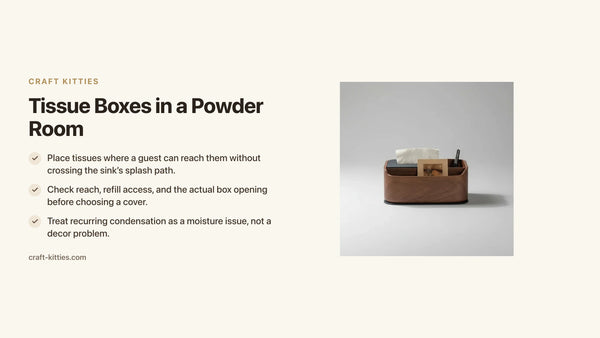
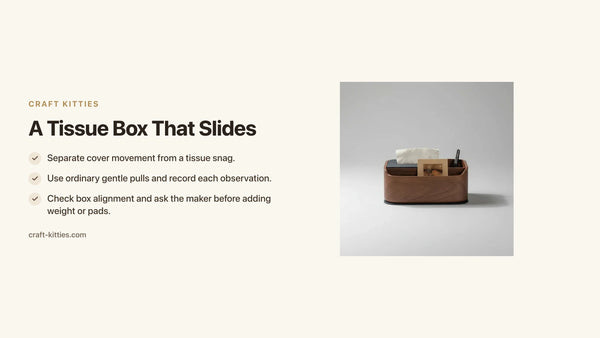
The Designer Wooden Tissue Box Cover with Storage is described as having compartments for pens, sticky notes, and small essentials, with an overall listing dimension of 24 × 12 × 8.5 cm. The Double Rectangle cover also describes built-in compartments and lists the same overall dimensions. Neither external size establishes the usable cavity, number of spaces, or clearance for a particular object. Confirm those details with the maker if they determine your choice.

Description
See the designer cover listing and double-rectangle cover listing for their descriptions. This is not a claim that either cover accepts every carton or accessory.
Draw the tissue path before filling compartments
Stand where you normally use the tissue. Mark the opening and imagine a straight, comfortable pull from the slot. Leave that route clear above and beside it. Then identify where each compartment begins and how a stored item comes out. If a hand must move a pen before reaching the tissue, the arrangement adds friction even if everything technically fits.
Use a paper outline of the actual item rather than guessing from a product photo. Measure length, width, and height where relevant, and note whether it must lie flat or be lifted vertically. Do not infer the cavity from overall product dimensions. A compact glasses case may still be inconvenient if its retrieval path blocks the opening.
Assign storage by retrieval conflict
| Item | Measured footprint | Possible conflict with tissue access | Decision |
|---|---|---|---|
| Pen | Measure length and cap width | A pen crossing the slot can snag the tissue | Store only in a separate compartment clear of the pull path |
| Sticky-note pad | Measure its base and stack height | A tall pad can obstruct the opening or require lifting | Check opening clearance; use a nearby drawer if uncertain |
| Glasses or case | Measure the case, not just the glasses | Frequent removal may occupy the same hand path | Keep elsewhere if retrieval blocks tissue access |
| Loose small item | Measure the largest item and group | Items can shift toward or cover the slot | Use a separate labeled dish if the space is not defined |
The decision is about access and measured fit, not a promise of internal capacity. If the cover has a lid or removable part, ask the maker how it is intended to open rather than forcing it.
Keep the arrangement easy to reset
Choose one home for each item. Return the pen and notes after use, and periodically check that nothing has migrated onto the slot. If a guest needs the tissue, the opening should be obvious without explanation. For broader bedside zoning, the nightstand organization guide covers a different surface and routine.
A room with persistent dampness raises a separate care question. The National Park Service notes that dust can be abrasive in its wood objects guidance. Avoid rubbing loose grit against the cover during a reset, and ask the maker for care suited to its finish. Do not assume a wooden cover is waterproof. The U.S. Forest Service explains that finish affects care choices; ask the maker for the instructions for this exact cover (wood finishes reference).
Keep tissue refills independent from stored items
Plan to lift and refill the tissue carton without emptying every accessory compartment. If the cover must be moved, set a clear landing spot nearby and return each small item to its measured place afterward. The listed dimensions apply to the outside; they do not prove how much room is available for the carton or the stored objects.

Description
FAQs
Can I store glasses in a tissue-box compartment?
Only after measuring the case and confirming the usable compartment dimensions. Also check that retrieving it does not block the tissue slot.
What belongs in a compartment?
Small items explicitly suited to the space, measured against the actual opening. The listing names examples such as pens and sticky notes but does not prove every item will fit.
How much space should remain above the slot?
Enough for an unobstructed pull with the tissue carton installed. The listing does not specify a clearance, so check the actual arrangement.
What if I cannot confirm the compartment size?
Keep the item in separate storage and ask the maker for the usable dimensions before assigning that compartment.