Small desks accumulate clutter faster than large ones. There is no buffer room for a stray cable, a pair of headphones, a notebook or the power strip that everything seems to need at once. Most storage ideas respond to this by adding more surface area — a shelf, a second drawer, a side table — which is exactly the wrong answer for a room that is already short on space.
The right answer is vertical: use the wall behind and beside your desk, not the floor underneath it. A wall-mounted rail, bar or hook system turns eighteen inches of blank wall into organized storage that sits at desk height, stays within reach and disappears visually when it is tidy. This guide covers the logic, the installation, the products that do the job in solid wood and the mistakes that turn a small workspace from cluttered to calm.
At a glance
- Wall-mounted rails recover floor space without adding furniture
- Solid red oak and beech bars used vertically — not just in bathrooms
- Double-layer model separates cables from accessories on the same wall footprint
- From $22
Why "under the desk" is the wrong frame
The phrase "under-desk storage" suggests something mounted underneath the desk surface — a clamp-on cable tray, a magnetic strip, a drawer that screws into the underside of the top. These exist, they solve a narrow problem, and they add friction every time you need to reconfigure the desk or clean it properly.
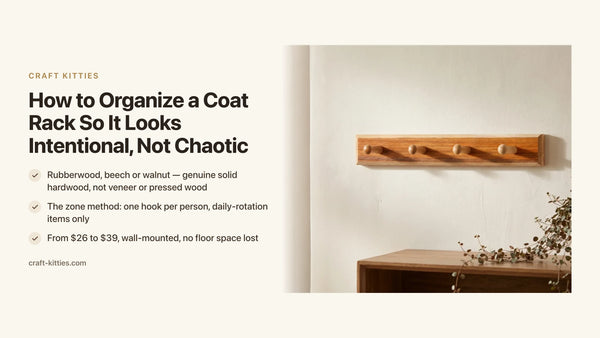
The more useful idea is storage at desk height, on the wall, that serves the same function without touching the desk at all. A rail or bar fixed to the wall at 24–28 inches from the floor sits right at the edge of your desk's shadow. It holds everything a desktop tray would hold — headphones, cables, a small pouch, a daily notebook — without occupying a single square inch of desk surface or floor. When you move the desk, the storage stays put. When you want to add a monitor arm or a keyboard tray, there is nothing clamped to the underside to work around.
This shift in framing — from under-the-desk to behind-the-desk — is what separates storage ideas that feel like more clutter from those that feel like less. The wall is already there; the question is whether you use it.
The four storage problems a wall-mounted bar solves

Cables on the floor. The cable from a laptop charger, an external drive, a desk lamp and a monitor can easily reach eight feet in total length. Left to themselves, they pool on the floor and tangle the moment you push the chair back. A single horizontal bar at desk height acts as a cable spine: each cable loops once around the bar with a velcro tie, drops cleanly to the outlet and stays in place. The floor opens up.
Headphones with nowhere to land. Wireless headphones are too good to toss in a drawer and too bulky to leave on the desk. A wall-mounted rail offers the cleanest solution: hang the headphones on the bar between sessions, lift them off when you need them. No hook to screw into the wall, no device-specific stand, no footprint.
A power strip sitting on the floor. A strip on the floor collects dust, registers as clutter to every eye that enters the room, and gets kicked by accident. Lift it to the wall — either clipped to a rail with a cable tether or mounted on a second bracket — and it disappears from the eye line entirely.
The "I'll deal with it later" pile. A shallow tray or a pouch hanging from a bar at desk height creates a home for the things that have no home: a stylus, a memory card, a set of earbuds. One small zone absorbs the objects that would otherwise form the pile.
Solid wood versus other materials: what changes at the desk
Most cable management and desk storage products are sold in black ABS plastic or matte metal. They are functional and invisible — invisible in the sense that they read as infrastructure rather than as part of the room. In a bedroom-office or a living-room-corner desk, infrastructure aesthetic works against you: the workspace reads as a workstation that was added to the room rather than designed for it.
Solid wood changes this at a meaningful level. A bar in red oak (Quercus rubra) or European beech has a warm, fine grain that holds its character in a small space. It reads as furniture — as something that belongs on a wall in a home — not as server-room cable management. The structural performance is identical: a properly wall-mounted solid hardwood rail carries headphones, cables and a small bag as well as any steel bracket. The difference is that it ages like the rest of the room, developing a patina rather than showing scuff marks.
The cases where metal or plastic win: under a standing desk where the arm swings and might catch on a protruding bar, or in a garage or utility room where the aesthetic argument simply does not apply. In a living space, solid wood is the better default.
The models from our studio
Four bars and one set, all in real solid wood, covering the range of small-space desk setups we see most: the minimal one-level setup, the corner arrangement that needs two tiers, the brass-accent room and the deep-wall installation.

Description
The Wall Mounted Wood Towel Bar is cut from real solid hardwood — red oak or beech — with a square-section profile that resists flex better than a round dowel under sustained hanging weight. The bracket plates are minimal and sit flush to the wall; the bar spans the space between them without deflecting. This is the baseline desk storage bar: one mounting, one zone, cables and accessories at desk height. At $24, it is also the lowest-friction entry point for the setup.

Description
The Wood & Brass Rack Set brings brass bracket hardware to the same solid wood bar construction. The warm-metal combination reads naturally beside a brass desk lamp, a copper cable clip or aged-leather desk accessories — the details that make a small-space desk feel assembled rather than assembled-by-accident. At $22 it is the most accessible bar in the lineup and the right pick for a room that already has warm metallic accents. The solid wood is the same hardwood construction: the brass is the hardware only, not a veneer over something cheaper.

Description
The Arc Design bar uses the same solid hardwood core with a gently curved profile on the bar itself. Where the square-section bar reads precise and architectural, the arc reads softer and more organic — a better fit for Japandi-style setups, natural-linen desktops or rooms that mix curved and straight furniture. The wall brackets are the same flush-mount hardware; the difference is entirely in the bar's silhouette. At $24 it matches the square bar in price and surpasses it in visual flexibility for rooms that want a less clinical line.

Description
The Double Layer bar is the storage-maximizer in the lineup: two solid wood bars stacked vertically on a single set of wall brackets. The same wall footprint yields two independent zones — the lower bar for cables and the power strip tether, the upper bar for headphones, a small bag or frequently used peripherals. For a standing-desk setup where the bar needs to serve both seated and standing positions, the double layer gives you a zone at each height. At $24 — the same price as either single bar — it is the obvious pick when one bar is not quite enough.
Comparison table
| Model | Price | Wood | Hardware | Best for |
|---|---|---|---|---|
| Square Hardwood Bar | $24.00 | Solid red oak or beech | Matte metal brackets | Clean single-zone desk rail |
| Wood & Brass Rack Set | $22.00 | Solid hardwood | Brass | Warm-metal desk setups |
| Arc Design Bar | $24.00 | Solid hardwood | Matte metal brackets | Organic or Japandi-style rooms |
| Double Layer Bar | $24.00 | Solid hardwood | Matte metal brackets | Two-zone storage, standing desks |
Decision matrix — which bar for which desk
| Your situation | The right pick |
|---|---|
| Clean modern or minimal room, one storage zone needed | Square Hardwood Bar — $24 |
| Room already has warm metal — brass lamp, copper accessories | Wood & Brass Rack Set — $22 |
| Japandi, organic or curved-furniture aesthetic | Arc Design Bar — $24 |
| More than one category of storage (cables + accessories) | Double Layer Bar — $24 |
| Standing desk with variable height, two access zones | Double Layer Bar — $24 |
| Gift for a home-office upgrade | Wood & Brass Rack Set — $22 (universal pairing) |
How to install a wall-mounted desk storage bar in four steps
1 — Find the wall space. The wall directly behind the desk is the first choice: it puts storage at exactly the right depth — arm-reach from the seated position, invisible from the front of the desk. If the desk sits against the wall, a side wall works equally well. The only wall to avoid is the one in front of you: things hanging there will eventually clutter your direct line of sight.
2 — Choose the height. Sit at the desk and let your arm drop naturally to the side of the keyboard. The height where your hand lands without bending your elbow is the installation sweet spot — typically 24–28 inches from the floor, or three to four inches below your desk surface. Mark that height with a pencil before reaching for the drill.
3 — Mount and level. Both bracket plates go into studs or wall anchors, spaced to match the bar length. Use a small level on the bar itself after tightening one side and before tightening the other — correcting level with both sides fixed requires removing one bracket and starting over. Two minutes with the level saves ten.
4 — Assign zones before you hang anything. This step is the one people skip, and skipping it recreates the clutter problem in a new location. Decide before the first cable goes on the bar: one zone for cables on the left, one zone for accessories on the right. Use a velcro tie to mark the boundary if it helps. Organization is a system, not a collection of objects.
The infographic: cable routing from the bar to the outlet

The goal is a cable that is visible in exactly two places: where it connects to the device at desk level, and where it plugs into the outlet. Between those two points, it should be invisible. The method: loop the cable once around the bar with a velcro tie at desk height to fix the departure point, then drop it straight down the wall inside a slim adhesive cable raceway (a $4 item at any hardware store). The raceway channels the cable flush to the wall all the way to the baseboard. The floor stays empty. The cable appears to begin at the bar and end at the outlet with nothing in between.
Mistakes that recreate the clutter problem
Buying storage before deciding what goes in it. A bar, a rail and a set of hooks do not create organization — they create new surfaces for accumulation. Identify the four or five objects that currently have no home on your desk before buying anything. The right storage solution becomes obvious once you know what it is holding.
Mounting the bar too high. The intuition is that higher equals more out-of-the-way. In practice, a bar mounted at full arm extension overhead is almost never used — things land on the desk or the floor instead. Mount it where your hand naturally goes, not where it can technically reach.
Mixing all cables on a single hook. One hook holding five cables still looks like a tangle — the spatial problem has been moved from the floor to the wall. Use the double-layer bar or two separate bars to segregate cable types. Power cables on one level, peripheral cables on another. Five seconds of visual sorting creates the calm that one massive hook never will.
Choosing storage that matches the desk, not the room. A black cable tray matches a black desk and fights a white or wood room. A walnut bar matches the room first — the desk is secondary. In a small space, everything is in each other's field of view; the room-level palette is the relevant one.
Stopping at the bar. A wall-mounted bar is infrastructure, not a destination. The bar earns its place when paired with an intentional desktop surface: a clear desk pad, a single object on the surface, nothing behind the monitor. The storage works because the desk works. Neither alone is enough.
What solid red oak and beech actually bring to a workspace
The two hardwoods most common in our towel bar collection are red oak (Quercus rubra) and European beech (Fagus sylvatica). Both are tight-grained, dimensionally stable hardwoods with a Janka hardness that puts them well above pine or poplar — the soft woods that ding and show scratches in a workspace environment.
Red oak has a warm honey tone with a pronounced open grain that catches light and reads as clearly wood from across the room. Beech is slightly finer-grained with a cooler, more uniform tone that pairs well with grey, white or linen-colored walls. Neither species requires elaborate care in an indoor workspace: a dry cloth, an occasional wipe with food-safe oil if the bar dries out in a very low-humidity room. There is no maintenance schedule. The wood develops a patina that a plastic rail or an anodized aluminum bracket does not — after two years, a solid wood bar looks intentional; after two years, everything else looks like it was forgotten.
The species choice for a desk setup follows the same logic as for bathroom accessories: contrast with the wall. Light wall — red oak reads against it. Warm or darker wall — beech's cooler tone keeps things balanced. When the room already has a wood tone in the furniture (a walnut desk, an oak chair), pick the bar that shares grain density with the closest piece — the visible wood grain is what the eye reads, not the species name.
FAQ — under-desk storage for small spaces
1 — What is the most effective under-desk storage for a small space? Wall-mounted rails or bars fixed behind or beside the desk are the most space-efficient solution: they take no floor area, keep cables and accessories within arm's reach, and leave the desktop surface clear. A double-layer bar adds a second tier on the same wall footprint.
2 — Can I use a towel bar as under-desk storage? Yes — and it works better than most products sold specifically as desk organizers. A wall-mounted towel bar at desk height holds headphones, a looped cable, a small pouch or a spray bottle. Solid wood bars in red oak or beech are rigid enough to carry daily hanging use without deflecting.
3 — How do I mount a rail without drilling into the desk itself? Mount the rail to the wall immediately behind the desk rather than to the desk surface. The desk stays free-standing and movable; the storage carries more weight than any clamp-on solution and never interferes with desk reconfiguration.
4 — What height should the bar be mounted at? Between 24 and 28 inches from the floor — roughly three to four inches below desktop level — places the bar within natural reach from a seated position and clear of knee-height when you push the chair in. Sit at the desk, drop your arm naturally and mark where your hand lands. That is the height.
5 — How do I stop cables from turning the bar into a mess? Use the bar as a cable spine, not a cable dump. Loop each cable once around the bar with a velcro tie before it drops to the outlet. Use a double-layer bar to separate power cables from peripheral cables — mixing them is what creates the visual tangle that a single hook cannot fix.
6 — Is solid wood better than metal for desk storage rails? For a visual workspace, yes. Solid red oak or beech reads as furniture rather than hardware — it integrates into a room that was designed rather than assembled from utility parts. Structural performance is comparable; the difference is aesthetic and how the object ages: wood develops character, chrome and matte metal accumulate scratches.
7 — How many bars do I actually need for a small desk? One double-layer bar handles the typical small-space desk: cables on the lower tier, accessories on the upper. A single bar handles a minimalist setup with one or two cables. A second bar is worth adding only if you have a corner desk or a standing-desk converter with a distinct second zone.
8 — Does wall-mounted storage work with a standing desk? Wall-mounted bars work perfectly alongside a standing desk — the storage height stays fixed while the desk surface travels. Mount the bar at the midpoint between your seated and standing desktop levels: reachable in both positions without repositioning.
9 — How do I choose between the square bar and the arc bar? The square-section bar is the right choice for modern, minimal or Scandinavian-style rooms where clean geometry is the point. The arc bar suits organic, Japandi or mid-century-influenced rooms where a softer line is more at home. The structural and functional difference is zero; the visual difference is everything in a small space.
10 — What is the best way to clean a solid wood desk bar? A dry cloth for daily dust. A barely damp cloth for surface marks. No harsh cleaners, no standing water. If the bar dries out noticeably after years in a dry environment, one wipe with a food-safe oil or beeswax brings it back. The maintenance investment is minimal and occasional, not scheduled.
Where to go next
The desk storage bar is usually the first piece of a small workspace that moves to the wall — rarely the last. Our towel bar collection gathers the models in this guide alongside companion pieces in matching wood families: the Wall Mounted Wood Towel Bar for the single-zone setup and the Wood & Brass Towel Rack Set when the room already has warm metallic accents. Customers who have used these bars in their home offices have shared over 243 reviews on Etsy — primarily how the change from a cluttered desktop to a organized wall rail changed how the space feels to work in.
Conclusion — less floor, less desk, more focus
If this guide leaves you with one method: mount storage to the wall, not to the desk; put it at the height where your hand naturally lands; assign zones before hanging the first cable. The Square Hardwood Bar is the answer for most single-zone setups at $24; the Double Layer Bar adds a second tier for the same price when one level is not enough; and the Wood & Brass Set at $22 settles the warm-metal question without compromise. Three options, one result: a small-space desk that finally has room to think.