Most of what is sold as calming interior design achieves the opposite: too many objects trying too hard to look effortless. Wabi sabi is the correct diagnosis and a genuinely different prescription. The Japanese philosophy — roughly translated as beauty in imperfection and transience — is not an aesthetic trend that photographs well and then ages badly. It is a practical approach to choosing objects: select materials that reveal themselves, let them show their age, and leave deliberate space between them.
At a glance
- Wabi sabi = imperfection chosen on purpose, not accumulated by neglect
- Solid hardwood — red oak, walnut, beech — is the single most reliable material anchor
- Start with one room and one honest material swap; the method accumulates naturally from there
This guide covers eighteen concrete ideas organized from principle to practice, from the most visible moves to the quietest ones. Each idea can stand alone or layer with the others. The connecting logic throughout is the same: is this object made of something real, does it carry the mark of how it was made, and does it earn its place in the room?
What wabi sabi actually means for an interior
Before the ideas: three principles that separate wabi sabi from any other natural or minimal interior trend, and that explain why it is difficult to fake.
Imperfection is the material. A perfect, smooth, machine-made surface has nothing to say. A piece of red oak (Quercus rubra) with visible grain, a hand-thrown ceramic bowl with an uneven rim, a linen curtain with a visible weave — each tells the story of what made it. That story is the point, not a flaw to excuse.
Transience is visible. Wabi sabi rooms are not preserved. A waxed hardwood towel bar deepens in color over years of contact with towels and hands; a handmade ceramic picks up a slight patina; linen softens with each wash. None of this is failure. It is the object becoming more itself — which is precisely what the philosophy values above the object remaining identical to how it arrived.
Emptiness is part of the composition. A shelf crammed with objects is not wabi sabi regardless of what they are made of. The Japanese concept of ma — charged negative space — is the interior design application: three objects surrounded by open shelf reads as intentional; twelve objects pushed together reads as accumulation. The space between objects is as active a design element as the objects themselves.
These three principles work as a checklist before placing any object, and explain why wabi sabi interiors are more demanding to curate than maximalist ones: imperfection cannot be manufactured, and restraint cannot be shortcut.
The six core materials and why each one belongs

Solid hardwood is the most reliable anchor. Red oak's honey grain deepens over the years. Walnut's brown becomes richer. Beech (Fagus sylvatica) stays pale but gains warmth. The critical distinction is solid versus veneered: veneered surfaces chip, do not age, and have no grain that runs through the piece. Solid hardwood does the opposite — the grain you see on the face runs through the full depth of the bar or shelf, and the surface develops rather than degrades.
Unglazed or salt-fired ceramic belongs wherever a smooth, factory-glazed piece would otherwise sit. The slight irregularity of a hand-thrown bowl, the porous finish of a salt-fired vase, the warm gray of raw stoneware — each does more for a wabi sabi room than any symmetrical, glossy decorative object at the same size and price.
Undyed natural linen and cotton bring the textile layer. The weave is visible to the eye and the hand. Undyed linen has a warmth that bleached white cannot replicate. It softens toward a warmer ivory with washing rather than degrading toward gray. Use either for curtains, bath mats, and throws. Avoid synthetic fibers — polyester aged looks like neglect; linen aged looks deliberate.
Raw stone, slate, and concrete provide weight and permanence. A flat river stone on a bathroom shelf, a slate coaster under a candle, a raw concrete planter on a sill — each grounds a composition in geological time and contrasts productively with the organic warmth of wood.
Hand-poured beeswax or soy candles contribute scent and slow physical transformation. The candle shrinks, the wick shortens, the wax changes shape with heat. This visible process is the kind of transience wabi sabi welcomes into a room. Paraffin in identical molds does not belong to this vocabulary.
Wicker and rattan are the structural fiber materials: baskets, trays, small shelving. The grid of woven fiber is a record of making, and both materials age into a warmer version of themselves — not a paler, cheaper one.
Humidity, sealed hardwood, and the bathroom question

The most consistent objection to solid wood bathroom hardware is humidity: the assumption that a damp room will destroy a wood surface over time, and that chrome or polymer is the practical choice even if it is the visually inferior one. This objection is correct for one category of wood product and incorrect for another, and the distinction is worth being precise about.
Bare wood and veneered wood — particleboard or MDF covered with a thin decorative layer — are genuinely poor choices for a bathroom. The substrate absorbs moisture through cut edges and seams; the veneer peels away at corners where cleaning products are applied; the whole piece degrades within a year or two of daily damp exposure. This is the source of the legitimate concern, and it applies to the majority of inexpensive wood-look bathroom products.
Sealed solid hardwood behaves differently. Red oak, walnut, and beech are dense, close-grained timbers that take a finish well and, once sealed with a food-grade wax or oil-wax coat, present a surface that repels ambient humidity and splashes, wipes clean with a damp cloth, and requires no periodic re-treatment under normal bathroom use. Over years of daily contact, a waxed hardwood towel bar deepens slightly in color and develops a patina at high-contact points — which is precisely the aging behavior that makes it the right material for a wabi sabi space.
The practical test is straightforward: if a product is sold with explicit information about the species and the finish — solid red oak, wax sealed; solid walnut, oil-wax coat — it belongs in the bathroom. If it is described as wood-look, bamboo-composite, or engineered wood with no finish specification, it does not. Our wooden bathroom accessories collection is built on sealed solid hardwood throughout.
Wabi sabi bathroom ideas — the room that responds most immediately
The bathroom is where wabi sabi upgrades are felt most quickly. The space is small, used several times daily, and most bathrooms default to chrome and ceramic with no natural material in them. A single solid wood object changes the reading of the entire room.
Idea 1: Replace the chrome towel bar with sealed solid hardwood
A chrome or stainless towel bar is functional and neutral to the point of invisibility. A solid hardwood towel bar is the opposite: present, warm, and a daily interaction with a real material. The grain of red oak or walnut against a white or off-white tile wall reads as deliberate without requiring renovation. The distinction to preserve is solid wood versus wood-look: a printed laminate surface has no grain that runs through the piece, edges that reveal the substrate, and a finish that resists change until it does not — then fails. Sealed solid hardwood has grain that runs through the full thickness, edges continuous with the face, and a surface that deepens with use.

Description
The square hardwood towel bar earns its place in a wabi sabi bathroom by doing exactly what the philosophy asks: it is honest about what it is. The grain is not printed; it is the actual fiber structure of the wood, running through the full depth of the bar. The silhouette is resolved and undecorated — a flat, square-edged plane that lets the material speak rather than competing with it. At $24, it is the single-object swap with the highest visual return in a bathroom, because it introduces the one material — sealed solid hardwood — that nothing already in a chrome-and-ceramic room provides.
Idea 2: Add brass as the only metal accent, and let it age
Wabi sabi does not exclude metal. It excludes polished, identical, synthetic metal. Unlacquered brass — slightly matte, warm-toned, with minor surface variation — belongs to the wabi sabi vocabulary precisely because it is designed to change. The material pair of solid hardwood and brass is the most direct application of the philosophy to bathroom hardware: wood deepens, brass oxidizes, and the two materials become more harmonious over months rather than less.

Description
At $22, the wood and brass towel rack is the piece for bathrooms that already have one warm-metal fixture to echo — a brass mirror frame, a bronze tap, an unlacquered faucet. The brass brackets will develop their own oxidation over time, shifting toward a deeper amber at high-touch points, which is not maintenance neglect but the material becoming more itself. In a kitchen context, the same rack sits naturally beside stone countertops or open wood shelving, carrying the same material language from the bathroom into the room most people forget to furnish.
Idea 3: Introduce an organic curve against the tile grid
Tile bathrooms are grids — horizontal grout lines, vertical grout lines, rectangular fixtures, linear hardware. A curved element does not break this geometry; it offers a counterpoint that makes the grid more visible and intentional, the way a single cursive word in a block of printed type draws the eye to the typography rather than away from it.

Description
The arc towel bar at $24 is the correct choice for bathrooms organized around rounded forms: a vessel sink, an oval mirror, a freestanding tub with curved edges. The curve is structural, not decorative — it is the shape of the bar itself, in solid hardwood, at the scale of the wall. Used as a towel rail, it draws the eye gently across the wood grain rather than anchoring it at a fixed point. Against a white or stone tile background, the arc silhouette and the warm grain together read as a considered material choice, not a fixture that was simply installed and forgotten.
Idea 4: Layer towel storage without adding furniture
Wabi sabi is not a museum aesthetic. It is a philosophy of daily use. Towels, robes, and throws are used every day and belong in the open, organized by a piece of hardware that is as considered as everything else in the room.

Description
The double-layer bar at $24 is the practical answer for shared bathrooms, framed in a way the philosophy endorses: it does not hide the fact that two people use the room, and it does not add furniture to solve a storage problem that wall hardware resolves better. Two bars at staggered heights create a deliberate vertical rhythm on the wall — a composition, not a coincidence. The solid hardwood construction keeps both rails within the wabi sabi material vocabulary, rather than introducing a chrome or polymer element at the point where function is most visible.
Idea 5: Use the brass rack in the kitchen as a material bridge
Material consistency across rooms is what makes a wabi sabi home read as a home rather than a collection of individually decorated spaces. The kitchen is consistently the room most people furnish last with the least consideration, and it is also the room where one honest material swap — at the wall level, at counter height — changes the register of everything around it.
Description
A wood and brass dish-towel rack at $22 on the kitchen wall, beside or below open hardwood shelving, connects the two rooms through shared material. The wood echoes the shelving; the brass echoes the cabinet hardware or a pendant light. The dish towel that hangs from it — linen, undyed, with a visible weave — completes a material conversation that the kitchen otherwise does not have. This is the wabi sabi method applied to the most-used room in the house: not a renovation, a single swap that makes the existing materials legible as choices.
Idea 6: Unglazed ceramic near the sink
Replace the soap dish, the small tray by the faucet, or the toothbrush holder with something hand-thrown or unglazed. The visible irregularity of a hand-made ceramic against a precise tile grid creates productive contrast — the grid reads as intentional background rather than as the dominant surface. This is the wabi sabi move that costs least and communicates most clearly, because handmade ceramic is the object most directly opposed to the uniformity that most bathrooms already contain.
Idea 7: One unbleached linen bath mat, not a matching set
A matching set of white terry towels on a chrome bar communicates a hotel. One generous unbleached linen bath mat, one linen hand towel on a wood bar — this communicates a home. Linen dries faster than cotton, softens toward warm ivory with washing rather than toward gray, and has a visible weave texture that synthetic bath mats suppress. The mismatch in color and fiber between linen and the hardwood bar is not accidental; it is the material harmony that wabi sabi interiors depend on.
Wabi sabi living room and bedroom ideas
The living room is where wabi sabi requires the most restraint, because the temptation to fill space is highest. The bedroom is where the philosophy has the most sensory impact, because the room is used at the times of day when perception is most open.
Idea 8: Off-white or warm gray walls, not pure white
Pure white walls amplify every object placed against them, which is the intent in a gallery or maximalist setting. In a wabi sabi room, the wall should recede and warm the space. Warm off-whites — the color of undyed cotton or unbleached linen before finishing — and stone grays do that. The test: hold a sheet of pure white paper against the paint chip. If the wall reads cooler than the paper, it will compete with natural wood tones rather than supporting them.
Idea 9: One solid wood furniture anchor
A dining table, a coffee table, or a console in solid red oak, walnut, or beech — one piece whose grain is visible across the room — establishes the material vocabulary for everything else. The grain does the work. A furniture piece with a wood-look finish has no grain to read; the eye slides off it. A solid red oak table has grain that the eye settles on, that catches the light differently at different times of day, and that reads as the kind of surface worth touching. Every other object in the room can then be chosen in relation to that anchor.
Idea 10: Group objects in threes, always on a tray
The rule of three works because it creates asymmetry: one tall anchor (a ceramic or narrow-necked vase), one mid-height object (a candle or small pot), and one low object (a smooth stone or folded textile). Asymmetry reads as considered curation; symmetry reads as deliberate arrangement. A tray underneath the three defines the boundary of the composition and prevents it from spreading across the surface, which is the direction toward clutter. Material note for the tray: natural wood, slate, or unglazed ceramic — not mirrored or lacquered.
Idea 11: Replace overhead lighting with layered warm light
A wabi sabi bedroom has no overhead light on in the evening. The ceiling fixture, when it must exist, is off at night. In its place: a warm-toned table lamp with a linen shade, one or two beeswax candles, and if possible a source of amber light at the far end of the room. The ceiling stays dark; the surfaces at eye level are warm. This single change — which costs nothing if the lamps already exist — shifts the emotional register of the room more effectively than any change to the objects in it.
Idea 12: Undyed linen bedding
High-thread-count sateen is perfectly smooth, visually uniform, and without character. Undyed linen bedding is the opposite: slightly nubbed, visibly woven, softening toward a warmer ivory with each wash. The wabi sabi principle applied to bedding is that the unmade bed, the slightly wrinkled pillow, the faded edge of a blanket that has been used for three years — these are the room working as intended. Wabi sabi does not mean unmade; it means that the evidence of use is not something to conceal.
Idea 13: One plant in an unglazed pot, not a collection
One trailing plant on the windowsill — a pothos, a string of pearls, a small philodendron in a terra cotta pot — brings slow movement and organic color into a bedroom that might otherwise read as static. The unglazed pot connects it to the ceramic vocabulary of the rest of the space. Six plants on a shelf connected to grow-light timers is a different project, and a different philosophy.
Wabi sabi entryway ideas
Idea 14: A solid wood bar at the door for coats and bags
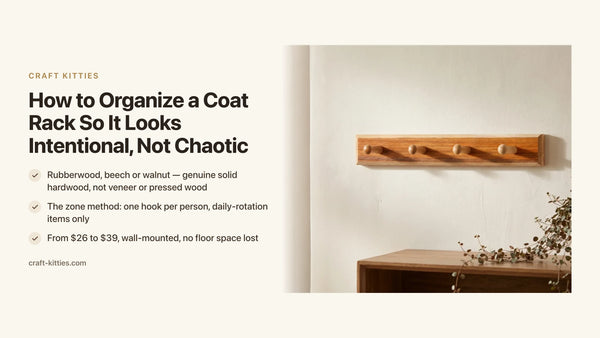
The entryway is the room most people furnish with a cheap hook rail and then forget. A solid hardwood wall bar — the same material vocabulary as the bathroom and bedroom — makes the entry continuous with the rest of the home rather than a separate, lower-quality threshold. A coat and a bag hanging from a solid wood bar with visible grain reads as deliberate. The same objects on a chrome hook set from a hardware store reads as a solution that has not been thought about.
Idea 15: A flat stone or handmade ceramic tray for keys
A flat river stone, a handmade ceramic plate, or a raw slate tray at the door holds keys, cards, and coins the way every household needs them held: in one place, in an object that belongs to the material language of the rest of the home. The default — a plastic bowl, a shelf with no vessel, nothing — is the wabi sabi equivalent of an unresolved sentence.
Idea 16: Leave the entry wall mostly bare
The most important wabi sabi idea in the entryway is the one that requires no object at all: resist the impulse to fill the entry wall with framed prints, mirrors, and hook rails. One solid wood bar, one small ceramic tray, one plant. Then stop. The bare wall around those three objects is not absence — it is the negative space that makes the objects legible as choices rather than accumulations.
Idea 17: One dried botanical, not fresh flowers
Fresh flowers in a wabi sabi interior require replacement before they begin to decay, which introduces a maintenance rhythm that runs counter to the philosophy. Dried grasses, pampas, eucalyptus branches, and seed pods age in place — they brown at the edges, they lose petals and fine stems over months — and this visible process is their contribution to the room. They are not failing; they are becoming more themselves.
Idea 18: Resist the impulse to match
The most consistent sabotage of a wabi sabi interior is buying a coordinated set: four identical mugs, a matching bathroom accessory set, three identical throw cushions in different sizes. The philosophy prefers near-matches — objects from the same material family with different grain patterns, objects in the same palette with different forms and ages. The result looks collected; the coordinated set looks purchased. This distinction is felt more clearly in a room over months than it is described in a sentence — which is why wabi sabi is a practice rather than a style code.
Comparison table — wabi sabi towel bars
| Model | Price | Silhouette | Hardware | Best wabi sabi context |
|---|---|---|---|---|
| Square hardwood bar | $24 | Flat planes, square edges | Minimal | Any bathroom — the foundational swap |
| Wood & brass rack set | $22 | Horizontal bar + warm brass wall brackets | Unlacquered brass | Bathrooms and kitchens with warm-metal accents |
| Arc design bar | $24 | Curved, organic line | Minimal | Rooms with rounded ceramic, vessel sinks, oval mirrors |
| Double-layer bar | $24 | Two staggered horizontal rails | Minimal | Shared bathrooms, intentional layered storage |
Decision matrix — which move for which room
| Your situation | The right move |
|---|---|
| Bathroom feels clinical — all chrome, no warmth | Square hardwood bar — one swap, room reads differently |
| Bathroom has a brass mirror, bronze tap, or warm-metal fixture | Wood and brass rack — echoes the existing metal, ages alongside it |
| Room organized around rounded forms — vessel sink, oval mirror, freestanding tub | Arc design bar — continues the organic line without repeating it |
| Two people, shared bathroom, two towels on one wall | Double-layer bar — two rails, one mount, no visual bulk |
| Kitchen with open shelving, stone countertops, or wooden cabinets | Wood and brass rack — connects kitchen to bathroom through shared material |
| Gift for someone moving into a new home | Square hardwood bar or wood and brass set — used daily, noticed by guests, works in any bathroom |
What wabi sabi is not: three misreadings
It is not shabby chic. Shabby chic stages decay — it distresses furniture artificially, it chooses floral prints in washed-out tones, it cultivates an atmosphere of nostalgic softness. Wabi sabi does not stage anything; it selects materials that age on their own terms and then allows that aging to happen. Staged decay looks brittle. Natural aging looks settled.
It is not minimalism with earth tones. Minimalism is a position about reduction — fewer objects, cleaner lines, the room stripped to structure. Wabi sabi is a position about impermanence — objects present, but chosen for how they change over time rather than for how long they resist change. A wabi sabi room can contain many objects. A minimalist room cannot. People who attempt wabi sabi by removing objects and then feel the room is too empty have misread the instruction.
It is not a permission to leave things unfinished. Because wabi sabi values unpolished surfaces and aging materials, there is a temptation to read it as acceptance of the provisional and underinvested. The opposite is closer to correct. A wabi sabi interior requires more careful selection than a conventional one, because every object must justify its presence on material and philosophical grounds rather than purely decorative ones. A sealed solid hardwood towel bar at $24 is a wabi sabi choice; a laminate wood-effect bar at $12 is not — not because of the price but because one will age into the room and one will degrade away from it.
FAQ — wabi sabi decor ideas
1 — What is wabi sabi decor exactly? Wabi sabi is a Japanese aesthetic philosophy that finds beauty in imperfection, transience, and incompleteness. In interior design it translates to materials that show their age, objects that carry the mark of how they were made, and arrangements that feel lived-in rather than staged. The defining rule is that nothing is more beautiful for being flawless.
2 — What colors belong in a wabi sabi palette? Warm off-whites, stone grays, clay ochres, muted sage, the deep brown of aged timber, and the pale beige of undyed linen. Pure white and primary colors are almost never present. The guiding test: any color you would find in a weathered outdoor environment on a cloudy autumn morning belongs in a wabi sabi room.
3 — Can wabi sabi work in a modern apartment? Yes, and it suits contemporary apartments particularly well. Most modern interiors default to uniform finishes and chrome fixtures — one solid wood object, one handmade ceramic, one undyed linen textile is enough to shift the character of a room without touching the walls or floors. Wabi sabi is an edit, not a renovation.
4 — What materials best embody wabi sabi style? Solid hardwood with visible grain — red oak, walnut, beech — is the most consistent anchor. Beyond wood: unglazed or salt-fired ceramic, undyed natural linen and cotton, raw stone and concrete, hand-poured wax candles, and wicker. The shared quality is that each material reveals how it was made and how it has aged — the opposite of seamless, machine-made surfaces.
5 — Does solid wood work in a bathroom? Sealed solid hardwood performs well in bathrooms. The critical distinction is between bare or veneered wood — which swells and delaminates in damp rooms — and sealed hardwood with a wax or oil-wax finish that repels moisture, wipes clean, and develops a patina. Red oak, walnut, and beech are the species best suited to bathroom hardware because of their density and grain structure.
6 — What is the difference between the square bar and the arc design? The square hardwood bar reads architectural — its flat planes and right angles suit bathrooms with tile grids and linear hardware. The arc design introduces a curved silhouette that softens the wall and pairs naturally with rounded ceramic, vessel sinks, or organic-form objects. Both are solid hardwood with a wax seal; the choice depends on the existing shapes in the room.
7 — Is wabi sabi the same as Japandi? They overlap but are not identical. Japandi blends Japanese minimalism with Scandinavian hygge, resulting in a lighter aesthetic with pale woods and a preference for clean order. Wabi sabi accepts a darker palette, more aged textures, and deliberate irregularity. Both value natural materials and restraint, but Japandi leans toward calm precision while wabi sabi leans toward earned imperfection.
8 — How do I start a wabi sabi bathroom without remodeling? Three moves cover most of the distance: replace a chrome or plastic towel bar with a sealed solid wood one, add an unglazed ceramic soap dish near the sink, and swap the bath mat for an undyed natural linen or cotton one. Those three objects change the material register of the room without touching the tiles, taps, or fixtures.
9 — What wood species work best for wabi sabi decor? Red oak (Quercus rubra), walnut (Juglans nigra), and beech (Fagus sylvatica) are the most natural fits. Red oak has a bold, open grain that reads rustic and grounded; walnut has a deep brown, fine grain that brings quiet richness; beech is pale and even-grained, suited to rooms at the lighter end of the wabi sabi palette. All three develop rather than deteriorate with age.
10 — Which towel bar works best in a small bathroom? The square hardwood bar at $24 has the most compact footprint and suits narrow walls. For a bathroom that needs to hang two towels without doubling the wall hardware, the double-layer bar solves the problem with a single mount. The wood and brass rack works in any size bathroom but reads especially well where there is already one warm-metal fixture to echo.
Where to go next
The bathroom is where wabi sabi upgrades have the most immediate impact, which is why a solid hardwood towel bar is the most-recommended first move. Our wooden bathroom accessories collection gathers the pieces that follow each other naturally — wood shelves, bath trays, and wall-mounted holders in solid red oak, walnut, and beech, all finished with the same sealed wax coat and all designed to age rather than deteriorate.
If you have encountered our work through Etsy, the same lineup is available there — 243 reviews document how these pieces look and perform in real homes after months and years of daily use, which is ultimately the most wabi sabi form of product verification there is.
Conclusion — one practice, one room at a time
Choose one room. Identify the object most at odds with the principles of honest material and deliberate imperfection. Replace it with something real. For most bathrooms, that is the towel bar. For most living rooms, it is the first shelf you dress. For most bedrooms, it is the overhead light that stays on at night.
The square hardwood towel bar at $24 is where most people start. The arc design is for the rooms organized around curved forms. The double-layer bar is for the rooms that are actually shared, which is ideally all of them. Wabi sabi does not ask for a finished room. It asks for a practice of choosing correctly, one object at a time.