At a glance
- Solid red oak, walnut and maple — real hardwood, not veneer
- From $15 geometric pencil cup to $55.20 all-in-one plant pod
- Pen holder + phone stand combo available for one-cable desks
A pen holder is the object most people think about last and see every day. Most desks have one — a mug that outgrew its kitchen role, a plastic cup from an office supply order, a jar repurposed because it was nearby. None of them look wrong exactly; they just never look right. Replacing that placeholder with a solid wood piece is one of the smallest decisions that makes a desk feel finished rather than assembled.
This guide focuses on walnut pen holders specifically — and, more broadly, on the family of solid hardwood desk organizers that pair walnut with red oak or maple to achieve a two-tone contrast no stain can replicate. We cover what sets walnut apart from other wood species, how to match a model to your actual workflow, what each of the five models from our studio does differently, and how to keep solid wood looking good over years of daily contact.
One point to settle before comparing models: this guide is about solid hardwood. Walnut veneer over MDF, printed wood-effect plastic, and bamboo pressed into sheets all look convincing in product photos. On a desk, within six months of regular use, they do not. The grain chips through at the rim; the base swells at the first spill; the texture that looked tactile in the image is smooth and faintly hollow underhand. Solid walnut — the same material all the way through — does not behave that way. That is the only distinction worth establishing before choosing anything else.
Why walnut reads differently on a desk
There are several hardwoods that make excellent pen holders. Walnut earns a specific place in desk accessories because its color sits in a range that photographs do not quite capture: not black, not brown, closer to the deep warm middle that makes everything next to it look deliberate. A walnut pen holder next to a white notebook, a silver laptop and a pale wood desk does not compete for attention. It anchors the surface the way a well-chosen piece of furniture anchors a room.

Red oak is lighter and more assertive. Its grain is open and bold — you can read it at arm's length. Against a neutral or dark desk it brings warmth; against a very light surface it can look busier than walnut. It is not a lesser wood, just a different visual argument.
Maple occupies the opposite end of the palette from walnut. Its color is pale blonde, almost cream, and its grain is tight enough to read as nearly uniform from a few feet away. Maple alone can look understated to the point of blankness. Spliced next to walnut, however, the contrast is immediate and graphic — dark brown stripe against pale blonde, reading like a natural inlay without any dye or paint involved.
The practical rule is contrast. A light, minimal desk — white surface, white monitor — benefits from walnut's depth. A desk in a darker room or with warmer tones already present works better with red oak. A desk that needs a focal point without adding color gets the walnut-maple splice. None of these choices is wrong; the wood that contrasts with its surroundings is the one that looks placed rather than abandoned.
Solid wood versus everything else: a point worth making once
Desk accessories occupy a category where the gap between the photograph and the object in hand is consistently large. Walnut-finish particleboard, bamboo-pressed panels and printed wood-effect resins all reach the same visual conclusions in a well-lit product image. They do not reach the same conclusions on a desk.
The failure modes of non-solid materials are predictable. Veneered MDF develops a feathered edge at the rim of a pen cup within months of pens being inserted and removed several times a day. Printed surfaces scratch through to a gray or pale substrate at the most visible contact points — the rim, the base corner, the interior where metal pen clips rub. Bamboo composite boards swell at the base in rooms with normal humidity variation, slowly becoming unstable.
Solid hardwood does none of these. The same material runs all the way through, so an edge scratch reveals wood, not substrate. The finish protects against contact moisture; the grain itself does not absorb ambient humidity at the rate that composites do. And unlike a surface treatment that wears off, the appearance of solid walnut or red oak improves with age rather than degrading — the wax coat deepens, the high-contact surfaces develop a faint patina, and the object reads as used rather than worn out.
The five models — what each one does
The models below are organized from simplest to most complex, which roughly tracks the scale of the problem they solve. A single-pen-cup desk needs a different answer than a desk that also holds a phone, markers, scissors and a plant.

Description
The geometric pencil cup is the answer when the desk already works and one object needs to be better. Its faceted form is not decorative for its own sake — the angled panels make the base proportionally wider relative to the height, keeping the cup stable when full. Real wood throughout, wax-finished. At $15 it is the most direct argument against every plastic cup on every desk that has one.

Description
The walnut and red oak two-tone model is the piece for a desk where one color alone would disappear. The contrast between walnut's deep brown and red oak's honey tone comes from placing two real hardwoods side by side — no dye, no color treatment. It reads as something made rather than manufactured. At $15.99, the price gap over the single-material geometric cup is small; the visual difference on the desk is not.

Description
The pen holder and phone stand combination addresses the most common single-object problem on modern desks: the phone that has nowhere deliberate to be. Without a stand, it lies flat (screen down, scratching) or leans against something else (the monitor, another cup, a book). The integrated wood slot keeps it upright at a comfortable reading angle with no additional object. Solid wood, wax finish, $35 — the cost of the pen holder and a cheap phone stand separately, in one piece that looks like it belongs.

Description
The walnut-maple splice is the piece for a desk that needs a focal point without color. Dark walnut strips and pale maple strips are joined along the grain in alternating bands — the result is a pattern that reads like a natural inlay, graphic enough to notice but not loud enough to compete. No stain produces this contrast; it requires two real hardwoods placed next to each other. At $36, it sits above the entry models by a margin that reflects the added work rather than a material shortcut.

Description
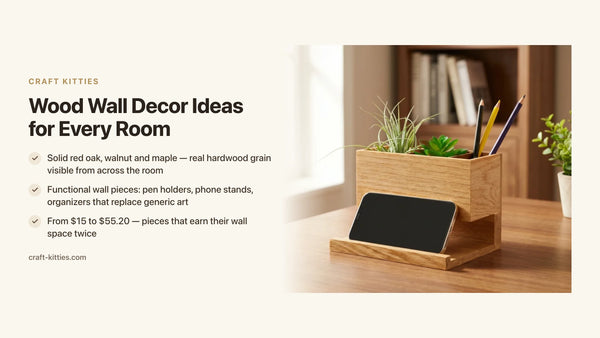
The plant pod is the model for a desk that has a writing-tools problem and a plant problem at the same time. Two compartments, one piece of solid red oak: one holds pens, pencils and markers; the other is sized and sealed for a small succulent or air plant. It keeps the desk from accumulating objects — one piece does the work of three (pen holder, phone-adjacent tray, planter). The red oak grain runs the full height of both pods, so the assembly reads as a single object. At $55.20 it is the statement piece in the lineup.
Comparison table
| Model | Price | Wood | Extra function | Best for |
|---|---|---|---|---|
| Geometric pencil cup | $15.00 | Solid wood | — | Entry point, clean minimal desk |
| Walnut & red oak two-tone | $15.99 | Solid walnut + solid red oak | — | Two-tone contrast, one-material desks |
| Pen holder + phone stand | $35.00 | Solid wood | Phone stand slot | Desks with a phone that needs a home |
| Walnut & maple splice | $36.00 | Solid walnut + solid maple | — | Visual focal point, graphic grain contrast |
| Red oak plant pod | $55.20 | Solid red oak | Integrated planter pod | All-in-one, statement piece |
Decision matrix — which model for which desk
| Your situation | The right pick |
|---|---|
| You want to replace a mug or plastic cup, nothing else | Geometric pencil cup — $15 |
| You want visual contrast without spending more than $20 | Walnut & red oak two-tone — $15.99 |
| Your phone has no dedicated spot on the desk | Pen holder + phone stand — $35 |
| You want the most graphic grain contrast in the lineup | Walnut & maple splice — $36 |
| You want pens + a plant in one piece, under one footprint | Red oak plant pod — $55.20 |
| Gift for someone who has most desk things already | Walnut & red oak two-tone — $15.99 or Red oak plant pod — $55.20 |
How grain direction affects what you see

The grain direction in a wood pen holder is a detail most buyers do not think to look for and then cannot un-see once they notice it. It determines what the piece looks like in the position it occupies — not in the hand, but at eye level across a desk.
Vertical grain runs from the base of the cup to the rim, so the lines are parallel to the axis of the holder. The result is a tall, clean pattern that makes the cup appear more slender than it is. Most cylindrical pen holders use this orientation; it is the neutral choice.
Horizontal grain runs around the circumference of the cup, creating a banded pattern that reads across the piece rather than along it. It makes the cup appear slightly wider and gives each face a distinct visual zone. The walnut-maple splice model uses horizontal bands by design — the alternating dark and pale strips are the entire visual argument of the piece.
End grain (the cross-section exposed at the top rim) reveals the growth rings and medullary rays of the wood — the patterns that are invisible in any other cut. End-grain pieces are the most labor-intensive to finish because the porous cut absorbs finish unevenly, but the rim detail is distinctive in a way that no other orientation achieves.
Knowing the grain orientation before ordering — usually readable from the product photos if you look for the line direction — is the one piece of information that moves a pen holder from "looks fine" to "exactly right" for the desk it will sit on.
Placing a pen holder correctly on a desk
Where the pen holder sits matters almost as much as which model you choose. The most common mistake is putting it at the back of the desk where it visually disappears behind the monitor. A pen holder is not storage equipment; it is a desk object. It belongs within comfortable reach and within view.
The natural position is the dominant-hand side of the desk, front quadrant — close enough to reach without leaning, visible from the chair without scanning. This keeps the pen available without the reaching motion that interrupts focus, and it keeps the wood visible in the peripheral field where it does its quiet work.
Pair the pen holder with objects in the same material family. A walnut pen holder next to a bamboo monitor riser and a black plastic cable box reads as three unrelated decisions that happened to end up near each other. The same walnut pen holder next to a wood mouse pad or a wood monitor stand reads as a considered surface. Our desk accessories collection groups pieces by material family — the pen holders above are designed to sit alongside the other wood desk pieces without requiring a mood board to make them work.
What solid walnut does to a desk over time
The honest answer about how walnut ages is this: better than almost any desk material. The surface of solid walnut deepens with contact. Not in the furniture-store sense of "develops a patina" as a euphemism for scratching — in the sense that the wood color actually intensifies where hands regularly touch it, the wax coat redistributes with friction in a way that produces an even sheen rather than a worn spot, and the grain becomes more visible rather than less as the piece ages.
Red oak follows the same trajectory. Maple develops a honey tone over years that its original pale color only hints at. These are not changes that happen on veneered or composite surfaces; they are properties of solid hardwood that no finish replicates.
The only care routine worth knowing: wipe with a dry or lightly damp cloth when dusty. Do not leave wet objects in the cup for extended periods — a damp brush resting overnight is the only scenario worth avoiding. No re-oiling schedule is needed. The wax finish applied at our studio is designed to be durable over years without maintenance intervention.
Five mistakes worth avoiding when buying a wood pen holder
Choosing the cup by its diameter without checking its height. A cup too short to contain scissors or a ruler forces those tools to lean out at an angle, which defeats the purpose of having an organizer. Check that the height accommodates the tallest tool in your usual set before ordering.
Buying a small cup for a varied tool set. A pencil cup sized for six pens becomes unusable once it holds three pens, two markers, a stylus and a ruler. When the tool set is mixed — objects of different diameters and weights — a multi-compartment or wider model keeps things retrievable rather than packed.
Underestimating the phone problem. Most desk workflows involve a phone that has no designated spot. It ends up flat, screen-down, constantly interrupted by face-down notifications, or leaning against the monitor. The pen holder with an integrated phone stand solves this without adding another object; buying a stand separately adds footprint and a second design language to reconcile.
Matching by price instead of by material family. A $15 walnut pen holder on a desk that has a $40 bamboo monitor riser and a $25 pine notebook stand creates a surface that looks diverse rather than designed. Within the same budget, objects in the same wood species or finish create the impression of a considered surface.
Returning a piece because it looks different in person. The most common feedback about solid walnut is that it is "darker than expected." Walnut is reliably dark — darker than most photographs suggest, darker than honey oak, often close to dark chocolate in low light. If the desk is light and you want a contrast, walnut is the right choice for exactly this reason. If the desk is already dark and you want wood to blend in, red oak or maple will serve better.
Where to go next
The pen holder is usually the first wood object that comes to a desk. The pieces that answer it best — a mouse pad in the same wood family, a monitor stand in matching red oak or walnut, a desk organizer tray — are in our desk accessories collection. They are designed to sit next to each other without requiring a coordinated purchase; each piece works alone and adds up with the others.
If you are starting with one piece and building from there, the Red Oak Plant Pod Pen Holder is the most self-contained choice — pen storage and a living element in one footprint. The Walnut & Maple Spliced model is the most visually singular piece in the lineup, worth buying if the desk needs one object that reads as considered without needing to add anything else around it.
Customers who found these through our Etsy shop (243 reviews) will find the same models here, with the full collection of desk and home accessories around them.
Conclusion
If this guide settles one thing: choose the wood by contrast with your desk surface rather than by photograph, match the model to your tool set rather than to an ideal, and buy solid hardwood the first time rather than replacing a cheaper choice in two years. The $15 geometric cup is the minimum that makes sense. The $15.99 walnut and red oak two-tone adds visual interest for almost no additional cost. The $55.20 plant pod is the piece for a desk that needs one object to do several things well. Between those three, most desk situations have a clear answer.