At a glance
- Solid walnut, red oak or a two-tone splice — real hardwood, not veneered MDF
- Five models from $15 to $55.20, from the single cup to the all-in-one organizer
- Built for crafters: wide apertures, stable bases, compartments for brushes and markers
The pencil holder is the object on the desk that gets touched more than any other — every session starts by reaching into it and ends by dropping tools back in. That frequency of contact is exactly why the material matters more than it might seem. A plastic cup flexes under a loaded handful of brushes; a veneered MDF cylinder chips at the rim within months; an acrylic tube shows every smear of paint. Solid hardwood behaves differently: it sits still, it cleans easily, and it ages in the direction of character rather than wear.
This guide is specifically about walnut pencil holders — and the red oak, maple and two-tone spliced variants that occupy the same category. It covers what separates the species visually and practically, how to choose between a single-cup and a multi-compartment organizer, which model fits which kind of creative workspace, and what the full lineup from our studio looks like side by side. If you already know what you want, the comparison table and decision matrix are about halfway down. If you want to understand the decision, start here.
One clarification that underpins everything else: every piece in this guide is solid hardwood — walnut, red oak or maple, cut from real boards. That is not a marketing claim; it is the property that gives these holders their weight, stability and longevity. Veneered or MDF alternatives look similar in photos and cost less for a reason. Solid wood does not.
Walnut or red oak: what the grain actually does on a desk

The choice between walnut and red oak is almost entirely visual — in terms of hardness, workability and durability under daily use, they are close enough that the difference is not worth weighing. What differs is what they do to the desk.
Walnut is dark, warm and quiet. Its grain is fine and tight, which means from a normal desk distance it reads as a smooth, deep brown surface rather than as a "wood" object in the rustic sense. Against a white or grey desk mat, it has presence without demanding attention. It is the species that disappears well into a minimal setup and stands out equally well on a cluttered creative table — both because of its colour and because of the seriousness it projects. It is the species most frequently described as "looking expensive" even at entry prices.
Red oak is lighter — honey to amber — with a grain that is bold and clearly readable. Where walnut recedes, red oak asserts. On a pale desk or against white shelving it adds warmth without weight; in a studio setting with natural light it catches that light differently across the day. It suits workspaces where the aesthetic is warm Scandinavian, natural material, or deliberately casual.
The spliced two-tone models — walnut-and-maple or walnut-and-red-oak — play on the contrast between the two species. A walnut body with a maple face, or a walnut half meeting a red oak half, creates a visual joint that reads immediately as handmade. It is the option for someone who wants the piece to register as a deliberate object, not just a container.
For practical purposes: choose by what your desk looks like, not by any abstract hierarchy of species. Walnut on a dark wood desk disappears; red oak on an orange pine surface muddles. The reliable rule is contrast — pick the species that stands apart from the surface it sits on.
Single cup, multi-compartment or all-in-one organizer
The second axis of this decision is format, and it has more day-to-day impact than the grain choice.
A single cylindrical cup is the simplest answer to a simple problem: one place for all tools. It works extremely well when the tool set is small or homogeneous — a handful of pencils and two or three pens, or a set of identical fine-liners. The weakness emerges when the tool set grows: pencils sink to the bottom of a mixed load, the fine-liner you need is behind the ruler, and reaching into a full cylinder becomes a rummaging operation rather than a quick grab.
A multi-compartment organizer solves that problem by separating tools by type or size. Brushes in one slot, markers in another, scissors upright on the end — each tool is visible and reachable without disturbing anything else. For artists and crafters whose work involves several media simultaneously, the multi-compartment format converts from a container into a time-saving system.
An all-in-one model like the Plant Pod goes further still: it absorbs multiple desk objects into one piece. Pen holder, small succulent planter, and general-purpose catch-all in a single footprint. For a desk that is already crowded, collapsing three objects into one is the most meaningful upgrade.
The heuristic is straightforward: count the distinct types of tool that live on your desk. If it is one type (pencils only), a single cup is the right answer. If it is two or three types (brushes, markers, scissors), a multi-compartment. If it is four or more types plus incidental clutter (phone, small plant, loose clips), an all-in-one.
The five models from our studio

Description
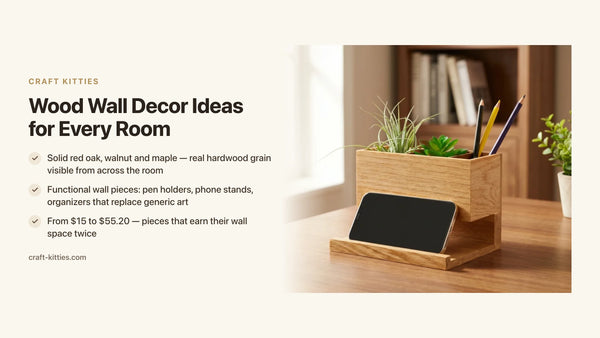
The Plant Pod is the model we reach for when the desk problem is bigger than "where do my pens go." Solid red oak, cut and finished in our studio, it combines multiple pen-and-brush compartments with an integrated planter slot sized for a small succulent or air plant. The compartments vary in diameter so that brushes, fine-liners and chunky markers each have a natural home without forcing you to sort by hand every session. At $55.20, it is the most ambitious piece in the lineup — the one that replaces the pen holder, the paper-clip dish and the desktop plant in a single object.

Description
The Walnut & Maple Spliced holder is where material meets craft. Two solid hardwoods — deep-brown walnut and pale maple — are joined and cut together, revealing a clean contrasting seam that makes the grain visible as a design decision rather than incidental texture. The piece works as a desk organizer and reads as a studio object. At $36.00, it is the pick for someone who wants the pencil holder to be the most interesting thing on the desk. The aperture is generous: standard pencils, fat markers and short brushes all fit without crowding.

Description
The Walnut & Red Oak Pen Holder is the most direct object in the lineup. Two solid species — warm red oak and deep walnut — cut and finished as a clean cylinder. No shelf, no compartments, no secondary function: it holds pens and pencils, sits without moving, and costs $15.99. It is the right answer when the desk is already organized and the only thing missing is a holder that looks as considered as the rest of the setup. It is also the most giftable piece at this price point — small, light, ships easily, instantly useful.

Description
The Pen Holder & Phone Stand is the answer for the desk where the phone is as constant a presence as the pencil cup. Solid wood with a cut groove that props the phone at a natural reading and viewing angle — the same piece that organizes tools keeps the screen visible without a separate stand. At $35.00, it consolidates two desktop objects. It is particularly useful at a crafting station where reference images or tutorials are kept open during work: no freestanding phone means one fewer object to knock over.

Description
The Geometric Pencil Cup is the most visually deliberate piece at the entry price. At $15.00, solid wood cut to an angular silhouette rather than a standard cylinder, it suits the desk where the aesthetic is explicit: clean lines, material honesty, no decoration beyond the grain itself. The angled form makes it recognizable from across the room — it does not disappear into the desk the way a plain cylinder does. For a gift or a first solid-wood piece, it is the model that requires the least justification.
Comparison table
| Model | Price | Wood | Format | Best for |
|---|---|---|---|---|
| Red Oak Plant Pod | $55.20 | Solid red oak | Multi-compartment + planter | Crowded creative desks, all-in-one |
| Walnut & Maple Splice | $36.00 | Solid walnut + maple | Single cup, large aperture | Design statement, gift |
| Walnut & Red Oak Holder | $15.99 | Solid walnut + red oak | Classic cylinder | Entry price, clean setup, gifting |
| Pen Holder + Phone Stand | $35.00 | Solid wood | Cup + phone groove | Connected workspace, tutorials on screen |
| Geometric Pencil Cup | $15.00 | Solid wood | Angular single cup | Minimal aesthetic, geometric desk |
Decision matrix — which holder for which desk
| Your situation | The right pick |
|---|---|
| Crafter or artist with brushes, markers, scissors and a plant on the desk | Red Oak Plant Pod — $55.20 |
| You want the holder to be a design object, not just a container | Walnut & Maple Splice — $36.00 |
| First solid-wood upgrade, simple tool set | Walnut & Red Oak Holder — $15.99 |
| Phone always on the desk during creative work | Pen Holder + Phone Stand — $35.00 |
| Minimal desk, geometric aesthetic, tight budget | Geometric Pencil Cup — $15.00 |
| Gift for a crafter, artist or designer | Walnut & Maple Splice — $36.00 or Plant Pod — $55.20 |
Why solid hardwood holds up where other materials fail

The pencil holder sits in a category where the price range is vast and the materials list is even wider — bamboo composites, acrylic, injection-molded plastic, veneered particleboard, solid pine and hardwood all compete on the shelf. At this price tier, it is worth understanding what the material actually does over time rather than taking any category at face value.
Veneered MDF is the most common substitute for solid wood at lower price points. It photographs well — the thin veneer carries the grain pattern convincingly. The failure mode is the edge: every corner and rim of a MDF piece is raw board sealed with veneer tape, and that tape lifts within months of regular contact. A pencil holder takes contact on its rim every time a tool is dropped in or pulled out. The result, predictably, is a chipped edge within a year that makes the piece look significantly older than it is.
Plastic and acrylic are honest materials in the sense that they do not pretend to be something else. Their weakness in this application is mechanical: a heavily loaded cylindrical pencil holder — brushes, rulers, multiple markers — applies lateral stress to the walls when tools are pulled out. Thin-wall plastic deforms over time; scratches on acrylic do not self-heal. Neither ages in an appealing direction.
Solid hardwood — walnut, red oak, maple — is dense enough that the rim and walls of a pencil holder made from it are the same material throughout. There is no veneer edge to chip, no hollow interior to dent. The finish (oil or wax on our pieces) deepens slightly with age and use rather than degrading. A solid hardwood pencil holder at five years of daily use looks more settled than it did at week one, not worse.
The weight is also part of the function. A heavy-based wooden holder does not slide when you drag a tool out at speed; it does not tip when loaded with a mix of heavy markers and light pencils. That stability is not a luxury feature — it is what makes the object actually disappear into the workflow instead of becoming a recurring small frustration.
How to position a pencil holder on the desk
The position of a pencil holder is a decision that most people make once, by default, and then live with for years. A few minutes of deliberate placement removes friction from every subsequent work session.
Dominant-hand side, within a forearm's reach. The holder should be reachable without shifting posture — arm extended naturally from the elbow, not reaching across the body. If you are right-handed, that means right side of the desk. The exception is when the right side is already occupied by a mouse or tablet; in that case, directly ahead and slightly to the right is the fallback.
Behind the primary work surface, not in front of it. A pencil holder placed in front of the keyboard or between you and your sketchpad creates visual interference. Behind the screen or at the rear edge of the desk keeps it accessible without occupying the visual field during work.
Separate from the water glass and the coffee cup. It sounds obvious until a cup of rinse water ends up next to the holder and brushes end up in both. Keep the tool zone and the liquid zone on opposite sides of the desk — the material damage from a tipped water glass to a solid wood piece is minor; the damage from repeated water contact to brushes stored in a damp cup is significant.
Group by proximity of use. Tools used together should live together — if watercolor brushes and fine-liners both serve the same project, put them in the same holder or in adjacent compartments of the multi-compartment model. Tools used in different projects or phases can live in different holders at different desk positions.
The crafter's vs the minimalist's approach to tool storage
Two distinct user profiles reach for a walnut pencil holder, and they weight the criteria differently.
The minimalist — typically someone whose desk serves one primary function, writing or drawing, with a small and consistent tool set — wants the pencil holder to disappear. The goal is to not notice the holder. For this profile, the Walnut & Red Oak Pen Holder at $15.99 or the Geometric Pencil Cup at $15.00 are the right answers: clean form, solid material, nothing that competes with the work surface for visual attention.
The crafter or artist — someone who works across multiple media, switches between pencils, inks, brushes, scissors and markers in a single session — wants the holder to be a system. The problem is not "where do my pens go" but "how do I find the right tool in three seconds without disrupting the work state." For this profile, the Red Oak Plant Pod is the honest answer: the compartmentalization does real work, and absorbing the desktop plant into the same footprint frees surface area without sacrificing the small green presence that makes a studio feel like a studio.
Both profiles benefit from solid hardwood over alternatives for the same reason: a material that ages better than it arrives does not need to be replaced, and a piece that does not tip under load does not need to be repositioned. The desk stays consistent, which keeps the work surface reliable.
What to look for when choosing beyond this lineup
If the five models above do not fully answer the question — perhaps because the tool set is unusual, the desk shape is non-standard, or the aesthetic sits outside what is shown here — these are the criteria worth carrying into any comparison of wood pencil holders.
Wall thickness. Thin-wall turned wood cups look elegant and tip easily when loaded. A holder with a wall thickness of at least 10 mm at the rim sits with the weight distribution that keeps it stable under a mixed tool load.
Base dimension relative to height. The tipping threshold of a cylindrical holder is roughly when the height-to-base ratio exceeds 2:1. A holder that is 5 inches tall should have a base diameter of at least 2.5 inches. The Plant Pod sidesteps this entirely with its wider, asymmetric footprint.
Interior finish. Some wood holders are finished only on the exterior; the interior is raw or roughly sanded. A rough interior catches brush ferrules and makes fine-liners harder to pull out cleanly. Look for an interior that is as smoothly finished as the exterior — or at minimum sanded to a point where there are no splinter risks.
Species provenance. Solid wood is not a monolith — there is a difference between certified domestic hardwood and low-cost imported wood labeled generically as "wood." Walnut and red oak cut from North American or European stock have the density and grain consistency that makes them worth the material premium.
FAQ — walnut and wood pencil holders
1 — What wood species is best for a pencil holder? Walnut is the most requested for its deep brown tone and fine grain — it reads as a quietly sophisticated object without announcing itself. Red oak is lighter with bolder grain and suits pale or warm setups. A spliced two-tone design combines both. All three are solid hardwood; the choice is visual, not functional.
2 — Will the holder tip over when full of tools? Solid hardwood is heavier than plastic or acrylic, which is what keeps it stable under a full load. The wall and base thickness of our holders are designed for mixed tool sets — brushes, markers and rulers included. The Plant Pod, with its wider footprint, is the most stable model for very heavy loads.
3 — Can these hold artist brushes and wide markers, not just pencils? Yes. The apertures are sized generously for creative tool sets. The Plant Pod's multi-compartment layout lets you separate brushes by size so nothing gets buried. The Phone Stand model also includes a flat slot for wide or flat tools.
4 — How do I clean a wood pencil holder? A dry or barely damp cloth for the exterior. Avoid leaving wet brushes standing in the cup overnight — the oil finish handles incidental moisture but not sustained soaking. A drop of food-grade mineral oil rubbed in once or twice a year keeps the finish looking fresh.
5 — What is the practical difference between the $15.99 and $55.20 models? The $15.99 Walnut & Red Oak is a single cylindrical cup — it solves one problem simply. The $55.20 Plant Pod is a multi-compartment desk system with an integrated planter. The difference is scope: one holds tools, the other organizes a desk.
6 — Do these ship assembled? Every piece ships fully assembled, ready to place. No hardware, no instructions, no flat-pack. What arrives is exactly what you see.
7 — Is the finish safe for children's creative spaces? The finish is a natural oil or wax coat — non-toxic, no heavy lacquer. It is safe in environments where children work at the desk.
8 — Can I use a wood pencil holder outdoors or in a humid room? These holders are designed for indoor desk use. The oil finish resists incidental moisture easily, but sustained outdoor humidity or direct exposure to rain will raise the grain over time. Keep them on the desk.
9 — What is the best gift price point in this lineup? The Walnut & Maple Splice at $36.00 is the piece that lands best as a gift — the two-tone joint reads immediately as handmade and considered, and it is the right size to box without excessive packaging. At $15.99 the Walnut & Red Oak is the option for a budget-conscious gift that still says "I thought about this."
10 — How does a wood pencil holder compare to a ceramic one? Ceramic cups are heavier at the base and lighter at the walls, which makes them stable but fragile at the rim. Solid wood is heavier overall, resilient at the edges, and warmer to the touch — which matters more than it sounds on an object you handle dozens of times a day.
Where to go next
If this guide has narrowed the choice to one or two models, our pen holder collection presents the full range in one place. For a crafter or artist building out a complete desk setup, the Red Oak Plant Pod is the natural anchor piece — start there and fill in the rest of the desk around it.
Our community of crafters and artists on Etsy — where we have collected 243 reviews from makers who use these holders daily — has been the sharpest feedback loop for sizing, stability and finish decisions. The models in this guide reflect what actually works in active creative workspaces, not just what photographs well.
Conclusion — the tool that holds your tools
The pencil holder is on the desk every single day. That frequency is the argument for getting it right once rather than cycling through plastic cups and veneered MDF. A solid walnut or red oak holder at $15.99 costs less than most desk accessories and outlasts them by a wide margin. The Walnut & Red Oak Pen Holder is the place to start if the desk is already set and the tool set is simple. The Red Oak Plant Pod is the answer if the desk is in need of a system, not just a cup. And the Walnut & Maple Splice is what to reach for when the holder also needs to be the most considered object on the desk.