At a glance
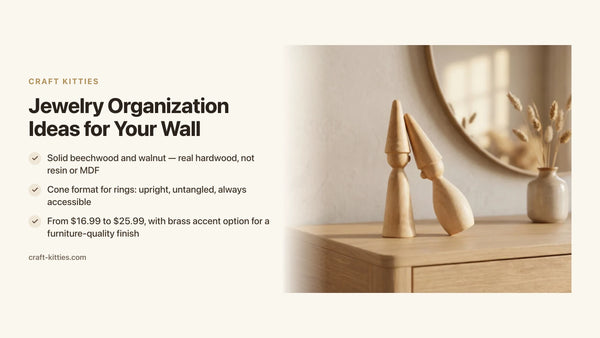
- Solid walnut or beechwood — real hardwood, smooth wax finish, no raw grain
- Set of two cones splits a shared vanity without clutter
- From $16.99 to $25.99, with a weighted brass base option
There is a version of a vanity top that looks finished and a version that looks like a surface where things got set down. The difference is rarely about what is on it — it is about what is organizing what is on it. A single walnut ring holder cone does more visual work than any tray or dish, because it has a shape that reads as a choice: something tapered, solid, dark-grained against a pale marble or ceramic surface. It cannot be mistaken for clutter.
The problem with most ring holders is not the idea but the execution: plastic cones with a velvet wrap that peels, resin pieces that look like decorative objects from a discount shop, or bare unfinished wood that splinters within a season. A solid walnut or beechwood cone, turned smooth and waxed, solves the problem permanently — it ages like furniture, not like an accessory.
This guide explains why grain darkness matters on a vanity, how to choose between walnut and beechwood, how to decide on cone count, and what the brass base actually contributes. Then it presents the pieces from our ring holder collection with current prices, a comparison table, a decision matrix, and the most useful questions we get asked.
One clarification before anything else, because everything flows from it: this guide is about solid hardwood. Turned from real walnut or real beech, not pressed wood, not painted MDF, not wood-look resin. Solid hardwood is what takes a wax coat properly, what sands smooth enough for a ring to slide without risk, and what develops character rather than showing wear.
At a glance
- Solid walnut or beechwood — real hardwood, smooth wax finish, no raw grain
- Set of two cones splits a shared vanity without clutter
- From $16.99 to $25.99, with a weighted brass base option
Why dark grain reads best on a vanity
Most vanity surfaces are light. White marble, pale quartz, cream ceramic tile, bleached oak — the vanity top is almost always the palest horizontal plane in the room. Against that background, a light-wood object blends in; a dark-wood object pulls focus.
This is the same logic as a dark-framed mirror on a white wall, or a matte black hardware choice in an otherwise all-white kitchen: the contrast does the aesthetic work without any other intervention. A walnut cone on a white marble vanity does not need styling around it. It simply sits there and reads as deliberate.
Beechwood works differently, and works well — but in a different register. Beech is warm honey, fine-grained, and integrates rather than contrasts. On a bathroom counter with warm tones, with aged brass fixtures or a terracotta tile floor, beech belongs naturally. It blends rather than stands out, which is sometimes exactly what a room needs.
The practical rule is simple: the lighter the vanity surface, the more walnut earns its place. The warmer and more tone-rich the surface, the more beech blends in. Both are solid hardwood with comparable durability; the choice is about how much visual presence you want the piece to have.
Walnut versus beechwood: the grain difference that matters

Walnut is deep brown — sometimes described as chocolate, sometimes as espresso — with a fine, tight grain that reads quietly sophisticated up close and as a confident dark accent from across the room. It is the most sought-after wood tone in contemporary home décor, which is not coincidental: it works against whites, grays, greens and near-neutrals without requiring any other warm element to carry it.
Beechwood is lighter, warmer, with a grain pattern that is more visible but more uniform — less "statement" and more "companion." It pairs naturally with natural linen, aged brass, rattan, and any vanity surface that already has warmth in it. The Beechwood Ring Holder Cone Set at $16.99 is the more accessible entry point, and the one that suits a bathroom already pulling toward natural and organic materials.
On every structural criterion the two species are comparable. Both are dense, closed-grain hardwoods that take a wax finish well and sand to a surface smooth enough for rings and bracelets to slide without risk of scratching. Both are heavier and more stable than any MDF or resin alternative. The choice between them is entirely visual — which grain tells the story you want on that particular surface.
A third consideration, if you share a vanity: using both. A walnut cone for one person's rings and a beechwood cone for the other's is a quiet, low-effort way to make a shared surface feel organized without labeling anything.
Single cone, set of two, or set with a base: choosing the right configuration

The configuration question is the most practical one, and it resolves quickly once you know how many rings you actually rotate through.
One cone holds four to six rings comfortably in a stack — more for thin bands, fewer for wide statement pieces. For a single person with a concise collection of everyday rings, one cone handles everything. It occupies the smallest footprint on the vanity, which is often the deciding argument in a bathroom where counter space is genuinely scarce.
A set of two cones works for two scenarios: a shared vanity where two people want their rings clearly separated, or a single person who wants to split everyday rings from fine jewelry or special-occasion pieces. The Wooden Ring Holder Set of 2 — Walnut Cone Display at $18.99 covers both cases. Two matching cones in solid walnut read as a considered pair rather than two random objects — they organize without looking like organizers.
A cone with a weighted brass base is the third configuration, and it changes the register of the piece. The Walnut Wood Ring Holder with Solid Brass Base at $25.99 is what you choose when you want the ring holder to be an object in its own right — not just a display prop but something with the presence of a small sculpture. The brass base prevents tipping when you slide a ring on or off in a hurry, and it patinas slowly over time in a way that deepens rather than cheapens the piece.
The pieces from our studio
Five configurations, from the most accessible entry to the statement piece, all in solid real wood.

Description
The beechwood cone set is the one we point to when the question is "which one fits a warm or natural bathroom." Two solid beechwood cones in matching honey grain — turned, sanded, and wax-finished so the surface is closed and safe for delicate pieces. At $16.99 for the pair, it is the entry point to a real-wood ring display without the visual statement of walnut. Works equally well as a couples set or as a split between everyday and fine jewelry.

Description
The walnut cone with a solid brass base is the model that changes the character of a vanity top. Deep chocolate-brown walnut on a weighted brass platform — the brass is solid, not plated, so it will age rather than chip. The base is heavy enough that sliding a ring on or off one-handed does not shift the cone. At $25.99, it is the piece that elevates a vanity from functional surface to a space that looks as considered as the rest of the home.

Description
The walnut set of two is the answer for a shared vanity or a more extensive personal collection. Two matching solid walnut cones in the same tight-grain deep brown finish — no mix-and-match, no visual noise. At $18.99 for the pair, they cost less than one decorative tray and do more organizational work. The pair reads as designed together, which is the point.
Comparison table
| Model | Price | Wood | Configuration | Best for |
|---|---|---|---|---|
| Beechwood Cone Set | $16.99 | Solid beech | Set of 2 cones | Warm, natural bathrooms; couples |
| Walnut Cone Set of 2 | $18.99 | Solid walnut | Set of 2 cones | Shared vanity; everyday + fine jewelry split |
| Walnut with Brass Base | $25.99 | Solid walnut | Single cone + brass base | Statement piece; minimal collections |
Decision matrix — which configuration for which vanity
| Your situation | The right pick |
|---|---|
| White or gray vanity, you want a visual anchor | Walnut with Brass Base — $25.99 |
| Warm or natural-material bathroom | Beechwood Cone Set — $16.99 |
| Shared vanity, two people, clean separation | Walnut Set of 2 — $18.99 |
| Solo, many rings, everyday vs fine jewelry split | Walnut Set of 2 — $18.99 |
| Gift for someone who wears rings daily | Walnut with Brass Base — $25.99 |
| Minimal vanity, one person, first ring holder | Beechwood Cone Set — $16.99 |
What solid wood does that no other material does
The ring holder category is full of alternatives that look appealing in a product photo and disappoint in daily use. Ceramic cones chip at the tip — the narrowest, most fragile point — within a few months of sliding rings on and off. Resin cones look like solid stone in photos but feel hollow and light in the hand, and they scratch easily. Velvet-wrapped holders collect lint, trap moisture, and cannot be cleaned without leaving a mark.
Solid hardwood solves each of these problems at the source. Dense grain does not chip; it wears smooth, not rough. Real walnut and real beech are closed-grain woods that, once waxed, present a surface with no texture variation that could catch on a fine band or a prong setting. Weight comes from the wood itself — a walnut cone has the satisfying density of something made from a real material, not from a mold. And maintenance is nothing: a dry cloth if dust settles, no products, no ritual.
The distinction between solid wood and wood-look alternatives is worth stating plainly because the category is not transparent about it. "Wood ring holder" in a search result returns everything from actual turned walnut to MDF with a wood-tone print. The difference in hand feel is immediate; the difference in longevity is measured in years. Our ring holder collection is solid hardwood throughout — no veneered surfaces, no wood-look finishes on composite cores.
How to place a ring holder on a vanity so it stays put
Placement sounds obvious but it is the detail that determines whether a ring holder gets used every day or gets pushed aside within a week.
The morning-hand rule. Set the cone on the side of your dominant hand, at the edge of the vanity closest to the sink. You remove rings before washing your hands — the cone should be reachable in that motion, not across the counter. The one exception is a couple who share a vanity: two cones, one each side, keeps the morning routine from requiring any coordination.
Proximity to the mirror. A ring holder placed within the mirror's sightline gets noticed when you are getting dressed. Out of the direct sightline, it works functionally but disappears from the room's composition. If you want the piece to contribute to how the vanity looks — not just what it does — the reflection matters.
The base question on marble. Marble and quartz are hard, smooth surfaces where a light cone can slide when you pull a ring off too quickly. The weighted brass base on the Walnut with Brass Base eliminates that problem. If you choose a set of two cones without a base, placing them against a small tray or a soap dish provides enough lateral resistance to hold them in place.
What to put beside it. A ring holder is not a standalone display; it anchors a grouping. A candle, a small plant, a perfume bottle, a clean-design hand lotion pump — any one of these beside the cone makes the corner of the vanity read as curated rather than collected. The rule is one organic element (the wood), one personal element (the fragrance or plant), and nothing else.
The case for buying the brass base version as a gift
A ring holder is one of the most reliable jewelry-adjacent gifts because it requires no knowledge of the recipient's jewelry taste — only the knowledge that they wear rings. That said, the difference in how a gift lands at $16.99 versus $25.99 is not linear: the Walnut with Brass Base has the visual weight and quality feel that signals a considered gift, not an afterthought.
The brass base is what makes the difference. Not because the walnut cone alone is insufficient — it is excellent — but because the brass base changes what the piece looks like sitting on a surface. It reads like an object from a design shop rather than from a home goods aisle, which is the reading you want when giving something that will sit on someone's vanity every morning.
For a housewarming, the walnut cone set of two is the more practical gift: it covers a shared home from the start and the two-cone format implies you thought about the recipient's living situation, not just their taste. Either path works; the brass base version is the safer bet when you do not know whether the home is shared.
Common mistakes with ring holders
Choosing the cone for how it looks in a product photo, not on your specific surface. A beechwood cone that photographs warmly against a gray background may disappear on a warm-toned marble. Look at your actual vanity surface and decide by contrast, not by the product image alone.
Stacking too many rings on one cone. Past six or seven rings, the stack becomes unstable and the top ring often slides off when you are adding or removing from the middle. Two cones at six rings each is more practical than one cone at twelve. It is also more legible — you can see each ring without displacing the others.
Placing the cone where it will not be used. A ring holder on the far end of the counter, behind the tap, gets ignored. The best ring holder is the one at arm's reach, in the motion you already make. If you wash your hands before removing your rings, put the cone by the sink. If you remove them at your dressing table, that is where it belongs.
Buying a "ring holder" that turns out to be a velvet dish. The dish format works for a drawer; on a vanity top, it collects dust and moisture and does not display pieces attractively. A cone holds each ring vertically, visibly, and in a way that does not tangle anything.
FAQ — walnut ring holders
1 — Why does walnut look better on a vanity than lighter wood? Contrast is the reason. A vanity top is almost always light — white marble, pale stone, cream ceramic, bleached oak. A walnut cone pulls focus in exactly the way a dark-framed mirror does: it reads as intentional, not as something you set down and forgot to style. Beechwood works beautifully too, but in a different register — warm honey against light surfaces, soft rather than striking.
2 — What is the difference between a walnut and a beechwood ring holder? Both are solid hardwood, turned and sanded smooth. Walnut is deep chocolate-brown with a fine, tight grain — the darker, more contemporary choice. Beech is warm honey with a subtler grain pattern — softer, more traditional. On a white or gray vanity, walnut provides the stronger visual anchor; on a warmer or wood-toned surface, beech integrates more naturally.
3 — How many ring holder cones do I need? One cone holds four to six stacked rings comfortably — more if they are thin bands, fewer if they are wide statement pieces. For daily-rotation jewelry only, one cone usually suffices. For couples sharing a vanity, a set of two keeps pieces separate without negotiation. If you split everyday rings from fine jewelry, two cones let you organize by category rather than by person.
4 — Does the brass base make a difference? Functionally, yes — the weighted brass base means the cone will not tip when you slide a ring on or off in a hurry. Visually, it elevates the piece from a display prop to something that reads like an object you chose deliberately. The brass patinas slowly over time, which pairs well with walnut's own warmth.
5 — Can a ring holder cone scratch rings or jewelry? Not when the wood is properly finished. Our cones are sanded smooth and finished with a fine wax coat that closes the grain entirely. There are no splinters, no rough edges, no exposed grain texture that could catch on a setting or scratch a band. Delicate pieces — thin gold bands, pavé settings — sit safely on the cone.
6 — Is a wooden ring holder a good gift? It is one of the most reliable jewelry-adjacent gifts because it does not require knowing someone's taste in jewelry — only knowing that they wear rings. A walnut cone with a brass base has the visual weight of a considered gift and the daily utility of something used every morning and every evening.
7 — How do I care for a solid wood ring holder? The wax finish does the protective work. Wipe with a dry cloth if dust collects; avoid leaving the cone in direct prolonged sunlight, which can lighten any wood over time. No oil, no re-finishing, no ritual. The wood will deepen slightly in color with age — walnut especially develops a richer tone over years of handling.
8 — Can I use a ring holder cone for other jewelry? Yes. Stacked bracelets slide over the cone and hold their shape without tangling. Necklaces draped over the tip keep chains from knotting in a drawer. Some people use a second cone specifically for bracelets alongside the first one for rings. The cone format is more versatile than it looks.
9 — What rings does the cone not work for? Very large cocktail rings with wide bases can sit awkwardly on the cone tip rather than sliding cleanly down — they rest on the taper rather than stacking. For that kind of piece, a wider flat dish or a hook-and-peg display is better suited. The cone format is ideal for bands, solitaires, stackable rings, and anything with a standard ring-hole diameter.
10 — Does walnut wood darken over time? Slightly, yes. Walnut starts deep and develops a richer, more nuanced tone over years of handling and ambient light exposure. This is a characteristic of solid walnut, not a defect — antique walnut furniture is darker and more beautiful than when it was new. The wax coat on the cone does not prevent this natural aging; it shapes it, keeping the surface smooth and even as the wood deepens.
Where to go next
A ring holder cone is often the first piece that makes a vanity look thought through — and rarely the last. Our full ring holder collection includes configurations for solo use, for couples, and for the vanity that deserves a statement piece. The Beechwood Ring Holder Cone Set is where most people start, at $16.99; the Walnut Wood Ring Holder with Solid Brass Base is where the conversation usually ends once someone has held it. Over 243 customer reviews on Etsy have shaped the details of these pieces — the smoothness of the wax, the weight of the base, the height of the taper. That feedback history is visible in what the cones feel like in daily use.
Conclusion — one cone, a finished vanity
If this guide leaves you with one method: choose walnut for a light or cool-toned vanity, beechwood for a warm or natural one; buy two cones if you share a surface or rotate between categories of jewelry; choose the brass base if you want the piece to read like a design object rather than a display tool. The Walnut with Brass Base is the answer for most people asking which one to get; the Walnut Set of 2 resolves the shared-vanity question at $18.99; and the Beechwood Cone Set opens the category at $16.99 without compromising on real wood. Three paths, one result: a vanity top that finally looks as intentional as the rest of the home.