At a glance
- Walnut costs more than beech or red oak — slower growth, tighter supply, more careful milling
- The premium is $2–$9 in our lineup: entry beechwood cone at $16.99, paired walnut set at $18.99, walnut and brass at $25.99
- Choose by contrast with your room: walnut against light walls, beech in Scandi or minimalist spaces, red oak to warm a neutral palette
The question of walnut versus oak — and where beechwood fits between them — comes up in almost every conversation about solid wood home accessories. The confusion is understandable: all three are genuine hardwoods, all three appear in credible furniture and decor, and the price gap between them is real but rarely explained. Shopping for a ring holder or a small decor piece, you land on a $16 beechwood cone and a $26 walnut-and-brass version and wonder whether you are paying for wood character, for marketing, or for something that will actually look different on your dresser five years from now.
This guide answers that question directly. It covers what drives the price difference between walnut, red oak, and beechwood — in raw lumber terms, not in brand language — then moves to where each wood performs best, how to tell solid wood from cheaper imitations in this category, and which specific piece to choose based on your room and your use. Three products from our studio anchor the comparison, with current prices, a comparison table, and a decision matrix that maps buyer situations to the right pick.
One premise to establish before anything else: this guide is about solid hardwood only. Ring holders made of resin, acrylic, or wood-look plastic exist at every price point and are easy to confuse with the real thing in a product photo. They behave differently at year one and dramatically differently at year three. That distinction — solid wood versus everything else — matters more to the buying decision than walnut versus oak, and it gets its own section below.
Why walnut costs more than oak or beech: the real reasons

Lumber pricing follows supply and the labor required to process it. Walnut — specifically American black walnut, Juglans nigra — is native to a narrower growing range than either red oak or beech, matures more slowly, and yields smaller usable sections per trunk. That scarcity works through every step of the supply chain: fewer trees harvested, less raw board available at the sawmill, higher cost per board-foot at the distributor, and by the time it becomes a finished accessory, a real though modest premium over species with broader availability.
Red oak (Quercus rubra) grows fast, ranges widely across eastern North America, and is one of the most abundant commercially harvested hardwoods in the country. Its price reflects that: red oak is the pragmatic choice when you want genuine hardwood character without the walnut premium. Beechwood sits in a similar position in Europe and northeastern North America — abundant, dimensionally stable, easy to mill cleanly — which is why it is the baseline hardwood for affordable solid-wood pieces.
The milling behavior adds another layer. Walnut's tight, fine grain requires slower, more controlled cuts to avoid tearout and preserve the smooth surface that makes it distinctive. That additional labor per linear foot compounds the raw material premium. The spread you see between a $16 beechwood piece and a $26 walnut piece is not a branding decision — it reflects genuine differences in input costs that run all the way back to the tree.
Cone versus tray: the primary choice for ring holders
Before comparing species and prices, there is a more fundamental decision: cone or flat tray? The format shapes the daily ritual differently, and understanding it matters more than the wood species for first-time buyers in this category.
A cone holds rings along its shaft by size — largest ring at the base, smallest near the tip. This geometry makes removal effortless: you reach for the ring you want without disturbing the others. It also creates a small vertical sculpture on the dresser or nightstand, which is why cone ring holders from solid wood are the most photographed piece in this category. The cone format works best when you have a small, consistent rotation of daily rings — typically two to four pieces per cone.
A flat tray spreads jewelry horizontally and suits a larger collection or mixed pieces (rings, earrings, small chains). It occupies more dresser surface but displays everything at once, which suits the "I want to see all my options" mindset. For rings alone in small quantities, a cone is the more intentional choice; for a full everyday collection, a tray makes practical sense.
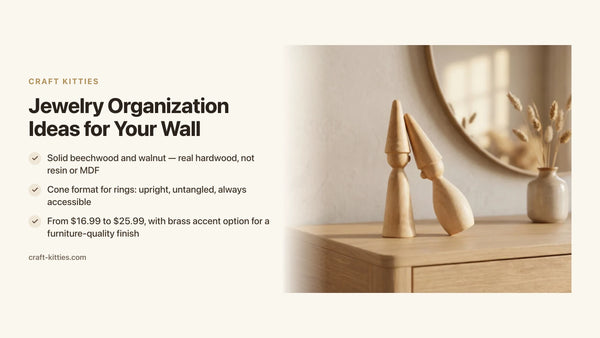
Our lineup for this comparison focuses on the cone format, which is where the walnut-versus-beech decision has the most visual impact on a dresser or nightstand.
Solid wood versus resin, acrylic, and veneer: why it matters at the three-year mark

The ring-holder market at every price point is saturated with resin, acrylic, and wood-look veneer pieces that photograph beautifully and price aggressively. They are easy to mistake for solid wood in a thumbnail. Understanding the material difference is what makes the $16–$26 price range feel justified rather than arbitrary.
Resin and acrylic cones dominate the lowest price tier ($5–$12). They are injection-molded, which means perfect surface uniformity out of the box. The problem is long-term: resin yellows under ambient UV over 18–24 months, acrylic becomes micro-scratched and cloudy with daily ring placement. Neither material can be maintained — there is no equivalent of re-waxing a wood surface. You replace them; you do not restore them.
Wood-look veneer over MDF or particle board is the middle trap. The surface grain looks convincing in photos. At the edges — where a ring holder takes repeated contact — the veneer chips and lifts within months. MDF swells with humidity, which is particularly relevant for a nightstand piece in a bedroom that experiences temperature variation. A waxed solid hardwood piece set next to a veneer piece after six months of daily use is an unmistakable comparison.
Solid hardwood — whether beechwood, walnut, or red oak — behaves like furniture because it is the same material as furniture. It develops a patina rather than degrading. The wax finish we apply is not a surface coating that peels; it is absorbed into the wood grain and can be renewed with a light re-application. A solid beechwood cone at $16.99 is a different category of object from a resin cone at $7, not a more expensive version of the same thing.
The three species in context: beech, walnut, and red oak on the dresser
The visual comparison between beech, walnut, and red oak is almost entirely about color and grain character against your specific room. The durability and finish of all three are comparable for a display piece that will never bear structural load.
Beechwood is pale — close to cream or light tan — with a fine, very uniform grain that reads as quiet and Scandinavian. Against white, off-white, or light-gray walls it creates subtle cohesion: the cone blends into the palette rather than asserting itself. This is not a weakness; in a minimalist or Japandi room it is exactly the right quality. Beechwood also photographs extremely cleanly, which is part of why it dominates lifestyle editorial for bedroom accessories.
Walnut is the statement piece of the three. Its deep chocolate-brown with purple and amber undertones creates the sharpest contrast against light backgrounds — the piece reads like a deliberate design choice from across the room. Paired with brass hardware, walnut enters a territory that furniture designers call "quietly luxurious": rich without being loud. It is the correct choice when the room is light or neutral and you want the accessory to anchor the surface it sits on.
Red oak sits between the two in warmth and visibility. Its honey tone and bold, open grain are distinctive without being dark. It works best in rooms with warm off-white, sage, or warm-gray walls — spaces where walnut might feel too heavy and beech too pale. Red oak also ages with visible warmth: the grain deepens slightly over years of ambient light exposure.
The contrast rule holds across all three: choose the species by how it will read against your dresser surface and the wall behind it, not by abstract preference for a species name.
The three pieces from our studio

Description
The Beechwood Ring Holder Cone Set is where solid hardwood ring display starts. Two cones in graduating sizes cut from real beechwood, finished with a natural wax that keeps the pale grain visible and the surface smooth to the touch. The paired format means both nightstand sides can match — which is why this is consistently the first choice for couples furnishing a shared bedroom. At $16.99, it is the clearest argument against the false economy of resin: the price difference from a $7 acrylic cone is less than a coffee, and the material difference is not comparable.

Description
The Walnut Wood Ring Holder with Solid Brass Base is the piece that stays out permanently. Solid walnut — the real thing, not walnut-stain veneer — with a machined brass base that adds weight and anchors the piece visually. The brass patinas gently over time alongside the walnut, which means the piece looks better at year two than at day one. At $25.99 it is the flagship of the three, and the one that most consistently photographs well regardless of the room it sits in. The nine-dollar premium over the beechwood set reflects real material costs: walnut lumber, brass hardware, slower milling — not a brand story.

Description
The Wooden Ring Holder Set of 2 in walnut gives you the deep grain of the flagship without the brass base — a cleaner, quieter version for rooms where metal accents are already present or where you want the wood to be the only statement. Two matching cones at $18.99 for the pair: $2 above the beechwood set for the step up to walnut. That spread makes the decision easy to reason about. If your room is light and you want contrast, the walnut set delivers it. If the room is warm-toned and you want cohesion, the beechwood set is the right call.
Comparison table
| Model | Price | Wood | Hardware | Best for |
|---|---|---|---|---|
| Beechwood Cone Set | $16.99 | Solid beechwood | — | Scandi / minimalist rooms, light palettes, first solid-wood piece |
| Walnut Cone Set of 2 | $18.99 | Solid walnut | — | Light or neutral rooms, shared nightstand, walnut without brass |
| Walnut + Brass Base | $25.99 | Solid walnut | Solid brass | Statement piece, gift, rooms with warm metal accents |
Decision matrix — which piece for which situation
| Your situation | The right pick |
|---|---|
| Light or white-walled room, you want the wood to stand out | Walnut + Brass Base |
| Scandi, minimalist, or Japandi bedroom with pale palette | Beechwood Cone Set |
| Shared nightstand, want a matching pair in warm wood | Walnut Cone Set of 2 |
| Wedding, anniversary, or housewarming gift | Walnut + Brass Base — the piece that stays out permanently |
| Unknown décor — buying for someone else | Beechwood Cone Set — pale wood reads in any room |
| Room already has walnut furniture, brass handles, or warm tones | Walnut Cone Set of 2 — coordinates without duplicating |
When the walnut premium is worth it — and when it is not
The question this article is titled around deserves a direct answer. Is the premium justified? The honest response is: it depends on the visual context, not on the material performance.
In terms of durability, maintenance, and longevity, a waxed beechwood cone and a waxed walnut cone are essentially identical. Both are real hardwood. Both respond to the same simple care routine — a dry cloth, an occasional re-wax. Both will outlast any resin or veneer alternative by years. If you are choosing between solid beech and solid walnut purely on practical grounds, the $9 price difference between our beechwood set ($16.99) and the walnut-and-brass piece ($25.99) is not buying you significantly more object.
What the walnut premium buys is visual weight and warmth. Walnut reads as premium on a light dresser surface in a way that beech does not — it creates contrast, anchors the space, and photographs with a depth that beech's pale uniformity cannot replicate. If your room is light-walled and you want the accessory to be noticed, walnut justifies its price. If your room is warm-toned or heavily furnished, beech's quiet presence may actually be the more refined choice — and the price difference becomes an argument in its favor rather than against it.
The walnut premium is worth it when the visual contrast between dark wood and light surface is something you will see every day and appreciate. It is not worth it if the room will swallow the color difference, or if the budget genuinely matters. Solid beechwood at $16.99 is not a compromise — it is a considered choice for a different aesthetic.
Common mistakes when choosing between wood species
Choosing from a product photo on a white background. Every species looks its best and most distinct in a studio setup with controlled lighting. On a natural-wood dresser, a walnut cone may read very differently — potentially blending in if the furniture is itself dark-toned. Look at your surface first, then the product photo.
Conflating walnut-stained finish with solid walnut. A walnut stain applied to beechwood or rubberwood will photograph convincingly as walnut and price like it too. The tell is the end grain: solid walnut shows consistent grain direction through the cut; stained alternative wood often shows patchy or inconsistent color at the base. Our pieces list the species explicitly — "solid beechwood" and "solid walnut" are not marketing language in our descriptions, they are material specifications.
Prioritizing hardness over aesthetics. Red oak is genuinely harder than walnut on the Janka scale. For a ring holder that will never bear load, the hardness number is irrelevant. Choosing red oak over walnut because "it is harder" is applying flooring criteria to a jewelry display — a category error that sacrifices the look you want for a performance metric that does not apply.
Underestimating how much a small object shapes a surface. A dresser top reads entirely differently with a carefully chosen wood cone on it versus a resin placeholder. The scale is small but the object is at eye level every morning, which amplifies its visual presence. Treating the ring holder as a low-stakes purchase usually leads to choosing the wrong one.
Caring for solid beechwood, walnut, and red oak
All three species in our lineup receive the same wax finish in our studio — the care routine is therefore identical regardless of which wood you choose.
Wipe with a dry cloth to remove dust and jewelry oils that accumulate over time. If the surface begins to look dry or dull (typically after six to twelve months of daily use), apply a very light coat of beeswax or furniture wax with a soft cloth, let it absorb for five minutes, and buff gently. That is the complete maintenance protocol. No sanding, no stripping, no specialist products.
What to avoid: prolonged contact with hand cream, perfume, or water directly on the wood surface. The wax coat handles ambient humidity and incidental contact; it is not a waterproof barrier for standing moisture. Keep the piece away from bathroom-level humidity, and it will look the same in ten years as it does on day one.
Where to go next
If this comparison has resolved the walnut-versus-beech question for you, the full ring holder collection shows every solid wood piece in the lineup — including formats beyond the cone for collectors with larger rotations.
For a closer look at the two individual pieces that anchor this guide: the Beechwood Ring Holder Cone Set is the place to start if your room is light or your palette is Scandinavian, and the Walnut Wood Ring Holder with Solid Brass Base is the right destination if you want the piece that photographs well in any room and holds its look for years. Both have found consistent use across hundreds of bedside tables — a pattern that runs across our Etsy shop, where 243 reviews speak to how the pieces settle into daily life.
Conclusion — what the price difference actually buys
The gap between a $16.99 beechwood cone and a $25.99 walnut-and-brass piece is not a quality gap. Both are solid hardwood, both are wax-finished, both will outlast every resin or acrylic alternative that entered the category at a lower price. What you are paying for with walnut is a visual property — deep color, tight grain, contrast on light surfaces — plus, in the brass-base version, hardware that patinas alongside the wood rather than looking out of place next to it.
The decision reduces to one question: what does the room need? A light, Scandinavian space needs the quiet credibility of beechwood. A light-walled neutral room that lacks a warm focal point needs the depth of walnut. A shared nightstand that will see two rings placed and retrieved every single day benefits most from the paired walnut set, where the matching geometry does quiet work without calling attention to itself.
Choose the species by contrast, the format by habit, and the hardware by what is already in the room. The price difference, at under $10 across the lineup, is not the deciding factor — the room is.
FAQ — walnut vs oak price and solid wood ring holders
1 — Why is walnut more expensive than oak or beech?
Walnut grows more slowly than red oak or beech, which limits supply and raises the cost of raw lumber. The wood also machines differently — walnut's tight grain requires slower, more controlled cuts to preserve its character. Those two factors compound: less available material, more careful processing. The retail premium on a walnut accessory versus a beech one directly reflects input costs, not a marketing markup.
2 — Is walnut stronger than red oak for a ring holder?
Red oak scores slightly higher on the Janka hardness scale (1,290 lbf vs walnut's 1,010 lbf), which matters for flooring but is irrelevant for a small display piece. The distinction that counts for a ring holder is surface character and color. Choose by how the wood looks on your dresser, not by hardness numbers designed for foot traffic.
3 — Which wood looks best on a light or white surface?
Walnut creates the sharpest contrast against white, cream, or light-gray surfaces — its deep chocolate-brown grain reads like a deliberate design choice. Beechwood's pale, uniform tone blends naturally into Scandinavian or minimalist palettes. Red oak, with its warm honey tone and bold grain, sits between the two and works best against off-white, sage, or warm-gray walls.
4 — Does solid wood last longer than resin or acrylic ring holders?
Yes, meaningfully. Solid hardwood develops a patina over years of daily use; it does not yellow, crack, or become brittle under UV exposure the way resin and acrylic do. A wax-finished wood surface can also be maintained indefinitely with a light re-wax. Resin and acrylic can look pristine on day one but rarely look better at year three.
5 — Is the walnut ring holder with brass base a good gift?
It is one of the strongest gift options in the category because walnut and brass is a pairing that photographs well and ages gracefully together. The piece stays out permanently — unlike flowers or candles, it is used daily and seen every morning. For a wedding, anniversary, or housewarming, it is the kind of object that communicates thought without requiring explanation.
6 — Can I use a cone ring holder for earrings and bracelets too?
Yes. The cone geometry holds rings along the shaft, but the base is flat and wide enough to rest a pair of earrings or a thin bracelet. A set of two cones at slightly different heights creates a tiered display that organizes a full everyday jewelry rotation without needing a separate tray.
7 — How do I care for a solid walnut or beechwood ring holder?
Wipe with a dry or barely damp cloth to remove dust. Avoid prolonged contact with moisture, perfume, or hand cream on the wood surface. Once or twice a year, a light application of beeswax or furniture wax restores the sheen. No sanding, no stripping — the finish is designed to be maintained, not replaced.
8 — What is the actual price difference between beech, walnut, and oak ring holders?
In our lineup: beechwood cone set at $16.99, walnut cone set of two at $18.99, walnut with solid brass base at $25.99. The spread from entry to flagship is under $10, which makes the step-up decision considerably more approachable than the species premium might suggest when shopping across other categories.