At a glance
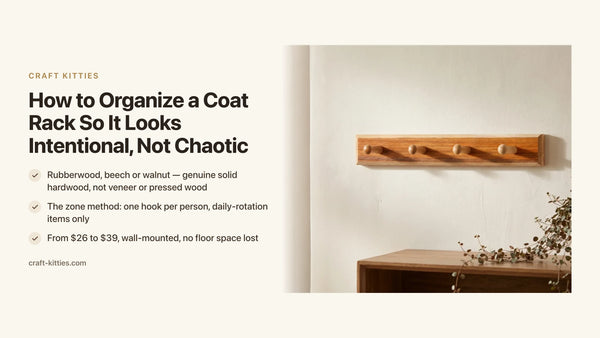
- Solid walnut, rubberwood with Brazilian veneer or two-tone beech — all real hardwood, nothing veneered
- Sizing rule: 6–8 inches of wall per hook, leave 3 inches clearance each side
- From $26 to $39, 2 to 6 hooks, boot-profile or flat
Choosing a wall hook rack is one of those decisions that feels small and turns out to be noticed every single day. The entry or mudroom is the room every person passes through twice — once leaving, once coming back — and a rack that is the wrong size, the wrong depth, or the wrong species for the wall ends up either crowding the space or looking lost in it. Get it right and it disappears into the room in the best sense: coats go on, coats come off, the wall stays tidy.
This guide is about making that decision well. It covers the four wood species in our lineup — rubberwood with Brazilian veneer, rubberwood with cherry veneer, beech-walnut two-tone, and solid walnut — the sizing logic that determines how many hooks fit your wall without crowding it, the hook geometry that determines whether coats stay on or slide off, and the mounting method that makes the difference between a rack that holds and one that tips. At the end, a comparison table and decision matrix narrow it down to the right model for your specific situation.
One point up front: every rack in this guide is built from solid hardwood or a real-wood veneer over a solid hardwood core. There is no MDF, no particleboard, no printed wood-grain film. That distinction matters in an entryway or mudroom, where hooks bear real weight daily and where the furniture takes the kind of repeated contact — jackets shoved on in a hurry, bags dropped in one motion — that exposes shortcuts in material quality within months.
Rubberwood: the wood most people haven't heard of but should
Rubberwood has a name that sounds like it was made up by someone trying to confuse buyers. It is, in fact, a dense tropical hardwood — the timber harvested from rubber trees (Hevea brasiliensis) at the end of their latex-producing life. Using the wood is the responsible end of that tree's lifecycle, not a byproduct of a synthetic industry. It machines like a fine-grained hardwood, takes veneer and finish cleanly, and holds screws with the grip of a material that knows it has a job to do.
In our hook racks, rubberwood is the structural backbone. The surface character — the grain, the color, the visual identity of the piece — comes from the veneer: Brazilian veneer for the warmth and figuring of tropical hardwood, cherry veneer for the amber-to-red tones that suit warmer interiors. The rubberwood beneath is why the backboard does not flex when you yank a coat off in a hurry, and why the hook anchors hold through years of daily use. It is a partnership between a structural wood and a surface wood, and both are real.

Solid walnut and two-tone beech: the furniture-grade option
Walnut needs less introduction than rubberwood. It is the wood of Shaker furniture, Japanese joinery, and the kind of cutting board that sits on the counter rather than getting stashed in a drawer. Deep brown, fine and tight grain, a quiet authority on a light wall — solid walnut on an entryway is one of those material choices that communicates quality to everyone who passes through, without announcing itself loudly.
The boot-profile walnut rack in our lineup carries that character into a four-hook strip designed for walls where the hook geometry matters as much as the wood. The boot profile — a curved tip that angles inward at the end — keeps coat collars and bag straps seated on the hook instead of drifting toward the tip and sliding off. It is a detail that sounds minor until you have spent a winter picking your coat up off the floor each morning.
The two-tone beech-and-walnut rack plays a different game: contrast. Beech is light, with a tight grain and almost neutral tone that reads as close to natural as a hardwood gets. Against it, walnut's deep brown reads sharper than it would against a darker species. The combination is both visually interesting and technically honest — both are solid hardwoods, the contrast is material, not painted or printed. The two-tone rack is the model for entries where the wall is doing something and the rack should answer it, not disappear.
How to size a wall hook rack for your space
Sizing is where most people make the mistake that lives with them for years. The instinct is to pick the number of hooks that matches the household count — two people, two hooks. The problem is that two hooks for two people means the rack is always full and you have no margin for a guest coat, a dog leash or a reusable shopping bag that needs a temporary home. A hook rack is like storage: you always end up using more than you planned.
The practical rule is household count plus two. A single person or couple is comfortable with four hooks. A family of three or four fills six hooks and will not miss the ones that stay empty between seasons. Going beyond six on a single strip creates a different problem: the hooks crowd into each other's reach zone, which means pulling one coat risks tangling with its neighbor. If you need eight or more hooks, two separate strips at different heights or in different zones is the cleaner solution.

Wall length calculation. Budget 6 to 8 inches of wall per hook, depending on the width of the items you hang. Coats and bags need more clearance than hats and scarves. Add 3 inches of margin on each side of the strip so the items at the ends can be hung and retrieved without scraping the wall. A 4-hook rack at that spacing fits comfortably on 28 to 32 inches. A 6-hook rack needs 40 to 48 inches. Measure your wall before choosing the configuration.
Height placement. Mount the strip high enough that the longest coat in the house clears the floor by at least 6 inches. For most adults, that means the hook tips sit around 66 to 70 inches from the floor. In a mudroom with children, a lower secondary row — hooks at 40 to 48 inches — lets kids hang their own gear without help, which is the kind of small design decision that changes daily routines.
The five models, in detail
Four handles, four distinct profiles for four distinct walls. Here is what each one is built from, what it is suited to, and who it is right for.

Description
The Brazilian-veneer rack is the most versatile piece in the lineup. The rubberwood core gives it the structural integrity to hold heavy winter coats without flex; the Brazilian veneer surface brings a warmth and figuring that reads as furniture rather than hardware. It is available in configurations from 4 to 6 hooks, which means it scales to the wall you have rather than requiring you to adapt. At $39, it is the model we point to when the question is "which one works in the most rooms" — the warm grain suits white walls, beige, light gray and raw plaster equally well.

Description
The cherry-veneer variant shares the same rubberwood backbone, same configurable hook count, same mounting system — the difference is the surface. Cherry veneer ages from amber to a deep reddish-brown over time as it is exposed to light, which means the piece develops rather than fades. It is the right choice for warm interiors: rooms with aged wood furniture, honey oak floors, terracotta tile, or exposed brick. At $37, it is slightly lower-priced than the Brazilian-veneer version and carries the same build quality underneath.

Description
The two-tone rack is the most configurable: 2 to 6 hooks, entirely in solid hardwood — no veneer, no core hidden beneath a surface. Beech provides the light element; walnut provides the dark. The contrast works in both directions: in a light room, the walnut elements anchor the wall; in a darker space, the beech elements lift it. At $26, it is the most accessible entry point to real solid hardwood in this lineup, and because it starts at 2 hooks, it is also the right answer for narrow walls where a 4-hook strip simply does not fit.

Description
The boot-profile walnut rack is the most purposeful design in the set. Four hooks in solid walnut — not veneered, not rubberwood, deep brown grain across the full thickness — with a hook geometry that curves inward at the tip to prevent items from sliding off. The boot profile is particularly useful for bag straps, which have a tendency to drift toward the tip and disengage from flat hooks. At $28.80, it sits between the two-tone and the veneer models in price, and it earns that position with the quality of the raw material and the care in the hook shape.
Comparison table
| Model | Price | Wood | Hooks | Best for |
|---|---|---|---|---|
| Rubberwood — Brazilian veneer | $39.00 | Rubberwood + Brazilian veneer | 4 to 6 | Most versatile, warm grain |
| Rubberwood — Cherry veneer | $37.00 | Rubberwood + cherry veneer | 4 to 6 | Warm interiors, ages with character |
| Two-tone Beech & Walnut | $26.00 | Solid beech + solid walnut | 2 to 6 | Narrow walls, solid hardwood on a budget |
| Walnut — Boot profile | $28.80 | Solid walnut | 4 | Bags, furniture-quality walnut, boot profile |
Decision matrix — which rack for which entry
| Your situation | The right pick |
|---|---|
| Light or neutral walls, you want something that works everywhere | Brazilian veneer — $39 |
| Warm interior: honey oak floors, terracotta or brick | Cherry veneer — $37 |
| Narrow wall, or you want real solid hardwood at a lower price | Two-tone Beech & Walnut — $26 |
| Bags, straps and heavy items that slide off flat hooks | Walnut boot profile — $28.80 |
| You want the cleanest statement piece in real walnut | Walnut boot profile — $28.80 |
| Gift for a housewarming or new home | Two-tone Beech & Walnut — $26 or Brazilian veneer — $39 |
Installing a wall hook rack: four steps that prevent the problems
A hook rack fails in two ways: the anchors pull out because they were placed wrong, or the strip sits at the wrong height and makes reaching awkward every time. Both are preventable with ten minutes of thought before picking up a drill.
1 — Find your studs, or plan your anchors. The ideal scenario is two screws into studs, which takes the load question off the table entirely. When studs are not in the right position, use heavy-duty toggle anchors rated for at least twice the expected load — four coats plus bags is typically 30 to 40 pounds at the strip; plan for 80-pound anchor capacity to give yourself real margin. Spreading two anchor points across the backboard is the minimum; on a 6-hook rack, three anchor points is better.
2 — Set the height first. Stand in the entry, reach up naturally with a coat in hand, and mark where the top of the hook should sit. For most adults in standard-height rooms, the hook tips land between 66 and 70 inches from the floor. In a mudroom with children, add a secondary strip at 40 to 48 inches — kids will use what they can reach without thinking about it.
3 — Level before you drill. A strip that is visually off-level will never stop bothering you. A cheap bubble level or the level app on your phone takes 30 seconds. The alternative is patching two sets of holes when you move it.
4 — Dress it before you call it done. An empty hook rack looks like hardware. One or two items hung on it — a hat, a light jacket, a canvas bag — shows the eye what it is for and makes the whole entry read as intentional. This is the step people skip, and the one that decides whether the piece becomes part of the room or stays a fixture on the wall.
Five mistakes that undercut a good rack
Underestimating the hook count. The mistake is not buying too many — excess hooks cost nothing. The mistake is buying too few and watching the rack stay permanently full with no margin. Plan for the household count plus two.
Choosing the species from a product photo against a white background. The same walnut can look dramatically different against your wall's specific undertone. Before ordering, hold a walnut swatch or a piece of walnut furniture against the wall — contrast decides the choice, and a studio photo cannot show you that.
Mounting at the old rack's holes without measuring. The previous occupant may have placed the rack at the wrong height or the wrong position. Inheriting their holes repeats their mistake. Ten minutes with a tape measure is the investment.
Loading two or three heavy items on one hook. A hook holds one coat or one bag reliably. Two winter coats stacked on a single hook puts shear stress on both the hook and the anchor. Use the hooks — that is what they are for.
Mixing wood tones with no shared element. A walnut rack next to a pine shelf and light oak floors reads as accidental. The simplest resolution is to pick the rack species that echoes the dominant floor or furniture tone in the entry, then let the wall color create the contrast.
FAQ — walnut wall hook racks
1 — What is the difference between a wall hook rack and individual hooks? A wall hook rack mounts as a single strip with all hooks spaced evenly along one backboard — one installation, one visual line, one structural unit. Individual hooks each need their own anchor. The rack installs faster, aligns automatically, and distributes weight across the full backboard rather than depending on each anchor in isolation. For three or more hooks side by side, the rack is almost always the better choice.
2 — How many hooks do I actually need? The household count plus two is the reliable formula. One or two people: four hooks. Three or four people: five or six. Beyond six hooks on a single strip, crowding becomes a problem and two strips are the better solution.
3 — What wall length do I need? Budget 6 to 8 inches of wall per hook, plus 3 inches clearance on each side. A 4-hook rack fits comfortably on 28 to 32 inches. A 6-hook rack needs 40 to 48 inches. Measure before choosing.
4 — Is rubberwood a real hardwood? Yes. Rubberwood is a dense tropical hardwood from rubber trees harvested at the end of their latex-producing life. It is structurally comparable to many fine-grained hardwoods, machines and finishes cleanly, and holds screws reliably. In our racks, rubberwood is the core; Brazilian or cherry veneer provides the surface character.
5 — Can a wood hook rack hold heavy winter coats? With proper mounting — two or more anchors into studs or rated drywall anchors — yes, reliably. The load is a mounting question, not a wood question. Our solid-wood backboards give screws full-thickness grip. One coat per hook; do not stack.
6 — What is the boot-profile hook shape? The boot profile curves inward and upward at the tip, which seats coat collars and bag straps against the curve instead of letting them migrate to the end and slide off. It functions better for bags and straps than a flat hook, and it has a more finished silhouette on the wall.
7 — Does the two-tone rack use real walnut? Yes. Both elements are solid hardwoods — real beech and real walnut, cut and machined, not veneered composite. The contrast is material, not printed or painted on.
8 — How do I mount the rack on drywall without studs? Use heavy-duty toggle anchors rated for at least twice the expected load — 80-pound capacity for a fully loaded 4-hook rack is a reasonable minimum. Spread anchors across at least two points on the backboard. If you can catch even one stud, do it; it dramatically increases stability.
9 — How do I care for the finish? A dry or barely damp cloth handles routine cleaning. No harsh solvents. Twice a year, a light pass of natural furniture wax keeps the finish protected and the wood from drying out. The wax finish is not fragile, but it does benefit from occasional attention.
Where to go next
The hook rack is usually the first piece of a real entryway — rarely the last. Our wall hook rack collection brings together the full lineup in one place, with detailed photos of each wood tone and configuration. If you want to start with the most versatile model, the rubberwood wall hook rack with Brazilian veneer covers most walls and most household sizes cleanly. If solid hardwood with maximum visual contrast is the goal, the two-tone beech and walnut rack starts at 2 hooks and scales to 6.
Our customers on Etsy — 243 reviews — consistently mention that the rack changed a room they had stopped thinking about. An entryway tends to work when it stops requiring decisions.
Conclusion — the right rack is the one sized for the wall you have
The choice comes down to two things: the wood species that reads well against your specific wall, and the hook count that matches your household without crowding. Pick the species by contrast rather than catalog — walnut against light paint, cherry veneer in warm rooms, two-tone beech-walnut where you want both. Count the people in the house, add two, and trust that number over the instinct to minimize.
The Brazilian veneer rack answers most situations at $39. The two-tone beech and walnut starts at $26 and 2 hooks for narrow walls. The walnut boot-profile rack earns its place for bags and straps. Three paths, one result: an entry that works every time someone walks through it.