At a glance
- Solid walnut, beech and two-tone hardwood — real wood throughout, not veneer
- From $5.00 to $26.00 for a full two-hook row
- Swivel arm folds flat in narrow entryways; magnetic model doubles as a key holder
The entryway is the first surface a guest reads and the last thing you touch when you leave the house. It also tends to be the room that gets the worst hardware — a strip of plastic-chrome hooks installed by the previous tenant, a command strip that never quite holds a real coat, a nail that gradually works itself loose under the weight of a winter parka. Upgrading to solid wood wall hooks is one of those improvements that costs less than a dinner out and changes the character of a wall permanently.
The specific case for walnut and dark-grain hardwoods is worth making clearly, because the visual logic is not obvious at a glance in an online catalog. This guide walks through the species, the formats, the installation decisions and the five models from our studio — with a comparison table, a decision matrix, installation notes and answers to the questions that come up most before a purchase. The goal is to leave with a clear choice, not more options.
At a glance
- Real hardwood (walnut, beech, red oak) against light walls — the contrast does the decorating
- Magnetic hook at $6.90 for keys + cables + small items; $5.00 swivel for a single coat; $26.00 two-hook row for the full entryway treatment
Why dark grain changes the entryway more than lighter wood does

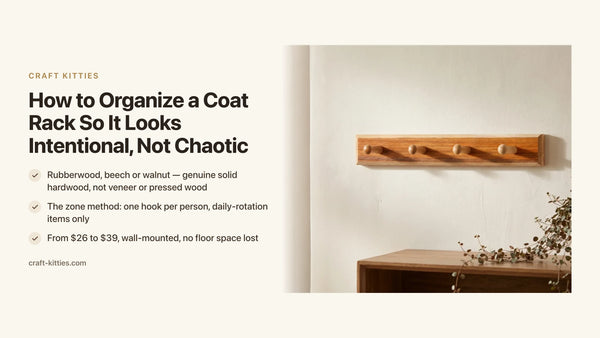
Most entryways in North American homes are painted a light neutral — white, greige, a pale warm gray. Against that background, a hook in chrome or matte black disappears into the wall hardware category. A hook in blond pine barely registers. A hook in solid walnut — deep chocolate-brown, fine tight grain — creates a deliberate contrast: one piece of material that reads as furniture rather than fixture. It is the same visual principle that makes a walnut picture frame on a white wall feel curated and a pine frame feel incidental.
Walnut is the species to reach for when the wall is light and you want the hook to be the design statement. Its grain is fine and directional, its color warm but not orange — the kind of brown that ages toward a slightly richer tone rather than bleaching out. Against white or pale gray, a single walnut hook at eye height reads like a deliberate choice.
Beech sits at the lighter end of the hardwood palette — creamy blond with a slightly more open grain, a quieter presence. It is the better choice against darker or earthier walls, in Scandinavian-influenced rooms where the wood color should recede rather than stand out, or in any space where you want the loaded coat to be the visual element rather than the hook beneath it. Beech is also the more practical choice for multi-hook rows where cost per hook matters and the visual intention is a clean line rather than a statement piece.
The two-tone row — beech body, walnut accents — resolves the choice for rooms where neither answer is obvious. The layered tones hold together because walnut and beech sit on the same warm undertone axis; they complement rather than contrast. The result is a pair of hooks that looks like it cost twice what it did, which is generally the right outcome for a front-door upgrade.
One clarification that every guide in this category should front-load, because almost every competitor avoids it: the difference between solid hardwood and wood-look or veneer is not cosmetic. In an entryway, hooks take repeated impact — coat buttons, bag buckles, umbrella tips. Particleboard or MDF with a printed wood film chips at the first season of that contact. Solid wood scratches; scratches on walnut can be buffed. The failure modes are categorically different.
Solid wood versus veneer: the distinction that decides the purchase
The wall hook market is saturated with products that photograph identically to solid wood and perform like particleboard. The reason is simple: a realistic wood-film print on MDF costs a fraction of a real hardwood blank, and in a product photo the difference is invisible. In daily use over two winters, it is not.
Solid hardwood means the hook is cut from a real piece of walnut, beech or red oak all the way through. When you look at the edge of the backplate, the grain continues — same direction, same species, same color. There is no substrate to delaminate. Dents compress the fiber rather than revealing a grey composite core. The surface can be re-oiled or lightly sanded.
Veneer on MDF means a 0.5 to 2mm wood-film layer over a pressed-wood core. The face looks fine. The edges reveal the core at any scuff. In an entryway, that scuff is coming — from a boot heel, a backpack buckle, the edge of a door. Once the veneer lifts at an edge, the piece degrades visibly and quickly. Moisture from winter gear accelerates the process.
All five models in this guide are solid hardwood. That is not a claim that requires verification on the product photo — it is the starting premise of everything that follows.
The five formats, and what each one solves

Choosing a wall hook is not only a material question — it is a spatial and functional one. A narrow apartment corridor asks for something different than a generous farmhouse mudroom. A household that loses keys weekly needs a different feature set than one that just wants a coat off the floor. The five formats below map directly to the five most common entryway situations.

Description
The boot-profile hook is the model you reach for when you want one object to do visible decorating work. The carved silhouette — a clean arc that evokes the line of a boot last — means the hook is interesting whether empty or loaded. Solid beech, natural finish, a weight and presence that matches what it hangs. It installs with two screws into the wall and holds a fully loaded winter coat without flexing.

Description
The magnetic hook is the answer to the entryway question that rarely gets asked directly: where do the keys actually go? The hook arm handles the coat; the magnet embedded in the face catches keys, a cable clip, a small bag clasp. Two problems solved by one object at one nail in the wall. In households where keys migrate to random surfaces every morning, this is the hook that changes the morning routine rather than just the décor.

Description
The carved swivel hook is built for the narrow hallway problem. When the arm folds flat, it takes up no more depth than a light switch cover — the wall reads clear. Opened, it holds a coat or bag with the same reliability as a fixed hook. The carving detail on the arm (a gentle organic curve, not a machine-pressed profile) means it is visually interesting whether open or closed. This is also the format that photographs best in a styled entryway because the sculptural element is always present.

Description
The basic swivel hook is the entry point to solid hardwood at $5.00 — the model to choose when the need is simple (one coat, one hook, one wall) and the budget is lean. Real hardwood all the way through, waxed finish, swivel arm. No design drama, no embedded hardware, no surface detail beyond the natural grain. The kind of hook that disappears when loaded and does its job for a decade.

Description
The two-tone row is where the entryway goes from functional to finished. Two full hooks on a shared backplate — room for two coats, two bags, two households sharing a front door. The pairing of light beech and darker walnut-tone creates a layered warmth that would cost significantly more in a furniture store. This is the model to choose when the goal is not a single hook but an entryway that reads as intentional from the doorway.
Comparison table
| Model | Price | Wood | Mechanism | Best for |
|---|---|---|---|---|
| Boot-Profile Hook | $12.00 | Solid beech | Fixed arm | Statement piece, single coat |
| Magnetic Hook | $6.90 | Solid beech | Fixed arm + magnet | Coat + keys in one spot |
| Carved Swivel Hook | $9.00 | Solid wood | Swivel arm, folds flat | Narrow corridor, design detail |
| Basic Swivel Hook | $5.00 | Solid hardwood | Swivel arm, folds flat | Entry price, functional minimum |
| Two-Tone 2-Hook Row | $26.00 | Beech + walnut | Fixed arms × 2 | Complete entryway solution |
Decision matrix — which model for which entryway
| Your situation | The right pick |
|---|---|
| Light walls, you want one piece to anchor the entryway visually | Boot-Profile Hook — $12.00 |
| Keys disappear every morning — you need coat and key storage in one | Magnetic Hook — $6.90 |
| Narrow hallway — projecting hooks are a collision hazard | Carved Swivel Hook — $9.00 |
| First upgrade, tight budget, just need one solid hook | Basic Swivel Hook — $5.00 |
| Full entryway treatment — two coats, two tones, one wall | Two-Tone 2-Hook Row — $26.00 |
| Housewarming gift — something used daily and noticed by every guest | Two-Tone Row or Boot-Profile Hook |
How to install a wood wall hook that will actually hold
The failure mode for most DIY hook installations is not the hook or the wall — it is the fix between them. A solid hardwood hook transferring the weight of a winter coat and a heavy bag creates lateral and downward force on the screw. The wall needs to take that load properly.
Step 1 — Find the stud or choose the right anchor. A screw driven straight into drywall with no anchor will pull out under load; it is not a matter of if but when. Use a stud finder and drive into the stud if your hook placement allows it. If no stud falls in a convenient position, use a togglebolt or a rated expansion anchor — anything marked for 40 lb or above per point is sufficient for a single coat hook. Avoid the small plastic anchors that come with picture frames.
Step 2 — Mark the height before drilling. The standard for an adult coat hook is 60 to 66 inches from the floor — high enough that a long coat clears the baseboard, low enough to reach without stretching. If you are mounting a row of multiple hooks, use a level line to mark all positions before drilling the first hole. Drilling one hole, holding the backplate to the wall, and marking the second position is faster and more accurate than measuring each hole independently.
Step 3 — Pre-drill a pilot hole. Particularly for the hardwood backplate, a pilot hole slightly narrower than your screw prevents the wood from splitting at the fixing point. For wall hooks that will take real load, a #8 or #10 screw with a length that reaches at least 1 inch into the stud (or fully engages the anchor) is the minimum.
Step 4 — Check level, then tighten. Hold the hook in position, confirm level, and tighten the screws snugly — not so hard that the wood compresses under the head. If the backplate has two fixing points, leave the first screw slightly loose until the second is in position, then tighten both.
Step 5 — Load test before you dress the wall. Hang a coat, tug it downward with some force. If the hook moves, the anchor has not engaged properly. Better to discover that before you arrange the entryway around it.
Three decisions that seem minor and are not
Where on the wall, not just how high. The height is the decision most guides address. The position on the horizontal axis matters at least as much. A hook mounted directly beside the door — within the arc of the door's swing — gets hit every time the door opens and eventually either dents or gets torn loose. Mount it past the door's natural stopping point: 6 to 8 inches beyond the fully open door is the minimum safe clearance.
Single hook or row. A row of identical hooks creates a coat rack; a single distinctive hook creates a moment. Both are valid, but they produce different walls. If the goal is a clean line (mudroom, family entryway with multiple coats), the row is the answer. If the goal is a decorative anchor in a hallway that otherwise lacks one, a single boot-profile or carved-swivel hook placed at eye height does more decorative work than a row of five identical pegs.
Finish compatibility with the room. A walnut hook is warm and rich — it reads well next to warm metal (brass, unlacquered bronze) and against light walls. Against a room already heavy with dark tones, it can disappear rather than stand out. Beech reads cooler and suits rooms with more gray in the palette. The two-tone row is the safest choice when the room's temperature is ambiguous, because it carries both.
Mistakes that shorten the life of a good hook
Mounting into drywall without an anchor. This is the single most common failure, and it is entirely preventable. A bare screw in drywall holds about 10 lb in shear; a loaded winter coat plus a heavy bag can exceed that easily. Use a rated anchor or find the stud.
Mounting too close to the door frame. A hook mounted in the swing arc of the door will take repeated low-speed impacts every day. At solid hardwood, the hook will survive; the wall finish behind it may not, and the screw gradually backs out under cyclical loading.
Choosing the hook color from the photo rather than the wall. Walnut looks different on a white studio background than on a cream wall or a gray-painted plaster surface. Before ordering, look at the actual wall and consider contrast: the hook that disappears against a warm beige may be exactly the right choice for a pale gray entryway.
Mixing materials with no visual thread. A walnut hook next to a chrome umbrella stand and a painted-metal console table reads as accidental. If the entryway already has a material language (black metal, brass, natural fiber), let the hook join it rather than contest it. Browse our wall hooks collection — the models are organized so neighboring pieces answer each other.
FAQ — walnut wall hooks
1 — What is the difference between walnut and beech for wall hooks? Walnut is deep chocolate-brown with a tight, fine grain — the darker tone works as a statement against light walls and reads like furniture rather than hardware. Beech is a lighter, warmer blond with a more open grain, quieter and more versatile in Scandi or farmhouse spaces. Both are real solid hardwoods; the choice is visual. Walnut commands a slightly higher price; beech suits larger rows where cost per hook matters.
2 — Are these hooks strong enough for heavy winter coats? Yes. Each hook is cut from solid hardwood designed for real entryway use — coats, bags, scarves, umbrellas. The key variable is the wall fixing, not the hook: use the appropriate anchor for your wall type and the hook holds without complaint. Swivel models add a folding arm that sits flat against the wall when empty.
3 — What does solid wood actually mean compared to veneer or wood-look? Solid wood is cut from a real hardwood blank all the way through — grain continues on every face, edge and cut. Veneer is a 0.5 to 2mm wood film on a pressed-wood core. In an entryway, that distinction becomes visible within months: veneer chips at coat-button contact, swells with moisture from wet gear, and delaminated edges cannot be repaired. Solid wood scratches; scratches on hardwood are buffable. The failure modes are categorically different.
4 — How high should wall hooks be mounted? The standard for adult coats is 60 to 66 inches from the floor — long coats clear the baseboard, the arm is within comfortable reach. For a family row, a second tier at 42 to 48 inches adds child-accessible hooks without cluttering the upper line. Mark all positions with a level line before drilling the first hole.
5 — What is the swivel mechanism and when does it matter? A swivel hook has an arm carved in one piece that rotates flat against the backplate when not in use. In narrow corridors where a projecting arm is a collision hazard, this is not a feature — it is the reason to choose the model. Folded flat, it adds no more depth than a light switch cover. Open, it holds a coat as reliably as any fixed arm.
6 — How do I mount a wood wall hook without damaging the wall? For drywall without a stud: togglebolt or expansion anchor rated above the expected load. For masonry: masonry bit and appropriate plug. Pre-drill a pilot hole slightly narrower than the screw to avoid splitting the backplate at the fixing point. For renters: adhesive-strip hooks work for keys and very light items; coat loads require screw fixing into a stud or rated anchor.
7 — Does the two-tone beech and walnut row look cohesive in person? Yes. Beech and walnut sit on the same warm undertone axis — they complement rather than contrast. The light body and darker arm create a layered warmth that would cost considerably more from a furniture maker. Against a light wall, the walnut tone grounds the row without making the wall feel heavy.
8 — Can these hooks go near a front door that gets wet in winter? Yes. The hooks are finished with a protective wax or oil coat that resists brief contact with moisture — wet coats, damp gloves, a dripping umbrella. The finish is not designed for prolonged standing water. Wipe the hook dry if it catches a drip. Standard entryway humidity — snow-dampened gear, a wet umbrella — causes no lasting damage to properly finished solid hardwood.
Where to go next
A single hook changes a wall; a considered entryway changes how a home reads from the moment you open the door. Browse the full wall hooks collection to see the complete range of formats and species. If the Beech Wood Boot-Profile Hook is the statement piece you're after, it ships ready to mount with two fixings. If two coats and a set of keys need a single address on the wall, the Two-Tone Beech & Walnut Row does that cleanly at $26.00. Our customers on Etsy (243 reviews) consistently note the weight and finish of the solid wood as the quality they weren't expecting at the price — which is the right order of surprises for an entryway upgrade.
Conclusion — one wall, one decision, a finished entryway
The method that applies here is the same one that works in any room where a single object does outsized decorative work: choose by contrast, not by match. A dark walnut grain against a light wall becomes a feature; the same hook on a dark wall becomes a detail. Pick the species that creates contrast with your surface, choose the mechanism that fits the corridor (swivel for narrow, fixed for generous), and mount it properly into a stud or rated anchor. The boot-profile hook at $12.00 is the statement piece for a single coat; the two-tone row at $26.00 is the full treatment. Both are solid hardwood, both install in under ten minutes, and both produce an entryway wall that looks intentional rather than inherited.