At a glance
- Warm minimalism = real materials + restrained palette + negative space
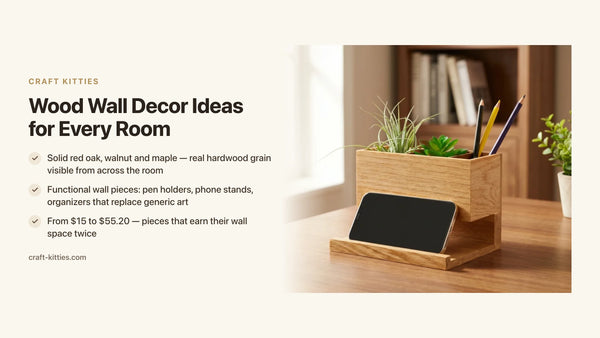
- Solid red oak, walnut, maple or beech for every wood accent
- Three objects per surface maximum; remove the rest
- From $29.99 for a genuine hardwood valet tray
Most attempts at minimalist decorating get stuck at the same point: the room empties out and turns cold. The sofa reads lonely, the coffee table feels abandoned, and a style that looked effortless in a magazine starts to feel more like a waiting room than a home. The missing variable is almost always warmth — not more things, but the right kind of material.
Warm minimalism resolves that tension. It is not a softer version of industrial minimalism, and it is not maximalism with better editing. It is a specific approach: fewer objects, chosen for genuine material quality, in a palette that stays within the warm half of the spectrum. Real wood, natural fiber, warm-toned stone and ceramic are the vocabulary. Restraint is the grammar. The result is a room that feels quiet without feeling empty — the particular kind of calm that comes when everything present belongs.
This guide walks through each decision point: palette, material hierarchy, furniture proportion, the object edit, lighting, and the role of one piece of solid wood in tying the whole room together. It ends with a comparison of the hardwood trays and organizers from our studio — designed specifically for the surfaces a warm minimalist living room produces.
The palette: warm neutrals, not cold gray

The first decision in a warm minimalist room is also the one that carries the most consequence: the base palette. Get this wrong and every subsequent choice fights against it; get it right and the rest of the room almost assembles itself.
The reliable warm minimalist palette has three layers. The base is the largest surface area — walls, large upholstered pieces, rugs — and it stays within a narrow range of warm neutrals: warm white (not stark white, which reads blue under most residential lighting), undyed linen, sand, and greige. These tones are close to each other in temperature and value, which is why they work together without the room feeling busy. The visual weight comes from texture differences between them, not from color contrast.
The material accent is where wood enters. Walnut brings deep brown tones with fine grain; red oak, lighter honey with bold grain; maple and beech, pale and clean. Any of these sits naturally against the warm neutrals without competing. This is the layer that makes a room feel finished rather than staged — real wood grain adds depth that painted or printed surfaces cannot replicate.
The punctuation accent — a soft terracotta cushion, a matte ceramic vase, a linen throw in warm oat — completes the palette with a note of color that is still within the warm family. One or two of these are enough. The moment a cool-toned blue or high-contrast black enters the room, the warm reading breaks. The test is simple: hold a gray paint chip against your wall and your wood. If it looks foreign, it is.
Furniture: proportion before piece count
The furniture edit in a warm minimalist living room is less about quantity than proportion. A single oversized sofa that overwhelms the room does more visual damage than two right-sized pieces; a coffee table that sits too low relative to the sofa creates distance between the seating area and the objects resting on it, which makes the room read as two unrelated zones rather than one composed space.
The guidelines that hold across room sizes are few and practical. Leave breathing room between the sofa and the coffee table — roughly 14 to 18 inches — enough to pass comfortably and enough for the eye to read negative space between pieces. Negative space in a minimalist room is not empty; it is part of the composition. A gap between the sofa and a side table is not a problem to solve by filling it.
Choose low-profile furniture in warm materials. Exposed solid wood legs, linen or bouclé upholstery, and matte ceramic or stone surfaces all belong in this register. Chrome, high-gloss lacquer, and overly structured silhouettes work against it. The furniture should look like it grew into its place over time — not like it arrived yesterday.
Scale the rug to the seating group, not to the room. A common mistake is choosing a rug that stops before the front legs of the sofa. In a warm minimalist room the rug is the ground plane that defines the seating area; it should extend at least under the front legs of every main seating piece to read as intentional rather than incidental.
The material hierarchy: why wood is first
In any warm minimalist interior, material decisions follow an order of priority. The materials with the most surface presence — walls, floor, upholstery — set the base. Everything else references them. The material that connects the base to the accent layer, in most well-executed warm minimalist rooms, is solid wood.
The reason wood holds this position is that it satisfies the two criteria warm minimalism demands simultaneously. It supplies warmth — through grain, through the variation of tone that no two pieces share, through the way it reads differently under different light throughout the day. And it supplies restraint — a single walnut shelf, a hardwood tray, a low console in red oak occupies a defined area and does not compete with everything else in the room.
The distinction between solid wood and wood-look alternatives matters here more than in any other context. A Japandi-inspired interior built around veneered MDF, printed laminate, or wood-look tile reads as approximation rather than intention. The entire premise of warm minimalism is that the materials are genuine — aged, irregular, alive. When the wood surfaces are real, the whole palette becomes more coherent, because every material reads as honest and the room stops having to work to convince.
The object edit: surface by surface

Every flat surface in a living room — coffee table, console, windowsill, side table — is a decision point. In a warm minimalist room each of these surfaces is either composed or left deliberately empty. There is no intermediate state of "I'll deal with it later." An unconsidered surface is the thing that makes a room feel unfinished even when the furniture and palette are right.
The object edit follows three tests. The rule of three: group objects in odd numbers, maximum three per surface. Two objects feel paired; four feel like accumulation; three feel deliberately chosen. The material test: in a warm minimalist palette, only materials that add genuine warmth belong — solid wood, unglazed or matte ceramic, natural stone, linen, cotton. Plastic, acrylic, reflective metal and high-gloss lacquer are the materials to remove first. The function test: does the object have a daily function? If so, it earns its place regardless of appearance. A solid wood tray that corrals keys, wallet and phone at the end of the day is both functional and beautiful; it makes the surface more orderly, not less.
The coffee table is the room's most legible surface — it is what people see first and what photographs communicate immediately. Apply the rule of three: a small stack of books, one ceramic object (a low bowl or a candleholder), and one piece with function (a hardwood tray that catches the remote and a coaster set). Remove the candle that never gets lit, the decorative box that holds nothing, and the coasters that have been sitting in the same diagonal since the day they arrived.
The console or credenza behind the sofa follows the same logic. One or two objects, in warm-toned materials, with enough negative space between them that each one reads individually. A walnut organizer with a low profile, a ceramic vase, a small ceramic lamp — that is enough. The goal is a surface that looks composed because it is composed, not one that looks sparse because it ran out of ideas.
Lighting: three layers, no overhead-only
Lighting is the variable that determines whether a warm minimalist room reads as calm or flat. A single overhead fixture on a flat ceiling produces even, directionless light that erases the shadows that give depth to wood grain, textile texture and the negative spaces between objects. The room becomes a photograph taken in direct sun — technically exposed, visually dull.
Warm minimalist rooms layer lighting across three categories. Ambient — the base level, which in a warm minimalist interior is usually kept lower than in a conventional room, warm-toned bulbs (2700K maximum), and diffused through a pendant or a floor lamp rather than a central ceiling fixture. Task — a reading lamp or a table lamp that creates a pool of light at a specific functional point, like beside a chair or at a desk. Accent — the subtlest layer: a candle on the coffee table tray, a small uplighter behind a plant, a lamp that catches the grain of a wooden shelf. Together these three layers produce the quality of light that makes a warm minimalist room feel inhabited.
The bulb choice matters more than the fixture choice. A beautiful fixture with a cool 4000K bulb in a warm minimalist room makes all the wood tones read greenish and the warm neutrals look gray. Get the Kelvin temperature right first — 2200K to 2700K for most warm minimalist interiors — then choose the fixture.
Five solid wood pieces that anchor a warm minimalist living room
The five pieces below are from our studio's valet tray collection. Each is cut from genuine hardwood — red oak, walnut, maple or beech — and finished with a protective natural oil coat. They serve the surfaces a warm minimalist living room produces: the entryway table, the coffee table, the home office corner, the bedside in an open-plan space. No veneers, no wood-look prints.

Description
The Hardwood Valet Tray & Key Rack is the piece designed for the console or narrow table at the entrance to a living space. It combines a flat tray section — the right size for phone, wallet, and keys — with a row of hooks for keys or small bags. Solid hardwood, natural oil finish. The key rack portion keeps daily carry off the surface of the tray itself, which means the tray remains visually clean. At $29.99, it is the entry point to the line.

Description
The Hardwood Valet Tray Desk Organizer takes the same principle — a defined zone for the objects that accumulate on surfaces — and scales it up for a working surface. Available in maple, beech or walnut, it sits with enough depth to organize remotes, a phone, a notepad and a pen without overcrowding. The difference between maple and walnut here is a palette decision: maple stays light and Scandi-clean; walnut adds depth and grounds the room in brown tones. At $47.20, it is the workhorse of the collection.

Description
The Solid Wood Valet Tray Desk Organizer is the premium version of the same form: heavier mill, a more pronounced rim height that keeps objects contained even during regular use, and the same choice of maple, beech or walnut. The extra weight and the elevated rim are what make this piece read as furniture rather than as an accessory. It belongs on a coffee table in a room that takes the curation seriously — not a conversation piece, but the kind of object that makes a room feel more considered from across it. $55.20.
Description
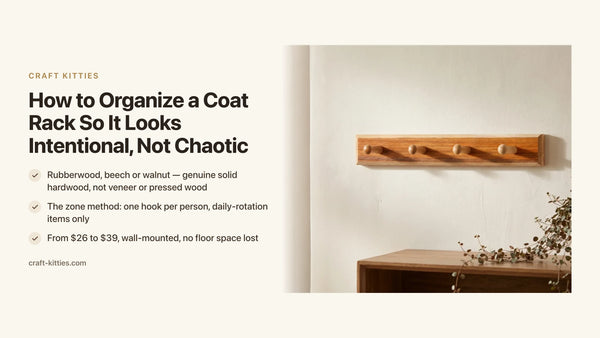
The Hardwood Valet Tray & Key Rack is also the piece that anchors a wider entryway system. In a warm minimalist open-plan living room, the entryway is not a separate zone — it is the first surface visible from the living room. Pairing the tray with a hook rack above creates a defined station where daily carry lands and stays, rather than migrating to the coffee table or the sofa arm. The Hardwood Valet Tray & Key Rack at $29.99 is the base of that system.
Description
The Hardwood Valet Tray in maple is the piece for rooms that need to stay light. Against a dark walnut floor or a dark-stained media console, a maple tray reads as a deliberate contrast — a pale, clean shape that lifts the surface it sits on. Beech occupies the middle ground: warmer than maple, lighter than walnut, with a fine grain that stays quiet. Available from $47.20 in the Hardwood Valet Tray Desk Organizer.
Comparison: which hardwood tray for which surface
| Model | Price | Wood options | Key feature | Best surface |
|---|---|---|---|---|
| Valet Tray & Key Rack | $29.99 | Solid hardwood | Integrated key hooks | Entryway console, hallway table |
| Hardwood Valet Tray Desk Organizer | $47.20 | Maple, Beech, Walnut | Generous tray depth | Coffee table, working console |
| Solid Wood Valet Tray Desk Organizer | $55.20 | Maple, Beech, Walnut | Elevated rim, heavier build | Primary coffee table piece |
Decision matrix — which tray for which room profile
| Your situation | The right pick |
|---|---|
| Open-plan space, entryway bleeds into living room | Valet Tray & Key Rack — defines the entry zone, keeps carry off the living room surfaces |
| Light Scandi palette, pale floors or pale wood furniture | Hardwood Valet Tray in maple or beech — stays within the light palette |
| Japandi room, dark walnut or mid-tone floors | Hardwood Valet Tray in walnut — reads as intentional extension of the floor material |
| Coffee table is the centerpiece, high-traffic object staging | Solid Wood Valet Tray Desk Organizer — heavier build, elevated rim holds objects through daily use |
| First solid wood piece, testing the style direction | Valet Tray & Key Rack at $29.99 — lowest commitment, highest visual impact per dollar at the entry |
Common mistakes in warm minimalist living rooms
The same errors appear consistently across rooms that set out to be warm minimalist and end up reading as either cold or cluttered. Recognizing them in advance costs nothing.
Using warm colors instead of warm materials. Painting the walls terracotta and filling the room with orange cushions is not warm minimalism — it is color saturation. Warmth in this aesthetic comes from material genuineness first: solid wood, unglazed ceramic, natural linen. Color follows from material, not the other way around.
Mixing too many wood tones. A walnut coffee table, a pine shelf, a light oak media unit and a dark stained side table in the same room fight each other — every piece asks to be looked at separately rather than together. The discipline is to anchor the room in one or two wood tones that are within a step of each other on the warm spectrum, then stay there.
Leaving surfaces "to be styled later." An empty console, a bare windowsill, a coffee table with only a remote on it — these read as unfinished, not as minimalist. Minimalism is composed negative space, not absence. An empty surface in a warm minimalist room should be empty on purpose, which means nothing else belongs on it. If a surface looks abandoned rather than cleared, add one object in the right material.
Buying placeholder furniture. Warm minimalism accumulates well when each object is a genuine choice. Buying a wood-look side table because it is close enough, or an almost-right rug because the right one takes longer to find — these create the compound interest problem: a room full of approximations that each look individually fine and collectively feel off. The material honesty of the style does not forgive proxies.
Over-lighting with warm bulbs alone. Dimming an overhead fixture to 30% produces one quality of warmth; layering a table lamp, a candle on the tray and a floor lamp behind the sofa produces another entirely. The first flattens; the second creates depth. Warm minimalism benefits from directional pools of light as much as from warm Kelvin temperature.
How to edit the room you have
Most warm minimalist living rooms are made from existing rooms, not built from scratch. The sequence that works consistently is to edit before acquiring.
Start by removing everything that fails the material test — anything plastic, high-gloss lacquer or printed wood-look. These objects are the ones most likely to break the palette's honesty. Put them elsewhere in the home or remove them entirely. At this point the room will likely look under-furnished, which is exactly right.
Next, assess the surface situation. Identify the two or three surfaces that are most visible from the main seating position — usually the coffee table, a console, and one side table. Apply the rule of three to each: at most three objects, in warm materials, at least one with daily function. Remove the rest.
Finally, identify the material gap. In most rooms this is wood: a room can have the right palette and the right edit but still feel cold because all the materials present are soft (upholstery, textiles) with no structural warm-toned solid. One piece of real hardwood — a tray, a shelf, a small console leg that shows grain — changes that. It is the least expensive correction with the most consistent result.
FAQ — warm minimalist living room ideas
1 — What makes a minimalist living room feel warm instead of cold? Warmth in a minimalist room comes from material honesty: real wood with visible grain, natural fiber textiles, and warm-toned neutrals rather than stark white and gray. Negative space is part of the palette, not an absence. When every object earns its place and the materials are genuine, the room reads calm and inviting rather than clinical.
2 — What colors work best for a warm minimalist living room? Warm whites, undyed linen, sand, soft terracotta accents, and the natural tones of hardwood — red oak, walnut, maple and beech — form the palette. The rule is to keep the wall and large-surface neutrals within two steps of each other on the warm side of the spectrum, then let natural wood tones supply the contrast.
3 — How many decorative objects is too many? The reliable test is the rule of three: group objects in odd numbers, never more than three per surface. If removing one object would not be noticed, it should come out. Each piece should either add material warmth or serve a daily function — ideally both.
4 — Is Japandi the same as warm minimalism? Japandi is one specific specialementsion of warm minimalism — it fuses Japanese wabi-sabi with Scandinavian hygge. Warm minimalism is the broader category, which includes Japandi, Scandi modern, and the current quiet luxury aesthetic. What they share is a preference for natural materials, restraint in color, and comfort without clutter.
5 — What type of wood suits a warm minimalist living room best? Walnut is the most sought-after because its deep brown tone and fine grain add visual weight without visual noise. Red oak brings lighter honey tones and bolder grain. Maple and beech are pale and clean, ideal for a Scandi-leaning palette. All four are genuine hardwoods that age and develop a patina with use.
6 — How do you add warmth without making the room feel cluttered? Concentrate warmth in material quality rather than object quantity. One solid walnut tray on the coffee table adds more warmth than five mixed-material decorative items. Layer textures — a linen throw, a ceramic bowl, a wood-grain surface — within a tight neutral palette. Warmth and clutter are opposites: clutter is many things competing; warmth is a few things agreeing.
7 — Can a small living room be warm and minimalist at the same time? Small rooms benefit most from warm minimalism. Fewer objects mean more visible floor and wall, which makes the space read larger. Warm neutrals on the walls prevent the closed-in feeling. Two or three solid wood pieces anchor the room without crowding it.
8 — What is the difference between a valet tray and a catchall tray? In practice they are used interchangeably. Valet tray traditionally refers to staging daily carry — wallet, keys, phone, watch — usually on a console or dresser. Catchall emphasizes the containing function on any surface. The shape and material are identical; the distinction is in how the tray is styled and where it sits.
9 — Does a warm minimalist room need to be expensive to look right? No — the approach is selective, not expensive. One genuine piece at a focal point does more than a room full of approximations. The first investment that consistently returns the most visual improvement is a piece of real solid wood at the most-viewed surface.
10 — How do I keep a warm minimalist room from looking staged? Style for daily function, not for photographs. A tray that catches your actual keys, a lamp you actually read by, a ceramic bowl you actually use — these prevent the room from reading as a set. Warm minimalism looks lived-in by design, because every object that remains has a reason to be there.
Where to go from here
The valet tray collection gathers the solid wood pieces designed for the surfaces this guide covers — entryway consoles, coffee tables, home office corners — all in genuine red oak, walnut, maple and beech with a natural oil finish. The Hardwood Valet Tray & Key Rack at $29.99 is the entry point for those beginning the edit. The Solid Wood Valet Tray Desk Organizer at $55.20 is the premium anchor for a coffee table that the whole room reads from.
If you find us on Etsy first — we have over 243 reviews from customers who made the same shift toward genuine material in everyday objects — you will find the same pieces in the same hardwoods, shipped with the same care.
One rule, consistently applied
The logic of warm minimalism is not complicated. Fewer objects, each one genuine, in a palette that stays warm. Every decision point in a living room — the furniture, the surface edit, the lighting, the single piece of solid wood that ties the neutrals together — follows from that one rule applied consistently. The room does not need to be redecorated from scratch. Most of the work is subtractive: removing what fails the material test, then adding one object that passes it. The result is a room that feels finished because it was chosen deliberately, not because it was filled completely.