At a glance
- Solid beech, walnut or red oak — real hardwood, not veneer
- Black metal for contrast, brass for warmth — the finish decides the style
- Match the metal across pieces; let the wood carry the variation
The living room shelf wall is one of those projects that looks easy in theory and becomes complicated in the hardware store. Wood and metal is a combination that photographs beautifully — you have seen the results in every shelter magazine — but in person, the wrong pairing reads as accidental rather than designed. A honey-toned pine board with chrome pipe brackets is not the same visual statement as a walnut slab with matte black iron angles, even if both tick the "wood and metal shelf" box on a search result page.
This guide is about making that combination work deliberately. It covers the material logic (which wood species with which metal finish, and why), the style archetypes that use wood-and-metal most fluently, how to proportion and arrange shelves once they are on the wall, and the common mistakes that undermine the pairing in otherwise well-decorated rooms. It also introduces a category of object that belongs on these shelves more often than people consider: a wood-and-metal ring holder, which brings the same material logic — solid hardwood, warm or cool metal base — down to a desktop or shelf scale, and solves a daily organizational problem at the same time.
One prerequisite: this guide discusses solid wood. The word "wood" on a shelf tag can mean anything from solid black walnut to MDF with a printed wood-grain laminate. The two behave completely differently in use and age differently over years. For everything that follows, when we say wood, we mean the real thing — a board cut from a tree.
What makes wood and metal work as a pairing

Every well-received interior pairing exploits the same underlying principle: contrast with a common thread. Wood and metal work because they oppose each other on almost every dimension — organic versus manufactured, warm versus cool, matte versus reflective — yet both carry a sense of permanence and craft that cheap materials do not. That shared seriousness is the thread that makes the contrast legible rather than jarring.
The proportional logic follows from this. Wood carries the bulk of the visual warmth. A wide, solid beech or walnut shelf registers first as a surface — your eye reads its grain, its color temperature, its horizontal mass. The metal element (bracket, edge, base, detail) reads second, as a frame or a contrast signal. Inverting this ratio — a thin wood plank heavily dominated by ornate or overscaled metal brackets — tips the reading from "wood and metal" to "metal with a wood accent," which is a different, less stable combination.
The species choice matters because each wood has a different color temperature. Beech (Fagus sylvatica) is light, almost cream-toned with a very fine, uniform grain — it reads as neutral and suits cooler rooms and lighter walls. Red oak (Quercus rubra) is warmer and honey-toned, with a bolder, more pronounced grain that reads from across the room — it suits rooms with earthier palettes. Walnut (Juglans nigra, black walnut) sits at the opposite end: deep chocolate-brown, fine grain, the warmest and most formally elegant of the three. Each of these is a solid hardwood that holds screws cleanly, accepts a wax or oil finish that protects without obscuring the grain, and ages over years rather than months.
The three style archetypes — and the metal finish each one requires
There is no universal "right" metal for wood shelves. The right finish depends on which design direction the room is moving in, because wood-and-metal is a vocabulary, not a single look.
Industrial. The original archetype: reclaimed or minimally finished wood, pipe or angle-iron brackets, visible hex bolts, a raw-materials-as-design-element ethos. The metal finish here is typically raw iron, blackened steel, or matte black powder coat. The wood is often lighter than it is wide — a narrow plank, not a thick slab — and the objects on it lean functional: books, a plant, a speaker. This combination works best in rooms with exposed brick, concrete, or dark-painted walls. Its weakness in a conventional living room is that it reads very heavy if overscaled; restraint with both the bracket gauge and the object count matters.
Japandi and Scandi-modern. The dominant direction in living room design since roughly 2020: clean-lined metal brackets (thin square rod or hairpin), smooth finished hardwood in lighter tones (beech, white oak, light maple), very spare object count per shelf. The metal finish is typically matte black for contrast or brushed nickel for a cooler neutral. The combination reads as assembled rather than installed — it has a quietness that industrial shelving does not. The objects on it are chosen, not accumulated: a ceramic, a book, a small plant, two or three pieces.
Warm transitional. The largest category in American living rooms: rooms that are neither farmhouse-rustic nor strictly minimal, that mix a sofa with wood legs with a metal-base coffee table without committing to either archetype. Here, the metal finish that makes wood-and-metal shelves feel natural is brushed brass or warm bronze — it shares the warm undertone of walnut and red oak, and it signals "home object" rather than "industrial object." This is the pairing where a solid walnut shelf with brass-detail brackets becomes a piece the room grows around rather than a statement imported from a different aesthetic entirely.
Choosing the wood species by metal finish

The pairing logic resolves to a simple matrix. Beech with matte black is the most versatile combination for lighter rooms — the contrast between the cream wood and the dark metal is sharp enough to read clearly on a white or pale grey wall without overwhelming the space. Red oak with brushed brass or warm gold shares the same color temperature (both sit in the orange-to-honey range) and creates a tonal coherence that registers as comfortable rather than designed. Walnut with matte black is the highest-contrast, most formally modern combination — the deep brown wood and flat black metal have a Japandi restraint that commands a wall without decoration. Walnut with aged bronze or brass is warmer and more interior-magazine-traditional — the two warm tones build on each other and the combination reads as collected over time.
The most reliable error to avoid: mixing a warm wood with a cool metal finish. Walnut next to brushed chrome pulls the brown toward a grayish reading. Red oak next to polished nickel does the same. If the room has chrome fixtures already, run beech rather than walnut on the shelves, or repaint the wall so the cool metal becomes the accent.
Proportioning shelves in a living room
The proportioning questions no product page answers but that decide whether a shelf wall looks composed or improvised:
How many shelves. The classic mistake is installing one shelf at eye level and stopping. A single shelf is a ledge; it reads as utilitarian. Two shelves at staggered widths create a visual rhythm. Three shelves, if proportioned carefully (widest at the base, shorter toward the eye, one narrow accent above), read as furniture. The number that starts to look deliberate is at least two.
Shelf width versus wall width. A shelf that runs the full width of the wall reads as built-in. A shelf that is exactly half the wall width reads as centered and symmetrical, which works for a single statement piece. A shelf slightly off-center (not aligned with the sofa or the TV) creates asymmetry that reads as designed. The mistake is the shelf that looks as though it was placed where a stud happened to fall.
The relationship to furniture below. A shelf cluster positioned so that its bottom edge aligns with or slightly above the top of the sofa creates visual continuity — the furniture and the wall feel like they belong to the same composition. A shelf cluster that floats in the middle of a wall with nothing below or alongside it looks stranded.
Bracket visibility. Visible brackets are a design statement — they signal the industrial or Japandi vocabulary. Floating shelves (with internal or hidden brackets) read cleaner and work better in transitional or minimalist rooms. If the bracket is visible, it needs to be intentional: the finish selected, the gauge right for the wood depth, the spacing consistent.

Description
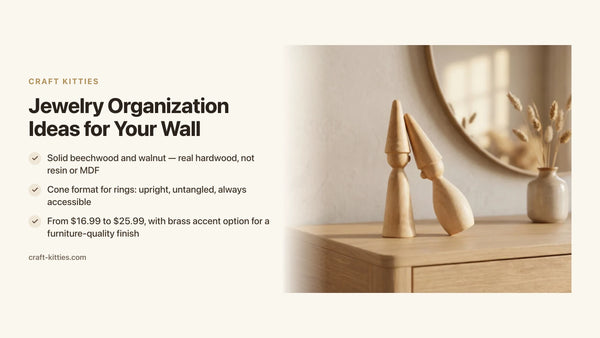
A pair of solid beech cones is one of those shelf objects that works twice: it is useful (rings in one place, always) and it is decorative in the way that small handmade wood objects are decorative — not ostentatious, not anonymous. The fine, even grain of beech reads as calm next to ceramic or metal objects, and the set format gives the two cones a relationship that a single cone does not have. At $16.99, it is the entry point to the studio's solid-wood ring storage line.

Description
This is the same material story as a walnut-and-brass shelf wall, resolved at the scale of a single object. Black walnut — fine grain, deep brown, the richest of the three species in the studio's line — set into a solid brass base that shares its warm color temperature. The result is an object that belongs on a walnut shelf with brass bracket accents, anchoring a grouping of ceramics or small plants. It is also, practically, the piece you stop searching for in the morning.

Description
A matching pair in solid walnut, without the brass base — cleaner, more Japandi in effect. Two objects of the same material and form, placed with deliberate spacing, create the kind of small composition that makes a shelf corner look resolved rather than filled. The fine grain of black walnut reads well in both high and low ambient light, which matters for a shelf that sits away from the main window.
Comparison — ring holder objects for a wood-and-metal shelf
| Product | Price | Wood species | Metal element | Best shelf pairing |
|---|---|---|---|---|
| Beechwood Cone Set | $16.99 | Solid beech | — | Beech or oak shelves, black metal brackets |
| Walnut + Brass Base | $25.99 | Solid walnut (Juglans nigra) | Solid brass | Walnut shelves, brass or bronze brackets |
| Walnut Cone Set of 2 | $18.99 | Solid walnut (Juglans nigra) | — | Dark wood shelves, Japandi or minimal rooms |
Decision matrix — which combination for which room
| Your room situation | The right combination |
|---|---|
| Light walls, cool Scandi or minimal palette | Beech shelf + matte black bracket + beech cone set |
| Warm transitional room, wood furniture already present | Red oak or walnut shelf + brushed brass bracket + walnut + brass holder |
| Japandi or minimal dark-wood aesthetic | Walnut shelf + matte black bracket + walnut cone pair |
| Industrial room, exposed materials, dark walls | Red oak or reclaimed wood + raw iron or blackened steel bracket |
| Couples sharing a shelf or nightstand | Walnut cone set of 2 — one per person, same material |
| Gift for someone who already has a wood-and-metal shelf | Walnut + brass ring holder — matches warm-metal and dark-wood rooms |
Styling a shelf grouping — the rules that hold
The object question is where most shelf projects stall. The wall is prepared, the brackets are in, the wood is level — and then the shelf sits empty for three months because no one is sure what to put on it.
The rules that consistently work:
Odd numbers. Three objects read as a grouping; two read as a pair; four read as a row. On a shelf, aim for groups of three or five, never four or six. The asymmetry of an odd number creates a visual tension that the eye finds interesting.
Height variation. A tall object, a medium object, a low or flat object. The triangle they form (tall at one end, medium in the middle, low at the other, or tall in the center with low flanking) is the underlying geometry of most shelf styling that photographs well. It prevents the flat horizon line that makes a shelf look like a windowsill.
Material contrast within the grouping. If the shelf is walnut, put a ceramic or a glass object on it, not another wood object. The contrast between the shelf material and the objects on it reads as more intentional than tonal harmony. A matte ceramic next to the fine grain of walnut, next to the small reflective surface of a brass ring holder — that three-part contrast is a coherent composition.
Negative space. This is the hardest rule to follow because it feels like waste. Leave thirty percent of the shelf empty. The empty space is not a gap to fill — it is the frame that makes the objects visible as objects rather than as inventory.
Description
The beech cone set is the low element in the triangle: it sits at shelf level, its natural cream tone contrasts with both darker ceramics and with the shelf surface if it is walnut or oak. The set format — two identical cones placed with spacing — creates a small internal rhythm that anchors the grouping without demanding attention.
Description
The brass base serves a double function on a dark-wood shelf: it introduces a point of metallic reflection in a surface that might otherwise read as uniformly matte, and it mirrors the bracket or hardware finish if the room runs warm-metal. It is the object that bridges the shelf itself and the objects grouped on it.
Mistakes that undermine wood-and-metal shelves
Mismatching the metal finishes across the room. A matte black shelf bracket next to a chrome light fixture next to a brushed gold picture frame is not eclectic — it reads as indecisive. Pick one metal family per room (warm: brass, bronze, gold; cool: chrome, nickel, gunmetal; neutral: matte black) and run it across the hardware. The wood can vary; the metal should not.
Choosing the wood from a product photo. A walnut shelf on a white background looks one color; on your particular paint color in your particular light, it looks different. The reliable approach: bring a sample board home before committing. The second-best approach: contrast always works. If the wall is light, go dark (walnut). If the wall is dark or warm, go lighter (beech or red oak).
Overloading the shelf. Every object added beyond the grouping of three or five reduces the impact of the objects already there. The rule that consistently separates composed shelves from cluttered ones: when you are certain there is room for one more thing, do not add it.
Ignoring the bracket as a design element. The bracket is visible; it is part of the combination. A cheap stamped-steel bracket on a beautiful walnut slab is the shelf equivalent of a paper label left on a glass jar. The bracket finish and gauge need to match the intention.
Using engineered wood where solid is specified. MDF, particleboard and veneered panels compress at the bracket hole over time, especially under static load. Solid hardwood does not. For shelves that carry books or hold objects permanently, the cost difference between solid beech and an MDF equivalent pays for itself in the second year.
Where solid hardwood pieces belong in a living room shelf arrangement
The living room shelf is the room's most visible storage — visible to guests, to the camera at family events, to you every morning before the day has organized itself. It earns considered objects.
The pieces from our ring holder collection are designed with the same material logic as the shelves this guide describes: solid hardwood (beech, walnut, red oak), finished to be touched rather than just seen, with metal elements chosen for material coherence rather than decoration. A Beechwood Ring Holder Cone Set is not a shelf accessory in the way a novelty trinket is; it is a small hardwood object that happens to hold rings, made from the same species logic as the shelf it sits on.
The Walnut Wood Ring Holder with Solid Brass Base is the piece most suited to a shelf styled around warm-metal and dark-wood pairings: the black walnut and solid brass repeat the combination at a scale you can pick up, and place it back in the same spot every day.
FAQ — wood and metal shelves for living room
1 — What metal finish works best with walnut wood shelves? Brass and aged bronze are the natural partners — they share the same warm undertone. Matte black creates a higher-contrast pairing that reads more industrial or Japandi. Avoid cold chrome with walnut, which pulls the wood's brown toward gray.
2 — What metal finish goes with lighter wood like beech? Matte black is the most reliable answer — the contrast is sharp and legible without competing with the wood. Brushed nickel also works in cooler, more Scandinavian rooms. Avoid warm brass with very light beech, which can feel tonally mismatched.
3 — Is solid wood actually necessary for shelves with metal brackets? For display shelves holding lightweight objects, yes. Solid wood holds screws reliably over years and does not delaminate at the bracket edge the way MDF does. The difference between solid beech and a veneered board becomes visible at every fixing point over time.
4 — How do I style a wood and metal shelf without it looking cluttered? Odd numbers and negative space: three objects maximum per shelf foot, grouped in an asymmetric triangle (tall, medium, small). Leave at least thirty percent of the shelf surface empty. The empty space is what makes the objects read as chosen rather than stored.
5 — Can I mix different wood tones on the same wall? Yes, but they need a shared thread. Two tones of the same species read as intentional. Two completely different species with no overlap in finish can feel accidental. A unifying metal bracket finish across all the shelves locks the grouping together.
6 — How much weight can a wood and metal floating shelf hold? That depends almost entirely on the bracket and the wall anchor, not the wood. Two properly anchored metal brackets in stud or with toggle bolts will hold 20–40 lbs depending on bracket gauge. Solid hardwood shelves do not flex under normal display loads.
7 — What is the difference between industrial and Japandi wood-and-metal combinations? Industrial favors lightly finished wood with visible hardware — pipe brackets, hex bolts, raw metal edges. Japandi prefers clean-lined thin brackets, smooth finished hardwood (often beech or white oak), and minimal object counts. Both pair wood with metal but arrive at opposite visual weights.
8 — Do wood and metal ring holders count as shelf decor? Absolutely. A solid walnut cone with a brass or black metal base is precisely the kind of object that anchors a shelf grouping — it has height variation, material contrast, and natural warmth that balances harder objects. It also solves a daily problem: rings always in the same place.
9 — Which species ages best on a living room shelf? Walnut (Juglans nigra) develops a very slow, even patina with exposure to light — it does not yellow or darken dramatically, it deepens slightly. Red oak (Quercus rubra) is stable but will show more grain movement in very dry interiors. Beech (Fagus sylvatica) is the most stable dimensionally and the most resistant to UV-driven color shift. All three are significantly more stable than pine or softwoods on a long-occupied shelf.
10 — Is a wood and metal object a good gift for someone who has just moved? Among the better ones. A solid hardwood piece with a metal accent fits rooms that are not yet fully decorated — it is not so specific that it clashes with unpacked furniture, and it is material enough to feel substantial. The walnut and brass ring holder is the version that reads most clearly as a considered gift rather than a generic object. Over 243 customers have left reviews for pieces from this studio on Etsy.
Where to go next
The ring holder collection gathers the full range of solid-wood storage pieces from the studio — beech, walnut and red oak in formats that suit single or paired use, desk or shelf. The Beechwood Ring Holder Cone Set is the entry point. The Walnut Wood Ring Holder with Solid Brass Base is the version that belongs on a shelf with warm-metal accents.
The short version
Choose the metal finish first; it determines the style archetype (industrial, Japandi, warm transitional) and narrows the wood species. Run the same metal finish across all the hardware in the room — brackets, fixtures, frame — and let the wood variation happen in the shelf itself or the objects on it. Leave thirty percent of every shelf surface empty. Add one small handmade hardwood object — a solid wood ring holder is the most functional version — as the low element in a three-part grouping, and the shelf reads as composed rather than decorated.