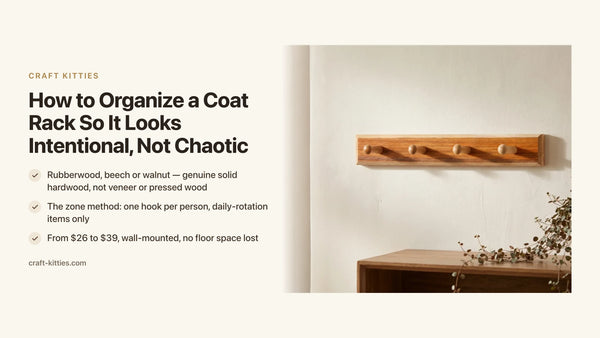
At a glance
- Solid rubberwood, beech and walnut — real hardwood, not veneer-over-MDF
- 2 to 6 hooks per panel, boot-profile reach for heavy coats
- From $26.00 to $39.00, matte black metal hardware throughout
The entryway is the room that takes the most abuse and receives the least attention. Coats land on chairs, bags pile on the floor, keys disappear. A wall hook rack solves all three problems at once — if it is the right one, mounted at the right height, in a material that does not look like it came from the back corner of a big-box store.
Wood and metal is the combination that works. Not because it is fashionable right now, but because the pairing resolves a real tension: wood is warm enough to keep an entryway from feeling like a utility closet, and metal hooks are the only hardware that holds a 10-pound winter coat for years without loosening. The question is which wood, how many hooks, which profile, and how to mount it so it stays put through the daily ritual of coats on and off.
This guide works through each decision in order: wood species and panel construction, hook count and hook profile, metal finish, sizing for your wall, and a comparison of the four racks from our studio. It closes with a decision matrix and answers to the questions we hear most often about entryway hook racks.
Why the material combination matters more than the style

The alternative to solid wood is MDF or particleboard with a veneer face. It looks identical in a product photo and fails differently in use: the panel swells at the fastener points when humidity cycles through seasons, screws lose their grip, and the whole rack starts to list after the first year. Solid hardwood — rubberwood, beech, walnut — does not behave that way. The density is uniform, the fasteners hold, and the panel stays flat regardless of what your entryway temperature does in winter.
The alternative to metal hooks is plastic or wooden pegs. Neither holds under load the way metal does. A powder-coated steel hook rated for 15 to 20 pounds per hook will still look and function identically five years in. Plastic creeps under constant stress; uncoated wooden pegs can split or absorb moisture at the joint. Metal is the right material for the load-bearing part; wood handles the visual part. The combination is not a style trend — it is the sensible division of labor.
The third factor nobody mentions until it fails: how the hook attaches to the panel. Hooks pressed into pre-drilled holes and held by friction loosen. Hooks bolted through the panel with a backing nut stay fixed. Every rack in our lineup uses through-mounted hardware — the hook is fixed through the panel, not pressed into it.
Rubberwood: the versatile hardwood you may not know by name
Rubberwood comes from the Hevea brasiliensis tree, harvested after its latex-producing years end. It is a dense, pale hardwood with a tight, even grain — more stable than many tropical hardwoods and better at holding fasteners than pine or cedar. Its own grain is quiet, which makes it an ideal base for face veneers: the panel is structurally sound while the visible face delivers the character of Brazilian veneer or cherry without the weight of a solid Brazilian hardwood panel.
In an entryway, rubberwood panels offer consistent screw-holding strength across the full width. There is no soft spot in the middle, no hidden knot where the drill might break through, no lamination seam that telegraphs through a painted or oiled finish. For a rack that will take three to six hooks and daily loading, it is the right choice of panel stock.
The Brazilian veneer face on our Rubberwood Wall Hook Rack with Brazilian Veneer shows a warm, golden-brown grain with a natural variation that reads as genuine rather than decorative. The cherry veneer on the Rubberwood Cherry Veneer version is warmer and slightly redder — closer to the palette of vintage Shaker furniture, which pairs naturally with both white and sage walls.
Beech and walnut: a two-tone approach for rooms that are already styled
Beech is pale and close-grained — the wood of school chairs and mid-century furniture throughout Scandinavia. It takes oil finishes evenly, holds a color that warms without dominating, and sits well with both grey and warm-white walls. Walnut is the opposite: deep brown, even-toned, the wood that reads "premium" in product photography and daily life alike.
The Two-Tone Beech & Walnut Wall Hook Rack puts both species on the same panel — lighter beech on the outer sections, darker walnut as the center rail, or a striped alternating pattern depending on the width you choose. The result is a rack that holds its own in a styled entryway without needing supporting decoration. It does not blend into the wall the way a single pale species can; it reads as a considered piece.
From a structural standpoint, both beech and walnut are genuine hardwoods — Janka hardness ratings of 1300 and 1010 respectively, compared to around 590 for pine. They do not dent around hook holes after years of coat-hanging, and they do not swell at the fastener points the way cheaper woods do. When the wood is this dense, the fasteners stay where you put them.
The walnut boot-profile rack: when reach matters more than width

A standard peg sits 1 to 1.5 inches out from the panel. A boot-profile hook — named after the curved silhouette it traces from the side — extends 3 to 4 inches, curves at the tip, and holds items far enough from the wall that a heavy coat and a tote bag can coexist on the same hook without the lower item being pressed into the wall.
The practical difference becomes obvious in October. A standard peg holds a light fall jacket cleanly. Add a winter coat — half an inch of wool, padded lining — and the weight angle shifts, the coat slides toward the wall, and eventually slides off. A boot-profile hook holds the coat fully extended from the panel so the hang is clean. Add a bag on the same hook and the total weight distributes across the full reach rather than cantilevering at the neck of the peg.
The Walnut Wood Wall Coat Rack with Boot-Profile Hooks is built around this logic: a solid walnut panel — deep brown, straight grain, oiled to show the natural figure — with four through-mounted boot-profile hooks in matte black powder-coated steel. The spacing is calibrated so a full winter coat on each hook clears the neighboring coat. Four hooks, real walnut, $28.80: the most load-efficient option in the lineup.
The five racks from our studio, in detail
Each panel is solid hardwood. None is MDF. Each hook is through-mounted metal. The price range is $26.00 to $39.00 — a range that covers every entryway size and most décor palettes.

Description
The rubberwood-Brazilian veneer rack is the pick when the entryway wall is a visible part of the room rather than a functional afterthought. The veneer face shows genuine grain variation — golden and amber tones — while the rubberwood core delivers the structural stability that keeps six hooks tight after years of daily use. Available in 4-hook and 6-hook configurations, so it adapts to the width of wall you have.

Description
Cherry veneer on a rubberwood panel reads like heirloom furniture in the right context. The reddish tone deepens slightly over months of light exposure — cherry is one of the few veneers that genuinely improves with age. Matte black hooks are the correct metal choice here: they anchor the warm tone rather than competing with it. Same structural specs as the Brazilian veneer version, different visual register.

Description
The beech-walnut rack earns its place as a design object rather than a utility piece. The contrast between the pale beech and the deep walnut creates a pattern across the panel face — horizontal stripes or a central rail depending on the configuration — that requires no additional wall art around it. Start with 2 hooks if the wall is narrow; scale to 6 if you need the full entryway capacity.

Description
Four hooks, solid walnut, boot-profile reach. The case for this rack is made in November when the first heavy coat of the season goes up: the hook holds it fully out from the panel, the bag on the same hook hangs freely below, and nothing ends up on the floor. At $28.80 it is the value choice that does not feel like one.
Comparison table
| Model | Price | Panel wood | Hook style | Best for |
|---|---|---|---|---|
| Brazilian veneer rack | $39.00 | Solid rubberwood + Brazilian veneer face | Matte black, 4–6 hooks | Statement entryway, warm-toned rooms |
| Cherry veneer rack | $37.00 | Solid rubberwood + cherry veneer face | Matte black, 4–6 hooks | Brick walls, Shaker millwork, warm paint |
| Beech & walnut two-tone | $26.00 | Solid beech + solid walnut | Matte black, 2–6 hooks | Japandi, Scandinavian, focal-point wall |
| Walnut boot-profile | $28.80 | Solid walnut | Matte black boot-profile, 4 hooks | Winter coats, heavy bags, mudrooms |
Decision matrix — which rack for which entryway
| Your situation | The right pick |
|---|---|
| Clean white or greige walls, you want the rack to be a visual anchor | Brazilian veneer rack |
| Warm-toned walls, brick or Shaker millwork | Cherry veneer rack |
| Japandi or Scandinavian interior, you want contrast built into the piece | Beech & walnut two-tone |
| Cold climate, heavy coats and bags every day | Walnut boot-profile |
| Family of four or more, need maximum hook count | Brazilian veneer rack (6-hook), or two two-tone racks side by side |
| Housewarming gift that does not feel generic | Beech & walnut two-tone — works in almost any décor, ships clean |
How to mount a wall hook rack so it stays level and loaded
Wall hook racks fail in one of two ways: they come off the wall, or they hang crooked. Both failures share the same root cause — the mounting hardware was not matched to the wall construction.
Locate the studs first. In most North American residential construction, studs run vertically every 16 inches. A rack mounted into two studs at 32 inches on center will hold any load the hooks themselves can carry. Use a stud finder or the knock test: a hollow sound means cavity, a solid sound means stud. Mark both centers with painter's tape before lifting the rack.
If studs do not align with your preferred position, use toggle bolts or snap toggles in drywall. A properly installed 1/4-inch toggle bolt in drywall holds 50 to 80 pounds — more than enough for a family's worth of coats. What fails is a screw driven into drywall alone without a toggle: it will pull through under sustained load. Use the toggle, not the screw.
Set the height before drilling. The standard is hooks at 60 to 66 inches from the floor for adult-height coats. Hold the rack at that height, check level with a small spirit level resting on the top edge, and mark both mounting holes before reaching for the drill. Two minutes of checking here prevents a row of plugged holes 2 inches below the right position.
For mudroom applications where the rack will regularly take wet gear — rain coats, snow parkas, soaked bags — mount slightly higher at 64 to 68 inches. The extra height gives gear underneath the hooks room to drip-dry without puddling at the base of the wall panel.
How to mix the hook rack with other entryway pieces
The mistake most people make is buying a rack, then buying a bench, then a mirror, then a console table, and ending up with four different wood tones and three different metal finishes in a six-foot entryway. The result reads as accumulated rather than considered, and no individual piece saves the whole.
The fix is a thread — one metal finish and one wood family, repeated across every piece that shares visual space. If the hook rack is walnut and matte black, the console table drawer pulls should be matte black, and the mirror frame should be walnut or a warm neutral. If the rack is beech and walnut with matte black hooks, the bench legs can be walnut or matte black metal — either anchor works.
The same logic applies to our wall hook rack collection: each rack is designed to work alongside a bench, a console shelf or a floating shelf in the same wood tone. You do not need to buy a matching set — you need to buy pieces that share a finish language and let the wall do the rest.
One piece of wall art above the rack is allowed. Two pieces compete with the rack for attention. The hook rack, properly chosen, is already the focal point of an entryway — it does not need a gallery wall behind it.
Mistakes that make a good rack fail
Buying too few hooks. The comfortable number is daily users plus two. Anything less means coats get stacked on the same hook, which means the bottom coat always ends up on the floor. If you are between hook counts, go up.
Mounting at the old holes. Previous tenants or owners often installed hooks at the wrong height, in the wrong position, or without finding studs. Inheriting bad holes means inheriting bad decisions. Plug the old holes, find the studs, and position the rack where it belongs — where your hand actually reaches when you take your coat off.
Choosing the wood from a product photo against a white studio background. Warm veneers and natural walnut read differently under warm incandescent light than under a daylight LED fixture. Before ordering, look at the wall under the actual light conditions of your entryway — noon daylight, evening lamp — and choose contrast rather than match.
Ignoring hook reach on a loaded wall. A narrow entryway where the hall is less than 36 inches wide needs boot-profile hooks more than a wide one. Standard pegs push coats back toward the wall and the door opening; boot-profile hooks hold coats fully extended, keeping the pathway clear.
FAQ — wood and metal wall hooks for the entryway
1 — What is the difference between rubberwood and walnut for wall hooks? Rubberwood is a dense, tight-grained hardwood that takes veneers exceptionally well — the body stays stable while the Brazilian or cherry face delivers the visual warmth. Walnut is a darker, straight-grained hardwood with a quieter, more premium look straight from the mill. Both are solid wood, both hold hooks and loaded bags without flex. The choice comes down to tone: rubberwood-with-veneer for warmth and grain character, walnut for deep, even color.
2 — How many hooks do I need for a family entryway? One hook per regular user plus two extras for guests and oversized bags. A couple is comfortable with four hooks. A family of four needs six to eight. Our racks scale from 2 to 6 on a single panel, and two racks side by side give you 8 to 12 hooks without visual clutter.
3 — Can wood wall hooks support heavy winter coats? Yes, when the rack is mounted into wall studs or solid masonry with appropriate anchors. The limiting factor is the anchor, not the wood. Our rubberwood and walnut panels are solid hardwood — not MDF, not particleboard — so the panel does not flex or crack under sustained load.
4 — What metal finish pairs best with walnut? Matte black is the most reliable partner: the contrast is clean without competing with the wood's warmth. Brushed brass works too and leans warmer. Chrome and polished nickel tend to pull against walnut's earthiness — they read cold where the wood reads warm.
5 — How high should wall hooks be mounted in an entryway? Hooks at 60 to 66 inches from the floor suits most adults for coats and bags. If the space also serves children, a second row at 36 to 42 inches covers the full household. In a narrow hall, favor the lower end of the adult range — it keeps coat tails from brushing the ceiling molding.
6 — Is a two-tone beech and walnut rack harder to match than a single-species rack? No — often easier. The beech picks up pale walls, the walnut anchors darker floors. The built-in contrast does the styling work without requiring you to choose between light and dark. It reads Scandinavian in a minimal entryway and mid-century in a warmer one.
7 — What is a boot-profile hook and why does it matter? A boot-profile hook extends 3 to 4 inches from the panel face and curves at the tip — deep enough that a bulky winter coat hangs fully away from the wall. Standard pegs hold 1 to 1.5 inches out; that is enough for a light jacket, not enough for a parka and a tote bag on the same hook.
8 — How do I decide between 4 and 6 hooks on the same panel? On walls narrower than 30 inches, four hooks keep coats far enough apart that they do not bunch. On a wider wall, six hooks give each item its own dedicated space. When in doubt, go wider: an empty hook is less frustrating than a crowded one.
9 — Do wood and metal wall hook racks work in a mudroom? Yes. Solid hardwood panels — rubberwood, beech, walnut — tolerate humidity swings better than MDF. The key is a sealed or oiled finish that prevents moisture penetration. Metal hooks in a mudroom should be powder-coated rather than raw steel to resist rust where wet gear accumulates.
10 — Is a wood and metal hook rack a good housewarming gift? It is one of the most practical gifts a new homeowner can receive and one of the least likely to duplicate what they already have. A rack from our wall hook rack collection ships ready to mount and works in virtually every entryway. On Etsy, with 243 reviews, it is consistently one of the pieces people mention as the one gift they actually use every single day.
Where to go next
The hook rack is usually the first piece of a proper entryway — rarely the last. Once the coats have a home, the floor gets a bench, the wall gets a mirror, and the console table arrives last. Our wall hook rack collection groups the racks by wood family so you can identify which pieces build a coherent entryway around the one you choose. Start with the Rubberwood Wall Hook Rack with Brazilian Veneer if the wall is the statement, or the Two-Tone Beech & Walnut rack if you want the contrast built in from day one.
One wall, one decision, a different entryway
If this guide resolves to a single principle: choose the wood by contrast with your wall and the hooks by what you actually hang. Dark wall — pale veneer or beech. Light wall — walnut or cherry veneer. Light jackets only — standard hooks. Winter coats and family bags — boot profile, full reach. Mount into studs, level the panel before drilling, and the entryway problem is solved once rather than worked around daily.
The walnut boot-profile rack handles the most demanding use case at $28.80. The two-tone beech and walnut rack opens the lineup at $26.00 with a piece that does more visual work than racks at three times the price. Either way, the floor stays clear, the coats have a home, and the entryway looks intentional for the first time.