The fifth wedding anniversary is traditionally wood. That tradition has been around long enough that anyone who knows about it will give you a cutting board or a picture frame printed on balsa. And anyone receiving those will nod politely, put them in a drawer, and pull out the same phone charger and plastic pen cup the next morning at the desk.
The tradition is sound. The execution is usually not.
Wood is the right material for a reason: it is the one that grows more interesting with time, just like the relationship it marks. The problem is not the material — it is that most "wood anniversary gifts for him" are decorative objects that sit on a shelf and accumulate dust. The gifts that land are the ones he actually uses every day. Which, for most men who work at a desk, means the desk.
This guide covers the real decision — whether to build something yourself or buy something handcrafted — then walks through the wood desk accessories that consistently work for this occasion, with prices, species, and a comparison table to make the choice simple.
At a glance
- Fifth anniversary = wood, but give him something he uses daily, not a shelf decoration
- DIY works if you have woodworking skills and two weeks of lead time; handcrafted wins for everyone else
- Solid red oak or walnut, $15–$55 — gift a piece with visible grain and real weight
Why wood still makes sense — and why most wood gifts miss
Wood as the fifth-anniversary gift is not an arbitrary convention. The underlying logic is that wood starts raw and becomes refined with attention and time — which maps cleanly onto what a five-year relationship has done. It develops grain, character, and depth that a newer piece does not have. As a metaphor, it works.
What the metaphor does not specify is what kind of wood object. And that ambiguity is where most gift-givers go wrong. They reach for something conspicuously wooden: a monogrammed paddle board, a serving tray shaped like a US state, a decorative bracket with a saying on it. None of those things get used. None of them are on his desk on a Tuesday morning when the metaphor actually matters.
The category of gift that holds up is the one he encounters daily without having to think about whether to use it. For men who work at a desk — at home or in an office — that means the objects that organize the surface. A pen holder he reaches into ten times a day. A phone stand he glances at between emails. An all-in-one organizer that replaced the pile that was there before. These are the gifts that survive ten years on the same desk without becoming a burden.
DIY or handcrafted: the honest comparison

The "should I make it or buy it?" question deserves a direct answer, not a hedge.
DIY makes sense in two scenarios. First: you already do woodworking. You own the tools, you understand grain direction, you know how to sand to 220 grit and apply a wax finish without leaving brush marks. In that case, a piece you cut and finished yourself is a different order of gesture than anything you could buy — and he will know it the moment he holds it. Second: you have two to three weeks before the date and a very specific design in mind that no maker currently produces. A custom jig, a dovetail box, a holder sized precisely for a specific set of items on his desk.
Handcrafted wins in every other scenario. Woodworking is a skill that takes years to develop well. The gap between a clean solid-walnut piece with squared edges and flush joints and a beginner's first attempt at the same is immediately visible. If you are new to it, the result of a DIY project is more likely to communicate "I tried" than "I made this for you" — which is not the same thing. A handcrafted piece made from solid hardwood by someone who does this professionally gives you a finished object that looks and feels premium, is ready when you need it, and eliminates the risk of a half-built project two days before the anniversary.
There is also a practical middle path worth naming: buy the piece, but add a personal layer. A short note written in your own hand about what the five years have meant. A date engraved into the grain. A presentation that makes the occasion explicit. The gesture is not diminished by the fact that someone else cut the wood — it is the choice and the framing that carry weight.
What solid wood actually means for a desk gift
Most desk accessories described as "wooden" are not solid wood. They are MDF core with a wood veneer, or particleboard with a printed wood-pattern film, or bamboo composite pressed at high density to imitate grain. These materials behave differently in daily use: they chip at corners, the surface does not accept hand-finishing, and they do not develop the patina that real wood develops with time and handling.
Solid red oak (Quercus rubra) is a North American hardwood with an open grain structure — the growth rings are visible and pronounced, giving the surface a bold, readable character. It is light in color, warm in tone, and lighter-looking on a dark desk surface. Janka hardness of around 1290 lbf: resistant to dents from pens and everyday handling.
Black walnut (Juglans nigra) sits at the opposite end of the palette: deep brown with a fine, tight grain that reads as understated luxury. It is the hardwood most associated with premium furniture and high-end desk accessories, which means its associations do some of the work before the recipient even knows the species name. Janka hardness around 1010 lbf: slightly softer than oak, but more than enough for a desk surface.
Hard maple (Acer saccharum) and spliced combinations of walnut and maple or walnut and red oak add a third dimension: two-tone grain patterns that no single species can produce, with the contrast lines as the design element.
The practical difference on a desk is this: solid hardwood develops a light patina from handling, becomes slightly more lustrous in the places touched most often, and does not show corner chips the way veneered pieces do. In five years, a solid walnut pen holder looks better than it did on day one. That is the right property for a fifth-anniversary gift.
The five pieces worth giving — and the case for each

Description
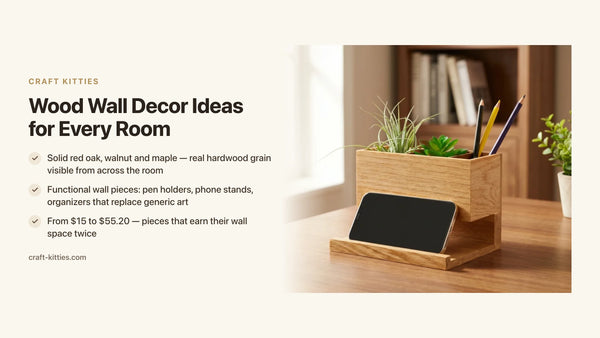
This is the piece to reach for when the gift needs to make an impression at the reveal and be genuinely useful the next morning. Solid red oak, the plant pod built directly into the structure, storage for pens, and a surface organizer that replaces the scattered pile most desks have. At $55.20, it is priced at the upper end of what a solid hardwood desk piece should cost — and it sits at that price because the design and the material earn it. One object that solves multiple problems on a surface he looks at every day.

Description
The walnut-and-maple combination does something a single-species piece cannot: the grain of two contrasting hardwoods, spliced and finished flush, creates a pattern that is clearly intentional and clearly not reproducible by a machine. Solid walnut and hard maple, $36. For the recipient who appreciates craft without needing it explained, this is the right piece — the material tells its own story before he reads a label.

Description
Not every gift has a large budget attached, and this is the piece that holds up at $15.99. Solid walnut and red oak, hand-finished, with the grain contrast present in the material rather than applied to it. The price is low because the form is simple — the material is not. For a desk that has never had a solid hardwood piece on it, this is the honest starting point.

Description
The practical argument for this piece is the phone stand built into the same base as the pen storage. Most men who work at a desk have a phone stand and a pen holder as two separate objects that compete for the same six inches of surface. At $35, this consolidates that footprint into a single solid-wood piece. The design is straightforward; the benefit is immediate and daily.

Description
The case for simplicity: a geometric pencil cup in solid wood, $15, that replaces whatever plastic or ceramic thing currently sits on the desk without asking for attention. This is the gift for the person whose desk is already organized and whose aesthetic runs minimal. The geometry is the design; the material is the upgrade. Nothing to assemble, nothing to explain.
Comparison table — which piece for which desk
| Piece | Price | Wood | Key feature | Best for |
|---|---|---|---|---|
| Red Oak Plant Pod | $55.20 | Solid red oak | Plant pod + pen storage + organizer in one | The statement anniversary gift |
| Walnut & Maple Spliced | $36.00 | Solid walnut + hard maple | Two-tone grain contrast | The design-conscious recipient |
| Walnut & Red Oak | $15.99 | Solid walnut + red oak | Entry price, real hardwood | First solid-wood piece on his desk |
| Pen Holder + Phone Stand | $35.00 | Solid wood | Integrated phone stand | The always-on-his-desk phone user |
| Geometric Pencil Cup | $15.00 | Solid wood | Clean geometry, minimal footprint | The minimalist who already has a clean desk |
Decision matrix — matching the gift to the man

| His profile | The right pick |
|---|---|
| Stuff on his desk, no real organization | Red Oak Plant Pod — $55.20 |
| Notices material quality before he reads labels | Walnut & Maple Spliced — $36.00 |
| Works from home, phone always within view | Pen Holder + Phone Stand — $35.00 |
| Minimal desk, does not want another object | Geometric Pencil Cup — $15.00 |
| Budget under $20, material still matters | Walnut & Red Oak — $15.99 |
| Group gift, milestone anniversary | Red Oak Plant Pod — $55.20 |
The mistakes that make a wood gift miss
Choosing "wooden" without confirming solid wood. The word wooden describes anything with wood on the surface — including particleboard with a printed veneer. The distinction matters in daily use: a solid hardwood piece develops a light patina from handling; a veneered MDF piece chips at the edges within months and ages in the wrong direction. Before any purchase, look for the wood species by name. If the listing says "wooden" but does not name a species, that is the tell.
Giving him something decorative instead of functional. A carved wooden frame, a wooden serving set, a wooden clock with a nature scene burned into it — these objects go on shelves and stay there. A pen holder goes on his desk and gets used before his first coffee every morning. The daily-use test is the right filter for a gift that has to carry meaning over time.
Ordering at the last minute and skipping personalization. If you want a date or initials engraved, most makers need three to five business days of lead time beyond the standard processing window. Order early enough that personalization is possible, not an afterthought you gave up on because the window closed.
Buying two medium gifts instead of one considered one. The instinct to fill a gift bag is understandable. Two generic wooden items at $12 each read as less intentional than one $25 piece in solid walnut with a note that explains why you chose it. A single object chosen for a clear reason lands harder than a collection of objects chosen to fill a price point.
How to give it well — the presentation that makes the difference
A gift without context is just an object. A solid walnut pen holder with a card that says "five years — and you still reach for the same desk every morning" is not the same gift. The object carries the occasion once you name the occasion. That does not require a long letter or an elaborate ritual — it requires one sentence that connects the material to the meaning.
If you are giving this on the actual anniversary: keep the desk clear when he opens it, and put the piece directly on the surface rather than leaving it in the box. The moment of placement is the visual statement — it replaces whatever was there with something that belongs there.
If he already has a pen holder: that is not a reason to change the gift. A solid red oak or walnut piece replaces a plastic or ceramic holder in a way that is immediately obvious. The weight, the grain, the way it sits on the surface — there is no competition. Present the swap as deliberate: "this one is real wood."
FAQ — wood anniversary gifts for him
1 — What is the traditional gift for a fifth wedding anniversary? The traditional material is wood. The convention has been around long enough to be broadly known, which means the "fifth anniversary = wood" framing lands with most recipients without needing explanation.
2 — Is DIY better than buying a handcrafted wood gift for him? DIY is better when you have real woodworking skills and enough lead time. For most people, a handcrafted piece by a specialist delivers better quality, a cleaner finish, and a lower risk of a half-finished result two days before the date.
3 — What wood is best for a desk gift for men? Red oak (Quercus rubra) and black walnut (Juglans nigra) are the two most reliable choices. Red oak is light with bold, readable grain; walnut is deep brown with a fine, tight grain that reads premium at first glance. Spliced walnut-and-maple combinations add two-tone contrast that neither species achieves alone.
4 — How much should I spend on a wood anniversary gift for him? Solid wood desk pieces range from $15 for a geometric pencil cup to $55.20 for an all-in-one plant-pod organizer. For a fifth anniversary, the $35–$55 range gives you solid hardwood construction, a design with visual weight, and something he will keep for years. Below $15, most products use composite materials with a wood appearance rather than solid wood.
5 — Can I personalize a wood desk gift? Yes. Solid red oak and walnut both accept laser engraving cleanly. A date, a set of initials, or a short phrase cut into the grain is the detail that separates a gift from an object. Confirm personalization availability and lead time with the maker before ordering.
6 — What if he already has a pen holder on his desk? A solid hardwood piece replaces whatever is already there. Most desk pen holders in daily use are plastic, ceramic, or particleboard. A piece in solid red oak or walnut — with visible grain and real weight — makes the replacement immediate and obvious. It is not redundant; it is an upgrade.
7 — Does a wood gift need maintenance? Very little. Solid hardwood pieces finished with natural wax or wax-oil need an occasional wipe with a dry cloth. The finish does the protective work. On a desk, in ordinary daily use, real-world maintenance is close to zero.
8 — Is a wood pen holder a good anniversary gift for a man who works from home? It is one of the most practical choices available. A work-from-home setup means he sees his desk every day — a handcrafted solid-wood piece on that surface becomes part of the working environment, not an object stored away. The occasion is present every morning without requiring a dedicated display shelf.
9 — How do I make sure the gift feels intentional, not generic? Two things: name the material specifically (solid red oak, solid walnut — not just "wooden"), and name the occasion in the way you present it. One sentence connecting the five years and the material is enough. The object earns its meaning from the context you give it, not from the price tag.
10 — What if the anniversary is not the fifth — can I still give a wood gift? Wood is conventional for the fifth, but it is a good material for any anniversary or milestone where the goal is a daily-use gift that lasts. A piece in solid walnut or red oak makes sense at any occasion where the point is to give something with visible quality and staying power.
Where to go next
The full range of solid wood desk accessories — pen holders, phone stands, multi-function organizers — is in the wood pen holder collection. If the Red Oak Plant Pod is where you landed, the product page has the full dimensions and current availability. For a two-tone alternative, the Walnut & Maple Spliced Pen Holder is the other piece we point to most often for milestone gifts.
Over 243 customers have reviewed these pieces on Etsy — the feedback there gives a clear picture of how each piece holds up in daily desk use, which is exactly the context these gifts are designed for.
Conclusion — one object, used daily, for years
The fifth anniversary is wood. The question is which wood object earns its place on his desk rather than becoming something he moves around because he does not know where to put it. The answer is almost always the same: give him something he reaches for every morning, made from a species with a name you can say out loud — red oak, walnut, maple — in a design that is cleaner than whatever it replaces. The Red Oak Plant Pod at $55.20 covers the full argument: solid hardwood, daily utility, a design with visual impact. The Geometric Pencil Cup at $15 makes the same material argument with a smaller footprint. The five years make the occasion. The wood makes it last.