At a glance
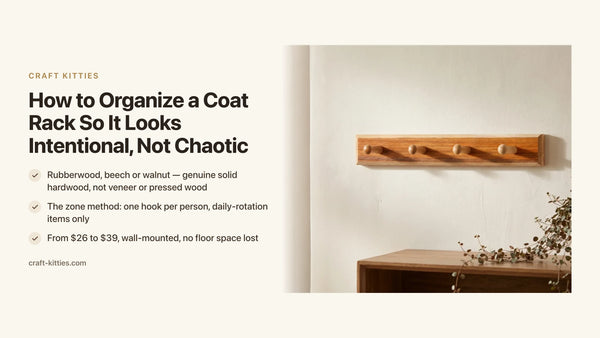
- Solid beech and walnut — real hardwood, not veneer or MDF
- Swivel models fold flat when not in use, ideal for narrow entryways
- From $5 to $26, one hook to two-hook rows in matching wood species
The entryway is the most used wall in the house and the least considered. Most hooks go up the same day as the moving boxes — a quick fix that stays for years. The result is usually a plastic command strip that yellows, or a chrome hook that looks borrowed from a hardware store, in a space that is actually the first and last thing you see every day.
Switching to solid wood entryway wall hooks is one of those small decisions that changes the room without changing the room. The structure, the palette and the furniture stay the same; a piece of actual hardwood on the wall instead of plastic shifts the overall impression. What takes that decision from good to genuinely right is choosing the correct species, size and placement for the specific wall and the specific load — which is what this guide covers, model by model.
One thing worth stating before anything else: the hooks in this guide are solid hardwood — beech, walnut, or both together. Not MDF with a printed grain, not pine veneer over particleboard. Solid hardwood holds screws with authority, handles the bump and drag of daily use without chipping, and ages into something that looks intentional rather than worn out.
Why species matters more than style

The word "wood" covers an enormous range of actual materials, and in the context of wall hooks it is the species that determines everything that matters after installation: how the hook ages, how it holds a load, and how it reads against the wall it sits on.
Beech is a pale, warm-golden hardwood with a very tight, straight grain. It is one of the densest common European hardwoods — denser than oak in practical terms — which makes it excellent for hooks that will take repeated side-loading from bags and coat pockets. The light tone makes it versatile: beech brightens a dark entryway and stays neutral in a bright one. Visually, it is closer to maple than to walnut, with less grain drama and more quiet consistency.
Walnut sits at the opposite end of the tonal range: a rich, dark chocolate brown with a fine, almost silky grain. It reads sophisticated on a light wall and stays assertive on a colored one. In small pieces like wall hooks, a real walnut surface has a presence that is difficult to replicate in stained woods — the depth comes from the material itself, not from pigment. Against an entryway with white or cream walls, a walnut hook can serve as a design object rather than just a utility piece.
The two-tone model — our Two-Tone Beech & Walnut Wall Coat Hooks — is the answer for entryways that already mix wood tones. Rather than forcing a choice between species, it makes that contrast deliberate and contained.
How to think about size and load
The size question in entryway hooks has two independent variables: the projection of the hook arm from the wall, and the spacing between hooks when you are mounting several. Both matter more than the overall physical footprint of the mounting plate.
Projection determines what the hook can carry without the load pressing against the wall. A short projection — one to two inches — works for keys, thin scarves and hats. A deeper projection of three to four inches handles a heavy winter coat without the shoulders resting on the plaster. The Beech Wood Boot-Profile Wall Hook has a shaped arm specifically designed to hold a coat or a bag without slippage, with a carved profile that prevents straps from sliding off under weight.
Spacing governs whether two hooks in a row read as a pair or as two objects that happen to share a wall. Hooks mounted on a single backing plate solve this automatically — the plate itself establishes the spacing and keeps the alignment exact regardless of wall irregularities. Individual hooks require a level and careful marking; the result can be just as clean, but the installation step is less forgiving.
For load-bearing: solid beech and walnut hooks mounted into a stud — or into a wall anchor rated for the appropriate weight — will hold a winter coat, a canvas bag and a scarf simultaneously without any structural concern. The wood itself is not the limiting factor. The mounting point is. For plasterboard walls without a stud behind the target location, use a hollow-wall anchor rated at minimum 15 lbs per point; for solid walls, a standard 2.5-inch screw will do.
Swivel or fixed: the entryway-specific decision

This distinction does not come up often in product listings, but it is one of the most practical decisions in an entryway.
A fixed hook projects from the wall at a constant angle. It is simpler — one piece of solid wood, two mounting screws — and it handles every coat shape without adjustment. Fixed hooks work best when the entryway is wide enough that the projecting arm does not catch people passing. In a standard hallway of 40 inches or more, a fixed hook is the right default.
A swivel hook rotates on a pivot mounted to the wall plate. When loaded, it holds the coat or bag at the optimal angle; when empty, it can fold flat against the wall and reduce the projection to near zero. In a narrow corridor — under 36 inches — or a galley entry where traffic passes close to the wall, a swivel hook is genuinely useful rather than a novelty. Our Natural Wood Swivel Wall Hooks and Solid Wood Wall Hooks are both built around this mechanism, with a carved hardwood arm that sits flush when folded.
A magnetic hook adds a second function: the hook face holds a small magnet that grips keys, a thin wallet or any flat metal object. The Beech Wood Magnetic Wall Hook is the smallest piece in the lineup and the one that earns its place closest to the front door, where keys need to land the moment you walk in and be findable the moment you leave.
The five models from our studio
Four distinct problems in the entryway, five solid-wood solutions.

Description
The boot-profile shape is the detail that separates this hook from a straight peg. The arm curves outward then upward, creating a cradle that holds a coat hanger or bag strap without letting it migrate toward the wall under its own weight. Solid beech throughout — no composite core, no veneer — with the grain running the length of the arm for maximum resistance to the lateral forces of a heavy bag. At $12, it is the anchor model for any entryway hook arrangement.

Description
The magnet is strong enough to hold a full keychain with car fob; the hook itself projects enough to carry a light jacket or a bag. The scale is deliberately compact — this is not a coat-rack replacement, it is a key-and-light-layer hook for the spot immediately adjacent to the door latch. Solid beech, natural finish. At $6.90 it is the entry point to the collection and the logical first addition before building out with more hooks alongside it.

Description
The carved profile of the arm adds visual character beyond what a turned or plain peg delivers; the swivel mechanism is the practical reason to choose this over a fixed hook in a tight entry. The wood is real solid hardwood finished with a protective wax coat that handles the humidity of coats coming in from rain. At $9, it is the swivel option that works without looking mechanical.

Description
Sometimes the right answer is the simplest one. This hook has one function and performs it cleanly: swivel arm, solid wood, no ornament beyond the grain of the material. At $5 it is the hook for the secondary door, the back of a closet, the laundry room, or the children's bathroom — anywhere you want real wood rather than plastic but the surface is more workhorse than showpiece.

Description
Two hooks on a single mounting plate means one level, two anchor points, and a result that reads as a deliberate design decision rather than two separate objects that happened to end up next to each other. The combination of pale beech and dark walnut works in entryways with mixed wood tones because it bridges them rather than competing with either. At $26, this is the flagship piece for a main entryway that will be used by two people regularly — one hook each, one wall plate, one installation.
Comparison table
| Model | Price | Wood | Mechanism | Best for |
|---|---|---|---|---|
| Boot-Profile Hook | $12.00 | Solid beech | Fixed, shaped arm | Daily coat and bag use |
| Magnetic Hook | $6.90 | Solid beech | Fixed + magnet face | Keys + light layer, door-side |
| Rustic Swivel Hook | $9.00 | Solid hardwood | Swivel, carved arm | Narrow hallways, rustic rooms |
| Swivel Coat Hook | $5.00 | Solid wood | Swivel, minimalist | Secondary spaces, utility use |
| Two-Tone 2-Hook Row | $26.00 | Beech + walnut | Fixed, dual arm | Main entryway, two users |
The decision matrix — which hook for which entryway
| Your situation | The right pick |
|---|---|
| Main entryway, two people, want it to look deliberate | Two-Tone 2-Hook Row |
| Keys always lost — need a hook right by the door latch | Magnetic Hook |
| Narrow hallway, hooks can't project far into the corridor | Rustic Swivel Hook (folds flat when empty) |
| Primary coat hook, one user, widest arm | Boot-Profile Hook |
| Secondary spot — back door, closet, laundry room | Swivel Coat Hook |
Placement: getting the height and spacing right
Placement is where most entryway hook installations go wrong — and where the problem tends to be permanent, given that it involves drilling.
Height is the variable people most often take from a style guide or a Pinterest board rather than from their own reach. The standard recommendation is 60 to 66 inches from the floor, which puts the hook at shoulder height for an adult of average build — high enough to keep a long coat off the ground, low enough to unhook with one hand without stretching. This range holds for most adults. If the primary users of the entry include children, a second lower row at 40 to 48 inches lets them hang and retrieve independently, which matters more than most adults expect until they have spent a winter stooping to help a seven-year-old with their jacket.
The most reliable method for individual height — as opposed to the range — is empirical. Stand at the door in your coat, reach toward the wall as you would to hang it, and have someone mark where your hand naturally lands. That mark will be more accurate than any formula.
Spacing between individual hooks should be at minimum 8 to 10 inches center-to-center, which is enough to keep two coats from overlapping. For a main entryway with heavy winter coats, 12 inches between hook centers gives each coat enough wall clearance to hang fully open. The Two-Tone Beech & Walnut Wall Coat Hooks solves this by mounting two hooks on a single plate with the spacing already set — the plate goes up level and the spacing problem disappears with it.
Wall position deserves attention too. The natural impulse is to center the hooks on the wall or to place them on the wall directly facing the front door. Hooks work better on the side wall — the wall to the right or left as you enter, rather than the one in front — because that placement puts the hook within reach the moment you cross the threshold, without requiring a 90-degree turn with a coat in your hands.
Three mistakes that cost nothing to avoid
Mounting into drywall without checking for a stud. A solid-wood hook is heavier than a plastic one and encourages heavier loads. If the screw hits only drywall, the weight of a wet winter coat will gradually pull the anchor loose. Use a stud finder before marking holes, or if there is no stud in the right location, use a hollow-wall anchor rated for at least 15 pounds per mounting point.
Choosing the wood tone from the product photo. Online photos are shot in controlled light against neutral backgrounds. Walnut photographed in studio lighting looks different from walnut in a narrow entry lit by a single overhead fixture. Before ordering, hold a dark and a light object against the wall at the intended spot and see which creates more useful contrast. Contrast is what makes a hook readable and intentional rather than absorbed into the wall.
Installing all hooks at the same height for all users. A hook at adult shoulder height is unreachable for a child and inconveniently low for someone very tall. If the entryway is used by more than one body height, either select a height that works as a compromise or plan for two rows — the arithmetic of one frustrating reach per day across a household is more significant than it sounds.
FAQ — wood entryway wall hooks
1 — What wood is best for entryway wall hooks? Beech and walnut are the strongest choices for an entryway because both are dense, close-grained hardwoods that resist denting and hold screws firmly. Beech is lighter in tone with a subtle grain; walnut is richer and darker. Either one outperforms pine or MDF in a high-traffic location where hooks take daily impact from heavy coats and bags.
2 — How high should wall hooks be mounted in an entryway? A range of 60 to 66 inches from the floor suits most adults and keeps coats off the ground. If children will use the hooks regularly, add a lower row at 40 to 48 inches. The most reliable method is to stand at the door holding a coat and mark where your hand naturally reaches before drilling anything.
3 — How many hooks does an entryway need? One hook per regular user is the minimum; two per user works much better in practice because it separates outer coats from bags, scarves or umbrellas. A two-hook row like the Beech & Walnut model consolidates this on a single wall plate, which reads tidier than individual hooks spaced unevenly.
4 — Can a single solid-wood hook hold a heavy winter coat and a bag? Yes, when the hook is solid hardwood and mounted into a stud or with a proper wall anchor. A beech or walnut hook screwed into a stud will hold 15 to 20 pounds without issue — more than enough for a winter coat, a tote and a scarf together. The failure mode is almost always the mounting point, not the wood itself.
5 — What is a swivel hook and when does it make sense? A swivel hook rotates on its base plate so it can fold flat against the wall when not in use. This matters in narrow entryways where a fixed hook projecting from the wall would catch sleeves or block passage. The trade-off is a slightly more complex mounting mechanism; for wide entryways, a fixed profile hook is simpler and equally effective.
6 — Do wood hooks work in damp entryways or near the front door? Yes. Solid hardwood like beech and walnut handles the humidity swings typical of an entryway — wet coats, open doors in rain — far better than MDF or veneered board, which swell at the edges. Waxed or oiled solid wood simply needs an occasional wipe; it does not absorb moisture the way bare or finished softwood does.
7 — Should I choose individual hooks or a multi-hook row? Individual hooks give more flexibility in spacing and are easier to replace one at a time. A multi-hook row on a single mounting plate is faster to install and reads as a deliberate design decision rather than a collection of separate objects. For a main entryway serving two or more people, a two-hook row is usually the cleaner solution.
8 — How do I match wood hooks to my existing entryway furniture? Match by tone contrast rather than exact color. Light floors and white walls take walnut well because the dark tone reads clearly. Darker floors or stained furniture call for beech, which adds warmth without competing. When the entryway already mixes wood tones, a two-tone hook in beech and walnut bridges both without looking accidental.
9 — How do I care for a solid-wood hook? A dry cloth is all routine maintenance requires. Solid beech and walnut finished with a protective coat are not sensitive to the routine humidity of a front entryway. If the surface is ever scratched, a light pass of fine-grain sandpaper and a dab of wood wax restores it without needing professional refinishing.
10 — Are these hooks a good gift for a housewarming? Yes, particularly because they are both practical and visible. A pair of matching hooks — or the two-tone row — makes a gift that is used daily and noticed by anyone who walks through the front door. For a housewarming, pairing the boot-profile hook with the magnetic key hook covers both the coat and the key-drop need in one box.
Where to go next
The entryway is usually where a wood transition begins in a home — rarely where it ends. Our full wall hooks collection covers the same solid beech and walnut species across additional hook profiles, sizes and mounting configurations, organized for entryways, bathrooms, bedrooms and studios. If the Beech Wood Boot-Profile Wall Hook is the anchor for your main door, the Two-Tone Beech & Walnut Wall Coat Hooks work naturally alongside it for a second user — same species, same wall, no mismatch.
You can also find these hooks on Etsy, where over 243 customers have left reviews — useful if you want to read how other entryways have used them before deciding.
Conclusion — three decisions, one finished entryway
If this guide leaves you with a method: choose the species by contrast with your wall, pick the mechanism (fixed or swivel) based on how wide your corridor is, and mount at your own arm's reach rather than at a standardized height. The Two-Tone 2-Hook Row is the answer for most main entryways with two users; the Boot-Profile Hook at $12 is the single best daily-use hook in the lineup; and the Magnetic Hook at $6.90 belongs right next to the door latch for anyone who has ever left the house without their keys. Three decisions, one wall, an entryway that finally looks considered.