At a glance
- Wood warms, metal grounds — the right choice shifts room by room
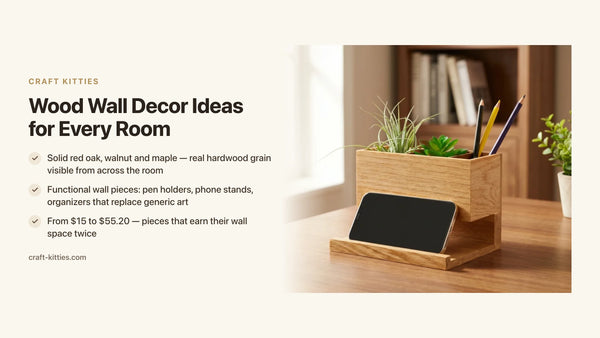
- Solid walnut, red oak and beech are the species worth choosing for wall decor
- Both materials can coexist: the rule is one dominant, one accent
Walk into any well-designed room and you notice the wall before you see what is on it. That is not accident — it is material doing its work. The question of wood or metal wall art is not about personal taste in isolation; it is about what the room already does and what it needs from the wall. A bedroom running warm and layered reads differently than a kitchen that is already all steel and tile. The right material does not stand out — it belongs.
This guide works through the decision room by room, explains what each material actually contributes to the atmosphere (not just the look), and gives you the practical information to choose and place wall decor that holds up over time. The trays, organizers and decorative pieces from our studio are introduced where they are genuinely relevant — alongside a comparison table, a room-by-room decision matrix, and answers to the questions we hear most.
One premise before anything else: this guide focuses on real materials. Printed wood-grain film peels. Hollow-core metal rusts at cut edges. The criteria discussed here — how a material ages, how it interacts with light, how it feels against other surfaces — apply only to solid hardwood and solid or powder-coated metal. Substitutes behave differently in every dimension.
What wood actually does to a room
Wood brings three things to a wall that metal cannot replicate: warmth, grain variation and biological familiarity. The warmth is not merely visual — surfaces with organic texture register as quieter to the eye, which lowers the perceived noise level of a busy room. Grain variation means no two pieces are identical; a solid walnut panel catches light differently than a beech panel of the same dimensions, even if the silhouettes match. And the familiarity is the oldest asset: wood is a material humans have lived alongside for millennia, which is why it reads as calm rather than impressive.
Solid walnut is the current benchmark for contemporary interiors. Deep brown with a fine, tight grain, it works as a statement on light walls and disappears — in the best way — on warm, mid-tone walls. Red oak runs lighter: honey-toned, with a bolder grain pattern that asserts itself even from a distance. It suits Scandinavian-style rooms and farmhouse kitchens particularly well. Beech sits between the two — pale, even-grained, and neutral enough to work in almost any palette. All three are solid hardwoods that hold finish well and age predictably over years.
The caveat for walls: wood needs a finish to hold up in rooms with any humidity. A wax or oil coat on solid wood makes the surface moisture-resistant, wipeable and stable. Without it, even solid hardwood moves with seasonal humidity changes. The pieces from our studio are finished before they leave — sealed and ready for any room, including bathrooms.
What metal actually does to a room
Metal introduces edge, precision and a cooler register. A powder-coated black metal bracket reads graphic; a brushed brass frame reads architectural; raw iron reads industrial. Metal does not warm a room — it defines it. That is a specific asset in spaces that already run warm (a rustic living room, a cozy bedroom) where a metal accent acts as a counterweight. It is a liability in spaces that already feel cool or stark, where adding more metal drives the room further into clinical territory.
Metal wall art also reflects light differently from wood. Polished or brushed surfaces create specular highlights that shift with the viewing angle and the time of day. In a well-lit hallway or a room with southern exposure, that movement can feel alive. In a bedroom optimized for low stimulation, it can feel restless.
Durability for metal comes down to the finish. Powder-coated metal is exceptionally resistant to scratches and moisture and will outlast most painted wood in a damp environment. Raw or thinly lacquered metal shows rust at cut edges and scratches. For humid rooms, the choice is not "wood vs metal" but "sealed solid wood vs powder-coated metal."
Room-by-room analysis

Living room
The living room is where the wood-versus-metal question gets most people stuck, because it is the room where both materials have strong advocates — and both can be right.
Wood is the default recommendation for organic, Japandi, Scandinavian and warm-modern living rooms. It adds texture without competing with furniture or textiles; it photographs naturally; it does not age out of style. A solid walnut shelf or a sculptural wooden tray on a floating ledge introduces material richness without visual noise. In a living room with warm plaster walls, wood-toned flooring and linen upholstery, another wood element on the wall feels like completion.
Metal suits industrial, eclectic and mid-century modern living rooms. A matte black geometric piece or a brushed brass frame anchors the room with graphic precision that wood cannot replicate. The risk is misuse: metal in a room that already has cool tones (gray plaster, blue upholstery, chrome fixtures) drives the palette further cold and makes the space feel more boardroom than home.
The most effective living room walls often use both: a walnut shelf holds a ceramic piece; a simple iron bracket carries it. The principle is one dominant material and one accent, not two competing focal points of equal visual weight.
Bedroom
The bedroom makes the case for wood clearly. Sleep environments benefit from low visual stimulation, and wood delivers it. A walnut tray on the nightstand, a solid red oak panel on the wall above the bed, a beech piece by the door — each introduces texture that the eye reads as calm rather than activating.
Metal in the bedroom works when it is matte and intentional: a simple black iron frame, a brushed brass hook. High-contrast polished metal, large-scale geometric metal art, or multiple metal pieces on the same wall tend to work against the room's purpose. The eye keeps tracking them.
The question to ask before placing anything on a bedroom wall: does this object invite the eye to rest, or does it invite it to move? Wood with fine grain answers the first. Polished metal with reflection answers the second.
Kitchen
Kitchens complicate the material question because they are functional rooms where decorative pieces compete with practical demands — and where humidity, grease and heat exist on a different level than in other rooms.
For the kitchen, sealed solid wood is a stronger choice than untreated wood in most configurations. A wax-finished walnut tray above the counter, or a red oak organizer by the sink, reads warm and intentional without being fussy. The finish does the protection work; the maintenance is a periodic wipe.
Powder-coated metal performs equally well in kitchens from a durability standpoint, and suits industrial and modern kitchen aesthetics naturally. The pitfall is crowding: kitchens already run dense with appliances, utensils and lighting. A large or busy metal piece on a kitchen wall can tip a room from curated to cluttered. When in doubt, smaller and simpler outperforms bigger and bolder in kitchen wall decor.
Bathroom
Bathrooms bring the humidity question to a head. The answer is less dramatic than most people expect: sealed solid hardwood handles bathroom conditions well. A wax-finished walnut shelf, a beech organizer, a red oak tray on a floating ledge — all are stable in a room with intermittent steam, provided the finish is intact and standing water is not left on surfaces.
The failure mode in bathrooms is bare or veneered wood: swells at edges, separates at corners, chips at the surface layer. Solid walnut or red oak finished with wax or oil is a categorically different material in terms of performance.
For metal in the bathroom, the same finish rule applies. Powder-coated or stainless steel works; raw iron or thin lacquer does not, over any meaningful time horizon.
The one scenario where metal edges out wood in bathrooms: very small shower-adjacent spaces where splashing is direct and sustained. There, powder-coated metal needs less maintenance than any wood finish. Everywhere else in the bathroom, sealed solid wood and powder-coated metal are comparably reliable.
Home office
The home office has a specific consideration that most guides ignore: the wall is often on camera. Zoom calls, video interviews, client meetings — the wall behind the desk is seen by more people than any other surface in the house.
For that reason, warm materials read better than cool ones in the video frame. Solid wood — a walnut tray on the desk, a red oak piece on the wall behind — adds visible texture that reads as thoughtful without requiring any explanation. Metal art, particularly high-contrast geometric pieces, can read as distracting or overly designed on camera.
Beyond the video consideration, wood suits the home office for the same reason it suits the bedroom: it keeps visual stimulation low, which supports sustained focus better than high-contrast metal. A calm wall is a productive wall.

Entryway
The entryway sets the tone for the entire home. What greets you at the door is not decor — it is editorial. It tells you what kind of house this is before you have seen any other room.
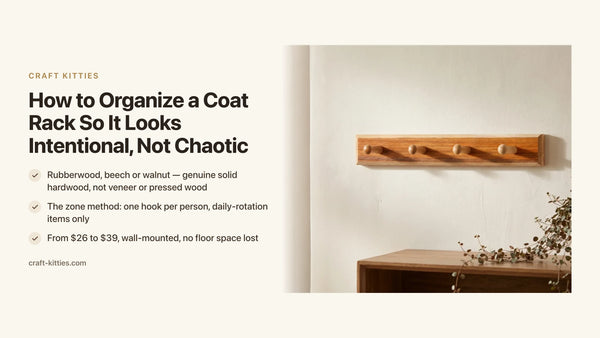
Wood in the entryway signals organic, calm, considered. A walnut tray on the console — holding keys, sunglasses, small change — reads as a home that knows what it is doing. A red oak hook rack says the same thing: organized, warm, intentional.
Metal in the entryway works when the rest of the home follows the same logic. A matte black key hook in an otherwise industrial apartment reads as consistent; the same piece in a warm, textured apartment reads as accidental.
The most reliable entryway wall decor decision: choose a material that appears somewhere else in the first room you see when the door opens. Continuity reads as design. Discontinuity reads as indecision.
The five pieces from our studio
Three products from our decorative tray collection handle the entryway and desk surface questions with solid walnut in three distinct configurations. Each is cut from real hardwood — walnut, red oak or beech depending on the piece — and finished with a wax coat that protects the surface without masking the grain.

Description
The small walnut tray is the most versatile piece in the lineup. Its compact dimensions sit cleanly on a desk corner, a bathroom counter or a nightstand — wherever you need one surface to do more organizing work than the bare shelf can manage. The walnut is solid hardwood with a wax finish that makes the surface easy to wipe and stable in any room.

Description
The square walnut tray steps up in both dimension and presence. The format suits a coffee table center, a dining console or a sideboard — anywhere a circular or rectangular tray would feel like a compromise. At $39 in solid walnut, it is the piece that anchors a surface rather than merely populating it.

Description
The entryway tray solves the problem most homes have at the door: a surface with no organization, which means keys end up in a different place every evening. The walnut version is compact enough to sit on a console without dominating it, and purposeful enough to hold the actual daily load — keys, transit card, sunglasses, loose change. One object that makes the coming-home moment frictionless.
Comparison table
| Product | Price | Material | Format | Best room |
|---|---|---|---|---|
| Small Walnut Tray | $29.00 | Solid walnut | Compact, rectangular | Desk, vanity, nightstand |
| Walnut Square Tray | $39.00 | Solid walnut | Square, generous depth | Coffee table, sideboard, dining console |
| Walnut Entryway Tray | $25.99 | Solid walnut | Compact, long | Entryway console, hallway shelf |
Room-by-room decision matrix
| Room + style | Primary material | Accent material | Species to consider |
|---|---|---|---|
| Living room — warm modern | Wood | Brushed brass or matte black | Walnut or red oak |
| Living room — industrial / eclectic | Metal | Raw or reclaimed wood | Beech or red oak |
| Bedroom — any style | Wood | Matte metal (minimal) | Walnut (dark) or beech (light) |
| Kitchen — modern / industrial | Metal or sealed wood | Either | Red oak or walnut (sealed) |
| Bathroom | Sealed wood or powder-coated metal | — | Walnut or red oak (wax-finished) |
| Home office | Wood | Matte metal (minimal) | Walnut (focus, video-friendly) |
| Entryway | Match first visible room | Either | Walnut or red oak |
The mixing rule — when wood and metal coexist
The question is not always one or the other. Most thoughtful interiors use both materials on the same wall — and the ones that work share a simple structure: one material dominant, one material accent.
A walnut shelf with black metal brackets is a clear example. The wood carries the visual mass; the metal defines the bracket as metal and introduces a graphic edge. Neither competes. Neither disappears. The shelf is what you see; the brackets are why it makes sense.
The failure mode is symmetry: two equally prominent materials on the same wall with no clear hierarchy. A large geometric metal piece next to a substantial wood panel fights for the same visual register. The eye moves back and forth without landing. Reducing one element — in size, in contrast, in quantity — resolves it immediately.
The practical rule: if wood is the primary surface (shelf, tray, panel), choose metal hardware that recedes — matte black or satin brass reads quieter than polished chrome. If metal is the primary art piece, keep wood surfaces low-profile and textured rather than graphic.
How to care for wood wall decor
Solid hardwood with a wax or oil finish is lower-maintenance than most people expect. The finish does the protective work; the owner's job is to not undermine it.
For surfaces with the wax finish: a dry or barely damp cloth handles everyday dust and light stains. No harsh cleaners, no abrasive pads. The wax layer is thin but effective; avoid anything that strips it. For bathroom or kitchen pieces: wipe standing water off promptly. A five-second wipe after the shower or after the counter gets wet is the entire maintenance protocol.
For occasional refreshing: a light application of beeswax or wood wax, buffed in and left to cure, restores both the sheen and the protection. Once or twice a year, depending on the room. This is the same care routine as for quality wooden furniture — nothing proprietary, nothing complicated.
What accelerates aging on solid wood: standing water left for extended periods, direct sustained UV from south-facing windows, and heat sources directly below the piece. In standard room conditions, a solid walnut or red oak piece kept off the radiator and out of a puddle will look better in five years than on day one.
Mistakes that make the choice harder than it needs to be
Choosing from product photos against a white studio background. A walnut tray against white looks dramatically dark; the same tray on a warm oak floor in front of plaster walls looks like it has always been there. Before ordering, photograph your actual wall with your phone, then hold the screen next to the product photo. The comparison is more useful than any color description.
Deciding material before deciding placement. The best approach runs the other way: pick the wall, decide what job the piece should do on that wall, then choose the material that serves that function in that specific light. Material as decoration is an afterthought; material as response to the room is design.
Buying art of a scale that competes with the furniture. Wall art does not need to fill the wall to work. A single well-chosen piece at the right height — roughly eye level when standing — does more than a gallery wall assembled to fill space. A solid walnut tray on a console at the entryway, for example, performs as both art and function simultaneously.
Ignoring the floor. Wood floors and wood wall decor either harmonize or fight, depending on the species match. Walnut art on a walnut floor can read as one continuous material with no contrast; red oak art on a walnut floor creates the intended separation. The simplest check: look at the floor and the wall together before buying.
Where to go from here
The pieces from our decorative tray collection cover the most common use cases — entryway, desk, vanity, coffee table — in solid walnut that works across the rooms discussed here. The Small Walnut Wood Tray at $29 and the Walnut Entryway Tray at $25.99 are the two starting points that fit the largest number of rooms without any risk of overpowering them. The Walnut Square Tray at $39 steps up for surfaces that need a more prominent anchor.
If you have been exploring on Etsy, our studio has 243 reviews from customers who were exactly in this position — choosing the right piece for a specific surface — and the feedback reflects which formats work best in practice.
FAQ — wood or metal wall art
1 — Is wood or metal wall art more durable? Both are durable when well made, but they age differently. Solid hardwood — walnut, red oak, beech — develops patina and character over decades; a wax or oil finish protects the surface from moisture and minor scratches. Metal resists dents and humidity well when powder-coated, but can show rust at raw edges or scratches if the coating is compromised. For humid rooms, sealed solid wood is more predictable than bare metal.
2 — Does wood wall art work in a modern or minimalist interior? Yes — the key is grain and silhouette. A flat-planed walnut or red oak piece with no ornamentation reads as confidently modern. The material is warm, but the form reads minimal. The pairing works especially well against white or warm-gray walls where the wood grain provides texture without visual noise.
3 — Which wall art material works best in a bathroom? Sealed solid wood handles bathroom humidity well — a wax or oil finish makes the surface moisture-resistant and easy to wipe. Bare or veneered wood is what swells and fails in damp rooms. For metal, choose powder-coated or stainless steel rather than raw iron. If the bathroom is very small and steamy, sealed walnut or red oak is the more forgiving long-term choice.
4 — Can I mix wood and metal wall art in the same room? Yes, and it often produces the richest result. The rule is one dominant material and one accent. A walnut shelf with a black metal bracket, or a metal frame holding a wood panel, reads as intentional. Two competing focal pieces of equal visual weight on the same wall tend to feel restless rather than designed.
5 — What wood species is best for wall decor? Walnut is the most sought-after for contemporary interiors: deep brown, tight grain, a quiet presence. Red oak is lighter, honey-toned, with a bolder grain that works in Scandinavian and farmhouse rooms. Beech is pale and even-grained, the most neutral of the three. All are solid hardwoods that hold a finish and age far better than veneered alternatives.
6 — Is metal wall art a good choice for a living room? It depends on the register you want. Brushed brass, matte black or aged iron suits industrial, eclectic or mid-century modern living rooms. In a warm, organic or Japandi-leaning space, metal can feel too cool and rigid unless balanced with plenty of wood and textile to soften it.
7 — Does wall art material affect the perceived value of a home? Not directly, but cohesive material choices read as intentional design to anyone who walks through. Solid wood pieces that integrate with the room's finishes — floors, furniture, trim — tend to photograph well and stage easily. Trendy metal art that dates quickly works against that.
8 — What is the best wall art for a home office? For a home office, solid wood has a specific advantage: it reads warm and calm on camera in video calls, adding texture without visual distraction. A walnut tray on the desk or a wood piece on the wall behind the monitor keeps the video frame looking considered. High-contrast metal art can feel activating rather than grounding in a focused work environment.
9 — Should I match my wall art to my floor? Matching species can create a beautiful monochromatic material story, but the risk is that nothing stands out. More often, contrast works better: walnut art on a lighter oak floor, or red oak pieces against a darker walnut floor. The practical check is to photograph the floor and wall together before committing to a piece.
10 — How do I know if a piece is genuinely solid wood? Weight is the first indicator — solid hardwood is significantly heavier than veneered particleboard of the same size. Look at the edges: solid wood shows continuous grain at cut corners; veneer shows a thin layer over a substrate that is a different material or color. A wax-finished solid wood surface also has a tactile depth that printed or sprayed finishes cannot replicate.