At a glance
- Real hardwood versus steel: honest comparison across style, strength, and cost
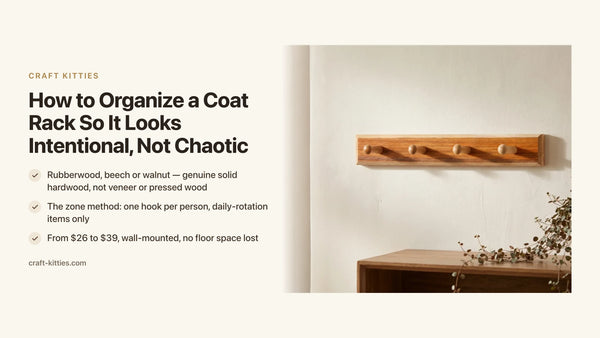
- Solid walnut, rubberwood and beech — heavier than metal rails, built to last decades
- Wall-mounted wood racks from $26 to $39, no compromise on looks or load
The coat rack decision seems simple until you are standing in front of a page of options and realize you are comparing things that do not have the same lifespan, the same look, or the same relationship to a wall. Metal coat racks often lead on price and variety; wood ones lead on warmth and longevity. Both work — but they work differently, and the wrong choice becomes obvious the moment you hang the third coat.
This guide runs through the comparison honestly: durability, weight capacity, aesthetics, installation, maintenance, and price. Then it presents the solid hardwood models from our studio — rubberwood with Brazilian veneer, rubberwood with Cherry veneer, two-tone beech and walnut, and solid walnut in a boot-profile design — with a comparison table, a decision matrix, and answers to the questions that come up most often before purchase.
One clarification before the comparison starts: this guide is specifically about solid hardwood on the wood side, not MDF boards with a wood-look film. Veneered particleboard and fiberboard coexist in the same product category and photograph almost identically, but they behave differently under load and over time. The comparison below refers to real wood throughout.
What the choice actually comes down to

The coat rack category splits neatly between two failure modes: the rack that looks wrong in the space, and the rack that physically fails over time. Material choice addresses both, which is why understanding the five real criteria matters more than reading specifications.
Durability is where the gap is most visible over time. Solid hardwood — walnut, beech, rubberwood — does not corrode, does not chip at a finish layer, and does not delaminate at the edges when moisture touches it. It can scratch, and it dents if something heavy hits it directly, but those marks become part of the surface character rather than a progressive failure. Metal racks with a powder-coat finish are durable when the coating is intact; once it chips at a corner or a screw hole, bare metal oxidizes, and the rust spreads slowly. Cast iron and thick steel are exceptions and are genuinely long-lasting, but they rarely appear in the residential coat rack category at accessible prices.
Load capacity is less decisive than it sounds. A solid wood board mounted with two screws into wall studs holds more weight than you will ever put on it. The same is true of a steel rail on proper anchors. What matters is the mounting, not the material. The hook design is the second factor: a narrow hook with a shallow curve drops bags; a wide, boot-profile hook holds a winter parka, a bag, and a scarf without any of them slipping.
Aesthetics is the real differentiator. Wood has grain, warmth, and texture — two pieces of walnut are never identical. Metal racks range from anonymous to industrial; some deliberately lean into that character, which suits specific rooms, but almost none add warmth to a space. If your entryway needs to feel welcoming rather than functional, wood is the default answer. If the room is already full of visible metal, concrete, or glass, a metal rack can read as coherent rather than cold.
Maintenance is a non-issue for either material. A dry cloth removes dust and fingerprints from a finished wood surface or a powder-coated metal rail in the same motion. Neither requires specialized products. The one difference: if a wood surface develops a shallow scratch over years, a light application of the same oil or wax it was finished with brings it back. A chipped metal finish has no equivalent repair that looks invisible.
Price genuinely favors metal at the entry level. A thin powder-coated steel rail with cast hooks can be made inexpensively at scale. Solid hardwood requires milling, drying, finishing, and quality control that costs more per unit. In our lineup, solid wood starts at $26 for the two-tone beech and walnut model — still accessible, and the difference in perceived quality when it is on the wall is immediate.
The case for solid wood in the entryway specifically
The entryway is the first surface guests see and the last thing you touch on the way out. It absorbs daily contact: wet coat sleeves brush against it in winter, bags snag on hooks, keys get tossed nearby. That daily abuse is exactly where material choice shows up.
A solid hardwood rack handles that contact without showing it as progressive degradation. Rubberwood is particularly well-suited: it is a dense, stable tropical hardwood sourced from plantation trees after their latex-producing cycle, which makes it both structurally sound and a more sustainable choice than many alternatives. Walnut is the most visually refined option in the hardwood category — its tight, straight grain and dark brown tone read as furniture, not hardware, which is why a walnut rack in a well-designed entry reads as an intentional design choice rather than a utility fix.
The counter-argument for metal is honest: if your entry is industrial, loft-style, or already anchored by exposed steel, concrete or rough brick, a sleek black metal rail fits more naturally than a warm walnut board. The entryway material decision is a room decision first.
The case for metal — and where it falls short
Metal's strongest argument is consistency and cleanness of line. A steel rail with evenly spaced hooks has no grain variation, no tonal shift from piece to piece, no knots. If pattern-free uniformity is the design intent, metal delivers it reliably. Industrial lofts and modern apartments with gray or white palettes often work better with black metal than with wood.
Where metal falls short is aging. A powder-coat finish is durable but not permanent. In a busy entryway where bags drag across the surface and hangers catch at the hooks, the coating scratches. Once the bare metal is exposed, the rack's appearance degrades faster than the rate of a wood surface developing patina. Cast iron and brushed steel without a coating age more gracefully, but those options are heavier, less common, and more expensive.
The second issue is warmth — or rather, the absence of it. An entryway anchored entirely in metal reads as functional. Some homeowners want exactly that. Most, once they live with it, find they want at least one warm material element at eye height. The coat rack is exactly that height.
How to read your entryway before deciding

Three questions settle the material decision faster than any specification sheet.
What is the dominant texture in the room? If your entry has wood flooring, a natural fiber rug, or wooden console furniture, a solid wood rack continues that thread and makes the space feel composed. If the room is mostly plaster, tile, and painted metal, a wood rack introduces the first organic texture — which is usually welcome.
What is the light like? Dark entries benefit from lighter wood tones — beech, rubberwood with Brazilian veneer — which catch and reflect light. Bright, white-walled entries can carry darker wood like walnut without the rack disappearing into the wall. A black metal rail in a dark entry is the worst-case scenario: functional, invisible, and cold.
What are you hanging? Heavy winter gear — parkas, ski jackets, weighted bags — needs hooks with wide, deep curves, regardless of whether the board is wood or metal. Our boot-profile walnut hooks are designed specifically for bulky outerwear. If you are mostly hanging light jackets and everyday bags, hook geometry matters less and aesthetics can lead the decision fully.
The models from our studio
Four wall-mounted solid wood coat racks, each with a distinct profile, covering every entryway scenario from compact rental hallways to wide mudroom walls.

Description
The Brazilian veneer rack is the most versatile piece in the lineup. Rubberwood provides a structural backbone that does not flex or warp at the mounting points; the Brazilian veneer face adds a rich, warm grain pattern that photographs closer to walnut than to oak. Available in four or six hooks to fit narrower hallways or wider mudrooms. At $39.00, it is the premium option in the range — priced below what most comparable solid wood pieces cost at furniture retailers, and it arrives ready to mount.

Description
The Cherry veneer version uses the same rubberwood core with a lighter, reddish-warm face. Cherry reads closer to maple or light oak — it brightens an entry rather than deepening it. For white or light-gray walls, it creates contrast without the stark jump of a dark walnut. At $37.00, the two-dollar difference from the Brazilian veneer model is the cheapest decision between two genuinely different looks.

Description
The two-tone model is the most distinctive in terms of visual design. Solid beech (lighter, fine-grained) sits alongside solid walnut (darker, tight grain) in the same board, creating a natural contrast that needs nothing added — no metal accents, no painted edges. Starting at $26.00 and available from two to six hooks, it is the most configurable option in the lineup and the starting point if budget leads the decision. The two-tone profile also draws less attention to the wall space between hooks, which matters in a tight hallway where a full-size board can feel heavy.

Description
The boot-profile rack answers a specific need: heavy winter gear. Most coat rack hooks are sized for a hanger, not a parka folded over a curved bar. The boot-profile hook is wider and deeper, which means a winter coat sits securely and a tote bag can share the same hook without either sliding off. Solid walnut, four hooks in a row, $28.80. It is the narrowest footprint in the lineup and the only one designed specifically for climates with serious winters.
Comparison table
| Model | Price | Wood | Hooks | Best for |
|---|---|---|---|---|
| Brazilian Veneer Rack | $39.00 | Rubberwood + Brazilian veneer | 4 or 6 | Warm-toned entries, flagship choice |
| Cherry Veneer Rack | $37.00 | Rubberwood + Cherry veneer | 4 or 6 | Light walls, brighter wood tone |
| Two-Tone Beech & Walnut | $26.00 | Solid beech + solid walnut | 2 to 6 | Visual interest, most configurable |
| Walnut Boot Profile | $28.80 | Solid walnut | 4 | Heavy outerwear, serious winters |
Decision matrix — which rack for which entryway
| Your situation | The right pick |
|---|---|
| Warm-toned entry, want the most refined wood look | Brazilian veneer rack |
| White or light-gray walls, lighter wood preferred | Cherry veneer rack |
| Design-conscious, want visual contrast without metallic elements | Two-tone beech & walnut |
| Heavy winter coats, bags, scarves — need serious hooks | Walnut boot-profile rack |
| Entry already has industrial or concrete palette, metal feels coherent | Metal rail — or the two-tone as a warm counterpoint |
| Budget is the first criterion, real wood is still the goal | Two-tone rack starting at $26 |
What to think about before mounting anything
The difference between a coat rack that works and one that becomes invisible background clutter usually comes down to three decisions made before the drill comes out.
Hook count before wall space. Most buyers look at the wall first and ask "how wide can this go?" The better question is "how many things do we actually hang daily?" A family of four needs at minimum six hook positions — two per person is the realistic minimum when bags, keys, and seasonal accessories share the same wall. A solo apartment dweller rarely needs more than four. An oversized rack in a tight entry creates visual congestion that defeats the purpose.
Height before anything else. The standard installation guideline puts the lowest hook at 60 to 66 inches from the floor — reachable by adults, too high for young children. Many families prefer two rows: a primary rack at adult height and a second, lower row that gives children their own designated spot. In a single-row setup, 64 inches to the center of the board works for most adults without requiring a stretch.
Leave six to eight inches between hooks. Hooks packed too tightly mean coats overlap and the front coat carries everything behind it. Six inches of clear spacing between hook centers lets each coat hang freely, allows a bag to share a hook without crowding, and keeps the wall looking intentional rather than crammed.
Mistakes that make a good rack disappointing
Anchoring into drywall only on a heavy load. Drywall anchors work for light objects. A rack carrying four heavy winter coats, boots hanging below, and a bag on every hook can pull an insufficient anchor out of the wall gradually. Two screws into studs, or structural wall anchors rated for the weight — not just wherever the wall is flat.
Choosing the finish from a product photo on a white background. Brazilian veneer photographs as a warm medium brown on a white screen; on a warm beige wall it can read lighter, on dark painted walls darker. Order a wood sample if your entry has a specific paint color, or check the model in the closest comparison photo available on a wall that looks like yours.
Hanging everything at once before the look settles. Mount the rack, let it sit for a week of actual use before adding accessories below or around it. The hooks themselves organize the space; adding a bench, a tray, or a mirror is much easier to calibrate once the rack is in place and the daily traffic pattern is clear.
Mixing materials randomly in a small space. A black metal rail next to a warm walnut console next to a white-painted coat tree next to a chrome umbrella stand reads as accidental. The entryway benefits from constraint: one wood tone, one metal tone if any, consistent finish. Our wall hook rack collection keeps the wood tones coherent across pieces for exactly this reason.
How installation actually goes
Pre-drilled mounting holes, included hardware, and a cleat-style back make our racks a single-visit install for most walls.
Step one: find the studs. A stud finder takes sixty seconds and prevents anchor failure. Mark two stud positions within the width of the board. If no studs fall at the right spacing, use hollow-wall anchors rated for at least 50 lbs each.
Step two: mark and level. Hold the rack against the wall at the target height, use a small level on top, and mark the mounting hole positions with a pencil. This takes more time than drilling but prevents a visibly tilted rack that bothers you every day.
Step three: drill and mount. Pilot holes in studs, screws with washers. The board should sit flush against the wall with no rocking at any corner. If it rocks, the wall surface is uneven — a thin shim at the high corner levels it invisibly.
Step four: load gradually. Hang one coat for the first day, check that the rack sits flat. A well-mounted solid wood rack on proper anchors will not shift — but confirming it on day one is less stressful than discovering movement after a full load of winter gear.
FAQ — wood vs metal coat rack
1 — Is wood or metal stronger for a coat rack? For wall-mounted racks, the mounting hardware and anchors are the structural variable — not the material of the board. Solid hardwood and properly rated steel are both stronger than any load a residential entryway applies. The durability difference shows up over years: wood develops character, powder-coated metal can chip.
2 — How many coats can a wooden wall hook rack hold? A well-mounted solid wood rack on wall studs or proper anchors holds at least 40 to 60 lbs distributed across hooks — comfortably more than any typical family uses daily. The board is not the limiting factor; the anchors are.
3 — Does a wood coat rack look dated in a modern home? No — when the wood is chosen for the room. Solid walnut with a clean profile works in Japandi, Scandinavian and warm minimalist interiors. Two-tone beech and walnut reads contemporary without being trendy. Veneered particleboard with visible filler reads dated; solid hardwood does not.
4 — What type of wood is best for a coat rack? Hardwoods: walnut, beech and rubberwood all have the density and rigidity the role requires. Walnut is the most decorative. Beech is lighter in tone and pairs cleanly with two-tone designs. Rubberwood is sustainably sourced, dimensionally stable, and takes veneers without telegraphing the joint.
5 — Is a wood coat rack harder to install than a metal one? No. Both follow the same steps: locate studs or anchors, mark, drill, screw. A solid wood board is heavier than a thin metal rail, so two mounting points are standard. Our models ship with pre-drilled holes and hardware included.
6 — Which is easier to clean — wood or metal? Both clean with a dry or slightly damp cloth. An oil- or wax-finished wood surface is as easy to wipe as powder-coated metal. If a wood surface develops a shallow scratch over years, a light re-application of finish brings it back; a chipped metal coating has no equivalent invisible repair.
7 — Can I use a wood coat rack in a humid mudroom? Yes. Our racks are finished with a protective oil or wax coat that resists ambient humidity and damp coat contact. Avoid prolonged saturation without air circulation — the same care you would give any sealed wood furniture.
8 — Wood vs metal for a rental: which makes fewer holes? Both wall-mounted options require drilling. If zero holes is the requirement, freestanding works for either material. Between two mounted options, a compact wood board with two anchor points leaves smaller marks when removed than a long metal rail with four or five. The patch job quality matters more than the rack material.
9 — Do wood coat racks work for heavy winter gear? Yes, when the hooks are designed for it. Our walnut boot-profile rack has wide, deep hooks built for bulky outerwear. Solid walnut does not flex under concentrated weight the way MDF or veneered particleboard can over time.
10 — How do I match a wood coat rack to existing furniture? Match on undertone first, not on exact shade. Rubberwood with Brazilian veneer reads warm brown — it pairs with walnut flooring, medium oak furniture, and warm-toned leather. Cherry veneer reads warm and light — it pairs with pine, natural oak, and beech furniture. The two-tone beech and walnut rack contains both a light and a dark tone, which makes it versatile in mixed-wood entries.
Where to go next
The walnut wall hook rack guide goes deeper on sizing and hook count for different family configurations. If the entry is compact and the goal is to maximize organization in a tight footprint, coat rack ideas for small entryways covers placement strategies and the wall-mount versus freestanding question in detail.
Our full wall hook rack collection gathers every configuration in one place — hook count, wood tone, and profile — so the decision resolves without jumping between product pages.
Over 240 customers who have bought from our studio on Etsy have reviewed these pieces; the consistent theme is how the wood looks on the wall versus in the product photo — warmer, more substantial, more permanent than expected.
Conclusion
The wood versus metal question is not really a performance question — both materials work for a coat rack. It is a question of what the rack becomes in ten years and what the entry feels like every time you walk through the door. Solid hardwood develops character and stays warm; metal with a coating eventually chips and stays industrial. For most entryways, wood is the clearer long-term choice — and within the solid hardwood category, the decision comes down to tone, hook design, and hook count.
The rubberwood Brazilian veneer rack covers the widest range of warm-toned entries. The two-tone beech and walnut model opens the category at $26 without giving up real hardwood. The walnut boot-profile rack settles the heavy-coat question. Three paths, one result: an entry that functions without sacrificing the way the room looks.