At a glance
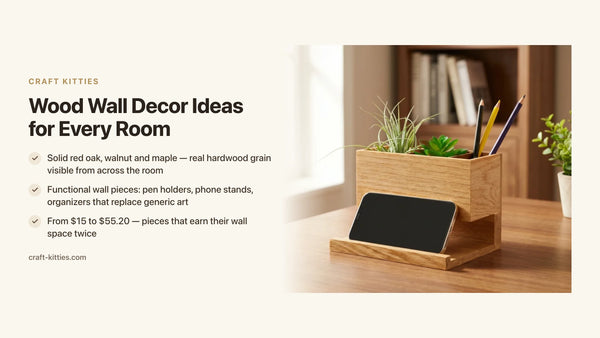
- Solid walnut, red oak, and beech read warm and age like furniture — metal reads clean and industrial
- Wood wins in natural, Scandinavian, and transitional rooms; metal wins in loft and minimalist spaces
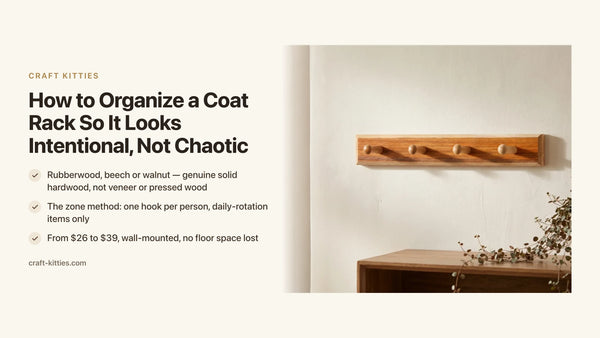
- Both work best when combined with a single consistent accent metal (brushed gold or matte black)
The choice between wood and metal is not a question of quality. Both materials can be well or badly made, appropriately or inappropriately used. The real question is simpler: what does your room need, and what do you want to live with for the next ten years?
Wood — solid walnut, red oak, beech — brings warmth. It ages. It develops a surface that photographs and behaves like furniture, not like a decoration that got hung on a wall. Metal — powder-coated steel, brushed aluminum, blackened iron — reads cleaner, harder, more architectural. It belongs on a loft wall or in a room that already speaks the language of industry and geometry.
Most rooms are somewhere in between. Most choices are not either/or. This guide lays out the honest case for each material, where each falls short, how they combine, and which products from our studio illustrate what solid wood can do on your wall and your surfaces.
What solid wood actually brings to a wall

The first thing wood does that metal cannot is catch light at a grain angle. A walnut panel on the wall does not reflect light back at you — it absorbs it, breaks it across the growth rings, and returns something that reads as warmth rather than brightness. That is the perceptual quality every interior stylist reaches for, and it is why solid wood has remained the default material for furniture and architectural trim across every era of interior design.
Walnut is the premium choice for wall display. Its deep brown surface sits at the intersection of furniture and art: serious enough to hold a wall alone, warm enough to anchor a lighter room without overpowering it. The grain is tight and fine — you read it up close, not from across the room. Against white or light gray walls, walnut is the most reliable choice for a piece that looks intended rather than hung.
Red oak is lighter, bolder in grain, and carries more visual energy. It brightens a neutral or darker room and pairs well with black metal accents — the contrast between the honey grain and the hardware is part of the composition. For rooms with existing warm tones (terracotta, ochre, warm linen), red oak reinforces the palette rather than competing with it.
Beech is the underestimated middle ground: warm without being dark, tight-grained without being plain. It reads naturally alongside both light and mid-toned interiors and is the species that ages most gracefully into a near-invisible character — not the statement walnut makes, but the quiet long-term presence of a piece that belongs.
What all three share: they are real hardwoods cut from solid lumber, not veneered panels or printed wood-effect boards. The grain you see is the grain through the entire thickness. When a corner gets nicked, there is more wood underneath — not a different material.
What metal brings to a wall
Metal does one thing better than wood: it disappears when you want it to. A matte black metal shelf bracket, a thin blackened iron rod, a brushed aluminum rail — these recede into the architecture instead of adding visual weight. That is useful in rooms that already carry a lot of texture and material, or in spaces where the rule is subtraction rather than addition.
The other quality metal delivers is precision. A laser-cut steel piece reads geometric in a way that wood, with its natural variation, cannot fully replicate. For rooms built around sharp lines, angular furniture, and polished surfaces — contemporary kitchens, loft living rooms, architectural bathrooms — metal wall pieces reinforce the room's language rather than interrupting it.
The trade-off is in aging. Powder-coated steel ages through its finish, not through its surface: chips and scratches reveal bare metal underneath, which can oxidize in humidity or look worn rather than characterful. Solid brushed aluminum holds longer, but it too develops a flatness over time rather than the depth that waxed hardwood builds. The word the design world uses for this distinction is patina — and only wood develops one.
Metal is also physically cold in a way that matters in smaller rooms. In a room under 150 square feet, a wall of flat steel or aluminum can read clinical rather than minimal. Wood in the same space reads as shelter.
The honest comparison: where each material wins

The clearest way to frame this is not which material is better overall, but which room profiles each material serves.
| Criterion | Solid wood (walnut / red oak / beech) | Metal (steel / aluminum / iron) |
|---|---|---|
| Warmth | High — grain absorbs and redirects light | Low to none — reflects flat |
| Geometric precision | Natural variation in grain and edge | High — laser-cut edges, exact angles |
| Long-term aging | Develops patina — deepens and mellows over years | Finish degrades — chips and oxidizes |
| Visual weight on the wall | Present — a statement | Can become near-invisible |
| Humidity resistance | Sealed hardwood: fine. Bare pine or veneer: avoid | Powder coat: fine. Bare steel: rusts |
| Interior style fit | Natural, Scandi, transitional, farmhouse, mid-century | Industrial, loft, contemporary, minimalist |
| Touch and feel | Warm, slightly textured, improves with handling | Cold, smooth, consistent |
The decision matrix — which material for which room
| Your room profile | The better choice |
|---|---|
| Light walls, neutral palette, looking for warmth | Solid walnut — the grain does the work |
| Darker or busier room, need visual breathing space | Red oak or beech — lighter species, less visual weight |
| Loft, industrial, or strictly contemporary space | Metal — or metal anchored by one wood accent |
| Farmhouse or rustic decor | Wood (red oak or beech) with black metal brackets |
| Small room, want the wall to breathe | One larger wood piece rather than several small metal ones |
| Transitional room (mixing eras and finishes) | Wood base with consistent accent metal — brushed gold or matte black |
The rule for combining both materials
The mistake most rooms make is treating the choice as binary: all wood or all metal. The rooms that work best are the ones where the two materials answer each other, and where a shared accent finish — one metal finish used across all hardware, brackets, and accents — is the thread that keeps everything coherent.
The practical rule: choose your accent metal first, then let wood and metal pieces share that language. If the kitchen hardware and the bathroom fittings are brushed gold, the wooden serving tray on the shelf and the metal plant bracket on the wall will read as the same room even though they are different materials. If black hardware is your constant, a walnut tray with black rail hooks and a black iron plant hanger on the same wall will feel designed rather than assembled.
The second rule: keep wood as the warm base, metal as the structural accent. Wood panels, trays, and boards carry visual warmth across the room; metal brackets, rails, and rods provide precision and graphic line. Reversing the proportion — metal as the dominant material, wood as the accent — tends to read cold unless the room is specifically designed for that effect.
The third rule: grain direction matters more than most people think. A horizontal wood grain on a tray displayed vertically reads differently from the same tray displayed horizontally. Before mounting anything, hold the piece to the wall in both orientations and step back. The orientation that makes the grain read most naturally with the room is usually obvious within ten seconds.
Wood as functional wall decor: what a tray does that art cannot
One of the more interesting developments in interior styling over the last decade is the serious tray. A solid wood tray is no longer only a surface for carrying objects — it is a display piece, a vignette organizer, and, when hung or leaned against a wall, a legitimate piece of wall decor that doubles as everyday storage.
The functional argument: a tray on a wall creates a dedicated surface for a rotating display — a candle, a small plant, a ceramic piece — without requiring a permanent shelf installation. It adds depth to a flat wall. Trays cast soft shadows at certain light angles in a way that a flat panel cannot. And it is reversible: what is displayed today can be cleared and replaced tomorrow without touching the wall.
The aesthetic argument: a well-grained walnut tray hung at eye level on a white wall is genuinely hard to distinguish from art. The grain creates movement; the edges create frame; the depth creates shadow. In a room that does not want framed prints but wants something on the walls, a solid wood tray does the same compositional work — at a fraction of the cost and with the bonus of remaining functional.
The key is choosing a tray whose grain has enough presence to read as a display object rather than a kitchen tool left on the wall. That means real hardwood — solid walnut or solid red oak — with a finished surface that reflects care rather than utility.

Description
The square format of this walnut tray is intentional: it works at the center of a composition in a way that rectangular trays, which require an orientation decision, do not. Solid walnut throughout — the grain you see on the surface runs through the full thickness of the board. The wax finish gives the wood a low-sheen depth that photographs accurately and looks exactly as good in person. The two cord-management slots are a detail that belongs to a studio that builds for daily use rather than for category photos. At $39, this is the piece we point to when the question is what solid wood is actually worth compared to a veneered alternative.

Description
The rectangular format serves rooms that have a longer surface to anchor: a console table in an entry, a coffee table in a living room, a kitchen island that needs visual definition. Solid walnut, sealed and finished for daily use. Displayed horizontally on a wall, the length of the piece creates a horizontal line that a square cannot — useful in rooms where the horizontal axis needs reinforcing (low ceilings, wide rooms, landscape-oriented walls). At $35, it is the entry point to solid walnut without entry-point compromises on finish or grain quality.
Our wooden serving trays collection gathers the pieces built for exactly this kind of double life — functional enough for daily use, grain-forward enough to hold a wall.
The styles where wood wins decisively
There are four interior styles where solid wood wall decor wins so clearly that the comparison with metal is almost academic.
Scandinavian and Nordic interiors are built around the combination of white walls, natural light, and raw organic material. Wood — especially light-toned species like beech and pale red oak, or the darker counterpoint of walnut — is the material the style is designed around. Metal in Scandi rooms is typically reserved for structure (legs, rails, light fixtures) rather than surface decoration. A solid wood tray on a white Scandi wall is not a decor choice; it is a category requirement.
Transitional interiors — rooms that mix contemporary lines with traditional warmth — need exactly what solid wood provides: a material that reads modern (clean edges, controlled grain, precise dimensions) but does not feel cold. Wood trays, wood panels, and wood shelving are the most reliable way to prevent a transitional room from sliding too far toward either extreme. They are the material that holds the negotiation in place.
Farmhouse and rustic rooms operate on a palette of organic materials: linen, ceramic, red oak, beech, iron. Metal is present but always as hardware — brackets, handles, rails — rather than as the decorative surface itself. In these rooms, wood is the skin and metal is the skeleton, and the distinction is visible in every piece that does the job well.
Mid-century modern rooms use walnut the way the style's original designers did: as the warm center of a room where every other element (upholstery, ceramics, brass) answers it. A walnut tray on a sideboard or a walnut panel on the wall is in direct conversation with the furniture that defines the style. No other material makes that conversation as naturally.
The styles where metal holds its own
For three interior styles, metal wall decor is the more considered choice.
Industrial and loft interiors are built around exposed structure: concrete, brick, unfinished steel, raw ductwork. Metal wall pieces — blackened iron, brushed steel, raw aluminum — belong here because they continue the visual language of the room rather than softening it. Wood in a genuine loft can feel like an attempt to domesticate a space that is better left raw. The exception is when one warm wood piece is used deliberately as a counterpoint — but that is a stylist's move, not a default.
Strictly contemporary rooms — white walls, floor-to-ceiling windows, furniture with no ornamentation — use wall art as geometric punctuation rather than material warmth. Laser-cut metal, anodized aluminum shapes, and powder-coated steel panels keep the discipline the room is organized around. Wood is not wrong here; it is simply more effort to integrate without tipping the room toward something softer than the design intent.
Minimalist rooms use wall decor sparingly enough that the material choice is nearly secondary — what matters is the object's form and what surrounds it. A single thin iron rod or a small blackened steel shelf in an otherwise empty room reads perfectly because the room's premise is removal, not addition. In those same rooms, one solid walnut tray can work equally well. The minimalist premise accommodates both; the decision returns to warmth versus architecture.
Five mistakes to avoid when choosing wall decor material
Choosing from product photos instead of your wall. A walnut piece that glows against a white studio background can read muddy against a warm greige wall. The right method: look at your wall under your actual light conditions at the time of day you spend most time in the room, then decide which species provides the contrast the composition needs.
Mixing accent metals without a thread. Brushed gold next to matte black next to chrome, all on the same wall, reads as unsettled even when each individual piece is well designed. Pick one accent metal and run it through every piece on the wall — that single discipline makes mixed materials look intentional rather than accumulated.
Scaling down in a small room. The reflex in small rooms is to choose smaller pieces to avoid "overwhelming" the space. The actual result is usually a wall covered in under-scaled objects that read as clutter. One piece sized correctly for the wall — typically 14 to 20 inches in its longest dimension — anchors a small room better than four pieces that are each one-third that size.
Treating material as permanent. Both wood and metal wall decor can be moved, restaged, and recombined. A walnut tray that worked in the living room may belong in the kitchen next year. Approach wall decor as you would furniture: it has the right to move with the room's needs.
Buying veneered "wood-look" pieces to stay on budget. The veneered alternative looks credible in a photograph. Within 18 months of a kitchen or bathroom wall — any space with humidity variation — the edges lift, the printed grain chips, and the piece looks cheap in a way the solid hardwood original would not. The price difference between a veneered board and a sealed solid wood piece is rarely more than $15 to $20. That gap is narrower than the difference in lifespan.
How to style a solid wood tray on the wall
The practical method for displaying a solid wood tray as wall decor has three steps.
Choose the wall position. The most effective position for a tray is behind a functional surface — above a console table, a sideboard, or a low shelf — where the tray and the surface below it create a composed layer rather than a floating object. A tray displayed alone on an otherwise empty wall needs to be large enough to hold the wall; a 12-inch tray on a nine-foot wall is lost. A tray above a console anchors the wall and the furniture simultaneously, which is why that pairing appears in virtually every shelter-magazine image that features a wood tray.
Choose the orientation. Square trays are format-neutral; orient them based on which edge of the grain reads best at the room's viewing distance. Rectangular trays read differently horizontal versus vertical — horizontal creates a grounding line, vertical creates height. Spend thirty seconds holding the tray to the wall in both orientations before committing to hanging hardware. The orientation that makes the grain read most naturally is usually obvious within those thirty seconds and rarely obvious before them.
Style the surface. A tray on a wall remains a tray — it has depth and a surface, and that surface wants objects. One to three small objects is the working range: a candle, a smooth stone, a small ceramic vessel, a folded linen cloth. More than three objects and the tray reads like a storage problem rather than a styled vignette. The objects should sit lower than the tray walls so the composition reads as intentional from across the room, not as a box of things.
Where to go from here
The wood versus metal question resolves differently in every room, but the underlying principle is consistent: match the material to the feeling the room already wants to project, then commit to a single accent metal that bridges all the pieces together. For rooms that are warm, layered, or transitional — the majority of living rooms, dining rooms, and entryways — solid walnut or red oak is the starting point. For rooms that are architectural, spare, or industrial, metal holds the wall well on its own terms.
The two trays in this guide — the Walnut Coffee Tray & Dessert Plate at $39 and the Walnut Rectangle Coffee Tray at $35 — represent what solid wood can do when the grain is cut from real hardwood and the finish is applied to last. They are functional objects that cross into decor territory naturally, without being asked to perform as art. That is the position solid wood has held in interiors for a long time, and it has not been displaced by alternatives that look like it but are not.
Our customers on Etsy — over 240 reviews from people living with our studio's pieces every day — consistently return to one observation about the wood trays: they look more considered than their price suggests. That is what real walnut and solid red oak do. They do not look like a decor purchase. They look like a furniture decision.
FAQ — wood vs metal wall decor
1 — Is wood or metal better for wall decor? It depends on the room and the look you want. Solid walnut, red oak, and beech add warmth and develop character over time; they suit natural, Scandinavian, and transitional interiors. Metal reads cleaner and more industrial; it suits modern, loft, and minimalist spaces. In most homes, a combination of both materials — anchored by one consistent accent metal — is more interesting than committing entirely to one.
2 — Does wood wall decor hold up in humid rooms? Finished solid wood performs well in normal household humidity. A waxed or oil-finished hardwood surface resists moisture and wipes clean. The wood to avoid in genuinely damp areas is bare, unfinished pine or any veneered board, which can swell at edges over time. Sealed walnut or red oak handles typical kitchen and bathroom humidity without issue.
3 — What wood species is best for wall display pieces? Walnut is the most versatile: its deep brown, tight-grained surface complements virtually every interior palette and reads like furniture against lighter walls. Red oak is lighter, bolder in grain — a better contrast choice in darker rooms. Beech sits between the two: warm, medium-toned, and fine-grained. All three are real hardwoods — the grain you see on the surface runs through the full thickness of the material.
4 — How do I style a wooden tray as wall decor? Mount or lean a solid wood tray at eye level above a console, a sideboard, or a shelf so it anchors both the wall and the surface below it. Add one to three small objects to the tray surface — a candle, a ceramic piece, a small plant — so the composition reads as a curated vignette. The grain of the wood does the primary visual work; restraint is the rule.
5 — Does metal wall decor dent or scratch over time? Powder-coated steel and anodized aluminum resist everyday contact well. The weak point is typically the finish rather than the metal itself: chips expose bare metal, which can oxidize in humid environments. Solid wood ages differently — small marks burnish into the surface and develop character rather than looking damaged.
6 — Can I mix wood and metal wall decor in the same room? Yes, and it is often the better-looking combination. The key is a single consistent accent metal — brushed gold or matte black — that bridges the two materials. A walnut tray displayed next to a black metal shelf reads as intentional rather than mixed, because the hardware finish provides the visual thread.
7 — What size wall decor works in a small room? In a small room, one larger piece at eye level reads better than several small ones scattered across the wall. A 14- to 18-inch tray or panel anchored above a piece of furniture uses negative space correctly — the rest of the wall breathes, and the single piece reads as a decision rather than a collection of objects.
8 — Is solid wood wall decor worth the higher price? For a piece you will live with daily, yes. Solid walnut or red oak does not chip, delaminate, or lose its surface texture over time — it develops a patina instead. Veneered or printed-wood alternatives look comparable in product photos and reveal themselves within one to two years of daily life. The price difference typically buys a decade or more of durability and a surface that improves rather than degrades.