At a glance
- Solid red oak, walnut and beech outlast plastic in every measurable way
- Plastic costs less upfront — wood costs less per year over a realistic lifespan
- Our pieces go from kitchen drawer to desk without modification
Pull a standard plastic organizer from any kitchen drawer after three years and it will likely show cracked dividers, a faint greasy film that wiping never fully removes, and a slight bow along the longest edge. It did not fail dramatically — it just declined quietly, and at some point you stopped noticing how tired it looked. That is the plastic organizer's characteristic exit: not a bang, but a slow fade to acceptable-enough.
The comparison between wood and plastic for drawer organizers sounds like it should be simple. It mostly is. But the practical questions — about durability, about cost over time, about care, about whether solid wood survives a kitchen environment — deserve direct answers. This guide gives them, with no agenda beyond helping you place the right thing in your drawer.
What "solid wood" actually means — and what it does not
The organizer category has a labeling problem. "Wooden," "wood-tone," "natural bamboo-style" and "solid hardwood" describe four different materials that behave in four different ways. Getting this straight before the rest of the comparison matters.
Solid hardwood (red oak, walnut, beech) is milled from a single piece or tight-jointed planks of the same species. No internal voids, no filler. It flexes with humidity and returns to shape. The surface can be sanded, re-waxed and restored. It is what furniture makers use.
Bamboo composite is technically a grass, not wood, pressed with adhesives into planks. It is harder than most hardwoods in raw form, but it delaminates when adhesives fail — and in a moist kitchen environment, they do. Not the same as solid wood.
MDF with wood veneer looks correct in a photo and reveals itself in about eighteen months: the veneer lifts at the corners, the edges swell when they absorb moisture, the surface cannot be refinished. Particleboard with a printed wood-grain film is its cheaper cousin.
Polypropylene or ABS plastic is honest about what it is. Lightweight, injection-molded, inexpensive. Its failure mode is mechanical: UV and temperature cycles embrittle it, joints crack under repeated pressure, the surface develops a greasy-looking film that household cleaners worsen over time.
When we say "solid wood" in this guide, we mean the first category. Every piece in our studio is solid hardwood — red oak, walnut, or beech — finished with a wax or oil-wax coat. Nothing else.
The durability comparison: where wood and plastic actually diverge

The durability gap between solid wood and plastic is not marketing language — it is a material science observation. Polypropylene is technically rated for 50+ years, but that figure applies to UV-stable, temperature-stable outdoor environments. A kitchen drawer is neither. Temperature cycles from a dishwasher nearby, intermittent humidity from a sink, the mechanical stress of being lifted and set down weekly: these degrade a plastic tray at the joints first, then along the base. Three to five years is a realistic lifespan before the dividers develop stress fractures.
Solid hardwood responds to humidity differently. It absorbs and releases moisture, which means it moves — very slightly, seasonally — rather than cracking. A well-finished piece has closed pores that limit that movement, so the practical effect is negligible. The deeper mechanism is that hardwood's internal structure is fibrous, not brittle: it bends before it breaks, then returns to shape. A red oak tray dropped on a tile floor survives; an equivalent plastic piece often does not.
The secondary durability factor is surface integrity. Plastic surfaces — especially the cheaper polypropylene used in budget organizers — develop microfractures from contact with cutlery metal. Grease and food residue migrate into those fractures and stay there. A waxed wood surface, by contrast, is sealed. When it does pick up a stain, a light buff with fine steel wool and a fresh coat of wax restores it. Plastic offers no comparable recovery path.
The cost comparison: upfront price versus real cost over time
The plastic organizer's advantage is obvious: a basic polypropylene insert runs $8–15 at any household retailer. Our solid walnut pen tray is $39. The gap is real and the upfront saving matters when a budget is tight.
The comparison changes when you extend the time horizon. A $12 plastic tray that needs replacing every three years costs $20 over five years and $40 over ten — more if you account for the twice-annual futile attempt to scrub the grease film out of it. A $39 walnut piece that lasts fifteen years costs less than $3 per year. The wood piece also does not depreciate the way plastic does: its surface can be refreshed, and its appearance on year ten is arguably better than day one, as the finish deepens slightly with contact and use.
None of this means plastic is the wrong choice. For a situation where the organizer will be replaced by circumstance — a rental kitchen you are furnishing temporarily, a drawer that will be reconfigured with a renovation in two years — the $12 option makes sense. For a kitchen or desk you intend to keep, the math points consistently toward solid wood.
Which wood species for drawers and desks?

The three hardwood species in our lineup each have a distinct visual character, and the choice between them is primarily aesthetic — in a finished, waxed state, all three perform identically in a drawer or on a desk.
Red oak is the most visually active of the three: a honey tone with an open, pronounced grain pattern that reads clearly from above. It brightens a dark drawer interior and pairs naturally with brass hardware and warm-toned kitchens. On a desk, it brings energy to a minimal setup.
Walnut is the opposite: deep brown, with a fine, tight grain that reads as quiet and intentional rather than bold. Against a light countertop or a pale desk surface, it functions like a piece of furniture — deliberate, warm, design-forward. Walnut is the species most associated with premium kitchen accessories and high-end desk setups, which makes it the easiest recommendation when you are unsure.
Beech sits between the two on the tone scale: pale, almost blond, with a tight even grain. It leans Scandinavian — unobtrusive, clean, at home in any color palette. In a kitchen with white or light grey cabinetry, beech vanishes in the best way: the drawer looks organized without the organizer competing for attention.
The practical rule: match the wood tone to the dominant material in the room. Light oak or beige cabinets with brushed nickel — red oak or beech. Darker tones, warm wood floors, black hardware — walnut. Already have walnut cutting boards or utensil handles — walnut, obviously.
The five products from our studio
These three pieces cover the primary use cases — deep kitchen drawers, open desk surfaces, and under-desk or drawer cable management — all in real hardwood, all finished in our studio.

Description
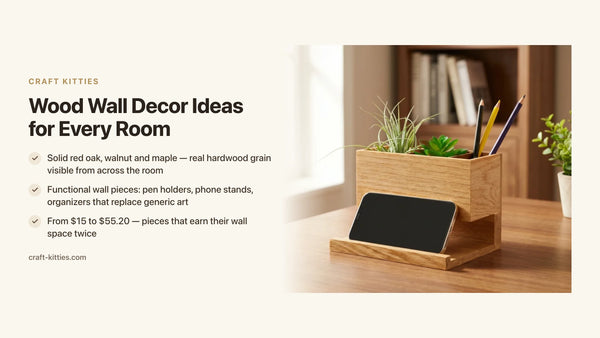
The 2-Tier Valet Tray is the piece for people who need more vertical space without sacrificing footprint. Two solid hardwood platforms, stacked at an angle, create separate zones for flat items (cards, pens, folded bills) on one level and upright items (a phone, a small notebook, a wallet) on the other. In a kitchen, the lower tray holds cutlery; the upper holds the objects you want visible — a timer, a small cookbook. On a desk, it separates the tools you reach for every hour from the things you need once a week. At $39, it is the most versatile piece in the lineup.

Description
The Walnut Cable Organizer Box addresses the problem that drawer trays cannot: power strips, charging bricks, and the tangle of cables that accumulates below desk level. Solid walnut with a fitted lid that closes cleanly — from above, the desk reads empty and intentional; below the lid, nothing has changed except it is now organized. At $46 it is the most purposeful of the three, and the one that has the greatest effect on how a workspace looks at a glance. It also works as a closed-top storage box for a junk drawer's worth of small items when cables are not the concern.

Description
The Walnut Pen Tray is the most honest piece in the lineup: a long, shallow tray cut from solid walnut, designed to hold exactly what you need within arm's reach — pens, a stylus, scissors, a small ruler, a few binder clips. No dividers, no additional structure. Its depth (shallow) is calibrated so nothing rolls out and everything is visible without shifting items around. In a kitchen it holds the slim utensils that disappear in a deep drawer — chopsticks, peelers, skewers. At $39 it is the entry point to solid walnut on a desk, and the piece that makes the rest of the setup look more considered by association.
Comparison table
| Piece | Price | Wood | Format | Best for |
|---|---|---|---|---|
| 2-Tier Valet Tray | $39.00 | Solid hardwood | Double-tier open tray | Drawer + desk dual use, daily silverware |
| Walnut Cable Organizer Box | $46.00 | Solid walnut | Closed box with lid | Cable management, closed storage |
| Walnut Pen Tray | $39.00 | Solid walnut | Shallow open tray | Pens, slim utensils, stationery |
| Standard plastic tray | $8–15 | Polypropylene | Segmented tray | Temporary setup, maximum budget constraint |
| Bamboo composite tray | $20–30 | Pressed bamboo | Segmented tray | Mid-budget, aware of delamination risk |
Decision matrix — which piece for which situation
| Your situation | The right pick |
|---|---|
| Kitchen drawer, daily silverware and utensils | 2-Tier Valet Tray — depth and two levels handle a full drawer |
| Desk surface, pens and everyday stationery | Walnut Pen Tray — shallow, minimal, always accessible |
| Cable and charging clutter under the desk | Walnut Cable Organizer Box — closes the visual problem entirely |
| Budget is the primary constraint right now | Plastic tray from a hardware store, replace when needed — honest choice |
| Renovating or moving in the next two years | Solid wood moves with you; its value is not drawer-specific |
| Gift for a kitchen or home office upgrade | Walnut Pen Tray — fits any setup, looks considered, works immediately |
How to care for a finished solid wood organizer
The care section of most wood product guides is longer than it needs to be, so here is the honest version: wipe it down, do not soak it, and forget about it.
A wax or oil-wax finished piece does not need oiling, conditioning, re-coating or any periodic treatment. The finish is closed. Your role is to wipe away crumbs and moisture after use — a dry cloth takes ten seconds — and to avoid leaving standing water on the surface. Ambient humidity, the kind present in any normal kitchen or office, does not affect a finished piece.
If you see a faint water ring or a light stain after some months of use: a very light buff with fine-grade steel wool (0000 grade) followed by a thin pass of paste wax restores the surface without any tools or skill. That is the one piece of maintenance a solid wood piece will realistically ever ask of you.
What to avoid: the dishwasher (the combination of heat and standing water cycles degrades any finish, solid wood or not), bleach-based cleaners (strip the wax coat), and leaving wet silverware in the tray for hours. Everything else is standard kitchen or desk use — the piece handles it.
Mistakes that send people back to plastic
Buying by dimensions without checking compartment depth. A tray that fits the drawer but has compartments only an inch deep will not hold a standard dinner fork flat without the handles stacking. Check compartment depth specifically, not just the overall tray dimensions.
Choosing a wood tone from a screen without accounting for the room. A rich walnut tray looks stunning on a white studio photography background. Against a warm-toned oak kitchen cabinet, the contrast is much lower — it may disappear rather than anchor the drawer. The reliable test is to look at the other materials in the drawer and on the counter before deciding on species.
Buying MDF-with-veneer for the lower price point. If a "solid wood" organizer is priced under $20, it is almost certainly not solid wood. The failure point — swelling edges, lifting veneer — shows up within one to two years in a kitchen drawer. Solid hardwood at $39 is less expensive per year over the actual lifespan.
Skipping the oil-wax coat on raw bamboo. Some bamboo composite trays are sold unfinished. Without a coat, they absorb grease from cutlery and develop staining that does not wash out. If you choose bamboo, treat it first.
Comparing per-unit cost without accounting for replacement cycles. The plastic tray wins on first purchase. On a five-year view, it usually does not. Run the real math for your situation before deciding.
FAQ — wood vs plastic silverware organizer
1 — Is solid wood really more durable than plastic for a drawer organizer? Yes, consistently. Polypropylene trays crack at the joints and warp under temperature changes over the span of a few years. Solid hardwood — red oak, walnut, or beech — does not crack at joints because there are no joints to fail; it flexes slightly with humidity and returns to shape. A well-finished solid wood organizer routinely outlasts the drawer it sits in.
2 — Does solid wood warp in a kitchen drawer? Not when it is properly finished. A wax or oil-wax coat closes the pores and prevents the moisture swings that cause warping. Bare, unfinished wood is the one to avoid in a humid environment. All our pieces leave the studio finished — no extra treatment needed.
3 — Can I use a wooden silverware organizer as a desk organizer? Absolutely. Solid wood organizers cross between kitchen and desk use without modification. A valet tray holds flatware in one setting and pens, clips and business cards in another. The material is indifferent to context; only compartment sizing matters.
4 — How do I clean a solid wood organizer? Wipe with a dry or barely damp cloth. No soaking, no dishwasher, no harsh cleaners. A few seconds per week is the full maintenance requirement for a finished piece.
5 — Red oak, walnut or beech — which is best for kitchen drawers? All three perform identically in a kitchen drawer when finished. The choice is aesthetic: red oak is honey-toned with a bold grain; walnut is deep brown with a fine quiet grain; beech is pale and tight, leaning Scandinavian. Match the wood tone to the cabinet hardware and countertop materials you already have.
6 — Is the price difference between wood and plastic actually worth it? On a per-year basis, usually yes. A plastic tray at $12 replaced every three years costs $20 over five years. A solid wood piece at $39 that lasts fifteen years costs under $3 per year. The wood piece also looks better over time rather than worse.
7 — What sizes fit standard kitchen drawers? Standard kitchen drawers run 12–24 inches wide and 18–22 inches deep. Our trays sit comfortably inside a standard 18-inch deep drawer. For shallower desk drawers (12–15 inches deep), the pen tray is the right fit.
8 — Does wood stain from silverware or kitchen use? A finished wood surface resists staining far better than raw wood or most plastics, which absorb grease and develop permanent yellowing. The wax coat forms a barrier you can wipe clean. If a stain does land, a light pass with fine steel wool and a fresh wax coat restores the surface completely.
Where to go next
A drawer organizer is usually the first wood piece people place in a kitchen or at a desk, and rarely the last. Our desk organizer collection gathers the full range — trays, boxes, pen trays, valet trays — in the same red oak, walnut and hardwood families, finished in our studio with the same wax-coated care. The Hardwood 2-Tier Valet Tray is where most people start; the Walnut Pen Tray Desk Organizer is what they add next.
A smaller number of our customers find us through our Etsy shop, where we have collected 243 reviews — useful if you want to read unmediated accounts of how these pieces hold up in real kitchens and desks over time.
Conclusion — the long answer is a short one
Wood beats plastic in a kitchen drawer or on a desk by every long-term metric: durability, surface maintenance, appearance over time, and cost per year once the replacement cycle is factored in. The only scenario where plastic wins is a strict upfront budget or a genuinely temporary setup. For everything else, the math and the look point the same direction.
The 2-Tier Valet Tray handles the kitchen drawer; the Walnut Pen Tray handles the desk surface; the Walnut Cable Organizer Box handles what sits beneath it. Three pieces, three problems solved — in solid wood that will still look right years from now.