At a glance
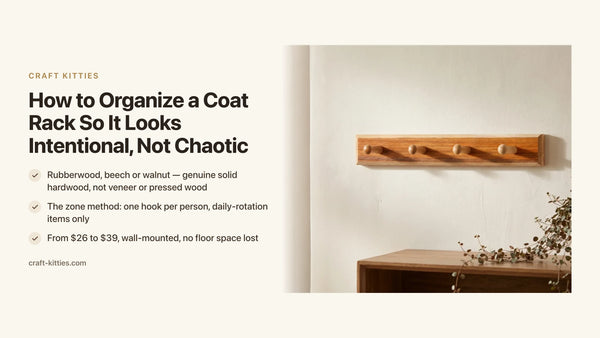
- Solid beech, walnut, or carved hardwood — real wood, not veneer
- A shelf above the hooks adds keys, mail, and a phone without a second installation
- From $5 to $26, with swivel, magnetic, and two-tone options
The entryway is the room that gets used the most and designed last. A hook added to the back of a door, a basket on the floor, keys somewhere on the counter — most hallways accumulate objects rather than organize them. A wood wall hook with a shelf does something different: it provides a fixed address for every arriving object and stacks the shelf above the hooks so the wall does twice the work in the same footprint.
The challenge is choosing well. Between solid beech and walnut, fixed and swivel, magnetic and standard, the options in this category span very different use cases that look similar in a product photo. This guide walks through what actually matters — wood species, hook mechanism, shelf utility, and mounting — then presents the five pieces from our studio with their prices, a comparison table, an installation method, and answers to the questions we hear most often.
One clarification up front: this guide covers solid hardwood only. A hook made of MDF with a wood-look film reveals itself quickly — corners chip, the finish cracks at contact points, and weight causes it to sag at the mounting screws. Solid beech and walnut age the way furniture does: they develop character with use instead of deteriorating.
Beech or walnut: choosing the wood for your wall

The two species in our core lineup are close in strength and far apart in appearance. Solid beech is pale — almost cream — with a fine, tight grain that gives it a neutral, Scandinavian character. Against white, grey, or linen walls it integrates quietly, making the room feel calm rather than busy. It suits minimal and modern interiors well and reads as a clean backdrop to the objects hung on it, rather than a statement in itself.
Solid walnut moves in the opposite direction. Its deep warm brown and finer grain read as a deliberate design choice on almost any wall. Against light paint, a walnut hook stands out the way a piece of furniture does — intentional, grounded. In a darker or more textured entryway it brings a premium note without adding visual weight. Walnut is the wood of choice in our two-tone pieces, where it pairs with lighter beech in the same hook to create a contrast that functions as décor before anything is hung on it.
On every practical criterion — load capacity, finish durability, screw grip — the two species are equivalent. Both are hardwoods; neither is a soft wood that dents easily under daily use. The decision is purely visual: choose by contrast with the wall that will hold the piece. A pale wall calls for walnut; a dark or heavily textured wall is better served by beech's restraint. When the wall sits between the two, the two-tone hook gives you both at once.
Fixed, swivel, or magnetic: the mechanism that changes the daily experience

The mechanism is the detail that determines whether the hook serves the space or fights it. Three approaches cover most entryway scenarios, and they are not interchangeable.
A fixed hook is the reliable default. The arm projects from the wall permanently, holds whatever weight the mounting allows, and requires no thought to use. Its only limitation is spatial: in a corridor where traffic is frequent, a protruding hook becomes an obstacle when nothing is hanging from it. If the wall has room and the corridor is not tight, a fixed hook with a shelf is the most robust long-term choice.
A swivel hook rotates on its axis. When nothing is on it, it folds flat against the carved wood body and becomes a wall accent rather than a protruding obstacle. When a coat arrives, it swings out in a single gesture. This is the right format for narrow hallways, the back of bathroom doors, or any wall that doubles as a passage. The carved wood form of a swivel hook also functions as an object when folded — it earns its place on the wall even between uses.
A magnetic hook is the least obvious and the most specialized. The magnet is embedded inside the solid wood body, invisible until metal comes near it. The result is a piece that looks purely decorative until a key ring, a lanyard, or a thin clip bag makes contact and holds. Magnetic hooks are the right pick for lightweight everyday items that move frequently — they make the "key location" problem disappear without adding a bulky hook to the wall. For winter coats and heavy bags, pair them with a fixed hook nearby.
The shelf: what it actually solves
The shelf portion of a wall hook with shelf is a small surface — typically six to ten inches deep — positioned just above the hooks. Its value is not storage in the traditional sense. It is a fixed destination for the objects that otherwise orbit the entryway without a place to land: keys, sunglasses, incoming mail, a small plant that softens the space, or a phone charging at eye level rather than on the floor.
What makes the shelf worth the extra wall space is the relationship between its height and the hooks below. When the hooks hold the coat and the shelf holds the keys, one piece at one address organizes the entire arriving ritual. The alternative — coat hook here, key bowl there, shelf somewhere else — scatters the same objects across three installations and still leaves the wall looking provisional.
A shelf also makes the piece visible as furniture rather than hardware. A bare hook disappears against a wall. A hook with a small plant or a seasonal object on the shelf reads as a considered element of the room — the kind of thing guests register without knowing why the entry feels more finished than expected.
Five pieces from our studio, in detail
Each piece below is solid hardwood — beech, walnut, or carved natural wood — chosen to cover the five buyer profiles we meet most: the one who wants a strong, classic statement hook; the one who needs a compact piece for daily light use; the one with a narrow corridor where protruding hardware is a problem; the one who wants a covert solution for keys and lightweight accessories; and the one who wants a two-tone pairing that functions as décor.

Description
The Boot-Profile is the piece for buyers who want their wall hook to look like something, not just hold something. Cut from solid beech, the boot-shaped silhouette gives it a sculptural quality that reads clearly even before a coat is hung on it. The natural wax finish protects the wood while letting the grain show — tactile, honest, nothing printed or laminated. It is the entryway hook that doubles as a conversation piece.

Description
The magnetic hook in solid beech is the covert option. The exterior looks like a simple carved wood block — decorative, minimal, no arm to catch clothing as you pass. Bring a key ring close and it holds firmly; pull back and it releases cleanly. It is the right piece for households where the key location is a recurring problem but where a traditional protruding hook feels too much for a small wall. At $6.90, it is also the lowest-commitment entry point to solid wood in the lineup.

Description
The rustic swivel hook is carved from natural hardwood in a form that references traditional wooden décor: organic, textured, with a worn-wood quality that suits farmhouse, cottage, and transitional interiors. When folded flat, the carved surface reads as wall art. When swung out, it holds a coat or bag with the full strength of a solid wood arm. In a narrow corridor where a fixed hook would be a constant obstacle, the swivel format turns the wall into a functional space without sacrificing the aesthetic.

Description
The entry point to solid wood in this lineup: a clean swivel hook in solid hardwood, no ornamentation, no hardware visible. It folds flat against the wall when not in use and swings out when needed. At $5.00, it is the most accessible piece in the collection and the right starting point for a first hook, a secondary hook behind a door, or a multi-hook installation where cost per unit matters.

Description
The two-tone hook is the statement piece of the lineup. Two fixed arms in the same mounting — one in pale beech, one in deep walnut — sit side by side and provide double the hanging capacity in a single installation. The contrast between the two tones gives the piece a visual clarity that a single-species hook does not have: from across the entry, the two woods register as a deliberate design choice rather than utility hardware. For two people sharing a single entry, it also solves the "whose hook is whose" problem without any labels.
Comparison table
| Model | Price | Wood | Mechanism | Best for |
|---|---|---|---|---|
| Boot-Profile Beech Hook | $12.00 | Solid beech | Fixed | Statement piece, sculptural silhouette |
| Beech Magnetic Hook | $6.90 | Solid beech | Magnetic | Keys, lightweight bags, minimal look |
| Rustic Swivel Hook | $9.00 | Carved natural hardwood | Swivel | Narrow corridors, farmhouse décor |
| Solid Wood Swivel Hook | $5.00 | Solid hardwood | Swivel | Entry price, behind doors, multi-hook |
| Two-Tone 2-Hook Row | $26.00 | Beech + walnut | Fixed × 2 | Two users, design-forward entryway |
Decision matrix — which hook for which situation
| Your situation | The right pick |
|---|---|
| You want the hook to be a visual anchor for the entryway | Boot-Profile Beech Hook ($12) |
| Keys disappear daily — you want a covert, always-there solution | Beech Magnetic Hook ($6.90) |
| Narrow hallway where a protruding hook is a daily hazard | Rustic Swivel Hook ($9) |
| First hook, tight budget, or secondary door hook | Solid Wood Swivel Hook ($5) |
| Two people sharing one entry, one installation | Two-Tone 2-Hook Row ($26) |
| A gift that gets used every single day | Two-Tone 2-Hook Row — the piece people remember |
How to install a wood wall hook with shelf in four steps
1 — Find the stud. For any hook that will carry daily coat loads, anchoring into a wall stud gives the long-term strength that drywall anchors alone cannot. A stud finder takes ninety seconds. Mark the center of the stud with a pencil before moving to the next step.
2 — Set the height. The hooks should sit at 60 to 66 inches from the floor — within natural arm reach for adults, high enough that long coats clear the ground. If you are mounting a piece with a shelf, the shelf will land two to four inches above the hook arms: factor that into your wall positioning before drilling. The goal is a shelf that is reachable without stretching, not one that requires a slight jump to place anything on it.
3 — Level and mark. Hold the piece against the wall at the target height, use a small level on the top edge, and mark both mounting holes with a pencil. Drilling blind without marks is the single most common cause of a visibly crooked installation — two seconds with a pencil prevents it.
4 — Mount and load deliberately. Drive the screws into the stud (or into anchors rated for the load), hand-tighten, and check that the piece sits flush before hanging anything. Give the first coat a firm pull before trusting the installation fully. Then place the shelf object: a plant, a small bowl for sunglasses, or nothing at all. An empty shelf still signals that the wall has been considered rather than ignored.
Matching wood hooks to the wall and the room
Solid wood wall hooks are not neutral — they carry a tone, and that tone interacts with the wall behind them and the floor below. Getting the pairing right is the difference between a hook that looks placed and one that looks bought.
The rule that holds across species and finishes is contrast: a pale beech hook needs a medium or dark wall to register, while a deep walnut hook reads best against white, off-white, or pale grey paint. The two-tone hook sidesteps this problem by offering contrast within the piece itself — it works against both light and medium-dark walls because one of its two tones always provides the differentiation.
Hardware matters in a similar way. The hooks in this lineup show the natural wood directly, with no visible metal hardware on the face. That keeps them compatible with any metal finish in the entryway — brushed brass, matte black, chrome — without creating a clash. If the entryway has strong existing hardware (a brass door handle, black light fixtures), the wood hooks sit alongside them rather than fighting them.
Floor materials also play a role that is easy to overlook. A beige or natural wood floor pairs with beech hooks in a way that reads tonally unified; a dark hardwood or concrete floor makes the lighter beech glow and gives walnut a depth that photographs cannot fully capture.
Four mistakes that reduce what a wood hook can do
Mounting too low. The instinct is often to set hooks at shoulder height or slightly below, especially in a low-ceilinged entryway. The result is coats that drag the floor and bags that block the bottom of the door. Measure up to 60-66 inches; it feels higher than expected and works better than it feels.
Using one hook for everything. A coat and a bag and a scarf and a dog leash on a single hook create the pile that makes an entryway look busy rather than organized. The two-hook row, or two separate hooks spaced eight to twelve inches apart, is nearly always the right installation — it takes three extra minutes and produces a fundamentally different daily experience.
Choosing the wood from the product photo instead of the wall. Studio lighting and white backgrounds make both beech and walnut look similar in photos. Before ordering, look at the actual wall where the piece will live, note whether it reads warm or cool, dark or light, and apply the contrast rule. This one step eliminates most return requests.
Skipping the shelf object. A hook with a shelf that holds nothing looks like a hook that forgot to be a shelf. The shelf earns its space with one object: a small succulent, a bowl for keys and coins, or a single framed card. The object does not need to be permanent — but it does need to be there, or the design logic of the piece is only half-specialementsed.
Wood wall hooks as part of a complete entryway
The hook and shelf piece is the anchor, but the entryway works as a system. A single hook with a shelf solves the coat-and-key problem; a mirror above and a mat below solve the visual entry and the floor transition. In between those pieces, the wall still has room for a second hook at a lower height for children or guests, a small hook for umbrellas near the door, or a dedicated magnetic hook at key height.
Our wall hooks collection is organized around exactly that system logic — each piece is sized and finished to sit alongside others rather than demand the wall for itself. The Boot-Profile Beech Hook and the Two-Tone Beech & Walnut Wall Coat Hooks in particular are designed to be installed together or separately depending on how much wall the entryway offers.
FAQ — wood wall hooks with shelf
1 — What is the difference between solid beech and walnut for wall hooks? Solid beech is pale, tight-grained, and nearly neutral — it blends with white, grey, and Scandinavian walls. Walnut is darker and warmer, with a finer grain that reads as a deliberate design choice against light surfaces. Both are hardwoods with the same daily strength. The choice is visual: beech recedes, walnut stands out.
2 — How much weight can a wood wall hook with a shelf hold? A properly anchored solid wood hook — into a stud or with rated drywall anchors — holds 20 to 30 lbs per hook without issue, which covers coats, bags, and helmets. The shelf is designed for lighter daily items: keys, mail, a small plant, or a phone. For heavier loads, anchor into a stud.
3 — How high should wall hooks with a shelf be mounted in an entryway? The hooks themselves are most useful at 60 to 66 inches from the floor — within natural arm reach for adults, high enough that long coats clear the ground. The shelf then lands two to four inches above the hook arms. For a household with children, a second lower row at 40 to 45 inches covers them without changing the main installation.
4 — Can a wood wall hook with shelf work in a narrow hallway? A wall hook with a shelf is the right format for tight spaces because it stacks two functions vertically on a single footprint. In corridors under 36 inches wide, a swivel hook is preferable to a fixed arm — it lies flat when not in use and eliminates the protruding obstacle when the space is empty.
5 — Is a magnetic wood hook practical for everyday use? Magnetic hooks are well-suited for lightweight items that move frequently — keys, lanyards, thin bags, sunglasses cases. The magnet is embedded inside the solid wood body and is invisible when not in use. For heavy coats or wet gear, pair a magnetic hook with a fixed or swivel hook on the same wall.
6 — What is a swivel wood wall hook and when is it useful? A swivel hook rotates on its axis and folds flat against the carved wood body when not in use. This makes it the right choice for narrow corridors, doors, and any wall where a protruding arm would be a daily obstacle. Folded flat, a carved swivel hook functions as a wall accent between uses.
7 — Do I need to drill to mount a wood wall hook with shelf? A piece with a shelf is best installed with screws — the shelf adds weight that adhesive strips may not sustain over time with daily loading. For a single hook without a shelf, heavy-duty adhesive is an option in rental situations. For a shelf piece, a screw installation is the reliable long-term choice.
8 — How do I care for a solid wood wall hook? A dry or barely damp cloth removes dust and light marks. Avoid harsh solvents and prolonged moisture. If the surface looks dull after years of use, a thin coat of natural wax or food-safe oil restores the tone. Solid beech and walnut do not rust, chip, or peel — they develop a patina with use.
Where to go next
A wall hook with a shelf is usually the first piece that turns an entryway from a landing strip into an organized space — and rarely the last. Our wall hooks collection gathers the pieces that work alongside each other: single hooks, double rows, swivel and magnetic options, all in solid beech and walnut finishes designed to sit on the same wall without competing.
Customers who have explored the lineup on Etsy — where the studio has 243 verified reviews — regularly pair the two-tone row with a single magnetic hook at key height: one piece for coats and bags, one for daily carry, nothing left on the floor.
Conclusion — one piece, two problems solved
If this guide leaves you with one method: choose the wood by contrast with your wall, pick the mechanism by the width of your corridor, and mount at arm height rather than at the previous hook's holes. The Boot-Profile Beech Hook is the answer when the hook should also be an object; the Rustic Swivel Hook solves the narrow-hallway problem without sacrifice; the Two-Tone 2-Hook Row turns a single installation into a complete entryway solution. Three paths, one result: a wall that finally holds the arriving day in place.