At a glance
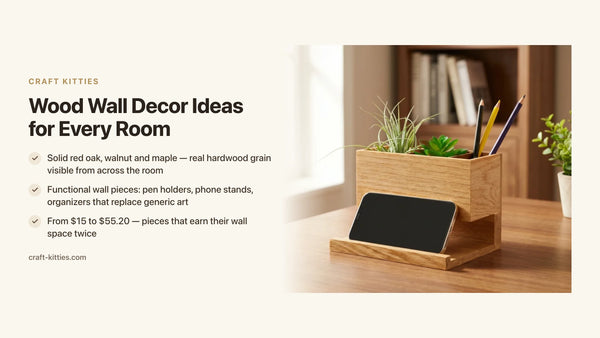
- Solid walnut, red oak or beech — real hardwood, not printed panels
- Start with a tray anchor, add pen holder and cable box, then fill what remains
- From $39, hardware in matte black or brushed gold
A desk that looks like a workspace tells you something is wrong before you open a single browser tab. The visual noise of tangled cables, scattered pens and a phone lying face-down in no particular place is not a personality quirk — it is a friction cost that compounds across every hour you sit there. The fix is not aesthetic minimalism for its own sake; it is having a place for every object so the desk resets itself to order in thirty seconds.
A wooden desk organizer set is the most durable and visually cohesive answer to that problem. Not because wood is the only material that works, but because solid walnut, red oak or beech does something no plastic bin or painted-metal tray manages: it ages like furniture rather than looking used. It brings warmth to a surface that otherwise reads as a technology stack, and it does it without imposing a decorating style on the rest of the room.
The challenge is choosing well and, more practically, choosing in the right order. A set that starts with six pieces ends up with three that get used and three that migrate to a drawer. This guide covers the species question, the hardware question, the sequencing of pieces, the products from our studio with their exact prices, two comparison tables, and the questions that come up repeatedly from people building their first real desk setup.
Red oak, walnut or beech: which species for your desk

The three species in our lineup each read differently on a desk, and the choice matters more than it sounds because a desk organizer set lives at eye level, in focus, for the entire time you are working.
Walnut is the most requested tone in home office settings for good reason. Its color sits in a deep chocolate brown with a fine, tight grain that reads quietly elegant rather than visually loud. On a light desk — white oak, white laminate, or pale natural wood — walnut creates contrast that makes the pieces read like intentional furniture. Against a dark desk it becomes a single-species composition, which works only if the hardware accents (drawer pulls, cable clips, monitor mounts) are already in that dark-wood register. The shorthand: if your desk is light, walnut is almost always the right call.
Red oak is lighter, honey-toned, with a grain that is visibly bold and directional. It suits desk setups that already have dark surfaces and benefit from the contrast working in reverse — a dark walnut desk with red oak organizers, dark furniture with light wood accents, a warmer reading. It also works naturally alongside unpainted brick walls, exposed concrete and darker paint colors where walnut might disappear. The grain pattern draws attention, which is an asset in rooms with neutral or minimal décor and a liability in rooms that already have a lot going on visually.
Beech is the quiet third option: very pale, smooth-grained, close in character to maple. It suits bright, Scandinavian-style desk setups where the goal is maximum lightness and minimum visual weight. It is less forgiving of scuffs and handling marks than walnut or oak in terms of visibility, but no less durable — beech is a hardwood that holds joinery and hardware firmly. If your desk is white or very light natural wood and you want the organizers to recede rather than stand out, beech is the answer.
On every other criterion the species are comparable: each is solid hardwood, each holds a wax or oil finish that protects against the ambient conditions of a home office, and each machines cleanly for the joinery that makes pen slots and cable ports function correctly. The choice is about the tone you want on your desk surface, not about which one will last longer.
Hardware finish: matte black or brushed gold
The hardware finish — the metal used for any feet, clips, compartment dividers, or drawer pulls — is the second axis of a coherent set, and it is the one that most people decide last when they should decide it first.
The logic is simple: metal finishes do not mix visually without reading as an error. A matte black pen tray next to a brushed gold cable box next to a silver monitor arm is not eclectic; it is inconsistent in a way that registers subliminally even if no one articulates it. The remedy is to choose one finish family and hold it across every piece — hardware included.
Matte black reads modern and architectural. It suits walnut particularly well (dark wood, dark metal, no glare), and it pairs naturally with the typical tech peripherals already on a desk — USB hubs, webcams, keyboard frames — which are almost all black. If your monitor is matte and your keyboard is dark, matte black hardware makes the organizer set disappear into the system rather than interrupt it.
Brushed gold is warmer and softer. It suits both walnut and red oak, and it flatters natural desk surfaces better than cold chrome. It signals a deliberate aesthetic choice rather than a default, which is why it lands well in home offices that lean toward interior design rather than productivity minimalism. If your desk setup already has any warm metal accent — a lamp base, a notebook spine, a monitor trim — brushed gold hardware reinforces that thread without forcing it.
The practical advice: look at the existing metal on your desk before ordering. One finish family already dominates; match it.
The right sequence: which pieces to add first

The most common error when building a desk organizer set is buying everything at once, placing it all on the desk, and discovering that three pieces overlap in function while one area stays uncovered. The right approach sequences the purchase by use frequency and visual weight.
Start with the anchor. A tray — flat, low-profile, large enough to hold a phone, a wallet, a pair of glasses and a notebook — is the visual center of the set. Everything else is arranged around it. A two-tier valet tray earns more real estate because the second level separates the items you reach for constantly (phone, pen) from those you need once a day (charger, business cards). Place the tray first, then step back and look at the desk before ordering anything else.
Add the upright piece next. Pens, pencils, a ruler, a pair of scissors — the items that need to stand vertically rather than lie flat. A pen tray keeps them in a single row rather than a forest, which is lower-profile and easier to scan. Add this second, once you know where the tray sits and which area of the desk it does not cover.
Then the cable box. Cables are the one element that reliably defeats any desk organization system that does not address them directly. A solid wood cable management box hides the power strip, the USB hub, and all the cables that feed from them, leaving only the single cable per device visible on the surface. This is the piece that most transforms the visual read of the desk, and it is the one most often added last — which delays the result for no good reason.
The fourth piece is optional and site-specific. A monitor riser creates storage below the screen and reduces neck strain; a small drawer unit answers the question of what to do with items you need at the desk but not on the surface. Add it once the first three are in place and you can see what problem remains.
The pieces from our studio
Three products, chosen because they address the three most common desk organization needs — daily carry, stationery, and cable management — in the same hardwood vocabulary.

Description
The Hardwood 2-Tier Valet Tray is the piece to place first. Two solid wood tiers — a wide lower platform for daily carry and a raised upper tier for items you reach for constantly — give the desk a visual center while keeping the surface genuinely clear. The natural hardwood finish is quiet enough to work alongside any wood tone already on the desk. At $39, it is the starting point of the set.

Description
The Walnut Cable Organizer Box solves the problem that defeats every other desk organization effort: cables. Solid walnut with a wax finish, it contains the power strip, the USB hub and all the cables that feed from them inside one object that reads as furniture rather than infrastructure. Port cutouts on the back face keep cable runs clean. At $46, it is the highest-impact single purchase in the set.

Description
The Walnut Pen Tray replaces the classic cylindrical pen cup with something lower-profile and more intentional. Solid walnut, a recessed tray format that keeps pens, pencils and stationery in a single visible row rather than buried in a vertical container. It does not dominate the desk visually, which is exactly the right behavior for the middle piece in a set. $39.
Comparison table
| Piece | Price | Wood | Function | Add first when |
|---|---|---|---|---|
| Hardwood 2-Tier Valet Tray | $39 | Solid hardwood | Daily carry anchor — phone, wallet, glasses | Always — it is the visual anchor |
| Walnut Cable Organizer Box | $46 | Solid walnut | Hides power strip and all cables | Cables are the dominant visual problem |
| Walnut Pen Tray | $39 | Solid walnut | Stationery, low-profile row format | Pens are scattered and a cup feels too tall |
Decision matrix — which combination for which setup
| Your situation | The right combination |
|---|---|
| You want one piece that makes an immediate difference | Walnut Cable Organizer Box — cables gone, desk already looks different |
| You work from home and want a real desk setup, not just storage | 2-Tier Valet Tray + Walnut Pen Tray — anchor and stationery, $78 |
| You want the full three-piece set | Valet Tray + Pen Tray + Cable Box — all three desks problems solved, $124 |
| You already have stationery storage sorted | 2-Tier Valet Tray + Walnut Cable Organizer Box — the two highest-impact pieces |
| Gift for someone who works from home | 2-Tier Valet Tray + Walnut Pen Tray — used every day, reads as intentional from day one |
| Standing desk setup | Walnut Cable Box first (cables move when the desk does), then low-profile Pen Tray |
What solid wood actually means in daily use
The distinction between solid wood and veneered or printed-wood alternatives matters more in a desk context than in almost any other furniture category, because desk objects are handled constantly. The pen tray gets picked up and set down. The valet tray gets slid across the desk. The cable box gets cables pushed through its ports and removed from them. Every one of these interactions is a durability test.
Solid red oak, solid walnut and solid beech are dense hardwoods. Their grain runs through the entire thickness of the piece, which means that a scratch or a scuff reveals more wood rather than exposing a core material of a different color. The finish — oil or wax in our studio pieces — penetrates the wood rather than sitting on top of it, which means it does not peel or chip at corners the way a lacquer coat does on painted MDF.
Veneered alternatives fail in a specific pattern: the veneer lifts at edges and corners, which are the places that see the most mechanical stress on a desk object. The failure is rarely sudden — it starts as a small raised edge, becomes a peel, and within eighteen months the piece looks worn in a way that solid wood does not replicate over a decade of use.
The practical takeaway is not that solid wood is perfect — it is heavier, it will show marks if you are not careful, and it costs more than printed alternatives. The takeaway is that the failure modes are different: solid wood develops character over time, veneered alternatives develop visible wear. If you are buying a desk set you intend to keep, the price difference resolves in the first year.
Three mistakes that undermine a desk set
Buying for the photo rather than the workflow. A set that photographs beautifully with three tall organizers, a plant and a leather notebook may be completely wrong for a desk where two monitors dominate the surface and the actual workflow involves physical papers, a drawing tablet and a microphone. Measure what is on your desk before ordering anything.
Skipping the cable box because the desk "isn't that bad." It is always that bad. Cables are the single most cited complaint in desk setup photographs, and the most consistent response when a cable box is added is that the desk looks completely different before anything else changes. It is not decorative; it is structural.
Mixing hardware finishes without a plan. This is covered above, but it bears repeating: one metal finish family, held consistently. The cost of getting this wrong is not catastrophic — you can add a piece later with the right finish — but it means the set never looks quite complete until you do. Decide the finish family when you order the first piece and hold it.
How to maintain solid wood desk organizers
Solid hardwood finished with oil or wax is about as low-maintenance as desk materials come. The daily routine is: nothing. The weekly routine, if the desk is in a dusty environment, is a dry cloth run over the surfaces and into the pen slots. That is the full maintenance protocol for a year.
Two things to avoid: leaving a wet glass or a damp cloth sitting on the wood surface for long periods, and using any alcohol-based cleaning product on the finish. Alcohol strips wax and oil finishes faster than any other agent, and a stripped finish is easy to spot because the wood loses its sheen and becomes more susceptible to surface marks. If the finish ever feels dry, a thin coat of furniture wax — rubbed in, buffed off — brings it back in ten minutes.
There is no sanding cycle, no annual re-oiling ritual, no sealer to reapply. The only thing solid wood asks of you in an office environment is not leaving liquids in contact with it.
Where to go next
The three pieces in this guide solve the most common desk problems — daily carry, stationery and cable management — and they do it in a single wood and hardware language. Our desk accessories collection gathers the full range: the Hardwood 2-Tier Valet Tray for the anchor, the Walnut Cable Organizer Box for wire management, and pieces that extend the set once the core three are in place.
If you found us through Etsy, you've already seen how these pieces perform in real setups — over 240 customers have reviewed our desk and home accessories there, and the consistent note is how different the desk reads once solid wood replaces the default plastic or painted-metal options.
FAQ — wooden desk organizer sets
1 — What wood is best for a desk organizer set? Walnut, red oak and beech are the three most durable and visually coherent choices. Walnut is deep brown with fine grain — the most requested for home office settings. Red oak is lighter with bolder grain, well suited to darker desk surfaces. Beech is very pale and smooth, best for bright minimal setups. All three are solid hardwoods that age well rather than chipping or swelling over time.
2 — How many pieces do I need? Three covers most desks: a tray or valet as the visual anchor, a pen or stationery holder for upright items, and a cable box to contain wires. A fourth piece — a monitor riser or small drawer unit — makes sense once the first three are placed and you can see what gap remains. Starting with more than four pieces before you know your actual workflow usually means three of them migrate to a drawer.
3 — Does solid wood hold up on a working desk? Yes, and in the specific ways that matter for daily desk use. Solid walnut, oak and beech resist scratching better than painted MDF, do not warp from ambient room humidity, and hold their oil or wax finish without peeling at corners. The difference from veneered alternatives shows up clearly in year two, not week one.
4 — Can I mix wood species in one set? Yes, intentionally. Walnut and oak in the same set create depth rather than confusion, as long as all hardware accents stay in the same finish family — all matte black, or all brushed gold. What reads as accidental is mixing three or more species with two or more hardware finishes simultaneously.
5 — What is a valet tray and why is it the starting piece? A valet tray is a low, open tray that collects the items you always put down without thinking — phone, wallet, keys, glasses, a notebook. On a desk it functions as the visual anchor: everything within it reads as curated rather than scattered. It is the starting piece because everything else is arranged around it, and its position determines what areas of the desk still need to be addressed.
6 — How do I clean solid wood desk organizers? A dry or barely damp cloth for everyday dust. A soft brush for corners and pen slots. No wet rags in extended contact with the surface, and no alcohol-based cleaners on any oiled or waxed piece — they strip the finish. No annual maintenance ritual is needed in a normal indoor office environment.
7 — Do wooden desk organizers work for standing desks? Yes, with a preference for low-profile pieces. On a standing desk you shift positions frequently and reach across the surface more, so trays and flat pen holders work better than tall cup-style organizers. A cable management box is particularly valuable because the cables move with the desk; containing them in a solid box prevents the tangle from re-forming every time you adjust the height.
8 — Matte black or brushed gold hardware? Match what is already on your desk. Matte black suits dark setups and integrates naturally with typical tech peripherals, which are almost all black. Brushed gold is warmer, suits both walnut and red oak, and works well when the setup already has any warm metal accent. Decide the hardware finish before ordering the first piece and hold it across all subsequent ones.
9 — Is a wooden desk organizer set a good gift? It is one of the more considered gifts for someone who works from home, because it solves a daily problem rather than adding another decorative object. The strongest gift combination is the valet tray paired with the pen tray — two pieces that address different needs and immediately read as a set. Over 240 customers on Etsy have noted the quality of the solid wood and the impression it makes as a gift.
10 — What is the difference between a pen tray and a pen cup? Format and visual weight. A pen cup holds stationery vertically in a compact footprint — useful when desk space is very limited. A pen tray keeps stationery in a horizontal row, lower-profile and easier to scan at a glance without lifting anything. On desks with enough surface area, the pen tray is the cleaner option because it does not interrupt the sightline the way a tall cylindrical cup does.
Conclusion — a desk that resets to order
The method, reduced to its simplest form: place the anchor first, match the hardware finish to what already lives on your desk, and add the cable box before you add any decorative piece. The Hardwood 2-Tier Valet Tray answers the first step at $39. The Walnut Cable Organizer Box answers the cable problem at $46. The Walnut Pen Tray closes the stationery gap at $39. Three pieces, one wood vocabulary, a desk that looks intentional instead of accumulated.