At a glance
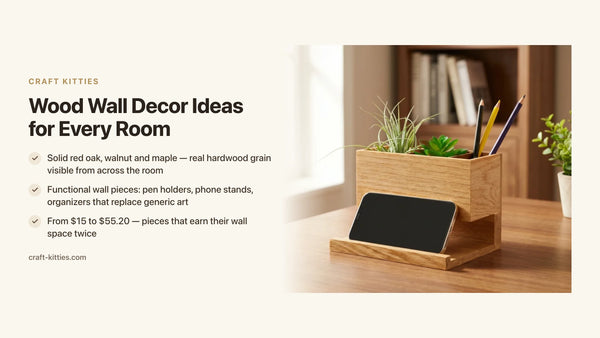
- Solid red oak, walnut or beech — real hardwood, not veneer or MDF
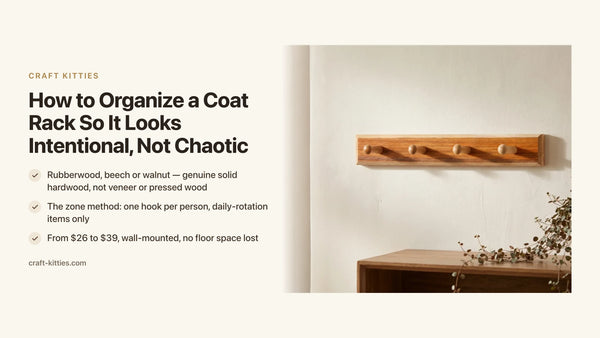
- Wall-mounted wood bars keep the desk surface clear while adding warmth
- From $22 to $24, with brass or matte black hardware accents
The question comes up once most people have lived with a cluttered desk for long enough: should the next organizer be wood or metal? Both materials are available at every price point, in every style from minimal to industrial, and product photography makes neither look obviously better than the other. The decision that seems cosmetic is actually a series of smaller decisions — about daily texture, longevity, maintenance, and the kind of workspace you want to sit in for hours at a stretch.
This guide works through the comparison honestly. Not the version where one material wins in every category and the conclusion was decided before the first sentence, but the version where the right answer depends on who is asking. By the end, you will have a clear picture of where each material leads, a comparison table for the specific products from our studio, and a decision matrix that points to the right pick for your setup without making you read the whole article twice.
One point to establish before the comparison: this guide is about solid hardwood on the wood side — red oak, walnut, and beech — and quality powder-coated or brass-finished metal on the other. Veneered particleboard is not wood, and bare stamped steel is not comparable to brushed brass or quality powder coat. The comparison that matters is between materials that will still look right in five years.
The core difference: what each material does to a workspace
The functional gap between wood and metal is narrower than the aesthetic gap. Both organize, both store, both keep the desk readable. The difference shows up at the edges of daily experience: the texture when your hand brushes the surface, the visual warmth when you glance up from the screen, and the way each material ages.
Solid hardwood has mass without heaviness. Red oak sits dense and stable; walnut has a quiet gravity. Both absorb minor desk vibration — the faint resonance of a keyboard at speed — in a way metal does not. Hardwood surfaces gain character over years of use; a shallow scratch on waxed walnut disappears with a soft cloth and a dab of wax. On a desk you spend hours at, material texture is not trivial.
Metal — especially powder-coated steel or brushed brass — is the cleaner, harder option. It wipes spotlessly, it holds its shape under weight, and it reads industrial or minimal depending on finish. Matte black steel suits a dark, focused setup; brushed brass suits a warmer palette. What metal does not do is develop character. A nick in the coating reveals bare metal underneath, and the only fix is paint.
Neither is superior in every dimension. The decision hinges on your workspace context, your aesthetic priorities, and the care you are willing to invest.
Why solid wood species matter — red oak, walnut or beech

Not all wood behaves the same on a desk. The three species that appear most in quality desk accessories each bring a distinct visual register, and choosing the wrong one for your setup can make even a well-made piece look out of place.
Red oak is light — a honey to amber tone — with a grain bold enough to read clearly across the room. It brightens a desk, adds visual energy, and pairs naturally with white walls, light surfaces, or setups that lean Japandi. Its grain is pronounced enough to be the main visual event of the piece, which suits buyers who want the organizer to announce itself without being loud.
Walnut is the opposite register: deep brown, close-grained, and quietly authoritative. On a light desk it functions like a dark-wood furniture piece — a visual anchor. On a darker surface it recedes and lets other objects define the scene. Walnut suits setups that are already mature in their design, where the organizer should slot in rather than stand out. It is the most asked-about species in our studio, consistently.
Beech sits between the two in tone — pale, even-grained, smooth-surfaced. It is the Scandinavian-functional choice: cool, clean, and more neutral than either oak or walnut. It works in setups that prefer the organizer to disappear into the overall palette.
All three are real hardwoods. Dense, stable, and finished to resist the daily friction of a work surface. A waxed red oak bar will not develop pressure dents from pen cases leaned against it; a walnut wall-mounted rack will not flex under the weight of folded towels or rolled cables. The species choice is an aesthetic one, not a durability trade-off.
Metal desk organizers: what works and what does not
Metal desk accessories cover a wide range — from precision-cut brushed steel to thin pressed-sheet constructions that flex under their own weight. The material quality gap is wider on the metal side than on the wood side, because bare steel is easier to hide behind a coat of paint than particleboard is behind veneer.
Powder-coated steel is the reliable baseline. A thick, even coat bonds to the metal, resists chips in normal use, and delivers a matte surface that wipes clean without marking. Matte black is the dominant finish in minimal and industrial setups because it recedes and lets the desk surface and the tools on it carry the visual weight.
Brushed brass or brushed gold is the premium option. It reads warmer than chrome and more intentional than raw metal, and it pairs exceptionally well with hardwood — the combination of brass hardware on a walnut or oak base is the most requested pairing in our studio. Brass does not rust and develops a low-key patina over time that most buyers consider an improvement.
Galvanized steel is the industrial choice: heavier, more textured, and suited to farmhouse or workshop-adjacent setups where the rougher surface texture reads as intentional character rather than unfinished.
What does not work is thin stamped steel — the kind that flexes when loaded, develops micro-rust at scratched edges within a year, and rattles on a hard surface. It is worth spending the extra ten dollars to land on a piece that holds its shape for five years instead of six months.
The comparison table: wood vs metal at a glance
| Criterion | Solid Wood (oak, walnut, beech) | Metal (powder coat, brass) |
|---|---|---|
| Daily texture | Warm, natural, absorbs vibration | Cool, hard, resonant |
| Aesthetics | High visual warmth, gains character over time | Clean, uniform, suits industrial/minimal |
| Durability | 10–20 years (hardwood, waxed finish) | 5–15 years (depends heavily on coating quality) |
| Scratch repair | Buffable with wax — surface recovers | Chip in coating = permanent (requires touch-up paint) |
| Cleaning | Dry or lightly damp cloth; no harsh products | Wipes spotless; tolerates slightly damp cloth |
| Best style pairing | Japandi, Scandinavian, warm minimal, mid-century | Industrial, dark minimal, contemporary |
| Mixed material | Wood + brass or black metal = classic pairing | Metal alone, or metal with glass/concrete |
Our studio's hardwood pieces, in detail
Four products built around the same principle: real hardwood — red oak, walnut, or beech — finished with care, paired with hardware that does not fight the material.

Description
The Wall Mounted Wood Towel Bar Holder is the piece that settles the "wall or surface" question in favor of the wall. Solid hardwood in a square cross-section profile — dense, smooth, and finished to resist daily contact — it mounts at two points and frees the desk surface entirely. The square geometry reads contemporary without trying too hard: it suits Japandi and Scandinavian setups equally, and because it is wall-mounted it adds visual order to the room rather than to the desk alone. At $24.00, it is the anchor piece to build a desk accessory set around.

Description
The Wood & Brass Towel Rack Wall Mounted Set is the answer to the buyer who wants both materials — and knows the combination is better than either alone. Solid wood paired with brushed brass hardware: the brass adds warmth without loudness, and the wood grounds the set so it reads intentional rather than decorative. At $22.00 it is the entry point into the wood-and-metal aesthetic that shows up in every well-styled home office in 2026. The set installs wall-mounted, which means it works equally in a bathroom or kitchen — one purchase, multiple rooms.

Description
The Wooden Towel Bar Holder — Arc Design is the organic alternative to the square-profile bar. Same solid hardwood, same wax finish, same two-anchor wall mount — different silhouette. The arc profile introduces a curved line into a workspace that is almost entirely composed of straight edges: screens, keyboards, cables, shelves. That one curve changes the feel of the wall without requiring a furniture overhaul. At $24.00, it is the piece for buyers who want warmth through shape rather than through finish.

Description
The Wooden Towel Bar Holder — Double Layer solves the most common desk organizer complaint: that one bar is never quite enough once you start using it. Two bars on one wall mount, one anchor point, the same solid hardwood and wax finish as the single-bar versions. Towels on one bar, cables or belts on the other; or two categories of tools separated and readable at a glance. At $24.00 for twice the storage surface, the math is straightforward.
The decision matrix: which piece for which setup
| Your situation | The right pick |
|---|---|
| You want to clear the desk surface and add warmth to the wall | Wall Mounted Wood Towel Bar — Square |
| You want the wood-and-metal combination in one set | Wood & Brass Rack Set |
| Your workspace is all straight lines and needs a softer element | Arc Design Bar |
| You need to organize two categories of items on one wall | Double Layer Bar |
| You prefer a full metal setup (industrial or dark minimal) | The brass hardware on our wood sets adds the metal note without committing to full metal |
How to mix wood and metal without it looking accidental

The best-looking workspaces in 2026 are not mono-material. They mix wood and metal, but they do it with rules — usually unspoken ones that separate "intentional" from "collected at random."
Rule one: one dominant material, one accent. If the desk surface, the shelves, and the organizer are all wood, then one black metal lamp base is an accent. If the walls are lined with black metal grid panels, then a walnut bar adds warmth as an accent. The failure mode is equal weight: metal grid panel, wood bar, chrome lamp, bamboo tray, raw pine shelf. No material dominates, so none of them reads as intentional.
Rule two: match metal finishes across the room. Mixing brass and chrome at the same visual scale — a brass rack next to a chrome lamp next to a gunmetal cable clip — is what turns a workspace into a showroom floor. Pick one metal finish and carry it through every small object. Matte black or brushed brass are the two finishes that photograph cleanly and age well. Our Wood & Brass Towel Rack Set commits to brushed brass as the hardware language; build from there.
Rule three: ground the setup with wood, let metal do the detail work. Wood is the heavier material visually — it anchors a space. Metal reads lighter and more precise. When wood carries the structure (a wall-mounted bar, a desk surface, a shelf) and metal handles the detail (hardware, clips, lamp arms), the room reads as designed. When it is the other way — metal structures with wood accents — it can work but requires more discipline to keep from looking cluttered.
Installing a wall-mounted bar in four steps
1 — Choose the wall zone. For a desk, the wall behind or to the side of the screen is the most accessible zone. For a bathroom, the side wall within arm's reach from the towel-change position. The goal in both cases is zero reaching — the object should be within natural hand extension without moving your body.
2 — Set the height. For desk use, mount at shoulder height when seated — roughly 48 to 52 inches from the floor. For bathroom or utility use, standard towel-bar height is 48 inches from the floor. The seated arm-extension test beats any chart: sit in your usual position, extend your hand to the wall, and mark where it lands naturally.
3 — Anchor properly. Two points, both into studs or with appropriate drywall anchors. Check level before tightening — a bar that looks straight is half the aesthetic value. Solid hardwood transfers a small amount of load to the wall every time you pull a towel or lift a cable; anchoring well is what prevents that from becoming a problem in year three.
4 — Load intentionally. The most common mistake is treating a wall-mounted bar as overflow storage — hanging everything that fits until the wall section reads cluttered. Load the bar with one category of object, leave breathing room between items, and the bar becomes part of the room's visual structure rather than a problem moved from the desk to the wall.
Mistakes that undercut a good organizer
Buying by product photo instead of by your wall. The same walnut bar that glows against the white background of a product image can disappear entirely on a cream wall, or look out of place against a heavily patterned wallpaper. Look at your actual wall before ordering. Contrast decides whether the piece reads.
Treating organization as a one-time fix. A desk organizer is not a solution to clutter — it is a structure that only works if the surrounding desk habits match it. A beautiful walnut bar surrounded by unmanaged cables and stacked papers does not help the workspace; it highlights the disorder around it. The organizer comes last, after the desk habits are in place.
Underestimating the weight argument for solid wood. A dense red oak or walnut bar is noticeably heavier than pressed-steel alternatives. That weight is not a drawback — it is what keeps the piece from shifting on the wall and what signals material quality to anyone who touches it. Do not mistake density for inconvenience.
Mixing four metal finishes in the same 60-inch span. Chrome monitor arm, gunmetal cable clips, raw steel legs, brass lamp. The individual pieces may each be good; together they form a visual argument that no one wins. Pick the finish you will commit to before the first purchase.
Caring for solid hardwood over the long term
Hardwood desk accessories ask very little in exchange for lasting twenty years. The wax or oil finish on red oak, walnut, and beech bars does the protective work; your maintenance routine is minimal by design.
Daily: a dry microfiber cloth, or nothing if the piece is dust-free. Do not use damp cloths as a default — occasional moisture is fine, routine moisture is not.
Weekly: if the bar or rack is in a bathroom or kitchen context, a lightly damp cloth removes humidity residue. Wipe and let dry. No soaking, no pooling.
Annually: a light pass with natural wax (beeswax or a commercial hardwood wax) keeps the finish sealed and the wood surface looking rich rather than dried-out. The application takes five minutes and significantly extends the lifetime of the piece.
What to avoid: alcohol-based cleaners, bleach, citrus-based products, and prolonged contact with standing water. Wax protects against incidental contact, not sustained exposure.
Surface scratches on waxed hardwood are not the crisis they are on coated metal. A soft cloth, a small amount of wax, and two minutes of buffing bring most surface marks back to baseline. The same nick on a powder-coated steel organizer exposes bare metal that will oxidize unless touched up with matching paint.
Where to go next
The pieces in this guide fit in more rooms than a desk. Our wooden bathroom accessories collection follows the same hardwood and hardware logic — the Wall Mounted Wood Towel Bar Holder and the Wood & Brass Towel Rack Set are both at home in a bathroom, a kitchen, or an entryway as they are beside a monitor.
If you have found our pieces through Etsy — where we have more than 243 customer reviews — the full catalog and same-day dispatch are available directly at craft-kitties.com.
Conclusion — the right material is the one you will live with
The comparison between wood and metal desk organizers is not resolved by a scorecard. Solid red oak and walnut win on warmth, repairability, and long-term character. Quality metal wins on uniformity and spot-clean convenience. The workspaces that look most considered are usually the ones that use both — wood carrying the structure and warmth, metal handling the detail work in a single consistent finish.
The Wall Mounted Wood Towel Bar is the starting point for buyers who want the desk surface back. The Wood & Brass Set answers the mixed-material question at $22. The Arc Design bar solves a workspace that has too many straight lines. And the Double Layer bar doubles the organization without doubling the wall space. Each is solid hardwood, wax-finished, and built to still look right ten years from now.