At a glance
- Solid red oak, walnut and maple — real hardwood, not veneer or bamboo
- From $15.00 to $55.20 for single cup to all-in-one organizer
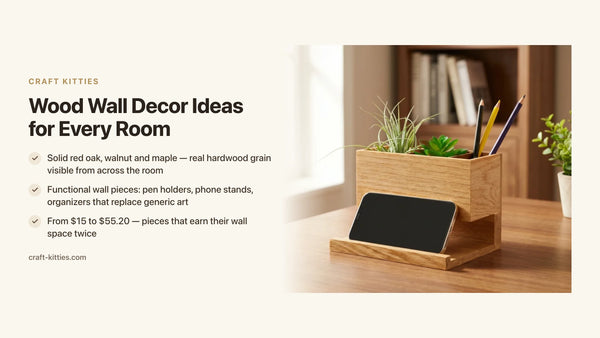
- One model doubles as a phone stand; one adds a live plant pod to the equation
The pen holder is the object every desk has and almost nobody chose. It tends to arrive as part of a set bought years ago, a promotional freebie, or the plastic cup that seemed like a temporary solution and never got replaced. The result is a surface that functions but does not cohere — and because a desk is one of the spaces looked at for the longest sustained periods of the day, that visual noise compounds quietly.
A solid wood pen holder is the smallest possible intervention that changes the register of a desk. It weighs more, sits with more authority, and gets better rather than worse with use. The question is not whether to make the switch — it is which wood, which format, and which size for the desk and the workflow.
This guide covers the criteria that actually matter when choosing a wooden pen holder: species, compartment count, additional functions (phone stand, plant pod), sizing, and care. It then presents five models from our desk accessories collection, a comparison table, a decision matrix, and answers to the questions most people ask before buying.
One clarification that runs through everything: this guide is about solid hardwood — red oak, walnut and maple cut from the actual wood, not pressed wood fiber clad in a printed wood-look film. The distinction is visible in daylight, palpable in the hand, and decisive for longevity.
Why species matters on a desk surface

A pen holder sits 18 to 24 inches from your eyes for most of the workday. At that distance, species reads clearly — not as a label, but as a mood. Red oak is warm and honey-toned with a bold, open grain that adds life to a neutral desk. It is the most forgiving species to work with and the most accessible in price. Walnut is the quieter choice: deep brown, tight-grained, a presence on the desk rather than a statement. Against a white or light desk surface it functions as an accent; on a dark surface it blends into the material family. Maple is pale, almost cream-toned, with a very fine grain — on its own it reads clean and modern; in a two-tone spliced design paired with walnut, the contrast between the two species becomes the visual point of the object.
All three are genuine hardwoods. This is not a textural preference — it is a structural one. Particleboard or MDF with a wood-look laminate shows its seams at the edges, dents at contact points, and swells if any liquid reaches it. Solid oak, walnut and maple do none of those things; they develop a surface patina instead.
Single cup or multi-compartment: the format decision
The format question is simpler than it appears. A single-cup holder makes sense when the desk already has drawer storage for everything else, and the surface should be kept as clear as possible. One cup, pens and pencils only, maximum visual calm.
A multi-compartment organizer is the answer when scissors, a ruler, small tools, sticky note pads or a phone also want to live on the surface. Dividing them by category avoids the gravitational collapse that happens to a single cup: it fills with everything, loses its function as a pen holder, and becomes a general-purpose dump zone.
The five models below cover both formats: two are focused single-cup designs, three add compartments or a secondary function. The right choice is the one that matches the current state of the desk, not the ideal state.
The five models from our studio

Description
The Plant Pod Pen Holder is the most ambitious piece in the lineup. Cut from solid red oak with a warm wax finish, it divides the desk surface into three zones: one tall compartment for pens and pencils, one wider slot for scissors and markers, and a raised pod designed to hold a small live plant — a succulent, an air plant, or a small cactus. At $55.20 it is the full consolidation: pencil cup, tool organizer and desk plant in a single footprint. The red oak grain at this scale reads as furniture, not stationery.

Description
The Walnut & Maple Spliced Pen Holder is built around a single idea: the visual tension between walnut's deep brown and maple's pale cream. The two species are joined at a clean splice, so the grain of each reads distinctly without any stain or paint interfering. At $36.00 it is a focused pencil cup — one compartment, well-sized for 10 to 15 writing instruments — for the desk where the surface should say something but not shout.

Description
The Walnut & Red Oak Pen Holder brings the same two-tone approach at $15.99. Solid walnut paired with solid red oak, handmade, one compartment. For buyers who want real hardwood on their desk and are not ready to commit to a larger organizer, this is the entry point without compromise on material. The walnut-and-red-oak combination works particularly well on light-colored desk surfaces, where the contrast between the two species reads clearly from a distance.

Description
The Pen Holder & Phone Stand solves the problem of the phone leaned against whatever happens to be next to it. Solid wood construction with a machined angled slot sized for smartphones — stable enough for video calls, positioned to keep the screen at a readable angle without taking up a separate stand footprint. At $35.00 it replaces two objects — pen cup and phone stand — with one, which on a small or already-occupied desk is a meaningful reduction. Compatible with most phone cases.

Description
The Geometric Pencil Cup is the most pared-down piece at $15.00. Solid wood with clean geometric lines, one compartment, a small footprint. It is the model for the desk that has storage everywhere else and needs only a single object to hold writing instruments upright. It is also the easiest first step if the goal is to test solid wood on a surface before committing to a larger piece.
Comparison table
| Model | Price | Wood | Format | Best for |
|---|---|---|---|---|
| Red Oak Plant Pod | $55.20 | Solid red oak | 3 compartments + plant pod | Full desk consolidation |
| Walnut & Maple Spliced | $36.00 | Solid walnut + solid maple | Single cup | High-contrast two-tone statement |
| Walnut & Red Oak | $15.99 | Solid walnut + solid red oak | Single cup | Entry price, real wood |
| Pen Holder & Phone Stand | $35.00 | Solid wood | Cup + phone slot | Two objects into one footprint |
| Geometric Pencil Cup | $15.00 | Solid wood | Single cup | Minimal footprint, focused use |
Decision matrix — which model for which desk
| Your situation | The right pick |
|---|---|
| Desk is cluttered — pens, scissors, tools and a phone all need homes | Red Oak Plant Pod — $55.20 |
| You want one focused object that reads as design, not function | Walnut & Maple Spliced — $36.00 |
| First solid wood piece on the desk, limited budget | Walnut & Red Oak — $15.99 |
| Phone currently leaning against a book or the monitor | Pen Holder & Phone Stand — $35.00 |
| Desk is already organized — just need one clean object for pens | Geometric Pencil Cup — $15.00 |
| Looking for a desk gift that is useful every day | Walnut & Maple Spliced — $36.00 or Walnut & Red Oak — $15.99 |
Sizing a pen holder to what actually goes in it

The most common sizing error is buying a holder based on how it looks empty and discovering it does not hold what was intended. The internal diameter and depth together determine what fits.
Pens and pencils only work fine in any holder with a 2-to-3-inch internal diameter and a depth of 4 to 5 inches. A narrower holder keeps items upright and grouped; a shallower one lets taller pens tip over. Ten to fifteen writing instruments is the natural capacity of a well-sized single cup.
Scissors and wider markers need either a multi-compartment design or a single cup with an opening of at least 3.5 inches. Forcing scissors into a narrow cup designed for pens results in them standing at an angle and jamming everything else.
A phone requires a machined slot, not a wider cup. A slot holds the device at a fixed angle; a cup never will, regardless of its diameter. This is the single most important reason the Pen Holder & Phone Stand is a distinct product rather than a larger version of the pencil cup.
A small plant calls for a design with dedicated pod clearance — both diameter and depth to accommodate roots or a soil plug. Dropping a plant into a standard pen cup works temporarily; the Red Oak Plant Pod is built to do it properly, with a raised pod that keeps moisture away from the pen compartment.
Why solid hardwood outlasts every alternative
The desk accessory market is dense with materials described as natural: bamboo composites, wood-look vinyl laminate, wood-fiber pressed board. All of them photograph convincingly and all of them behave differently from solid hardwood under daily contact over years.
Solid red oak is open-grained and hard — Janka hardness rating around 1290 lbf. It dents less than pine, holds a finish cleanly, and the grain pattern intensifies rather than fades with age. A red oak pen holder that gets knocked off a desk has a dent; a plastic one breaks.
Solid walnut sits at around 1010 lbf on the Janka scale — slightly less hard than red oak but considerably harder than most wood-composite products. The surface accepts oil and wax finishes that penetrate into the wood rather than sitting on top, which means the finish does not peel. Walnut is also naturally resistant to warping in normal indoor humidity conditions, which matters for a desk in a heated or air-conditioned environment where humidity varies seasonally.
Solid maple is the hardest of the three at approximately 1450 lbf. The pale, tight grain is what makes it useful in two-tone designs: it does not compete visually with the walnut in a splice joint, it contrasts cleanly. From a durability standpoint, maple pen holders do not dent, score or stain under the kind of casual impact that a pen cup receives.
Compare any of those to the alternatives. Bamboo composites are bonded with adhesives that respond to humidity changes over years; the outer layers can delaminate. MDF with wood-look laminate holds up at the edges only as long as the laminate does, which under repeated contact is 12 to 24 months. Plastic does not age — it just looks increasingly plastic.
A solid wood pen holder on a desk that gets daily use looks different at year five than it did at day one. It looks better.
How to position a pen holder on a desk
The placement question is low-stakes but worth resolving deliberately rather than by accident, because an object placed badly stays placed badly.
Dominant hand side, within reach without shifting your body. A pen holder you have to lean for loses two seconds per retrieval. That is noise, not a catastrophe — but on a surface you interact with repeatedly across a workday, it registers. Place the holder on the same side as your writing hand, within natural arm's reach from your primary seated position.
Not directly behind the monitor. Placing storage behind the monitor creates a retrieval motion that requires looking away from the screen and reaching behind an obstacle. Even a few inches to the side of the monitor places the holder in a usable position.
Leave the writing zone clear. The space directly in front of the keyboard, extending 8 to 12 inches to either side, is the primary work zone. Desk accessories belong outside it — to the far side, next to the monitor, or at the back edge. A pen holder in the writing zone is in the way.
At the back left or back right corner. For most people, one of these two positions works. The back edge keeps the surface clear at the center; the corner positions the holder at the natural reach distance without encroaching on the primary zone.
Mistakes that undo a good purchase
Choosing by color from a product photo without checking the desk surface. A walnut holder that photographs as warm brown against a white studio background will read differently on a dark espresso desk — it may blend and lose the contrast that made it appealing. Before ordering walnut, check what your desk surface looks like in your room's actual lighting. On light surfaces, walnut stands out; on dark surfaces, red oak or maple does the work instead.
Buying a single-cup design when the real problem is scattered tools. A focused pen cup reorganizes pens and pencils. It does not solve the scissors that end up in a drawer, the ruler that rests on top of the keyboard, or the phone that migrates across the surface. If the desk has more than one category of loose object, the single-cup solution will relocate the problem rather than resolving it.
Underestimating compartment depth. A pen holder that is visually proportionate but shallow — say, 3 inches deep — lets taller items tip continuously. Ballpoint pens, mechanical pencils and fine-liners are 5 to 6 inches long; the holder needs to capture at least half that length to keep them upright without friction.
Grouping materials without a thread. A solid walnut pen holder next to a chrome lamp, a bamboo phone stand and a fabric cable organizer reads as a collection of unrelated objects rather than a considered desk. When adding a wooden piece, the strongest move is also adding a second wooden accessory — a matching tray, a matching phone stand — so the wood reads as intentional rather than accidental.
Caring for a solid wood desk accessory
Solid hardwood asks very little. A dry cloth handles everyday dust. A barely damp cloth handles any residue — pen marks on the inner walls, fingerprints on the outer surface. No harsh cleaners, no soaking.
Once or twice a year, a thin coat of furniture wax applied with a soft cloth and buffed off keeps the surface alive. On walnut, this is when the grain deepens visibly. On red oak, the warm amber tone intensifies. Neither requires any sanding, stripping or reapplication of finish between regular wax treatments.
The one thing to avoid is leaving a wet container — a rinsing cup, a plant with no drainage layer — directly in contact with the wood for extended periods. The wax finish resists light moisture; it was not designed for a standing puddle.
Where to go next
A wooden pen holder tends to be the first piece that switches the logic of a desk from assembled to intentional. Once the pen cup is right, the things it sits next to start to matter. Our desk accessories collection brings together the pieces that answer each other — trays, stands, organizers and holders all working in the same red oak, walnut and maple families, so a desk can develop coherence piece by piece rather than all at once.
If you discovered our work through Etsy, where we have collected over 243 reviews from customers who sent us photos of their setups, you will find the full range here on the studio site.
Conclusion — the smallest upgrade that changes a desk
The pen holder may be the only desk accessory that is looked at more than it is used. It sits in the sightline, contributes to the peripheral mood of the surface, and signals whether the desk was set up deliberately or just accumulated. Solid red oak, walnut and maple do that work better than any alternative.
If one model should cover most desks: the Walnut & Red Oak Pen Holder at $15.99 is the entry point with real material quality and no functional compromise. For a desk with more categories to organize, the Red Oak Plant Pod is the consolidation move that replaces several objects with one. And for the desk where a phone stand is also needed, the Pen Holder & Phone Stand at $35.00 handles both without adding footprint.
FAQ — wooden pen holders for desk
1 — What wood is best for a pen holder? Red oak, walnut and maple are the three species most suited to desk accessories. Red oak is light-toned with a bold grain and very forgiving of daily contact. Walnut is deeper, quieter on a busy surface, and the most sought-after tone in high-end desk setups. Maple is pale and tight-grained, making the two-tone spliced look especially striking. All three are solid hardwood — not veneer, not MDF — and will outlast any plastic or bamboo alternative by years.
2 — Is solid wood better than bamboo for a pen holder? Solid hardwood (oak, walnut, maple) and bamboo both beat plastic on feel and longevity. The practical difference is density and character. Hardwood is heavier, so the holder stays put under daily use. The grain on solid wood reads as furniture-quality; bamboo tends to look utilitarian. On a desk looked at for hours a day, that visual difference compounds.
3 — How wide should a pen holder be? For pens and pencils only, a 2-to-3-inch internal diameter is enough for 10 to 15 items. If you also carry scissors or markers, look for a wider opening of 3.5 to 4 inches or a multi-compartment design. The plant-pod all-in-one in our lineup handles pens, scissors and a small plant simultaneously in a 4.7-inch-wide body.
4 — Can a wooden pen holder double as a phone stand? Only if it is designed for it. Our Wooden Pen Holder & Phone Stand has an angled slot machined into the solid wood body specifically for vertical phone display — stable enough for video calls. A regular round cup will not hold a phone reliably; the slot has to be part of the design from the start.
5 — How do I keep a wooden pen holder from scratching my desk? Look for felt pads on the base — our holders ship with felt feet applied. If you have an older holder without them, self-adhesive felt pads from any hardware store solve it in two minutes. The wood itself will not scratch a surface; it is the bare edge of an unpadded base that does.
6 — Is a pen holder with a phone stand worth it? If you prop your phone against something on your desk already — a book, the monitor base, another object — the answer is yes. A dedicated phone slot keeps the phone at a readable angle without a separate stand footprint. It consolidates two objects into one, which on a small or occupied desk is a meaningful reduction.
7 — What is the difference between a pen holder and a desk organizer? A pen holder has one compartment sized for writing instruments. A desk organizer has multiple compartments for different categories — pens, scissors, a phone, small plants. The distinction matters because an organizer occupies more footprint and handles more categories; a pen holder is more focused and takes less space. Several models in our lineup bridge the two.
8 — How do I care for a solid wood pen holder? Wipe it with a dry or slightly damp cloth. No soaking, no harsh cleaners. Once a year, a thin coat of furniture wax keeps the surface alive. Solid wood treated this way does not degrade — it develops patina, which on walnut or red oak reads as an improvement.
9 — Does a wooden pen holder make a good gift? It is one of the more considered desk gifts precisely because most people never buy one for themselves. A solid wood holder in walnut or two-tone walnut-and-maple reads as genuinely thoughtful and is used every day. Pair it with a matching wooden desk accessory for a coherent gift.