At a glance
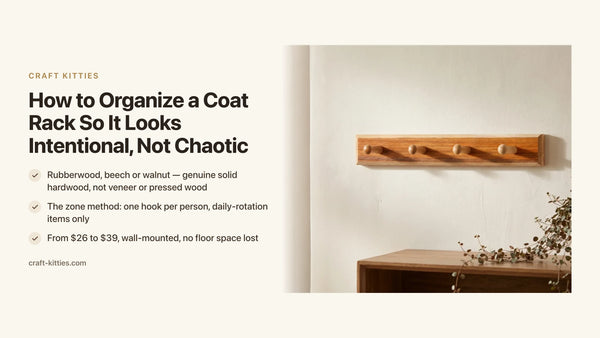
- Solid rubberwood, red oak, beech or walnut — real hardwood, not MDF or bamboo
- From $26 for 2 to 6 hooks, single-tone or two-tone
- Shaker proportions that read the same in a farmhouse or a modern apartment
The Shaker peg rack is one of those objects that has been in continuous production for roughly two centuries, not because it is fashionable, but because it is correct. The proportions are right, the function is clear, and nothing about it signals the decade it was made. A well-chosen wooden Shaker peg rack installed today will look as right in fifteen years as it does on the day you hang it — which is more than can be said for most entryway furniture.
The problem with buying one in 2026 is that the market is saturated with impostors. Particleboard rails dressed in wood-print laminate, bamboo racks with glued composite joinery, single-hook clusters sold as "minimalist peg racks" — none of them age the way real hardwood does, and most of them show it within two or three seasons of daily use. The hooks strip, the rail delaminates at the edges, and the object that was supposed to finish the entryway becomes the thing you eventually take down in frustration.
This guide covers what to look for, why the wood species and hook count matter more than the photographs suggest, and which models from our studio belong in which space. Prices, a comparison table, a decision matrix, and the installation method are all here. The FAQ at the end addresses the questions we hear most often.
At a glance
- Solid rubberwood, red oak, beech or walnut — real hardwood, not MDF or bamboo
- From $26 for 2 to 6 hooks, single-tone or two-tone
- Shaker proportions that read the same in a farmhouse or a modern apartment
Why the Shaker peg rack has outlasted every alternative
The Shaker furniture tradition produced very few ornamental objects. Everything built by Shaker craftspeople was designed around function, proportion and the conviction that visual honesty — showing the material for what it is — was a form of integrity. The peg rail came out of that ethos: a horizontal board, evenly spaced turned pegs, three or four fixing points into the wall. No curves for show, no carving for sentiment.
What that restraint produced, without intending to, was an object with almost no expiration date. A rack built in the early twentieth century and a rack built in our studio this year share the same visual logic, which means they read as intentional in a wide-plank farmhouse kitchen, a Scandinavian-influenced apartment, a mid-century modern hallway, and a transitional entryway that mixes old and new without committing to either. The proportions are neutral enough to recede when the room has more going on, and present enough to anchor a bare wall when there is not much else there.
The alternative — a cluster of individual hooks, a freestanding coat stand, a shelf with hooks below — each works for a specific use case and announces itself more. The coat stand is imposing. The shelf is practical but reads as storage. The hook cluster is a functional fix, not a finished look. The Shaker peg rail is the one format that sits between furniture and fixture, which is why it belongs in more rooms and more decorating contexts than any of the alternatives.
Solid wood versus everything else: why the material is the decision

A wall-mounted rack with six hooks, fully loaded with winter coats and bags, can carry 25 to 35 pounds on a daily basis. That weight is distributed across the mounting screws, which means the structural integrity of the board behind the hooks is not a cosmetic question — it is the question.
MDF (medium-density fiberboard) is the most common core material in the lower price tier. Its central mass holds screws adequately, but near the edges — exactly where the end-hook mounting points tend to fall — the fiber structure is weak and screws pull out under sustained load. The painted or laminated surface resists the first few humid seasons, then swells at the seams and delaminate at any moisture intrusion. Once the surface is compromised on MDF, there is no practical repair: you replace the piece.
Bamboo composites are denser than MDF and more dimensionally stable, which makes them a more honest material. The risk is in the laminated construction — strips of bamboo bonded with adhesive — which can separate over years of thermal cycling in a poorly insulated entryway or a humid mudroom. In a climate-controlled interior space, bamboo performs reliably; in an exposed mudroom, the risk is real.
Solid hardwood — rubberwood, red oak, walnut, beech — holds screws across the full thickness of the board, not just through a face layer. It handles humidity without permanent deformation when properly finished. It develops a patina over years of contact and light exposure, rather than chipping or peeling. And when the surface is scratched or worn after a decade of use, it can be lightly sanded and re-oiled rather than replaced. The premium over MDF at our price points is $10 to $15 per piece. For an object that takes a daily coat load, that gap closes in the first winter.
Wood species: how rubberwood, beech and walnut differ in the room

The species question matters less for durability — all four options in our lineup are solid hardwood with comparable structural performance — and more for how the rack reads on your specific wall.
Rubberwood with Brazilian veneer produces the lightest, most neutral tone in the lineup. The base grain is fine and even; the veneer overlay adds a warm honey-to-tan surface that sits between blond oak and pale maple. It brightens a dark hallway without imposing, and it disappears politely in a light, airy entryway that is already working visually.
Rubberwood with cherry veneer shifts into warmer, richer territory. Cherry veneer starts at amber and deepens to a reddish-brown with light exposure over the first year — one of the few wood tones that genuinely improves with time. In a room with warm metallics, aged brass hardware or terracotta tones, the cherry veneer belongs. In a very light or cool-toned space, it can read heavy.
Beech and walnut two-tone is the most deliberate option in the lineup. Beech is a pale, fine-grained European hardwood; walnut is deep brown with a distinct grain pattern. Together, the contrast is high enough to be intentional and restrained enough to stay within the warm wood palette. This is the option for a room that has nothing else on the walls and needs the rack to function as both storage and visual weight.
Walnut boot profile is the most furniture-like of the four. Solid walnut, with the characteristic medium-to-dark brown tone and the distinct open grain that makes walnut the most identifiable wood in home décor. The boot profile refers to the hook shape — a broader, flatter silhouette that carries bags and helmet straps without the narrow tip that standard pegs can leave marks on softer goods.
The reliable rule: contrast with the wall, not similarity. A walnut rack against a warm beige wall reads flat; the same rack against a white or light gray wall reads as a deliberate material choice.
The models from our studio
Four racks, each designed around a distinct profile, covering the range from the lightest Scandinavian-influenced option to the most furniture-grade walnut piece.

Description
The Brazilian veneer rack is the one we point to when the question is "which works in the most rooms". Solid rubberwood core with a Brazilian veneer surface, available in 4 or 6 hooks depending on how much wall space the entryway offers. The tone is honey-to-tan — warm enough to read as wood, light enough not to dominate. At $39 it is the highest-priced option in the lineup, which reflects the veneer quality and the hook range, not a cosmetic premium.

Description
The cherry veneer version shares the rubberwood core and the 4-to-6-hook range, but the surface finish moves the register from light-neutral to warm-amber. If the entryway already has aged brass hardware, terracotta tile or warm oak flooring, this is the rack that completes the palette rather than conflicting with it. At $37 it is $2 less than the Brazilian veneer option; the structural spec is identical.

Description
The two-tone beech and walnut rack is the most flexible in the lineup by hook count: it starts at 2 hooks for a studio entryway or a single wall section and scales to 6 for a full household or a dedicated mudroom wall. Solid beech and solid walnut in the same rail — the contrast between the pale beech and the deep walnut reads as intentional furniture rather than accidental mixing. At $26 it is also the most accessible price in the lineup, which makes it the right answer for someone who wants real solid wood without the $39 price point.

Description
The walnut boot profile rack is built for the entryway that carries more than coats. Solid walnut, 4 hooks, with a broader-tipped boot profile that distributes the load of helmet straps, wide tote handles and thick bag loops without the narrow-point pressure that standard round pegs leave on softer materials. At $28.80 for the 4-hook row, it is the most specialized option in the lineup — designed for households where the hooks carry work bags and sports gear as often as they carry coats.
Comparison table
| Model | Price | Wood | Hooks | Best for |
|---|---|---|---|---|
| Rubberwood, Brazilian veneer | $39.00 | Solid rubberwood + Brazilian veneer | 4 or 6 | Light, versatile tone — most rooms |
| Rubberwood, cherry veneer | $37.00 | Solid rubberwood + cherry veneer | 4 or 6 | Warm rooms, brass or earthy tones |
| Beech & walnut two-tone | $26.00 | Solid beech + solid walnut | 2, 4 or 6 | High contrast, most scalable, entry price |
| Walnut boot profile | $28.80 | Solid walnut | 4 | Heavy bags, wide straps, gear |
Decision matrix — which rack for which situation
| Your situation | The right pick |
|---|---|
| Light or neutral walls, you want the safest visual choice | Brazilian veneer, $39 |
| Warm-toned room with brass hardware or earthy accents | Cherry veneer, $37 |
| Entry point to real hardwood, or a studio with limited wall space | Beech & walnut, from $26 |
| Family entryway, 3+ people, bags and helmets as often as coats | Beech & walnut 6-hook, $26 |
| You carry work bags, gym bags or wide-strap totes daily | Walnut boot profile, $28.80 |
| Gift for a housewarming — needs to work in any entryway | Brazilian veneer, $39 — the most universal tone |
How to hang a Shaker peg rack correctly
The four steps below apply to all models in our lineup. Read them before picking up a drill — the decisions that matter happen before the first hole.
1 — Decide on the wall, not just the hallway. The entryway wall facing the door is the most visited, which makes it the natural candidate. The side wall is the practical choice if the door swings into the facing wall's path. The back wall behind the door is a last resort: you have to walk past the rack before you can use it. Avoid any wall where the rack will block a light switch or compete with a picture frame — those compromises compound over time.
2 — Choose the height before you measure. The standard guidance puts adult coats at 60 to 72 inches from the floor. A more reliable method is empirical: put on your heaviest coat, stand in front of the wall, and extend your arm to where you would naturally reach for the first hook. Mark that point. If the household includes children, consider a second lower rail at 36 to 40 inches — one morning of routing two coats at two heights is worth fewer years of contested hooks.
3 — Find a stud or choose the right anchor. A six-hook rack fully loaded with wet winter coats and bags can reach 30 pounds of sustained dynamic load. On drywall without a stud, standard plastic anchors are not adequate for that weight. Use toggle bolts rated for at least twice the expected load, or locate a stud for at least one of the two mounting points and supplement with a heavy-duty toggle for the second. A stud finder pays for itself on the first rack installation.
4 — Level once, drill once. Hold the rack against the wall at the chosen height, place a level on the top edge, and mark both mounting points lightly with a pencil before committing to any hole. Drilling a leveled mounting point takes two minutes; correcting a rack that hangs three degrees off level after the holes are in the wall takes considerably longer and leaves evidence.
Hook count: the number that most people get wrong
The single most common installation regret with a peg rack is not the species, not the wall, and not the height — it is the hook count. The two-hook version that looked generous in the product photo fills in the first week and becomes a source of daily friction by the second month.
The calculation is simple and worth doing before ordering. Count the number of people who regularly use the entryway. Multiply by two — one hook for the coat, one for the bag or the second coat in winter. Add one hook for the overflow: an umbrella, a visitor's jacket, a grocery tote that has not made it back to the kitchen yet. That number is the minimum. Rounding up to the next available size (4, 6) is almost always the better call.
A rack with two empty hooks when the house is quiet is a rack with room for a guest. A full rack with no room for a wet umbrella is a rack that generates the small, daily exasperation of an object that does not quite do what you put it there to do.
What a Shaker peg rack can hold — and what it cannot
The Shaker tradition used peg rails in every room in the house, including as rack storage for chairs turned upside-down for easier floor-cleaning. That background is a useful reminder that the format is more versatile than the entryway coat-hook role it is most often assigned to.
In a bedroom, the same rack carries robes, scarves and belts along a wall that has no obvious furniture anchor. In a mudroom or laundry room, it holds wet jackets and sports bags that cannot go in a closet until they dry. In a bathroom, a two- or four-hook version carries towels with a material warmth that chrome bars do not offer. In a kitchen, small bags, aprons and reusable grocery totes that live in daily circulation find their place without a drawer.
What the format does not handle well: folded or draped items without a loop or handle, and any item heavier than the peg profile can support without leaving marks. The boot profile hook is specifically designed to address the second problem — the wider tip distributes load across a broader contact surface, which matters for leather bag straps, helmet clips and the nylon webbing of a backpack shoulder. For standard coats, scarves and tote bags, any profile works.
The mistakes that compromise a good rack
Choosing the tone from a product photo on a white background. A Brazilian veneer that reads as pale honey against a white digital background can read as warm tan against the actual wall. Before ordering, hold a piece of similarly-toned wood (a furniture leg, a wood flooring sample, a cutting board) against the wall under the room's actual lighting. If it contrasts comfortably, order. If it blends in, consider the two-tone or the cherry veneer.
Mounting into a single central stud and calling it done. A rack fixed at one point is a rack that will rotate under load. Two fixing points are the minimum; the rail needs both endpoints secured to resist the torque that a full hook load generates. If only one stud is available, anchor the second point with a properly rated toggle bolt — not a standard plastic anchor.
Hanging the rack before the wall paint is cured. Fresh latex paint cures fully in 30 days, not 24 hours. Mounting hardware against incompletely cured paint can pull the finish when you remove or adjust later. If the entryway was recently painted, wait the full 30 days or accept that repositioning may require touch-up work.
Installing at the old rack's height without questioning it. If you are replacing an existing rack, the previous height may have been set for a different household's average reach, or it may have been set poorly from the start. Take five minutes to do the seated-arm-reach test before inheriting someone else's measurement error.
FAQ — wooden Shaker peg rack
1 — What makes a Shaker peg rack different from a regular coat hook? A Shaker peg rack is a horizontal rail with evenly spaced turned or tapered pegs derived from the Shaker furniture tradition. The defining characteristic is design restraint: every element serves a function, nothing is ornamental for its own sake. The rail distributes weight evenly, the pegs angle slightly upward so items stay put, and the proportions are governed by balance rather than trend. That is exactly why the style works as well in a 1930s farmhouse as in a 2020s apartment.
2 — Is rubberwood a real hardwood? Yes. Rubberwood is a dense tropical hardwood from plantation Hevea brasiliensis trees harvested at end of latex life — a responsible use of wood that would otherwise be discarded. Its Janka hardness is comparable to cherry and slightly below red oak. It machines cleanly, takes a smooth finish, and holds screws firmly. The fine, even grain is also why it bonds well with veneer overlays for a high-contrast surface.
3 — How many hooks do I need? Multiply the number of regular entryway users by two, then add one. Two people: five hooks minimum, six is comfortable. A single person in a studio: two or three. Round up to the next available size; an empty hook is always useful, a full rack with no spare capacity is a daily frustration.
4 — Can I mount this on drywall without hitting a stud? Yes, with heavy-duty toggle bolts rated for the expected load. A six-hook rack can carry 25 to 30 pounds fully loaded — standard plastic anchors are not adequate for that. The safest configuration is one fixing point into a stud and one properly anchored toggle bolt. A stud finder is the right tool to have before any wall-mount installation.
5 — What height should the rack sit at? Between 60 and 72 inches from the floor for adult coats. The empirical method is more reliable than any chart: stand in front of the wall in your heaviest coat and mark where your hand naturally reaches for the first hook. That mark is your height.
6 — Brazilian veneer versus cherry veneer: which should I choose? Brazilian veneer is lighter, honey-to-tan, more neutral — it works in the largest range of rooms. Cherry veneer is warmer and richer, shifts toward reddish-brown over time, and belongs in rooms that already lean warm. If the decision will not resolve, Brazilian veneer is the safer default.
7 — Is solid wood better than MDF or bamboo for a coat rack? Yes, structurally. MDF holds screws poorly near edges and swells when humidity reaches the face seams. Bamboo composites can delaminate in high-humidity entryways over time. Solid hardwood holds screws across its full thickness, handles humidity without permanent deformation when finished, and can be refinished after years of use. The price difference at our price points is $10 to $15 — for an object that carries daily coat loads, the investment pays for itself quickly.
8 — How do I care for a finished wood peg rack? A dry or barely damp cloth for routine cleaning. No all-purpose spray cleaners directly on the wood — they strip the finish over time. Once a year, a light pass with conditioning wax or a few drops of food-grade mineral oil on a cloth keeps the wood from drying out, particularly in homes with forced-air heating.
9 — Does a two-tone rack work in a minimalist room? Yes, when both tones stay within the warm wood palette. Beech and walnut together read as an intentional material choice, not a clash — the contrast is enough to be deliberate and restrained enough not to compete. In a minimalist room with little else on the walls, the two-tone actually anchors the space better than a single flat tone because it carries more visual weight.
10 — What can I hang beyond coats? Bags, leashes, umbrellas, helmet clips, scarves, belts, aprons, reusable grocery totes, robes, sports bags and towels — in that order of frequency in our experience. The boot-profile hook specifically handles wide straps and thick handles without pressure marks. The Shaker tradition used peg rails in every room of the house; the entryway is just where the format is best understood in 2026.
Where to go next
The peg rack is rarely the only hook surface an entryway needs. Our full wall hook rack collection gathers all formats — single hooks, double hooks, rail systems and specialty profiles — in the same solid wood families as the racks in this guide. If you are starting with the rubberwood wall hook rack with Brazilian veneer, the matching lower-profile models are in the same collection for a layered entryway without mismatched tones. For a first piece that can scale to a second, the two-tone beech and walnut wall hook rack anchors an entryway at the lowest price point in the lineup and leaves room to add.
Our customers on Etsy (243 reviews) regularly mention the entryway peg rack as the piece that finished a space they had been trying to complete for years — not because it is complicated, but because it is correct.
Conclusion — the object that stays right
If this guide reduces to one method: choose the tone by contrast with your wall, count hooks by household plus one, hit at least one stud in the wall. The Brazilian veneer rack at $39 is the answer for the widest range of rooms; the beech and walnut two-tone at $26 is the right call for a first solid wood piece or a smaller wall section; the walnut boot profile at $28.80 is the one to choose when what hangs on the hooks is heavier than coats. Three paths, one result: an entryway that holds up to daily use and still looks right in ten years.