At a glance
- Solid red oak, walnut or beech — sealed real hardwood, not veneer
- Wall-mounted single, double-layer, arc and brass designs from $22
- Hardware included, straightforward two-anchor installation
The towel bar is the most-touched object in the bathroom and the last one most people spend any thought on. Chrome tubes hang from the same positions they came in, year after year, while everything else in the room gets updated. Swapping a builder-grade bar for a solid wood one is not a renovation — it takes twenty minutes and two screws — but it changes the register of the room in a way that a new soap dispenser or a fresh coat of paint does not.
The difficulty is choosing correctly the first time. A bar that looks good in a product photo can sit wrong against a specific wall tile. A design that reads minimal in neutral lighting can feel out of place in a bathroom with strong wood tones. And some "wooden" bars are not wood at all — veneer on MDF that behaves well for a year and reveals itself at the first season of daily humidity.
This guide works through the criteria that actually matter when buying a wooden towel bar: wood species, bar format, hardware finish, mounting method, and the questions of proportion and placement that most guides skip. It then presents the four models from our studio with their prices, a comparison table, a decision matrix, and answers to the questions buyers ask most often.
One clarification before anything else: this guide is exclusively about solid hardwood. Veneered alternatives often look nearly identical in photographs; they perform differently over time in a humid room. Sealed solid wood — red oak, walnut, beech — develops a surface patina and holds its structure. Pressed wood with a printed wood pattern does not.
At a glance
- Solid red oak, walnut or beech — sealed real hardwood, not veneer
- Wall-mounted single, double-layer, arc and brass designs from $22
- Hardware included, straightforward two-anchor installation
Red oak, walnut, or beech: choosing the wood that works with your bathroom

The three species in our lineup differ first in their visual character, then in nothing that matters for daily use.
Red oak is the warm, characterful choice: a honey to amber tone with a grain that is legible from across the room. It reads well against white subway tile, light grout, and beige or off-white walls — the bold grain provides enough presence that the bar becomes an intentional element rather than a utility fixture. Red oak is also the most common hardwood in American interiors, which means it relates naturally to vanities, floors, and trim that were already built from it.
Walnut sits at the opposite end of the palette. Deep brown, with a tight and fine grain that does not announce itself — walnut earns its reputation in home décor because it is almost impossible to place badly. Against a white or cream bathroom it provides strong contrast; against a darker palette it recedes naturally. Our walnut bars carry a professional wax finish that emphasizes the grain without darkening it artificially.
Beech occupies the middle ground: a pale, even-textured hardwood with grain that is subtle rather than dramatic. It reads closest to a Scandinavian design sensibility — light, unfussy, modern. For bathrooms with cool-toned tiles, pale grout, or matte-white fixtures, beech integrates rather than contrasts, which can be precisely the effect you want.
What does not vary across the three: structural strength, moisture resistance when sealed, and the way the surface ages. All three are solid hardwood, cut from real wood rather than composed of layers, and all three receive a protective finish that makes them suitable for a bathroom environment without ongoing maintenance beyond an occasional wipe.
The reliable rule: choose by contrast with your dominant wall color. Light bathroom — reach for walnut or a darker red oak tone. Warm-toned room — beech or light red oak lightens rather than doubles the warmth. Dark tile with light grout — any of the three works; the hardware finish becomes the deciding factor.
Single bar, double layer, or arc: the format question
The bar format is not a style choice — it is a function choice that should be made before considering color or hardware.
A single bar holds one towel. It is the right format for a half-bath, a guest bathroom used lightly, or a primary bathroom where only one towel needs to hang at a time. It takes less visual space on the wall, mounts with less footprint, and suits any bathroom where multiple towels hanging simultaneously is not a daily need.
A double-layer bar stacks two horizontal bars at different heights on a single set of brackets. The upper bar typically holds a hand towel; the lower holds a full bath towel. This format doubles the drying capacity on the same wall footprint as a single bar — it does not require twice the wall space, only slightly taller brackets. For a shared bathroom, a couple's bathroom, or any room where two towels need to air out without overlapping, the double-layer bar is the practical answer that a second single bar on a different wall rarely provides as well.
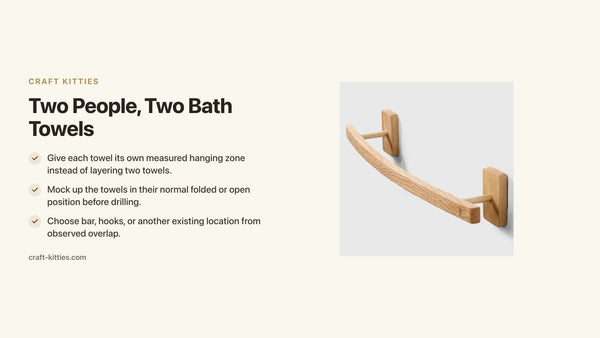
An arc design curves the mounting arms outward rather than projecting them straight from the wall. This creates a small visual difference — a softer silhouette that suits transitional and contemporary bathrooms — but it also serves a practical function: towels hang slightly away from the wall surface, improving airflow on both sides and allowing thicker towels to dry more evenly.
There is no universally superior format. A single bar in a minimally used half-bath is more appropriate than a double-layer bar that reads as over-equipped. A double-layer bar in a busy primary bathroom is more practical than two single bars taking twice the wall space.
The models from our studio
Four bars, all in solid hardwood, chosen to cover the buyer profiles we encounter most: the minimalist, the brass enthusiast, the double-duty shopper, and the arc aficionado.

Description
The square hardwood design is the closest thing to a default in the lineup: clean bracket geometry, solid wood bar, no ornamentation beyond the material itself. It reads well in bathrooms that already have a clear design language and need an accessory that participates without competing. At $24, it is also the entry point to solid hardwood without compromising on material or build — the bar is real wood, the brackets are properly anchored, and the installation hardware is included.

Description
The wood and brass combination is the bar for bathrooms where the hardware matters as much as the wood. Brushed brass catches light differently than chrome or matte black, and against solid wood grain it reads as a warm, quietly considered pairing rather than a trend. This model is also sized for kitchen use — the bar clears a dish towel easily — which makes it the right pick for anyone buying a matching set for two rooms. At $22, it comes in below the single-design bars, which makes it the practical choice for the set buyer.

Description
The arc design is for buyers who have already considered and rejected the straight-bracket look. The curved arms read softer against tile and drywall and suit a wider range of bathroom palettes than the square bracket does. Practically, the outward curve also keeps the towel slightly off the wall surface, which is a small but real advantage for thicker bath towels that trap moisture against flat surfaces. At $24, it matches the square design in price with a distinct visual outcome.

Description
The double-layer bar is the answer to "I need more than one towel to hang but I only have one sensible wall to mount on." Both bars are solid wood; the bracket geometry keeps the two levels at a usable distance — enough to reach each bar independently, not so much that the unit reads as oversized. At $24, the double capacity for the same price as a single bar makes this the most efficient option in the lineup for a shared or active bathroom.
Comparison table
| Model | Price | Wood | Hardware | Best for |
|---|---|---|---|---|
| Square hardwood design | $24 | Solid red oak or walnut | Matte black or natural | Clean, minimal bathrooms |
| Wood & brass rack set | $22 | Solid wood | Brushed brass | Warm bathrooms, brass fixtures, kitchen sets |
| Arc design | $24 | Solid red oak or walnut | Matte black or natural | Contemporary and transitional styles, airflow |
| Double layer | $24 | Solid hardwood | Matte black or natural | Shared bathrooms, two-towel households |
Decision matrix — which bar for which bathroom
| Your situation | The right pick |
|---|---|
| Clean bathroom, you want the wood to speak for itself | Square hardwood design — $24 |
| Bathroom with gold or brass fixtures, or warm tile | Wood & brass rack set — $22 |
| Contemporary or transitional bathroom, softer silhouette | Arc design — $24 |
| Two people sharing one bathroom, limited wall space | Double layer — $24 |
| Buying for bathroom and kitchen together | Wood & brass rack set — works in both rooms |
| Housewarming gift or bathroom upgrade gift | Wood & brass — most universally giftable at $22 |
Hardware finish: brass, matte black, or natural

The hardware finish on a towel bar does more visual work than the bar itself in some bathrooms. In a room with consistent metalwork — faucets, shower head, towel hooks all in the same family — a bar that matches that finish reads as deliberate. A bar that doesn't match reads as inherited.
Brushed brass is the most compositionally active finish in the lineup. It adds warmth and a quality signal that reads clearly in a room — the kind of finish that makes guests notice the bar rather than overlook it. Pair it with warm tiles, cream paint, or gold faucets; avoid it in a bathroom where the existing metal is cool chrome or matte black, as the combination looks accidental rather than mixed.
Matte black is the graphic finish: high contrast against any wood tone, suits a contemporary bathroom without requiring a particular tile or paint color, and ages uniformly since it does not patina or tarnish. For a farmhouse bathroom with warm wood and dark grout it is a natural companion. For a modern white-on-white bathroom it provides the definition the design needs.
Natural or unstained hardware — closer to the wood itself in tone — is the quietest finish option. It suits buyers who want the wood to dominate the visual field and the bracket to recede. In a bathroom with very clean lines and limited other metalwork, natural hardware can read as the most sophisticated choice precisely because it does not assert itself.
The matching rule is simple: identify the finish already on your faucets, shower head, and light fixtures, then match it or make a deliberate contrast choice. What to avoid is proximity to a close-but-not-quite finish — two different types of gold, or warm silver next to cool silver, which reads as an oversight rather than a decision.
Installing a wall-mounted wooden towel bar
Step 1 — Choose the wall and the height. The near wall of your dominant hand is the standard choice: you reach for the towel naturally, without crossing your body. For a bath towel bar, 48 inches from the floor is the conventional height; for a hand towel bar, 36 to 40 inches is more common. The seated arm-reach test applies here too: stand beside where you will use the towel, extend your arm, mark where your hand naturally lands.
Step 2 — Locate the studs, or plan for anchors. Use a stud finder and check whether either bracket point lands on a stud. If yes, screw directly into it — the most secure mounting. If not, wall anchors rated for the load are entirely adequate in drywall; for tile, use tile anchors with the appropriate bit. The installation notes for each model specify the right anchor type.
Step 3 — Mark, level, and drill. Mark both bracket points with a pencil level, drill at the marks, and insert anchors if needed. Hang the bracket plate, check level before tightening fully, then tighten. Repeat for the second bracket. Set the bar into the bracket slots and fix it per the model's method — typically a small set screw on the underside that tightens against the bar without marring the wood surface.
Step 4 — Hang the first towel and check. Hang a towel and give the bar a firm horizontal pull. If the mounting moves, the anchors need rechecking before the bar goes into daily use. If everything holds, you are done — and the job from drilling to first towel typically runs under twenty minutes.
The proportions question: bar length versus bathroom size
A towel bar that is too short for the room looks undersized and provisional; a bar that is too long crowds the wall and makes the bathroom feel smaller. The common sizes in our lineup fall in the 16- to 24-inch range, which suits the majority of standard bathroom walls and accommodates a full bath towel without the towel folding back on itself.
For a small powder room or half-bath, the lower end of that range is typically more proportionate — the bar fills the visual space without dominating a tight wall. For a primary bathroom with larger tile formats or more open wall space, the longer options in the lineup read better in proportion.
A practical sanity check before buying: tape a strip of paper the width of the bar you are considering onto the wall where it will hang. Step back and look. This takes two minutes and resolves the proportion question more reliably than any photo simulation.
What a wooden towel bar does that chrome does not
The difference between a chrome towel bar and a solid wood one is not primarily about appearance — though the appearance is different — it is about what the object communicates about the room.
A chrome bar is a utility fixture. It is inexpensive to manufacture, easy to replace, and easy to ignore. In most bathrooms it is present rather than chosen. A solid wood bar is an accessory in the same sense that a framed mirror or a ceramic soap dispenser is an accessory: it is an object with its own visual character that participates in the room's composition rather than merely fulfilling a function within it.
This distinction matters more in some bathrooms than others. A primary bathroom where the design has been assembled with some care — tile, vanity, hardware, lighting chosen in relation to each other — benefits from accessories that belong to the same conversation. A chrome bar that cost $12 and was installed by a contractor does not belong to that conversation; a solid walnut or red oak bar with matched hardware does.
The functional argument is also real: solid hardwood at this scale is more rigid than hollow chrome tubing, which means the bar does not flex or rattle under weight, and the bracket attachment to the wall is not working against a tube that transfers vibration. The bar sits still. It stays where it was put.
Mistakes that undermine a good towel bar purchase
Choosing the finish before deciding on the bar format. Which finish is right depends partly on which format you are buying — the double-layer bar has a different visual weight than the single, and what reads as a brass accent on the single can read as an excess of brass on the double. Settle the format first, then the finish.
Mounting at the old bar's height without question. The previous bar may have been installed at the wrong height, or for a user of different height. Inheriting that position inherits whatever compromise it represented. The seated arm-reach test is fast and reliable; use it rather than defaulting to the existing holes.
Picking a wood species that matches the vanity instead of contrasting with the wall. The wall is what you see behind the bar; the vanity is to the side of it. A walnut bar against a white wall reads clearly; the same bar in the same finish pressed close to a similar-toned walnut vanity reads as noise. Contrast with the dominant surface, not similarity with the neighboring piece.
Mixing hardware finishes across accessories without a plan. A brass towel bar next to matte-black hooks and a chrome faucet reads as accumulated, not curated. If the faucets are already a committed finish, either match them on the bar or make a deliberate mixed-metal choice — warm metals together (brass with gold, or with copper), or one dominant metal plus one accent. Our wooden bathroom accessories collection is organized so pieces in the same hardware family can be found together.
Caring for a solid wood towel bar
The maintenance routine for a solid hardwood bar is minimal enough that "routine" is almost an overstatement.
Daily: hang towels. Wipe the bar with a dry cloth if water lands on it. That is the full daily interaction.
Periodically — once or twice a year — apply a thin coat of furniture wax or beeswax to the bar surface and work it in with a soft cloth. This refreshes the protective finish and restores the depth of the grain without any stripping, sanding, or refinishing. The wax application takes five minutes and maintains the bar in the same condition it arrived in.
What to avoid: harsh chemical cleaners, abrasive sponges, and letting water pool in the bracket junction. The wax finish handles ambient humidity and the occasional splash; it is not designed for prolonged soaking. Dry the bracket area if water accumulates there after a shower session in a very small bathroom.
The patina that develops on a sealed hardwood surface over time — a slight deepening of the grain, a warmth that comes from handling — is a property of the material, not a sign of deterioration. Solid wood ages like furniture, not like paint.
Where to go next
A towel bar is rarely the only wooden piece a bathroom ends up with. Once one solid wood accessory is on the wall, the chrome toilet paper holder beside it or the builder-grade hook on the back of the door tends to look increasingly provisional. Our wooden bathroom accessories collection gathers the pieces designed to answer each other: towel bars, toilet paper holders, towel hooks, and shelving in the same red oak, walnut, and beech families, all finished consistently so a bathroom can be assembled from a single visual vocabulary rather than accumulated piece by piece.
If you are starting with the bar, the Wall Mounted Wood Towel Bar Holder at $24 is the natural anchor. If the brass hardware is the draw, the Wood & Brass Towel Rack set at $22 is the piece that the rest of the room can build around. Both ship with installation hardware included.
FAQ — wooden towel bars
1 — Can wood handle bathroom humidity? Yes, when sealed. Our bars are solid hardwood finished with a protective wax or oil coat that resists the ambient moisture of a daily-use bathroom. Wipe down after splashing; apply a light wax once or twice a year. Solid hardwood does not swell or delaminate at normal bathroom humidity levels — that is a behavior of MDF and veneered materials, not of sealed hardwood.
2 — What is the difference between single and double-layer? A single bar holds one towel flat; a double-layer bar holds two towels simultaneously on two separate horizontal bars — a hand towel on top, a bath towel below. Same wall footprint, twice the capacity. The right choice depends on how many towels need to hang at once, not on the size of the bathroom.
3 — What species of wood are these bars made from? Solid red oak, walnut, and beech — three real hardwoods with distinct grain patterns and tones. None of our towel bars are veneer, MDF, or printed wood-effect material. The species notes in each product listing specify exactly which wood is used.
4 — What height should the bar be mounted at? 48 inches from the floor for a bath towel bar; 36 to 40 inches for a hand towel bar. The practical test: stand beside the vanity, extend your arm naturally, and mark where your hand lands. That is a more reliable guide than any standard number.
5 — Do I need to hit a stud? Not necessarily. Our bars mount on two anchor points; if a stud falls there, use it. If not, wall anchors rated for the load work reliably in drywall. For tile installations, tile anchors with the appropriate masonry bit handle it without issue.
6 — Does the wood tone need to match my vanity exactly? It does not need to match — it needs to relate. The principle is contrast or deliberate family. What to avoid is accidental proximity to a close-but-different finish. Match the hardware finish first; let the wood tone be the choice that follows.
7 — What is the advantage of brushed brass hardware? Brass adds warmth and a quality read that chrome or matte black does not deliver in the same way. Against solid wood grain it pairs naturally without competing. It is the right choice for bathrooms with warm tile, gold faucets, or cream walls. Matte black is the stronger choice for a graphic contemporary or farmhouse bathroom.
8 — Can the bar hold a heavy wet towel? Yes. Solid hardwood at this scale is more rigid than hollow metal tubing at the same dimensions. The bracket attachment is at two wall points. A wet bath towel is well within the design load; the bar will not flex, deflect, or pull away from the wall under normal use.
9 — How do I maintain a waxed wood towel bar? Dry cloth for daily cleaning; no harsh chemicals or abrasive pads. Once or twice a year, a light application of furniture wax or beeswax refreshes the finish in five minutes. The wood will develop a natural patina over time — this is characteristic of solid hardwood, not a sign of wear.
10 — Is a wooden towel bar a good gift? It is one of the more practical housewarming or bathroom-upgrade gifts available at this price point — an object used daily that visibly improves the room it lives in. The Wood & Brass Towel Rack set at $22 is the most universally giftable model because the brass hardware reads well in almost any bathroom and the kitchen compatibility makes it useful regardless of the recipient's exact bathroom layout. Our studio has 243 reviews on Etsy for anyone who prefers to see feedback from other buyers before purchasing.
The bar that finishes the wall
A towel bar is not a prominent object. It is not the first thing a guest sees in a bathroom, and it is not the decision most people deliberate over. But it is an object touched multiple times a day, every day, and in a room that has otherwise been carefully assembled, a chrome tube that was never chosen reads as the thing that did not get finished.
Solid wood changes that calculation at $22 to $24. The square hardwood design is the right bar for a clean, minimal bathroom. The wood and brass set is the right bar for a warm bathroom with gold hardware. The arc design is the right bar for a contemporary space with a softer visual vocabulary. And the double-layer is the right bar for any bathroom where two people share one wall.
Twenty minutes of installation. The bathroom feels finished.