At a glance
- Solid red oak, walnut or beech — real hardwood, wax-sealed for bathrooms
- Built-in shelf holds a phone, a candle, hand cream — not just a rod on a wall
- Single bar, arc design, double layer or brass accent — from $22
The towel bar is the most used and least thought about object in the bathroom. Most bathrooms have whatever came with the apartment — a chrome rod at an arbitrary height, screwed into the wall by a previous occupant who may not have owned a level. It stays there for years because replacing it never feels urgent enough, and in the meantime the bathroom never quite reaches the finish that better furniture elsewhere has achieved.
A wooden towel bar with a built-in shelf changes both problems at once. It replaces the chrome rod with something that reads like furniture, and it adds a small horizontal surface where none existed — enough for a phone, a candle, hand cream or a rolled washcloth. The upgrade costs less than a dinner out and takes about fifteen minutes to install. What holds most people back is choosing well among the options available, which look similar in photographs and behave differently in daily use.
This guide covers the criteria that matter: the wood species, what the shelf is actually for, the case for a second bar, hardware choices, installation, and care. At the end there are detailed cards for each model from our studio, a comparison table, and a decision matrix designed to end the deliberation rather than prolong it.
The one premise worth stating before anything else: this guide is about solid hardwood. Towel bars sold as "wood" that are made of MDF, veneered particleboard or hollow bamboo reveal the difference within a year — swelling edges, peeling finish, hardware that pulls away from softened material. Wax-sealed solid red oak, walnut or beech behaves like furniture: it ages, it stays intact, and the protective coat means it does not require the constant maintenance that bare wood in a humid room would demand.
Why the shelf changes everything
A towel bar is hardware. A towel bar with a shelf is furniture. The distinction is not decorative — it is functional, and it is why the shelf models account for the majority of what our studio produces in this category.
The problem a bathroom shelf solves is not about towels. It is about the three or four small objects that need to be within arm's reach of the sink but have nowhere to live: the phone you set down while washing your hands, the hand cream that ends up on the counter edge, the candle that makes the room feel intentional, the folded face cloth that is too small for a hook. A bathroom counter is already occupied by the sink, the soap dispenser and probably the toothbrush holder. The wall above the towel bar is empty — it is the only available surface in the room that nobody has claimed yet.
The shelf above the bar uses that space without claiming more wall area, because it sits within the footprint of the bar's mounting hardware. You install one object and gain two functions: a place to hang towels at the right height, and a small elevated surface that the room could not offer before.
The weight limit is worth setting realistic expectations about: the shelf is sized for daily carry items — a phone, a candle, two or three small containers. It is not a bathroom cabinet. For heavier or bulkier storage, the double-layer bar provides a second rod rather than a shelf, and the two can work together in adjacent positions on the same wall.
Red oak, walnut or beech: which wood for which bathroom

The three species in our lineup look different on the wall and perform identically in a sealed bathroom environment. Choosing between them is an aesthetic decision, and that decision simplifies to a single question: what does your wall look like?
Red oak is warm and specialementsive. Its grain is bold enough to read from across the room — open pores, a honey-to-amber palette, and visible medullary rays that give the wood a texture you notice. Against white tile or pale plaster walls it brings warmth and contrast. In rooms that already have strong color, it adds character without competing. It is the species that looks most visibly "wood" — a clear departure from any metal or plastic hardware it replaces.
Walnut is quieter and richer. Deep brown with a fine, tight grain, it reads closer to fine furniture than to workshop craft. Against a light wall it stands out as the darkest element in the room, which works well as a deliberate accent. In bathrooms that have other dark tones — matte black fixtures, charcoal grout, dark tiles — walnut blends into a coherent palette rather than competing with it. It is the species most associated with premium bath hardware in interior design contexts, and the most photographed in renovation accounts.
Beech is pale and smooth. Its grain is subtle, close to invisible at distance, and its tone is cool and contemporary — closer to Scandinavian interiors than to American farmhouse or mid-century modern. In a mostly-white or mostly-grey bathroom it disappears pleasantly, letting the form of the object speak rather than the material. In rooms with strong warm tones, it can feel slightly cold, which is worth considering before ordering.
On durability and care, the three species are equivalent. Each is finished with a wax or wax-oil coat that seals the surface against ambient humidity, resists splashing and wipes clean with a dry cloth. None requires periodic re-oiling in normal bathroom use. The protective coat is the same formula across species — the choice is entirely about the look you want on the wall.
Single bar, arc, or double layer: choosing the right format

The format decision is about how many towels need to hang in the same spot and how much visual weight the wall can carry.
A single bar is the most common and the cleanest. One bar at the right height, one towel within reach — the format that works for a guest bathroom, a powder room or any space used primarily by one person at a time. The square hardwood design is the straightforward execution: a horizontal bar between two solid wood brackets with a small platform on top, flush against the wall. It takes fifteen minutes to mount and reads like a deliberate design choice from the moment it goes up.
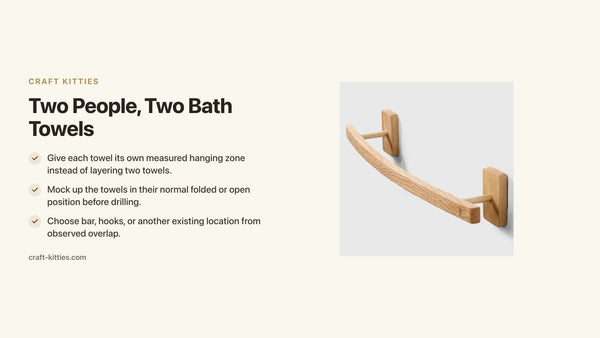
The arc design keeps the same footprint and the same single-bar function, but the bar itself curves slightly upward at the ends rather than running straight. The effect is subtle in photographs and more noticeable in the room: it lifts the visual weight of the piece slightly and softens the overall profile. In bathrooms with round fixtures, oval mirrors or otherwise soft forms, the arc reads more naturally than a straight bar. In very geometric, rectilinear bathrooms the straight bar is a better fit. The choice between them is genuine — both are equally useful.
The double-layer bar is the format for shared bathrooms and families. Two bars at staggered heights let you hang a large bath towel on the lower bar and a hand towel or second bath towel on the upper bar, both within reach at once, without adding a second set of wall anchors. For a bathroom that sees two people in the morning or a guest room that needs to be ready for a couple, the double-layer eliminates the small daily friction of a single bar that is already occupied. It is also the better choice for anyone who line-dries one towel per day: the lower bar holds the wet towel in use, the upper bar holds a fresh one.
The models from our studio
Four models covering the main configurations: a clean square bar, a brass-accented set, an arc design, and a double-layer version for shared bathrooms.

Description
The wall mounted square bar is the model we point to when the brief is simply "a wooden towel bar that looks considered." Solid hardwood — red oak or walnut — finished with a wax seal that resists humidity and wipes clean. Two compact square brackets, a straight bar sized for full bath towels and a flat shelf platform that handles a phone, hand cream or a candle without drama. The form is quiet enough to disappear into a well-furnished bathroom and deliberate enough to elevate one that is not yet there.

Description
The wood and brass set pairs solid wood brackets with a coated brass-tone rod and ring. The brass hardware is coated against tarnish and oxidation — bathroom humidity does not affect it under normal conditions. The pairing of warm wood grain and matte brass reads as the two most popular material combinations in contemporary bath hardware, combined in a single piece rather than mixed from separate sources. It works in bathrooms that already have brass mirror frames, brass faucets or brass cabinet pulls; it also works as the first piece of a palette you build around it. At $22, it is the most accessible entry in the lineup without any compromise on the solid-wood build.

Description
The arc bar asks one question: does your bathroom have round or soft forms? If it does — a round mirror above the sink, an oval freestanding tub nearby, rounded cabinet pulls, an arched window — the straight bar creates a minor tension with the rest of the room. The arc resolves it. The curve is not decorative in the theatrical sense; it is a response to the geometry of the room. In all other respects it is identical to the square bar: same solid hardwood, same wax seal, same shelf platform, same wall footprint, same installation.

Description
The double-layer bar is built for the bathroom that sees more than one person daily. Two bars at staggered heights — lower for a large bath towel, upper for a hand towel or a second bath towel — within the same mounting footprint and the same number of wall anchors as a single bar. It is the most space-efficient solution to the shared bathroom's recurring small problem: the only towel bar is already occupied, so the second towel ends up on a hook, a door handle or the floor. One double-layer bar, installed once, ends that. Available in solid red oak or walnut.
Comparison table
| Model | Price | Wood | Hardware | Best for |
|---|---|---|---|---|
| Square hardwood bar | $24.00 | Solid red oak or walnut | Wax-sealed wood brackets | Clean, versatile single bar |
| Wood & brass set | $22.00 | Solid beech or oak | Coated brass-tone rod & ring | Brass-accent bathrooms, best value |
| Arc design bar | $24.00 | Solid red oak or walnut | Wax-sealed wood brackets | Bathrooms with round or soft forms |
| Double-layer bar | $24.00 | Solid red oak or walnut | Wax-sealed wood brackets | Shared bathrooms, families, two towels |
Decision matrix — which model for which situation
| Your situation | The right pick |
|---|---|
| One person, one bathroom, white or light walls | Square hardwood bar in walnut — $24 |
| Bathroom already has brass mirrors, faucets or pulls | Wood & brass set — $22, best entry price |
| Round mirror, oval sink, soft forms throughout the room | Arc design bar — $24 |
| Two people sharing one bathroom, or a guest room for couples | Double-layer bar — $24 |
| Housewarming or bathroom refresh gift | Square hardwood bar with a matching piece from the wooden bathroom accessories collection |
Solid wood versus "wood-look" — what the label means
The gap between solid hardwood and every alternative sounds technical until you see what happens in a bathroom over two years. It is worth naming the distinction clearly, because the market is dense with products that use words like "bamboo," "engineered wood," "wood-tone" and "natural wood" in ways that obscure what they actually are.
Solid hardwood is a plank cut directly from the tree, with the same material all the way through. Its grain runs the full depth of the piece. When a solid hardwood towel bar gets a scratch, the scratch reveals more of the same wood. When it gets wet, the wax seal on the surface takes the exposure; the wood behind the seal is not affected. Over time, it develops a patina. It can be refinished. It does not swell, splinter or delaminate.
MDF and particleboard are wood fiber pressed with resin binders. They are often sold as "wood" or finished to look like wood. Their behavior in a bathroom is the opposite of solid hardwood: the edges absorb moisture first, causing swelling; the face veneer lifts or bubbles; the mounting hardware eventually pulls loose as the substrate softens. They last two to four years in normal bathroom conditions and are not refinishable.
Hollow bamboo shares properties closer to grass than hardwood. It is lightweight and technically renewable, but its moisture resistance in a fully enclosed bathroom environment is poor unless sealed far more aggressively than most consumer products are. The tubes in hollow bamboo construction can also crack under uneven load.
Every towel bar in our lineup is solid red oak, solid walnut or solid beech — hardwoods with the same material throughout, wax-sealed at our studio for bathroom use. There are no veneers, no composite cores and no hollow sections. The weight of the piece in hand and the grain visible on the cut ends are the fastest verification: solid wood feels dense and the grain runs all the way through.
Installing a wall-mounted wooden towel bar — step by step
The installation is straightforward and does not require a professional. What it does require is doing the four steps in order, because shortcuts at step two tend to become regrets at step four.
1 — Locate the wall type. Drywall, tile or plaster each needs a different anchor. For drywall, a toggle bolt or hollow-wall anchor handles the load easily; for tile, a carbide-tipped bit at slow speed (no hammer function) prevents cracking; for plaster over lath, a standard screw into a stud is the cleanest solution. Two minutes spent identifying the wall type prevents stripped anchors and remounting.
2 — Mark and level. The standard height for a towel bar is 48 to 54 inches from the floor — most adults find the lower end of that range more natural for a bar they reach toward while standing. Hold the bar at the intended height and mark both bracket positions with a pencil. Lay a small level across the marks before drilling: a bar that is half an inch off level is visible every day.
3 — Drill and anchor. Use the correct bit for your wall material and the anchor size specified in the hardware packet. Drill the two holes, seat the anchors flush, and insert the screws without overtightening — solid wood brackets do not need to be cranked down, and overtightening in drywall anchors can strip the hold.
4 — Mount and check. Hang the bar on the screws, snug the final fit and give it a firm downward pull to test the anchor load. If the bar does not shift or flex, the installation is complete. Load it with towels and leave it — there is no break-in period.
The one step most people skip is using the level at step two. It costs thirty seconds and prevents the permanent mild irritation of a bar that is slightly crooked.
Mistakes that cost a good towel bar its finish
Choosing the wood color from a product photograph. Studio photos are shot in controlled light against neutral backgrounds — colors shift significantly in actual bathroom lighting, especially warm incandescent or LED bulbs. The reliable test is to hold a sample of the wood species (or a similarly toned swatch from a hardware store) against the actual tile or wall color under your bathroom light before ordering. Walnut that glows in a studio photo can disappear against a dark-grouted tile wall.
Mounting at the old bar's height without questioning it. A previous occupant installed hardware at their height, for their use patterns, and possibly without a level. Inheriting their holes means inheriting their decisions. Measure fresh: 48 to 54 inches from the floor, on the wall within natural arm extension from where you stand at the sink.
Leaving standing water on the shelf. The wax coat resists splashing and ambient humidity — it is not designed to have a rinsing cup left sitting in pooled water overnight. A quick wipe after any direct water contact is the only maintenance solid wood in a bathroom actually needs. The goal is moisture-resistant, not waterproof; the distinction matters only when a container sits wet on the surface for extended periods.
Pairing the bar with mismatched hardware throughout the room. A walnut bar with brass fittings next to a chrome faucet and a black towel hook creates a hardware mix-up that reads as accidental rather than curated. The simplest rule is to match the metal tone to at least one other fixture already in the room — or to replace two or three chrome pieces with the same brass or black finish when installing the bar. Our wooden bathroom accessories collection is organized by wood family and hardware tone, which makes coordinating straightforward.
Where a wooden towel bar fits in a larger bathroom refresh
A towel bar with a shelf is rarely the only piece that changes in a bathroom. It tends to be the first piece — the one that sets a material palette and a standard that everything else is then measured against. Once a solid walnut bar is on the wall, the chrome faucet looks out of place, and then the soap dispenser, and then the cabinet pulls. This is not a complaint; it is how a bathroom improves over time, piece by piece, guided by the first deliberate choice.
The practical approach is to start with the bar and identify two or three other objects in the same wood and hardware family at the same time, even if you buy them later. Our wooden bathroom accessories collection groups pieces by wood species and hardware tone so you can see the complete vignette before committing: the Wall Mounted Wood Towel Bar Holder alongside soap dishes, shelves and hooks in matching finishes. A bathroom that gets four pieces in the same family reads as designed. One that gets one piece reads as a nice accident.
The other coordination worth doing is hardware tone. Brass with brass, black with black, silver-tone with silver-tone. Mixing warm brass and cool chrome in the same small room creates a visual tension that registers even for people who cannot identify why the room feels unfinished. Pick one and hold the line.
FAQ — wooden towel bars with shelf
1 — Can solid wood handle daily bathroom humidity? Yes — when sealed. Our bars are solid red oak, walnut or beech finished with a wax or wax-oil coat that resists ambient humidity and splashing, wipes clean with a dry cloth and holds up in normal bathroom conditions indefinitely. The distinction is sealed solid hardwood versus veneered MDF or particleboard: veneer absorbs humidity at the edges and swells over months, solid wood does not.
2 — What can I put on the shelf? It is a convenience and display shelf: a phone, hand cream, a small diffuser, a candle, a folded face cloth. It is sized for daily essentials rather than heavy storage. For two towels in the same footprint, the double-layer model gives you a second bar rather than a shelf.
3 — How high should it be mounted? Between 48 and 54 inches from the floor is the standard range — lower if you want the shelf at a comfortable height for items you reach for while standing. Mark the position with tape and step back before drilling.
4 — Red oak, walnut or beech — which holds up best? All three are hardwoods and all three are finished with the same wax seal — durability is identical. Red oak is honey-warm with bold grain, walnut is deep brown with fine grain, beech is pale and smooth. The choice is about contrast with your wall, not about performance.
5 — Will the brass hardware tarnish near a shower? The brass-tone hardware in the wood and brass set is coated against oxidation and performs normally in bathroom conditions. A dry wipe after direct splash is all the care it needs.
6 — What is the difference between single bar and double layer? Single: one bar, one towel, minimal wall footprint, clean look. Double layer: two bars at staggered heights, same wall anchors, lets you hang a bath towel and a hand towel simultaneously. For shared bathrooms the double layer is the clear practical choice.
7 — Do I need a professional to install it? No. Two anchor points, a drill and a level cover the full job in about fifteen minutes. The only step that benefits from care is matching the anchor type to your wall material: hollow-wall anchors for drywall, carbide bit and tile anchors for ceramic tile.
8 — How much weight can the bar hold? More than any reasonable number of bath towels. The limiting factor is always the wall anchors, not the hardwood or the hardware. Use the correct anchor for your wall type and the bar will outlast the towels many times over.
9 — Can I mount it on tile? Yes, with a carbide-tipped or diamond-tipped bit at slow speed, no hammer function. Mark the tile surface with tape to prevent the bit from skating. Use tile-rated anchors in the holes.
10 — Is a wooden towel bar a good housewarming gift? One of the more considered options in the category: visible every day, actually useful, and coherent enough with most bathroom color palettes that it does not require the recipient to redecorate around it. It photographs well for anyone who documents a renovation, and it pairs naturally with a second piece from the same wood family — a soap dish or a small shelf — to give the recipient a matching set rather than an isolated object.
Where to go next
The towel bar is usually the first piece that shifts a bathroom away from builder-grade hardware — and rarely the last. Our wooden bathroom accessories collection gathers the pieces that answer each other: bars, shelves, hooks and soap dishes in the same red oak, walnut and beech families, all wax-sealed to the same standard. Start with one piece and let the room suggest the next.
You can also find these pieces on Etsy, where 243 customers have shared their own bathroom refresh photos — a useful reference if you want to see the pieces in real rooms rather than studio settings.
Conclusion — hardware that reads like furniture
The simplest method for choosing: pick the wood by contrast with your wall (walnut for light walls, red oak for darker or busier rooms, beech for minimal or contemporary spaces), choose the format by use (single bar for one person, arc for soft-form bathrooms, double layer for shared spaces, brass set if brass is already in the room), and mount it at the height your arm naturally falls rather than where the old rod was drilled. The square hardwood bar covers most bathrooms; the wood and brass set is the entry price without compromise; the double-layer bar ends the shared-bathroom towel problem permanently. Three paths, one outcome: a bathroom where the hardware looks as deliberate as the rest of the room.