At a glance
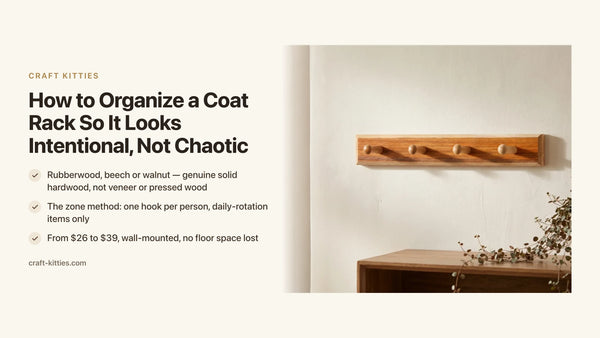
- Solid beech, walnut and real oak — genuine hardwood, not printed veneer
- Swivel models fold flat when empty, fixed hooks stay out of the way in open walls
- From $5 to $26 — a set of two starts at the price of a coffee and lasts decades
A coat thrown over a chair. A bag hung from a door handle. Scarves stacked on the same hook until the whole pile falls. None of this happens because your hallway lacks discipline — it happens because the wall is missing one well-placed hook.
A wooden wall hook is not a complex purchase. But getting it wrong is easy: fixed when it should swivel, too low for a winter coat, too lightweight for daily use, or simply the wrong wood against the wrong wall. Getting it right means the hallway actually works — clothes land where they belong, the wall looks intentional, and nothing falls, snags or leaves a scratch on a sleeve.
This guide covers the two decisions that matter before buying (species and mechanism), the five hooks in our studio lineup with real prices, a comparison table, a decision matrix, how to hang them properly, and a full FAQ. If you already know which model you want, you can skip ahead. If you want to choose well the first time, start here.
Why the material matters more than the price
The wall hook category is flooded with objects that look like wood and are not. Pressed-fiber panels with a photo-printed grain pattern, hollow plastic bodies in a wood-tone finish, bamboo-and-glue composites that cost the same as real hardwood and behave like cardboard in humid air. The difference becomes obvious the first time someone hangs a wet coat, or when the hook shaft carries a loaded laptop bag for the third winter in a row.
Solid hardwood — beech, walnut, real red oak — does not flex under load the way plastic does. It does not delaminate at the surface the way veneered board does. It does not lose its finish character after a year of sleeve and zipper contact. A waxed solid-wood hook develops a slight patina with use, the same way a good leather bag or wooden furniture does: it looks more itself over time, not worse.
The other material consideration is surface texture. A coat, a scarf, a delicate knit — these all make contact with the hook shaft every day. A smooth, rounded hardwood profile is forgiving on fabric in a way that bare metal or sharp-edged plastic is not. Our studio finishes each hook with a natural wax or oil coat that leaves the surface smooth to the touch and protective against moisture without adding an artificial plastic feel.
The short version: buy solid wood once. Replace pressed-fiber twice.
Beech or walnut: reading the room before choosing the grain

The two dominant species in our lineup are beech and walnut. Red oak appears in carved rustic models. Understanding each one takes thirty seconds and prevents a return.
Beech is a pale, close-grained hardwood with a creamy to light tan color and a fine, uniform texture. It reads as clean and understated against most wall colors — white, off-white, warm gray, sage — which makes it the default choice for Scandinavian, minimalist or transitional rooms. It is also the species that photographs best in flat light, which is why most of our product photography defaults to it.
Walnut is denser, darker, and richer. The grain varies more, with the characteristic streaks and color shifts that make each piece slightly different. Against a light wall it functions as an accent — the hook becomes a design object rather than a background object. It suits mid-century modern rooms, leather furniture, aged brass hardware and spaces that already have warmth.
Two-tone (beech and walnut combined) reads as a deliberate statement: the contrast strip between the two woods is visible, and the 2-hook panel version uses this contrast as its main visual feature. It is the right choice when you want the hooks to contribute to the room's visual interest rather than disappear into it.
For red oak in the carved rustic swivel model: the surface has the rougher, more textured character of naturally finished hardwood, and it suits farmhouse, cottage and rustic contexts where a more polished look would feel out of place.
The reliable contrast rule: pale wall, use walnut. Warmer or darker wall, use beech. Either wall, two-tone pulls focus deliberately. Choose by what you want the hook to do — blend or stand out.
Fixed vs. swivel: the mechanism that decides daily life
This is the choice most buyers skip, and it is the one that matters most in everyday use.
A fixed hook is permanently extended from the wall. It is the simplest design and works well in spaces where the hook is out of the travel path — along an open wall, inside a closet, or in a mudroom where people walk parallel to the hooks rather than past them. The boot-profile hook in our lineup is a fixed design with an exaggerated boot-silhouette profile that holds heavy outerwear securely at the toe of the curve.
A swivel hook rotates 180° on its mount. Flush to the wall when not in use, it extends fully when you need it and folds back when you do not. This behavior is the correct answer to two common problems: a tight hallway where a permanent protrusion catches sleeves on the way through, and a door-back installation where the hook needs to clear the door frame when the door swings. In both cases, a fixed hook is an obstacle you navigate around; a swivel hook is simply not there when it is not needed.
The magnetic hook is a third category — a compact, flat hook that holds keys, sunglasses cases and lightweight bags with a magnet, no arm extension required. It installs flush and holds up to its rated weight limit without moving parts.
Practical rule: for a hallway or behind a door, start with swivel. For an open mudroom wall or a dedicated coat wall with clearance, fixed is fine and slightly more secure at heavy loads. The magnetic model is a complement, not a replacement — ideal for keys and small items alongside a coat hook.
The five hooks from our studio

Description
The boot-profile hook earns its price through two things: the silhouette and the wood. The exaggerated curve, shaped after a boot's heel, catches the collar or loop of a heavy coat at the natural weight center — which is why coats stay on instead of sliding off at the end of the day. Solid beech, waxed, with two standard screw holes. At $12 per hook, a pair of them handles a full entryway at a price well below a single branded chrome alternative.

Description
The magnetic beech hook is the piece that solves a different problem: where do keys, sunglasses and the phone cable go when you walk in? A standard coat hook is too large and too low for these. The magnetic hook mounts at the right height — eye level, beside the door — and holds with a magnet that sits inside the solid beech body, invisible until you need it. $6.90 is a small investment for never losing your keys in the entryway again.

Description
The rustic swivel hook is carved from solid wood — the surface texture shows the tool marks and natural character of real hardwood, not the machine-perfect smoothness of an injection-molded part. The swivel mechanism is the functional story: it folds flat to the wall between uses and extends to hold a coat, bag or towel without catching on anything. In a narrow hallway where every inch between the wall and the walking path matters, this hook is the answer. At $9 per hook, it is also among the more accessible entry points to genuine solid wood in the entryway category.

Description
The solid wood swivel coat hook is the working piece in the lineup. No decorative carved profile, no two-tone accent, no magnet — just a clean swivel hook in solid wood at $5.00 per piece. When you need a row of six hooks for a mudroom or a family entryway, this is how you build it without spending more on hooks than on the coat rack furniture they replace. The swivel mechanism works identically to the higher-price models; the price reflects fewer decorative steps, not fewer functional ones.

Description
The two-tone panel is the piece you buy when the hooks are part of the room's visual language, not just its function. A horizontal panel in solid beech with a walnut accent strip across the face, holding two swivel hooks at standard spacing. The contrast between the pale beech and the dark walnut reads as a deliberate choice — the kind of detail you notice when you enter the room, the kind of detail that makes a guest ask where it came from. At $26.00 for the complete 2-hook unit, it costs less than a single designer hook from a hardware brand and carries more visual weight. Mount it above a bench, a console or directly on an empty wall — it works in any of these positions.
Comparison table
| Model | Price | Wood | Mechanism | Best for |
|---|---|---|---|---|
| Boot-Profile Hook | $12.00 | Solid beech | Fixed, boot silhouette | Heavy coats on an open wall |
| Magnetic Hook | $6.90 | Solid beech | Magnetic, flush profile | Keys, sunglasses, light bags |
| Rustic Swivel Hook | $9.00 | Solid oak (hand-carved) | Swivel 180° | Tight hallways, rustic rooms |
| Swivel Coat Hook | $5.00 | Solid wood | Swivel 180° | Multi-hook rows, budget build |
| Two-Tone 2-Hook Panel | $26.00 | Solid beech + walnut | Swivel, panel-mounted | Visual statement, 2-person entryway |
Decision matrix — which hook for which situation
| Your situation | The right pick |
|---|---|
| Open entryway wall, heavy winter coats daily | Boot-Profile Hook — the silhouette holds heavy outerwear at the natural balance point |
| Narrow hallway or behind a door | Rustic Swivel or Swivel Coat Hook — fold flat when not in use |
| Keys, cards and small everyday carry | Magnetic Hook — flush, unobtrusive, effective at eye level |
| Family mudroom — need 4 to 6 hooks in a row | Swivel Coat Hook at $5 each — full swivel without the decorative surcharge |
| Two adults, want one clean pair of hooks | Two-Tone 2-Hook Panel — pre-spaced, pre-leveled, one piece to mount |
| Gift for a housewarming or home refresh | Two-Tone Panel or two Boot-Profile Hooks — gift that gets used every day |
How to install wall hooks that stay in place

Installation is where most wall hook problems originate — not the hook itself, but the mounting. Four steps, done in order, prevent all of them.
Step 1 — Find the stud or choose the right anchor. A wood stud is the best mounting point. Use a stud finder and mark its edges, then center the screw between them. If no stud falls where you need the hook, use a hollow-wall anchor rated for at least twice the expected load. Drywall alone without a stud or anchor will fail under a winter coat; this is not a question of wood hook quality, it is a question of where the load actually transfers.
Step 2 — Mark the height before drilling. The standard for adult coat hooks is 60 to 66 inches from the floor — high enough for a long coat to clear the baseboard, low enough to reach without stretching. For a household with both adults and children, a second lower row at 48 to 50 inches prevents the morning rush. Hold a coat against the wall at your planned height and look at the hem clearance before committing. Two minutes spent here prevents an awkward adjustment later.
Step 3 — Drive screws flush, not overtight. Hardwood is strong but splitting is possible if you overtorque. Pre-drill a pilot hole slightly smaller than the screw diameter for solid-wood mounting plates, then drive to flush contact. Do not force the screw until the wood compresses visibly. A flush mount distributes load across the full plate surface; an overtightened mount concentrates stress at the screw head and will crack a decorative model eventually.
Step 4 — Load test before hanging anything valuable. Hang a heavy bag or a full coat, give a light downward pull. If the hook shifts, the anchor is not set. If it holds firm, the installation is complete. Swivel hooks should be tested at full extension under load — the pivot point should feel solid, not loose. Any play in the pivot at installation only increases with time.
What makes a good entryway coat arrangement
Most entryways fail not because they lack hooks, but because the hooks are placed without thinking about how they will be used together. Getting the arrangement right costs nothing — it just requires making three decisions consciously instead of guessing.
Spacing between hooks. If two hooks are too close together, hanging coats overlap and neither hangs properly. The minimum workable spacing for adult coats is 8 to 10 inches center-to-center. For family-use rows, 10 to 12 inches gives each coat its own clearance. The two-tone panel has its hooks pre-spaced for two adults — which is one less decision to make.
Mixing fixed and swivel. A combined arrangement works well in a wider entryway: one or two fixed boot-profile hooks for heavy outerwear on the side nearest the door, swivel hooks further along the wall for lighter items that get hung and retrieved more quickly. Fixed hooks are slightly more stable at high load; swivel hooks are more forgiving of traffic.
Adding a lower key hook. A single magnetic hook at eye level, beside the main coat hooks, solves the last recurring problem: where keys go when you arrive. Without a dedicated spot, keys migrate to every flat surface in the house. With one beech magnetic hook mounted 5 inches to the side of the coat hooks, the habit forms automatically because the hook is at exactly the right height and in exactly the right line of sight.
Three mistakes that waste good hooks
Mounting into drywall without an anchor or stud. The most common error, and the one that causes hooks to pull clean out of the wall after a season. Solid wood hooks are heavy enough to stay put; the wall section they are mounted into needs to match their durability. Stud or rated anchor, always.
Choosing the hook by the product photo rather than your wall color. A pale beech hook that disappears beautifully against a white studio background can vanish entirely on a white wall — which is the opposite of the effect you wanted. Contrast is the rule: dark wood against light walls, light wood against mid-tone or darker walls. If both walls are light, the two-tone panel creates its own contrast and reads from across the room.
Underestimating the number of hooks. One hook per person is the minimum; two per person is realistic for a household that wears different outerwear in different seasons. A family of four that installs two hooks will always have coats on chairs. Buying two additional swivel hooks at $5 each to complete the row costs less than one trip to a furniture store.
How to care for solid wood hooks
A wooden wall hook requires almost no maintenance. The wax or oil finish applied at the studio protects the surface from the daily contact of fabric, leather and humidity that a hook experiences in a hallway. The care routine is correspondingly minimal.
Once a week or less: wipe down with a dry cloth to remove dust from the top of the hook and the mounting plate. Once a year or when the surface starts to feel rough to the touch: apply a thin coat of beeswax or natural wood oil with a cloth, let it absorb for five minutes, wipe off the excess. This refreshes the protective layer and keeps the surface smooth and forgiving against garment fabric.
Avoid: harsh chemical cleaners, furniture polish sprays that contain silicone (they seal the surface and prevent future finishing), and letting wet coats drip directly onto the wood for extended periods. An occasional damp coat is fine — solid beech and walnut are moisture-tolerant when sealed. A coat dripping directly from rain for hours is more than the surface protection is designed to handle; hang it on a rack near the door before moving it to the wall hook.
Swivel mechanisms: inspect the pivot once a year. If the pivot feels loose, a small standard screw at the center can usually be tightened without removing the hook from the wall. If it feels stiff, a drop of food-safe mineral oil on the pivot point is enough to free it.
Where to go next
A coat hook is typically the first solid-wood piece to go on an entryway wall — and rarely the last. Our wall hooks collection covers the full lineup from individual hooks to multi-hook panels, organized by mechanism and species. If you are building out a complete entryway system, the Two-Tone Beech and Walnut Wall Hooks and the Beech Wood Boot-Profile Wall Hook are the two pieces to start with — they answer the "daily coat" and "key" questions in the same wood family, which is what makes an entryway look assembled rather than accumulated.
Our studio's work appears on Etsy with over 243 reviews from customers who have been living with these pieces long enough to know whether they hold.
FAQ — wooden wall hooks for hanging clothes
1 — What makes solid wood wall hooks better than plastic or metal ones? Solid wood — beech, walnut or oak — combines load-bearing strength with a finished surface that does not scratch garment fabric on contact. Unlike plastic hooks, which flex under a heavy coat and tend to crack over time, or raw metal hooks, which can snag delicate weaves, a waxed or oiled hardwood hook presents a smooth rounded surface. It holds more weight cleanly and looks like furniture rather than hardware.
2 — How much weight can a wooden wall hook hold? A correctly installed solid-wood hook mounted into wall studs or with appropriate anchors will typically hold 15 to 25 lbs per hook — enough for a heavy winter coat, a canvas bag loaded with gear, or a towel plus robe together. The weak point is almost always the mounting, not the wood itself. Two screws into studs will outlast any plastic alternative.
3 — Will a wall hook damage my wall when I install it? Installation always involves two small screw holes, which are easily filled and painted if you move. Magnetic models and some swivel hooks can be surface-mounted with strong adhesive for zero-hole installation — the right option for renters or painted walls where holes are not allowed.
4 — What is a swivel wall hook and why does it matter for clothes? A swivel hook rotates on its mount — typically 180° — so it lies flat against the wall when empty and swings out to hold a coat when needed. This is the key advantage over fixed hooks in tight spaces like hallways and behind doors: the hook does not protrude when unused, so it does not catch a sleeve as you walk past or leave a visible bump on the wall.
5 — Beech or walnut for a wall hook — which is the better wood? Both are hardwoods and both are excellent. Beech is pale with a fine, even grain — it brightens a darker entryway and suits Scandinavian or minimalist rooms. Walnut is deep brown with a rich, varied grain — it pairs naturally with leather, aged brass and mid-century furniture. For load capacity and durability, there is no practical difference. The choice is entirely visual.
6 — How high should wall hooks be mounted for hanging coats? Between 60 and 66 inches from the floor is the common guideline for adult coats — high enough for the hem to clear the baseboard, low enough to reach without stretching. For a mix of adults and children, stagger two rows: one at standard height, one at 48 to 50 inches. Mark the wall and do a dry run with a coat before driving the final screws.
7 — Can I install wooden wall hooks without drilling? Yes, with the right model. Magnetic hooks and some lightweight swivel hooks can be mounted using high-strength adhesive strips rated for the hook's expected load. This works well for smooth painted drywall and plaster surfaces. On textured walls or for heavy winter coats, screw mounting into studs is more reliable. Check the product weight rating before choosing adhesive-only installation.
8 — How do I care for a wooden wall hook? Almost no maintenance is needed. A dry cloth removes dust; a barely damp cloth removes fingerprints or grime near the hook shaft. Once a year, a thin coat of beeswax or natural wood oil keeps the finish alive and prevents the surface from drying out. Avoid harsh cleaners or soaking the wood.
9 — Are wooden wall hooks suitable for behind a door? Yes, and swivel models are particularly well-suited. A swivel hook sits flat against the door when not in use, so it does not interfere with the door closing or catch clothing when someone enters. Fixed hooks behind a door can snag bags on the opposite wall — measure the door clearance before choosing a fixed model.
10 — Do wooden wall hooks make a good gift? They make an excellent housewarming or home-refresh gift precisely because they are both practical and visible. A pair of matching hooks in solid beech, or the two-tone beech and walnut panel, signals attention to detail and works in any home. Combine two of the same model for a small row, or choose the two-hook panel as a ready-made gift that needs no pairing.