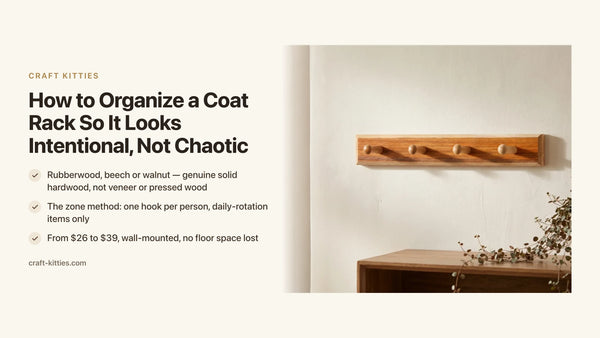
At a glance
- Solid beech, walnut and red oak — real hardwood, not veneer or composite
- Wide boot-profile head won't crush crown or brim
- From $5 to $26, swivel, magnetic and two-tone options
A hat you love deserves better than a coat closet floor. Left in a pile, brims warp. Hung on a narrow metal prong, the crown dents. The right wooden wall hook solves both problems at once — it gives the hat a place on the wall, at eye level, without putting pressure on any point the hat was not designed to carry. And because it is wood rather than a chrome peg-strip, it reads as décor rather than as storage hardware.
This guide covers everything that shapes a good decision: why the hook profile matters more than you would think, how wood species affect the look, where swivel and magnetic mechanics earn their place, how to get spacing and height right, and which hooks from our wall hooks collection suit which situations. Five models, two comparison tables, an installation sequence, and the eight questions we hear most from people setting up an entryway hat display.
One fact worth stating before anything else: these hooks are cut from solid beech, walnut and red oak. Not veneer over MDF, not resin printed to look like wood grain. Solid hardwood — the kind that acquires a patina instead of chipping, and that holds a screw firmly over years of daily use.
At a glance
- Solid beech, walnut and red oak — real hardwood, not veneer or composite
- Wide boot-profile head won't crush crown or brim
- From $5 to $26, swivel, magnetic and two-tone options
Why the hook profile is the first decision, not the last
Most people start their search by asking "wood or metal?" or "what color should it be?" The question that actually determines whether a hat comes off the hook undamaged is the shape of the hook head itself.
A narrow metal prong — the kind built into most entry closet strips — concentrates the full weight of the hat on a circle roughly the diameter of a pencil. On a baseball cap with a structured crown, that point load slowly deforms the interior band over weeks. On a wide-brim felt or straw hat, it creates a pressure ridge that is nearly impossible to steam out fully. The hat ends up hung but slowly wrecked.
A wide, rounded hook head — like the boot-profile shape in our Beech Wood Boot-Profile Wall Hook — distributes that load across a much larger arc of the crown. The hat rests the way it would on a head rather than on a pin. It hangs securely, but the brim geometry is undisturbed when you lift it off.
Solid wood has an additional advantage here: it is naturally smooth and slightly warm to the touch, without the sharp edges or rough texture that can catch on straw weave or fine felt. A beech or walnut hook finishes to a surface that treats delicate hat materials gently by default.
Wood species: beech, walnut and red oak compared

The three species in our lineup differ most in color and character, and very little in anything else. Beech is the palest and most neutral: a light blond tone with a fine, even grain that does not compete with wall color or adjacent décor. It is the quiet choice — present enough to read as natural wood, restrained enough not to dominate. Most of our swivel and magnetic models are beech for exactly that reason.
Walnut sits at the opposite end of the palette. Deep, warm brown with a tight, composed grain, it has the quiet authority of furniture-grade material. A walnut hook on a white wall reads as an intentional accent; in a darker entryway it adds richness without heaviness. Our two-tone model pairs beech and walnut in the same row — the contrast between the two species is the design.
Red oak falls between them in tone: a warm honey color with a bolder, more specialementsive grain pattern that catches light differently than the quieter species. It suits rooms with existing wood elements — floors, a console table, window trim — where the grain adds texture rather than noise.
In terms of hardness and durability, all three are excellent entryway materials. Beech, walnut and red oak are dense hardwoods that hold screws firmly, resist the denting and scuffing of daily coat-and-bag contact, and finish with a smooth surface that wipes clean. The choice between them is entirely visual.
The five models, in detail
These five hooks cover the full range of entryway hat-display situations — from a single-hat vignette to a full row for a family's daily outerwear.

Description
The boot-profile shape is the primary design feature here. The head is wide enough to support a hat crown the way a hat form would — from the inside, across a generous curve — rather than pressing on a single point. Solid beech throughout, naturally finished and smooth enough to be gentle on felt, straw or structured fabric. At $12 it is the cleanest single-hook answer for anyone with one or two statement hats they want on display.

Description
The magnetic version solves a specific entryway problem: you want to hang a hat but you also need somewhere for keys that does not involve a separate dish or bracket. The magnet is built into the hook body — invisible from the front — and holds a key ring or a magnetic accessory organizer firmly without extra hardware. At $6.90 it is the most affordable entry into solid beech, and it installs in the same footprint as a standard single hook.

Description
The swivel mechanism earns its place in tight entryways and gallery-wall hat displays where the hat hangs close to the wall surface. Rotating the hook outward before hanging means the brim never catches against the plaster or the neighboring frame. The carving gives the hook a hand-worked quality — not perfectly uniform, intentionally rustic — that suits farmhouse, cabin and collected-over-time interiors. Solid wood throughout, $9.

Description
This is the high-volume option. At $5 per hook, it is designed to be installed in a row — three, four, or five across a mudroom wall — so that an entire family's worth of coats, bags and hats all have a designated spot. The swivel head works equally well for a hat as for a coat hanger. Simple in form, honest about what it is, and easy to space evenly across a long wall stretch.

Description
The two-tone model is the most deliberate design piece in the lineup. A single bar holds two hooks — one in light beech, one in deep walnut — and the natural contrast between the species does the visual work without paint, stain or applied hardware. It installs as one piece (one set of anchor points, one level line) and reads on the wall as a coordinated object rather than two separate hooks. At $26 for the pair it is the right choice when the entryway is visible from the living area and the hook needs to earn its place aesthetically.
Comparison table
| Model | Price | Wood | Mechanism | Best for |
|---|---|---|---|---|
| Boot-Profile Wall Hook | $12.00 | Solid beech | Fixed, wide profile | Single hat display, brim protection |
| Magnetic Wall Hook | $6.90 | Solid beech | Fixed + magnet | Hat + keys in one spot |
| Swivel Rustic Hook | $9.00 | Solid carved wood | Swivel | Tight walls, farmhouse style |
| Solid Wood Swivel Hook | $5.00 | Solid wood | Swivel | Multi-hook rows, mudrooms |
| Two-Tone 2-Hook Row | $26.00 | Beech + walnut | Fixed pair | Visible entryway, design accent |
Decision matrix — which hook for which situation
| Your situation | The right pick |
|---|---|
| One or two prized hats you want displayed without brim damage | Boot-Profile Hook |
| Hat hook that doubles as a key spot | Magnetic Hook |
| Narrow entryway, brim catches on the wall when hanging | Swivel Rustic Hook |
| Full family row — coats, bags and hats all need hooks | Solid Wood Swivel Hook (×3 or more) |
| Entryway visible from the living room, hook needs to look intentional | Two-Tone 2-Hook Row |
| Farmhouse, cabin or rustic interior | Swivel Rustic Hook |
Spacing and height: the numbers that make a row look right
Getting the spacing and height right before drilling is the decision that determines whether the finished row looks composed or accidental. It is worth a few minutes of measurement.

Spacing between hook centers. The key number is brim diameter plus clearance. A standard baseball cap has a brim diameter of roughly 8 to 9 inches; with 2 inches of clearance on each side, 10 to 12 inches between hook centers prevents brims from overlapping. Wide-brim felt or straw hats — which can run 14 to 18 inches brim-to-brim — need 14 to 16 inches of center-to-center spacing so the edges do not press against each other and leave a permanent crease. If you are mixing hat types on the same row, space for the widest brim and let the smaller ones breathe.
Height from the floor. For a dedicated hat display, 60 to 65 inches places the hook at eye level for most adults — you can see what you are reaching for, and the hat hangs freely without the brim touching a console table or shelf below. If the same row of hooks will carry jackets and bags as well as hats, raise to 66 to 70 inches so full-length coats clear the floor entirely. A secondary row at 40 to 48 inches accommodates children's hooks without crowding the adult row.
Horizontal reference line. Mark the hook height with a long level line — masking tape works well — before committing any holes. Stand back and view the line against the room. It is much easier to shift a tape mark than to fill and repaint a hole.
Installing wooden wall hooks: four steps
1 — Locate the studs or anchor points. Use a stud finder, or probe gently with a finish nail to confirm solid material before committing. For a single hat hook bearing only a hat's weight, a well-set drywall anchor is sufficient. For a hook that will also carry a winter coat and a bag, find the stud.
2 — Mark and pilot-drill. Mark the exact hook position with a pencil, then drill a pilot hole slightly smaller in diameter than your screw. Pilot holes prevent splitting in solid hardwood and give the screw something to bite cleanly into the wall anchor.
3 — Drive the screw level. Snug is correct — overtightening compresses the wood against the wall and can stress the grain of a solid-wood mount. If the hook has two anchor points (like the two-tone bar), set one screw partially, check level, then drive the second before tightening both fully.
4 — Test before loading. Hang a bag or apply light downward pressure before the first hat goes on. The hook should feel entirely solid with no flex or rotation. If it moves at all, the anchor has not seated properly — pull and reset rather than hoping it holds under daily use.
Mistakes that damage hats and walls
Using a hook too small for the brim. A narrow prong that fits a baseball cap perfectly will leave a pressure indent in a panama or wide felt brim within weeks. When in doubt, size up — the boot-profile hook exists specifically to accommodate the full range of hat sizes without adjustment.
Hanging a damp hat. Wood and moisture coexist well over the long term, but a wet hat pressed against a wood hook for hours will transfer moisture into the hat's band and accelerate the structural degradation of the crown. Give hats a few minutes to air before hanging, or use the hook as a drying position with the hat loosely placed rather than pushed fully onto the hook.
Anchoring into tile grout or plaster seams. The weakest material in any wall segment is the joint. Tile grout cracks; old plaster seams crumble. If your entryway wall has either, move an inch in either direction to find solid substrate, or choose an adhesive-mount option rather than a screw.
Mounting every hook at the same height without considering what goes on each one. A row of identical hooks at 64 inches works for hats. It does not work for a long coat — which will drag the floor — and it does not work for a child who cannot reach it. Thinking through what the hook actually needs to hold before marking the wall avoids a second installation.
How wooden hat hooks age over time
Solid beech, walnut and red oak are dimensionally stable materials. They do not swell, warp or peel in the way that veneered or MDF-backed hooks do in the humidity cycles of an entryway — coats dripping in from rain, the door opening and closing, the mild temperature swings between seasons. Over time, a solid-wood hook develops a patina: the finish deepens slightly where hands touch it most often, the grain becomes a little more visible. It reads as wear rather than damage. That is the difference between material that ages and material that deteriorates.
The maintenance expectation is correspondingly low. A dry cloth removes dust; a barely damp cloth cleans the occasional smudge. The finish on our hooks is applied in the studio to protect the wood without requiring a renewal schedule — no annual re-oiling, no sanding, no particular product. The hook does not need attention; it just needs to be used.
Where wooden hat hooks earn their keep beyond the entryway
The obvious placement is the entryway row — hats near the door, reached for without opening a closet. But the same hooks solve similar problems in other rooms.
A bedroom gallery wall with two or three hooks at different heights turns a hat collection into deliberate décor. The hats are accessible without being stored, visible without taking floor or shelf space. The two-tone beech-and-walnut bar is particularly suited here — it reads as a design object rather than storage hardware.
A mudroom or laundry room benefits from the higher-volume hooks. Four or five of the solid wood swivel hooks in a row at the same height give each member of a household a designated position for outdoor gear — hats above, bags below, coats on the same hook in winter. The swivel mechanism makes sharing a hook between a hat and a coat feasible without constant readjustment.
A home office or studio where a collection of caps accumulates over time is another natural fit. Rather than a stacked box or a rack that hides what is in it, a row of wall hooks keeps the collection visible — and, with a wide-profile hook, keeps every hat in the shape it was bought in.
FAQ — wooden wall hooks for hats
1 — What kind of wall hook keeps a hat from losing its shape? A hook with a wide, rounded or boot-shaped profile distributes weight across the inside of the crown rather than concentrating it on a single point. Solid wood hooks — beech, walnut or red oak — are naturally smooth and will not snag delicate straw or felt brims the way metal prongs can. The boot-profile beech hook is built specifically for this.
2 — How far apart should hat hooks be spaced on the wall? The safe minimum is the diameter of your widest brim plus about two inches of clearance on each side. For most baseball caps that means 10 to 12 inches between hook centers; for wide-brim felt or straw hats, allow 14 to 16 inches so brims do not overlap and press each other out of shape.
3 — Can wooden wall hooks hold heavy winter hats and coats? Yes, provided the hooks are mounted into wall studs or with appropriate anchors. Solid beech and walnut hooks are load-rated for coats, bags and accessories. The weak point is almost never the wood — it is an under-sized wall anchor. Use a stud finder, go into solid material, and the hook will outlast the wall finish.
4 — Do swivel hooks work better than fixed hooks for hats? Swivel hooks offer one practical advantage: you can angle the hook outward to place or retrieve a hat without dragging it across the wall. For tight entryway walls where the hat hangs close to the surface, a swivel hook reduces the risk of bumping the brim each time. Fixed hooks work equally well in spaces where you have a clear approach angle.
5 — How do I install wooden wall hooks without damaging the wall? Use a stud finder before drilling. For hooks that will hold a single hat or keys, a drywall anchor rated for the weight is sufficient. For hooks expected to carry coats and bags as well, locate a stud. Mark with a pencil, drill a pilot hole smaller than your screw diameter, and drive the screw snugly — never overtighten into wood.
6 — What is the difference between beech, walnut and red oak for wall hooks? Beech is light blond with fine grain — neutral on any wall. Walnut is deep brown with a quiet, tight grain that reads like furniture. Red oak sits between them: warm honey with bolder, more specialementsive grain. All three are dense hardwoods that hold screws firmly and resist daily handling without denting. The choice is purely visual.
7 — Can I use hat hooks in a mudroom or near the front door? Entryways and mudrooms are exactly where wooden wall hooks perform best. The finish on solid hardwood handles daily handling, humidity from coats and umbrellas, and temperature swings without warping or swelling. Mount at a height that lets coats hang freely — usually 60 to 66 inches from the floor — and the space pulls together functionally and visually.
8 — What is the right height to mount hat hooks on the wall? For hats only, 60 to 65 inches from the floor places the hook at eye level, making it easy to spot and grab the hat you want without searching. If the same row of hooks will also carry jackets, raise to 66 to 70 inches so the coats clear the floor entirely. Children's hooks belong at 40 to 48 inches on a separate row.
Where to go next
A hat hook is rarely the only thing an entryway needs. Our full wall hooks collection brings together the hooks that answer each other — single hooks, rows, swivel and magnetic — all in the same solid beech, walnut and red oak families so the wall reads as considered rather than assembled from different sources. If you already know the hook you want, the Beech Wood Boot-Profile Wall Hook and the Two-Tone Beech & Walnut Row are the two we point to most often for hat display specifically.
We have over 243 customer reviews on Etsy from buyers who have put these hooks through real entryway use — the feedback shapes which profiles and finishes we continue to make.
One hook, a different entryway
The choice is simpler than the search makes it seem: wide profile for brim protection, swivel if the wall is tight, two-tone if the hook is on display. Mount at eye level, space for your widest brim, anchor into solid material. A hat that has a real place on the wall is a hat you will actually reach for — and an entryway that looks like it was put together rather than accumulated.