At a glance
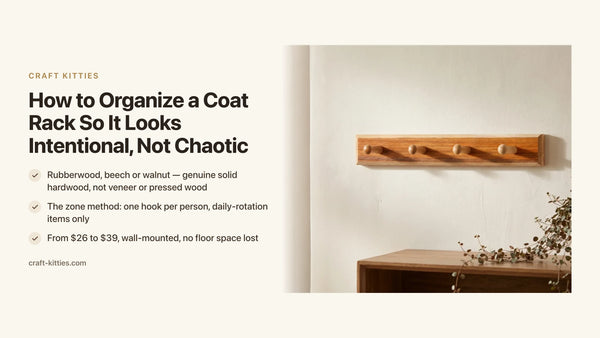
- Solid hardwood — rubberwood, beech, walnut — not veneered particleboard
- Peg racks for bags and light items; hook rails for coats and heavy gear
- From $26 to $39, modular options from 2 to 6 hooks
Walk into almost any entryway and you'll find the same situation: a cheap double-hook bracket from the hardware store, holding twice what it was designed for, slowly pulling away from the drywall. The coats end up on chairs, the bags on the floor, the keys on whatever flat surface is closest to the door. The system never quite works because the object was chosen as an afterthought.
A solid wood wall hook rack changes that calculus — not because wood is magic, but because the right rack, mounted correctly, becomes a fixed point in the room's logic. Coats go there because the hooks are in the right place and actually hold. Bags hang there because the rail is long enough. Keys land there because the habit has a physical support.
The question most people get stuck on is the one this guide addresses directly: peg rack or hook rail, and which wood, and how many hooks, and how high. There is a clear answer to each, and they are simpler than the market variety makes them seem.
Peg rack vs. hook rail: the real difference in daily use

The vocabulary gets used interchangeably in product listings, which causes confusion. Here is what actually distinguishes them.
A peg rack uses short cylindrical dowels — pegs — set horizontally into a flat backboard. You loop a bag's strap over a peg, or drape a light jacket from the shoulder. The round profile is smooth and unobstructed, which means nothing snags and removal is a single clean motion. The drawback is load: pegs work against gravity rather than with it. Heavy winter coats tend to slip unless the peg is long enough to catch the coat's hanging loop, and bulky gear can overload the horizontal projection.
A hook rail replaces the peg with a shaped hook — curved or angled, deeper projection, designed to catch and hold rather than simply support. The curve means a heavy coat stays put even when the door opens and sends air pressure across the rail. The trade-off is that shaped hooks can snag fine fabrics, and the deeper projection takes more visual space on the wall.
In practice, the best entryway organizers do not force a choice: they use a solid wood backboard with shaped hooks that have enough curve for coats and enough clearance for bags. That is the format the racks in our studio are built around — rubberwood or beech or walnut backboard, with hook profiles matched to real household load. The peg-only format is more common in mudrooms and craft rooms where the load is lighter and the snag risk is lower.
Why solid wood is the only backboard material worth using
Every wall hook rack eventually does the same thing: it takes a concentrated load at each hook point and distributes it across the screws that fix the backboard to the wall. The backboard is not decorative — it is a structural member.
This is why the choice of wood matters more than it might seem. Solid hardwood — red oak, walnut, beech, rubberwood — resists compression under load, holds screw threads firmly even after years of repeated stress, and does not flex or bow when a heavy coat shifts the load. Veneered MDF or particleboard does the opposite: the substrate compresses around the screw points over time, the threads loosen, and eventually the entire rack starts to move when you pull a coat off a hook. It does not fail dramatically; it fails slowly, in the way that cheap furniture always fails.
The racks from our studio use rubberwood or solid beech for the structural core, with genuine wood veneer where the surface calls for it. Rubberwood is a dense, fine-grained tropical hardwood — it machines well, holds screws without compression, and takes a smooth finish. Beech is the European workhorse of solid furniture: tight grain, consistent density, nearly colorless base that shows veneer cleanly. Walnut is the aesthetic peak of the lineup: deep brown, fine grain, a presence on the wall that reads like furniture rather than hardware.
The five factors that actually determine which rack to buy
Most buying guides reduce the decision to style preference. That is the wrong frame. The five factors below determine whether a rack works — the aesthetic follows once these are settled.
1. Hook count and spacing. One hook per household member is the floor, not the ceiling. Spacing below four inches between hooks means full coats cannot hang flat; they compress, wrinkle, and get pulled off the rail rather than hung on it. The wall hook rack collection includes models from 2 to 6 hooks, with standard spacing calibrated to let adult outerwear hang without crowding.
2. Rail length and wall span. A hook count tells you nothing about whether the rack fits your wall. Measure the available span before filtering by hook count — a 6-hook rail on a narrow wall becomes an obstacle. The modular Two-Tone Beech & Walnut model solves this directly: it starts at 2 hooks on a compact rail and expands to 6 hooks as the wall or storage need allows.
3. Mounting hardware and wall type. Drywall with studs at 16-inch spacing is the standard residential case; the rails in our lineup are drilled to span at least two stud positions. Plaster walls, concrete, or tile each require different anchor types. The golden rule: never mount a coat-weight rack with basic plastic drywall anchors alone. Expansion anchors, toggle bolts, or direct stud screws are the only options for daily load.
4. Hook profile and what you hang. Boot-profile hooks have a deeper, forward-projecting curve designed for winter outerwear with reinforced shoulder seams — the coat does not slip because the hook catches the hanging loop rather than just supporting the collar. Standard hooks work fine for lighter jackets, bags, and scarves. If the rack will hold parkas, ski jackets, or loaded tote bags, the deeper hook profile is the right choice.
5. Finish durability. Wood near an entryway encounters hands, occasional moisture from wet coats, and daily contact. Oil-finished and wax-finished rails handle this well — the surface is slightly open, which means small scratches blend rather than showing white against a darker stain. High-gloss lacquered surfaces look pristine in product photos and show every mark in real use.
The racks from our studio
Four models, each built around a different buyer profile. All solid wood or solid wood core with genuine veneer — no particleboard backboards.

Description
The Rubberwood Wall Hook Rack with Brazilian Veneer is the rack we point to when the question is "which one will still look good in five years". The rubberwood core is dense and screw-stable; the Brazilian veneer surface brings a warm, furniture-grade look that suits both modern and transitional interiors. Available in 4 or 6 hooks, with hooks spaced to accommodate full outerwear without crowding. At $39.00, it is the full-spec option for a household that hangs coats daily.

Description
The Rubberwood Wall Hook Rack with Cherry Veneer shares the same rubberwood core as the Brazilian-veneer model — same structural performance, same hook configurations — with a cherry-veneer surface that reads a richer, slightly reddish tone. Against white, cream, or pale-gray walls it adds warmth without going rustic. At $37.00 it is the slightly lighter investment for the same structural specification, with a different palette.

Description
The Two-Tone Beech & Walnut Wall Hook Rack is the rack for people who are not sure how much storage they actually need — and do not want to find out by buying the wrong size. The beech backboard starts small and accepts additional walnut-toned hooks without any new hardware. Starting at $26.00 for a 2-hook configuration, it is the most accessible entry point to a solid-wood rail that can grow with the household.

Description
The Walnut Wood Wall Coat Rack with Boot Profile makes one deliberate choice and commits to it: solid walnut, flat backboard, four hooks with a deeper forward-projecting profile designed to hold heavy coats securely. There is no decorative hardware, no shelf, no secondary accent — the walnut grain is the statement. At $28.80, it is the minimal aesthetic option for an entryway that already has good bones and just needs a rail that keeps up.
Comparison table — all four models side by side
| Model | Price | Core wood | Hooks | Best for |
|---|---|---|---|---|
| Rubberwood, Brazilian veneer | $39.00 | Rubberwood + Brazilian veneer | 4 or 6 | Full-spec daily-use entryway |
| Rubberwood, cherry veneer | $37.00 | Rubberwood + cherry veneer | 4 or 6 | Warm reddish palette, same performance |
| Beech & walnut two-tone | from $26.00 | Solid beech + walnut hooks | 2 to 6 (modular) | Apartments, smaller walls, flexible sizing |
| Walnut boot-profile, 4-hook | $28.80 | Solid walnut | 4 (fixed) | Heavy coats, minimal aesthetic |
Decision matrix — matching your situation to the right model
| Your situation | The right pick |
|---|---|
| Family household, coats hung daily, want it to last | Rubberwood Brazilian veneer — 6 hooks |
| Light walls, prefer a warmer reddish tone | Rubberwood cherry veneer — 4 or 6 hooks |
| Apartment or narrow wall, not sure how many hooks | Beech & walnut two-tone — start at 2, expand to 6 |
| Heavy parkas, minimal look, solid walnut | Walnut boot-profile 4-hook |
| Gift for a new home, crowd-pleasing material | Rubberwood Brazilian veneer — universally flattering tone |
How to mount a wall hook rack that will not pull out

The rack is only as stable as its mounting. Most hook-rack failures are not a wood problem — they are a fixings problem. This four-step process applies to every model in the lineup.
Step 1 — Locate studs or select anchors. Run a stud finder along the intended wall span before committing to a position. If two studs fall within the rail's length, screw directly into them — this is the strongest possible mount for daily outerwear load. If the rack will span between studs or land on a plaster or concrete wall, choose anchors rated to at least three times your expected load before drilling a single hole.
Step 2 — Mark the right height. For adults, the top edge of the rail should sit between 60 and 66 inches from the floor. This places the hooks at natural shoulder height, which is reachable without stretching and high enough to keep long coats clear of the floor. If the household includes children under ten, a secondary lower peg strip at 36 to 40 inches handles their gear without cluttering the main rail.
Step 3 — Drill and fix across two points minimum. A rail mounted at a single central point behaves like a lever — any asymmetric load creates a rotation that stresses the single anchor repeatedly. Two fixing points separated by at least 12 to 16 inches distribute the load across the wall surface and eliminate the lever effect entirely. All the rails from our studio are pre-drilled for a minimum two-point mount.
Step 4 — Load-test before daily use. Once the rail is up, apply gradual pressure to each hook individually — not the full weight of a winter coat, but a firm downward pull. If the rack flexes or the wall surface around the screws shows any movement, add a third fixing point or switch to a stronger anchor type before trusting it with daily gear. Five minutes of testing beats repairing a wall crater later.
Mistakes that undermine a good rack
Buying by hook count instead of rail length. A 6-hook rack on a 24-inch wall leaves coats overlapping and guests fighting for space. Measure the available wall span first, then filter by hook count. The right answer is usually fewer hooks, better spaced.
Ignoring the hook profile for the load. Standard shallow hooks are designed for light layers and bags. Hanging a heavy winter parka on a shallow hook creates a slow-motion pull toward the floor — the coat works against the hook's geometry every time someone takes it off. The boot-profile deep-curve hook exists precisely because household coats are heavy.
Mounting at the old rack's holes without reviewing the position. The previous occupant may have placed the rack too low, too far from the door, or directly above a light switch that now prevents the hooks from being used fully. An inherited set of holes is not a mandate — fill them and start from the right position.
Choosing a finish that does not match the maintenance available. An oiled or wax-finished solid wood rail needs an occasional wipe and nothing else. A lacquered or high-gloss surface shows every fingerprint and scratch in an entryway context — which is a high-contact surface by definition. Oil and wax finishes are the more practical choice for a hook rack; they age with character rather than showing damage.
Underestimating expansion. Most households start with a 4-hook rack and realize within a year that guests have nowhere to hang anything. Either size up from the start — the 6-hook rubberwood models are built for this — or choose the modular beech-and-walnut option that starts small and grows on the same backboard.
The wood species guide for entryway racks
The four species in our lineup each make a different statement on the wall, and each has a structural argument worth understanding before choosing by color alone.
Rubberwood is the most underrated material in solid-wood furniture. Dense, uniform grain, close to beech in hardness, and almost free of the knots and structural inconsistencies that make some hardwoods unpredictable. Its natural color is pale and neutral, which makes it an ideal substrate for veneer — the Brazilian and cherry veneer models use rubberwood precisely because it takes the veneer surface without telegraphing underlying grain. For an entryway rack, rubberwood means a stable, screw-holding backboard that will not compress under repeated load.
Beech is the workhorse of European solid-wood furniture — tight, pale grain, very consistent density across the board, machines cleanly. The beech-and-walnut two-tone model uses beech for the backboard because its consistency allows precise machining of the hook-mount holes, which is what makes the modular expansion system work reliably. On the wall, beech reads light and clean — it suits Scandinavian, contemporary, and transitional interiors equally well.
Walnut is where the lineup reaches its aesthetic peak. American black walnut is one of the most photographed woods in home décor for a reason: the depth of the brown, the fineness of the grain, and the way it shifts tone under different light all add up to a wood that does not require decoration. The walnut boot-profile rack takes this to its logical conclusion — the wood is the design, and the hooks are sized and shaped to stay out of the way. Structurally, walnut is a hardwood in every meaningful sense: harder than pine, denser than poplar, holds screws with no compression.
What all three share is real structural wood. This is the point that distinguishes them from the budget category: no particleboard, no hollow core, no printed wood-effect surface that chips when a coat hook pulls at 45 degrees. Solid or solid-core wood is a different category of object, and in the context of a daily-use rack, that difference is measured in years.
Where to go from here
A wall hook rack is usually the first permanent piece installed in an entryway — and the one that anchors the rest. Once the rail is fixed and the coats have a home, the next questions are typically about key storage, a mirror, and whether a shelf below the hooks makes the entry fully functional. The wall hook rack collection groups the models by format and size, and includes pieces that pair naturally with the rails above.
If you are still deciding between the rubberwood models and the walnut boot-profile rack, the criterion is usually aesthetic: rubberwood with veneer suits warmer, furniture-forward interiors; solid walnut suits interiors that want the wood as the focal point rather than a background material.
Our Etsy shop (243 reviews) carries several models from the lineup for those who prefer to order through the marketplace — the core assortment and current pricing are the same across both channels.
FAQ — wooden wall peg rack and hook rails
1 — What is the actual difference between a peg rack and a hook rail? A peg rack uses cylindrical wood dowels — round pegs — that you loop straps over or drape light layers from. A hook rail uses shaped hooks with a forward curve that catches and holds heavier items under their own weight. In daily use, peg racks suit bags, hats, and light jackets; hook rails handle winter coats and heavier gear. Most entryway racks in this lineup use hook profiles because household coat loads are heavier than a peg is designed for.
2 — What wood is actually best for a wall hook rack? Solid hardwoods — rubberwood, beech, walnut — are the only options worth considering for a rack that will hold coats daily. They resist compression around screw holes over time, which is the failure mode of veneered MDF and particleboard backboards. Walnut is the aesthetic peak; beech is the best value in solid wood; rubberwood is the most structurally consistent for modular or veneer applications.
3 — How many hooks do I actually need? One per regular household member plus two extra for guests and overflow is the working rule. Spacing matters as much as count — hooks closer than four inches apart prevent full coats from hanging flat. A 4-hook rail suits a two-person household comfortably; a family of four or more should look at 6 hooks or a modular option.
4 — How high should the rack be mounted? The top of the rail at 60 to 66 inches from the floor for adult-height use. This puts the hooks at natural shoulder reach without requiring a stretch. For mixed households with children, consider a second lower strip at 36 to 40 inches for kids' backpacks and jackets.
5 — Can a wood rack actually hold heavy coats without pulling from the wall? Yes, when mounted correctly. The backboard is not the limiting factor — solid hardwood handles far more than a household coat load. The failure point is always the wall fixings: use studs, toggle bolts, or rated expansion anchors, and spread the mount across two fixing points at least 12 inches apart.
6 — Does a rubberwood rack perform the same as solid oak or walnut? Structurally, yes. Rubberwood is a dense tropical hardwood with screw-holding characteristics close to beech. It is not a budget substitute — it is a different species with different aesthetics but comparable structural performance. The veneer surface adds the visual character without compromising the core.
7 — How do I stop the rack from pulling out of drywall? Locate studs and screw into them where possible. When studs are not available at the right position, use toggle bolts or expansion anchors rated for at least three times the expected load. Never mount a coat-weight rack with basic plastic drywall anchors at a single central point.
8 — Is the modular beech-and-walnut option actually modular? Yes — it ships as a 2-hook configuration on a full-length backboard pre-drilled for additional hooks, and expands to 6 hooks with the same hardware. The backboard does not need to be removed or replaced. This makes it the right choice for apartments where you are not sure how much storage you need, or for households in transition.
9 — What finish is best for an entryway context? Oil or wax finish over any high-gloss lacquer. Entryways are high-contact surfaces — hands, bags, occasional moisture from wet coats. Oil and wax finishes absorb minor scratches into their surface character rather than showing white chips against a dark stain. They also require no maintenance beyond an occasional dry wipe.