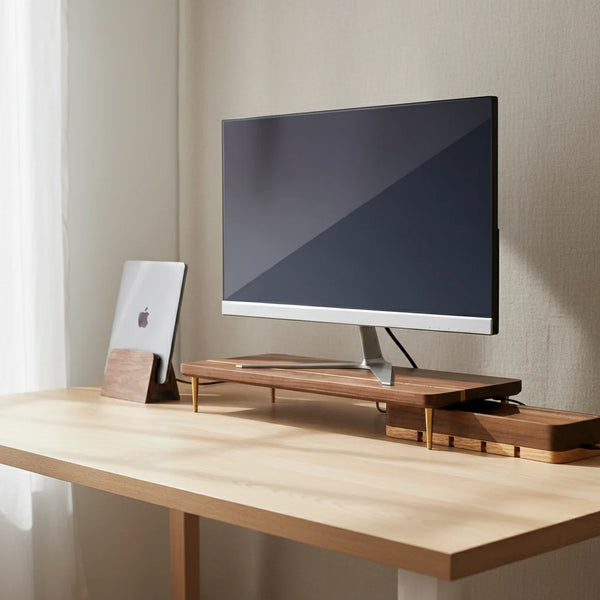
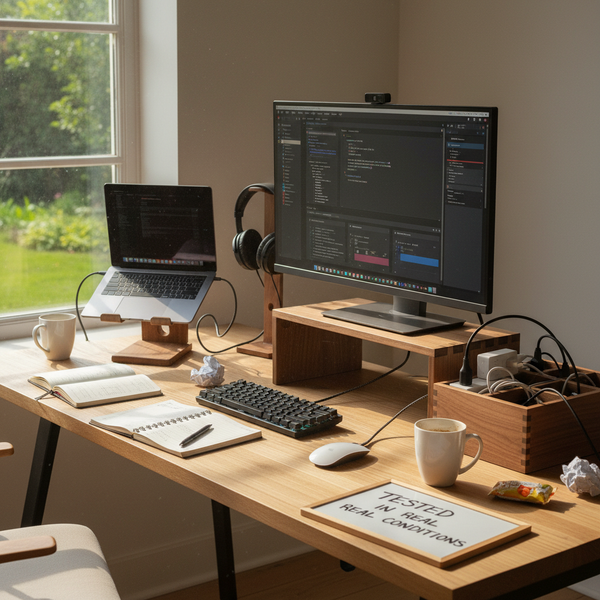
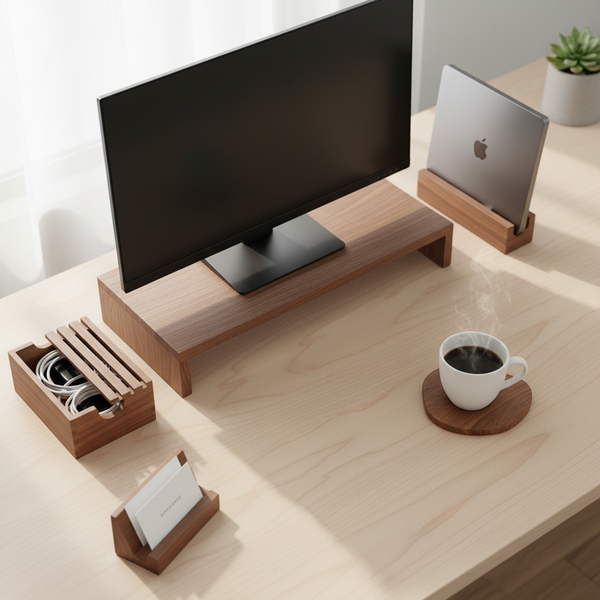
A small desk doesn't have to feel small. The challenge with a desk under 120 cm wide isn't the size — it's that most desk accessories are designed for desks twice as wide, so they crowd out the working surface instead of using it more efficiently. The trick is to pick pieces that either reclaim space (vertical laptop stand, cable hider) or earn their footprint with a clear daily job (coaster, paperweight, card holder).
After a year of testing the wooden accessories in our catalogue specifically on small-space setups — studio apartments, dorm-room desks, narrow corner desks in 35 m² flats — five pieces consistently delivered: they made the desk feel bigger, not smaller. The goal isn't to fill the surface; it's to reclaim it.
This guide walks through each piece, with specs, photos, and a decision matrix tailored to desks of three small sizes: under 100 cm, 100-120 cm, and 120-140 cm. For the wider 2026 desk-accessories landscape, see our pieces on the 5 best wood desk accessories overall or the desk accessories you actually need.
At a glance — five pieces for small desks
| Item | Price | Footprint | Space saved | Best for |
|---|---|---|---|---|
| Vertical Laptop Stand | $67.00 | 10 × 10 × 12 cm | ~660 cm² reclaimed | Clamshell MacBook setup |
| USB Cord Organizer Box | $46.00 | 23 × 12 × 11 cm | Hides power strip + 4 cables | Cable clutter |
| Walnut Cookie Coaster | $22.99 | Ø 10 × 1.2 cm | Mug stays in one spot | Coffee rings, daily use |
| Wood Paperweight | $29.00 | 7 × 7 × 3 cm | Visual anchor, calm focus | Loose papers, focus |
| Walnut Business Card Holder | $24.00 | 9 × 6 × 3 cm | Cards in one slot | Trade shows, card storage |
The rule for small-desk accessories
Three principles filter what works on a small desk vs. what just adds clutter.
Verticality wins. Anything that turns horizontal space (the desk surface) into vertical space (above the desk or held vertically) is gold. A vertical laptop stand is the prime example — it turns a 30 × 22 cm footprint into a 10 × 10 cm footprint.
Hidden beats visible. On a large desk, a visible power strip is acceptable. On a small desk, it dominates the visual field. A cord box hides what would otherwise be the most cluttered area.
Multi-use beats single-use. A coaster is single-use (a mug rest). A wooden paperweight is multi-use (visual anchor, focus object, and the literal paperweight job if needed). On a small desk, every piece needs to justify its footprint with at least two purposes.
1. Vertical Laptop Stand — the biggest single space-saver
If you're running a MacBook in clamshell on a small desk, a vertical stand is the single most impactful upgrade you can make. It turns the closed laptop from a 30 × 22 cm rectangle of horizontal real estate into a 10 × 10 cm footprint at the back of the desk. That's roughly 660 cm² reclaimed — enough to actually fit a notebook, a coffee mug, or both, without juggling.


Specs. 10 × 10 cm footprint, 12 cm tall, slot width adjustable 1.0-1.7 cm via two captive thumbscrews. Single block of solid American walnut. Silicone strips lining the slot to prevent aluminum scratches. Around 950 g.
Best for. Every current MacBook (Air, Pro 14", Pro 16") and most modern ultrabooks. Especially powerful on small desks where the open-laptop footprint costs you a third or more of the working surface.
Where to place it. Back-right corner of the desk, just behind where your right hand sits when typing. The dock cable runs from the laptop to your USB-C dock — keep it short (30-45 cm braided cables work well) to avoid the cable adding back the clutter the stand was supposed to solve.
Note. Leave 2 cm of air on each side of the slot for laptop airflow. Don't dock the laptop while it's running at full load.
2. Walnut USB Cord Organizer Box — invisible cables
On a small desk, the cable nest behind the monitor or laptop is visually catastrophic. A 23 × 12 × 11 cm cord box hides the entire power strip plus four to six cables inside a single piece of walnut — reading as a small decorative box on the desk rather than the chaos it actually contains.


Specs. 23 × 12 × 11 cm. Solid walnut. Lift-off lid (no hinge, no latch). Four side cutouts sized for USB-C and barrel plugs. Interior fits a six-outlet power strip plus four to six coiled cables.
Best for. Any small desk with more than two devices charging simultaneously. Particularly transformative for studio apartments where the desk is visible from the living area — the cord box turns a workspace into something that looks deliberate rather than transitional.
Use case. Single power cable from the strip exits through one of the side cutouts to the wall outlet. The rest stays inside. The top of the lid becomes a small tray for AirPods, USB stick, keys.
Small-desk note. On a desk under 100 cm wide, the cord box fits behind the monitor or alongside the vertical laptop stand. If your desk depth is under 50 cm, position the box at the side rather than the back to avoid cramping the monitor area.
3. Walnut Wooden Cookie Cup Coaster — saved daily annoyance
The coaster earns its tiny footprint on a small desk because the alternative is worse: a wet ring on the desk surface every time you set down a coffee or water glass. On a 100 cm desk you don't have room to put a damp mug "anywhere reasonable" — it has to go in one specific spot, and that spot needs a coaster.


Specs. Ø 10 × 1.2 cm. Solid walnut. Six carved chip-shaped divots on the top face that act as drainage channels for cold-mug condensation. Untreated raw wood.
Best for. Daily mug-and-glass users. Particularly good on small desks where the mug needs to go in one specific spot — usually back-left, behind the keyboard, where it's accessible but not in the typing path.
Why the cookie shape works on a small desk. Reads as deliberate and slightly playful — which is the right tone on a small workspace where every object visible is a choice. A plain rectangular coaster reads as utilitarian; the cookie shape signals personality without taking more space.
Care note. Walnut darkens slightly where your fingers grip it most. After two months you'll see a small patina at the edge — which is the kind of detail you only notice when you look up from the screen, and which makes the small desk feel a bit more lived-in.
4. Wood Paperweight — calm focus on a small desk
The paperweight is the rare object that earns its footprint through what it does for the rest of the desk, not for itself. It acts as a small visual anchor — a dense object front-and-center where your eye can rest between sentences. On a small desk where every object has to justify itself, the paperweight justifies through reduced visual fatigue.


Specs. 7 × 7 × 3 cm cube-form solid hardwood block, finished raw. Around 200 g.
Best for. Small desks that feel visually busy despite minimal objects (the cause is usually the screen plus several small loose items). The paperweight gives the eye a single object to settle on, which quiets the visual field.
Multi-use. Literal paperweight for loose paper (rare in 2026 but it happens), focus object for hand-holding during phone calls, occasional weight on the corner of a notebook page to keep it flat for writing.
Where to place it. Front-left or front-right of the desk, between the keyboard and the desk edge — within reach of your non-dominant hand for absent-minded grip during reading or thinking.
5. Walnut Business Card Holder — small storage solved
A card holder on a small desk does double duty: it holds your own cards for the rare occasion you hand one out, and it holds the cards you collect from others (more common — networking, client meetings, conferences). The 9 × 6 × 3 cm footprint is small enough to live at the back-corner of any desk, and the wood reads as deliberate rather than utilitarian.


Specs. 9 × 6 × 3 cm. Solid walnut. Single CNC-milled slot tilted forward at about 15° so cards are visible at a glance. Capacity ~25 standard 85 × 55 mm cards. Around 110 g.
Best for. Freelancers, designers, photographers — anyone whose work involves occasional card exchange. Also useful for tarot decks, transit cards, memory cards, anything roughly the same dimensions.
Small-desk placement. Back-right corner of the desk near the vertical laptop stand. Cards face inward so you see your own stack; collected cards go behind, sorted in the order you received them. The card holder doubles as a quiet visual element — a small wooden block that adds rhythm without taking real space.
Decision matrix by desk size
| Desk size | Start with | Add later |
|---|---|---|
| Under 100 cm wide | Laptop stand + coaster | Cord box if cables visible |
| 100-120 cm wide | Laptop stand + cord box | Coaster, then paperweight |
| 120-140 cm wide | Monitor stand + cord box | Card holder, paperweight, coaster |
| Studio apartment (desk visible) | Cord box first — visual cleanup | Laptop stand, then coaster |
| Dorm or shared room | Laptop stand + coaster | Paperweight for focus |
| Corner desk under 90 cm | Laptop stand only | Coaster if room allows |
Small-desk layout principles
The verticality principle. Whenever possible, replace horizontal space with vertical space. The laptop stand is the prime example. The card holder, with cards stored vertically, is a secondary example. A bookshelf above the desk replaces all horizontal book storage.
The corner principle. On a desk under 120 cm wide, the corners are gold. Put your highest-leverage small objects (paperweight, card holder, coaster) at the corners and leave the central 60-80 cm as working surface.
The single-tone principle. A small desk amplifies visual noise. Stick to one wood tone (walnut OR red oak, not both). One color for cables (black or braided neutral). One material family for objects. The small-desk version of restraint isn't "fewer objects" — it's "fewer types of objects."
Care — solid wood on a small desk
The smaller the surface, the more important each piece's longevity. A scratched, chipped, or yellowed accessory dominates a small desk in a way it wouldn't on a wider one.
Daily. Microfiber cloth, barely damp, dry immediately.
Twice a year. Food-safe mineral oil or beeswax conditioner. Lint-free cloth, ten-minute sit, buff off.
Avoid. Silicone furniture sprays, citrus cleaners, vinegar, prolonged direct sunlight.
Repair scratches. Pencil eraser for surface scuffs. One drop of mineral oil for deeper scratches. Damp cloth + warm iron for dents.
FAQ
What are the best desk accessories for a small space? A vertical laptop stand (to reclaim space) and a cord organizer box (to hide cables) are the two most impactful. Add a coaster for daily mug use, then a paperweight for visual calm, then a card holder if you handle cards.
How can I maximize a small desk? Three principles: verticality (laptop stand instead of open laptop), hidden cables (cord box instead of visible power strip), and corner usage (small objects at the corners, central 60-80 cm as working surface). Pick wood in one tone, cables in one color, and avoid duplicating materials.
Will a monitor stand fit on a small desk? Our standard stands are 50 × 22 cm. They fit on desks 100 cm wide and up, but they reduce under-desk legroom by their thickness. On desks under 100 cm wide, the vertical laptop stand is the better choice.
Do I need a cord organizer box on a small desk? Yes — arguably more than on a large desk. On a small desk the cable nest is visually prominent, and a $46 cord box turns it into a clean wooden surface in ten minutes.
Can I use a coaster and a paperweight on a small desk? Yes. Both have small footprints (10 × 1.2 cm and 7 × 7 × 3 cm) and both earn their space. Place the coaster behind the keyboard at one corner and the paperweight at the opposite corner.
Are these pieces good for a dorm room or shared space? Yes. The wooden accessories are particularly good for shared spaces because they look deliberate rather than transient — they read as someone who's setting up their workspace properly, even if the room itself is shared.
Will the wood get scratched by small-space wear? Solid hardwood handles daily use without visible scratches. The small marks that do appear (from coffee mug edges, pen scuffs) buff out with a damp cloth and a drop of mineral oil. The wood ages by darkening, which is the opposite of decay.
Do you ship internationally? Yes, to most countries. Rates and lead times calculate at checkout. EU shoppers can use our French sister store craft-kitties.fr for faster delivery.
Are these accessories real solid wood? All five pieces are solid hardwood — no veneer, no MDF core, no plywood substrate. Species is listed explicitly on every product page.
A small desk worth keeping
A small desk doesn't have to feel like a compromise. The five pieces above — vertical laptop stand, cord box, coaster, paperweight, card holder — turn a 100 cm or even an 85 cm desk from "barely working" to "feels intentional." The total footprint of all five is roughly 700 cm², which leaves the working surface clear.
For desks 120 cm and wider, see our broader pieces on the 5 best wood desk accessories overall or the desk accessories you actually need. For the wider monitor-stand discussion, see 5 minimalist monitor stand risers.
Browse the desk accessories collection for the full catalogue.