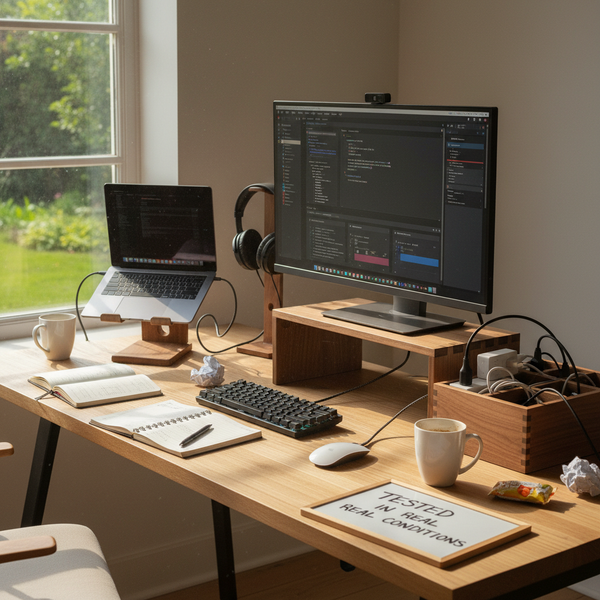
There's a whole category of objects on the internet marketed as "desk accessories" — light-up phone stands shaped like the moon, magnetic levitating planters, sand-art ornaments timed to fall over your keyboard. They photograph well on Pinterest. They don't survive a year of real use.
This guide is the opposite. After a year of running an office where the desk is the most-used object in the building, five accessories stayed — and the rest quietly moved into a drawer. The ones that stayed share a profile: they each solve a specific friction (screen height, cable mess, laptop overflow, daily clutter, occasional measurements), they're built from solid hardwood that won't chip in a year, and they look like they belong on a desk you'd actually work at — not on one you'd shoot for a moodboard.
If you've already read our 2026 selection of five wood desk accessories, this is the companion piece — focused less on aesthetic and more on which pieces earn their place on a working desk and which ones don't.
At a glance — comparison table
| Item | Price | Material | Solves | Footprint |
|---|---|---|---|---|
| Walnut Monitor Stand | $89.00 | Solid walnut | Screen too low, neck strain | 50 × 22 × 6 cm |
| Cord Organizer Box | $46.00 | Solid walnut | Cable mess, exposed strip | 23 × 12 × 11 cm |
| Vertical Laptop Stand | $67.00 | Solid walnut | Closed-lid clamshell setup | 10 × 10 × 12 cm |
| Walnut Desk Tray | $39.00 | Solid walnut | Loose small items, watches, keys | 22 × 13 × 2.5 cm |
| Wooden Ruler | $12.00 | Walnut + red oak | Precise measurement, drafting | 30 × 3 × 0.6 cm |
The rule we use before buying anything for a desk
Three questions, asked out loud, before any new object goes onto a working surface.
Does it solve a daily friction? Not an occasional one — daily. The monitor stand is a daily piece. A pen rest shaped like a tiny hammock isn't. If the answer is "I use this maybe twice a month," it goes in a drawer, not on the desk.
Will it still look right after a year? Veneered MDF chips at the edges. Painted wood scratches. Anodized aluminum scuffs in patterns that look terrible after eighteen months. Solid hardwood ages by darkening slightly and picking up a patina — the opposite of decay. The five items on this list are all solid wood for that reason.
Can it disappear when you don't need it? A good desk accessory should be invisible until you reach for it. Bright colors, glossy finishes, and unnecessary branding all break this rule. The pieces here are matte, unstained, unbranded on their visible faces.
1. The monitor stand — the single largest comfort upgrade
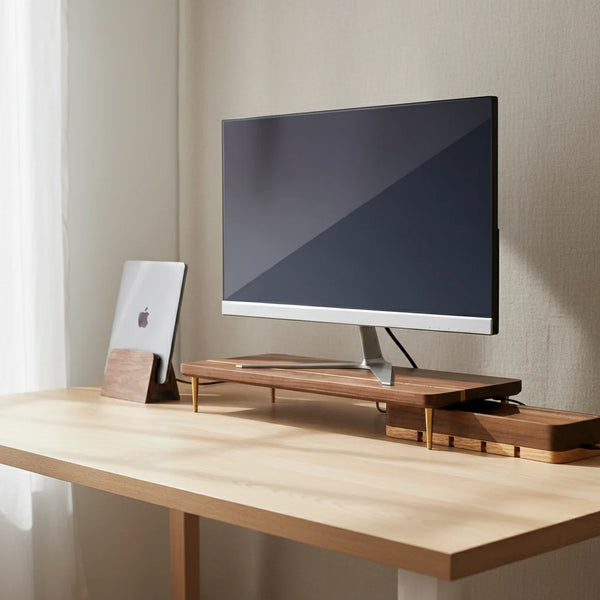
Most desks are 73 to 75 cm tall, and most monitors at standard tilt put the top of the screen 5 to 10 cm below where a seated eye should rest. That gap is the source of the neck stiffness most people attribute to "long days at the screen." Raising the monitor 6 cm with a stand brings the screen back into the right line of sight, and the difference is usually felt within a day.


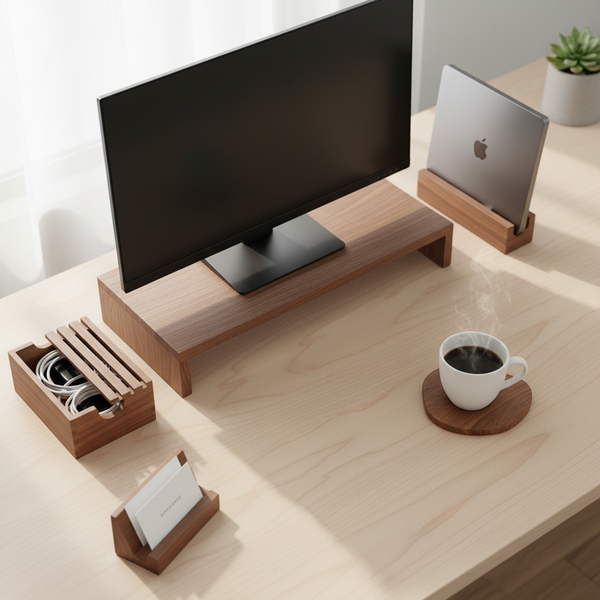
Specs. 50 × 22 × 6 cm, solid American black walnut, about 1.6 kg, rated for a 27" display up to roughly 12 kg with no measurable flex. The splicing pattern — alternating walnut grain orientation across the top surface — adds visual depth without ornament and is the single design choice that ages best across a decade of use.
Why it earns the slot. Of every accessory on this list, the monitor stand is the only one whose effect can be measured in your body. Within a week of using it you'll notice that the involuntary head-tilt-forward you didn't know you were doing has stopped. The under-stand space becomes parking for keyboards, notebooks, a closed laptop — it returns visible desk surface to you.
Where it could be wrong for you. If your screen is already at the right height (sit-stand desk, mounted arm), skip it. If you run dual monitors, look at the wider Walnut Dual Monitor Stand at $109 instead. If your room is pale and you want the wood to bring brightness rather than depth, the Red Oak Splicing Wood Monitor Stand is the identical silhouette in a warmer, lighter grain.
Pair with. The additional monitor riser leg set adds 6 cm or 8 cm of height for taller users or anyone alternating between a low office chair and a tall standing desk.
2. The cord organizer box — the visible win
Cables lose desks. They drape behind the monitor, snake across the back edge, gather dust, and look worse every week. The first cord organizer most people try is a plastic clip on the underside of the desk — which doesn't actually fix anything, because the cables it clips are still visible from the side.


Specs. 23 × 12 × 11 cm, solid walnut, lift-off lid (no hinge, no latch), four side cutouts. Interior comfortably holds a six-outlet power strip plus four to six coiled cables. The lid sits flush by gravity, which means one-handed lift even with a coffee in the other hand.
Why it earns the slot. The cord box is the only piece on the list whose effect is purely visual — nothing changes mechanically, but the desk looks completely different ten minutes after you set it up. A cluttered desk reads as someone who's behind. A clean desk reads as someone who's in control. The box does most of that work for $46.
Use case. Run the power cable from the strip out one cutout, plug the rest of the device cables inside. The lid becomes a small tray for AirPods cases, USB sticks, occasional house keys. Sitting next to a monitor stand it doesn't compete for attention — it disappears.
The version we recommend against. Bamboo cord boxes look similar in photos but warp in humidity within a year. Plastic boxes with cable cut-outs are usable but cheap-looking next to anything else made of hardwood. The walnut version is the one that ages alongside a serious desk.
3. The vertical laptop stand — desk space back
The clamshell setup — laptop closed, plugged into an external monitor — is the single most common pro configuration of 2026. A vertical stand turns the closed laptop into a small, dense object that lives at the back-right of the desk instead of taking up a full 30 × 22 cm rectangle of horizontal real estate.


Specs. 10 × 10 × 12 cm, solid walnut, slot adjustable via two captive thumbscrews, silicone strips lining the slot to prevent aluminum scratches. Around 950 g — heavy enough that one-handed dock-and-undock is smooth.
Why it earns the slot. Reclaims roughly 660 cm² of desk surface (the footprint of an open laptop). On a small desk that's the difference between cramped and uncluttered. The dock-and-undock motion is fast enough that you'll use it for every meeting, every change of position — and the silicone strips have prevented every aluminum-scuffing complaint we've heard.
Where it could be wrong for you. If you use your laptop open most of the day (no external monitor), skip it. The vertical stand is purely for closed-lid use. If your laptop runs hot under load (older Intel MacBooks, gaming laptops), keep at least 2 cm of air on each side of the slot for side-vent airflow.
4. The walnut desk tray — the daily-clutter solution
This is the piece most desks don't know they need until they have one. Watch you remove while you type, AirPods case, occasional house keys, a stack of business cards you collected today — they all want to land somewhere precise. Without a tray, they get spread across the desk surface and become friction every time you reach for the keyboard.


Specs. 22 × 13 × 2.5 cm, solid walnut, CNC-milled from a single block (no joins, no glue lines), low walls about 1.5 cm tall, rounded interior corners. Weighted around 350 g — heavy enough to stay still when you drop a watch into it without ceremony.
Why it earns the slot. Replaces the bowl-of-stuff every desk eventually grows. The walls are tall enough to contain small items but low enough that the tray reads as part of the desk rather than a separate object. Watches don't slide out, AirPods cases sit flat, business cards stack neatly along one edge.
Use case. Park it at the back-right corner of the desk, near the monitor stand. Drop the watch, the AirPods case, the keys, the day's pocket lint there at the start of the work session — pick it back up when you leave. This is the piece that takes the longest to fully appreciate, because the benefit accumulates over months rather than minutes.
5. The wooden ruler — small thing, daily use
Most desks don't have a ruler. Most desks should. Not for measuring as such — for the dozens of small daily needs that aren't "measurement" exactly: a straight edge for cutting paper, a tool for poking AirPods debris out of a charging port, something to flatten a curled receipt, occasionally the actual measurement of a screen, a frame, a piece of furniture you're shopping for.


Specs. 30 × 3 × 0.6 cm, double-laminated walnut and red oak, laser-etched centimetre and inch markings on opposite faces, rounded edges that survive being knocked off the desk repeatedly. Around 60 g.
Why it earns the slot. It's the cheapest object on this list and the one that gets the most varied use. A plastic ruler costs less but feels worse, scratches more visibly, and ends up in a drawer. A wooden ruler stays on the desk because it doesn't visually clash with anything — it reads as a small piece of furniture rather than a school-supply leftover.
Where it could be wrong for you. If you genuinely never measure or draw straight lines, you don't need it. We'd still argue for keeping a ruler on a working desk on principle — but it's the only item on this list where "I don't need it" is a defensible answer.
How to choose — decision matrix
| Your situation | Start here |
|---|---|
| You squint at your monitor / shoulders ache after 4 PM | Monitor Stand — fixes ergonomics first |
| Cables visibly drape behind / under your desk | Cord Organizer Box — biggest visual cleanup |
| You use a MacBook in clamshell on a small desk | Vertical Laptop Stand — reclaims a full laptop footprint |
| Loose small objects (watch, AirPods, keys) on the desk | Walnut Desk Tray — corralling them in one place |
| You sketch, draft, or work with paper occasionally | Wooden Ruler — and a [paperweight](/products/wood-paperweight) if you handle loose paper |
| Dual monitors, large workspace | Walnut Dual Monitor Stand + Cord Organizer |
Order of priority. If you're buying one piece at a time: monitor stand first, cord organizer second, laptop stand third, tray fourth, ruler last. That order matches the size of the daily friction each piece solves.
Care — keeping hardwood looking right for a decade
Daily. Wipe with a barely-damp microfiber cloth, dry immediately. Don't leave water rings.
Twice a year. A small amount of food-safe mineral oil or beeswax conditioner rubbed in with a lint-free cloth — let sit ten minutes, buff off. Walnut darkens slightly each time, which is the patina people pay extra for on leather goods.
Avoid. Silicone furniture sprays (block future oiling), citrus cleaners and vinegar (etch the surface), direct sunlight that lasts hours (UV lightens walnut, darkens oak).
Repair. Pencil eraser for surface scuffs; one drop of mineral oil rubbed in with a fingertip for shallow scratches; damp cloth and a warm iron for 5–10 seconds to lift dents.
FAQ
What are the most essential wooden desk accessories? A monitor stand and a cord organizer cover roughly 80% of what most desks need. Add a vertical laptop stand if you run clamshell, a desk tray if loose objects accumulate, and a ruler for everyday small jobs.
How many desk accessories should I have? Three to five is the sweet spot for most home offices. Beyond that you're adding visual noise. The pieces above are arranged in priority order so you can stop wherever your desk is content.
Is walnut better than oak for desk accessories? Walnut is darker, denser, and ages by deepening in color — best paired with black, anthracite, or brass. Red oak is paler, with more open grain, and brightens warm or Scandinavian-style rooms. Both are durable enough; the choice is aesthetic.
Do wooden desk accessories make a real difference? The monitor stand and cord organizer have measurable effects (neck strain reduction, desk visible-clutter reduction). The tray and ruler accumulate value over months. The laptop stand is binary — it solves the closed-laptop-takes-up-too-much-space problem completely or it's irrelevant.
Will these accessories work with a standing desk? Yes. The monitor stand height should be calibrated to your seated eye level; the cord organizer and tray work identically at standing or seated height. The vertical laptop stand is unchanged.
Are these accessories safe near heat (laptop chargers, etc.)? Solid hardwood handles laptop charger heat, dock heat, and mug heat indefinitely. Avoid placing anything hotter than a coffee mug directly on untreated wood, and keep wood pieces outside the steam plume of a humidifier.
Are the materials really solid wood, not veneer? All five pieces are solid hardwood — no MDF core, no plywood substrate, no veneer face. We list species explicitly on every product page.
What if my desk is small (under 120 cm wide)? Start with the vertical laptop stand and the cord organizer. The monitor stand fits on most small desks but reduces under-desk legroom — consider before buying.
Do you ship internationally? We ship from our warehouse to most countries. Rates and lead times calculate at checkout. EU shoppers often prefer ordering from our French sister store craft-kitties.fr for faster delivery.
The shorter version
The desk accessories you actually need are the ones that solve daily friction without adding visual noise. Five fit that test in our experience: a monitor stand (ergonomic comfort), a cord organizer (visual order), a vertical laptop stand (reclaimed surface), a desk tray (corralled small objects), and a wooden ruler (small daily uses). Start with one, add another every few months as your desk tells you what it's missing.
For the broader 2026 selection, see our five best wood desk accessories piece. Or browse the full desk accessories collection to see everything we ship.