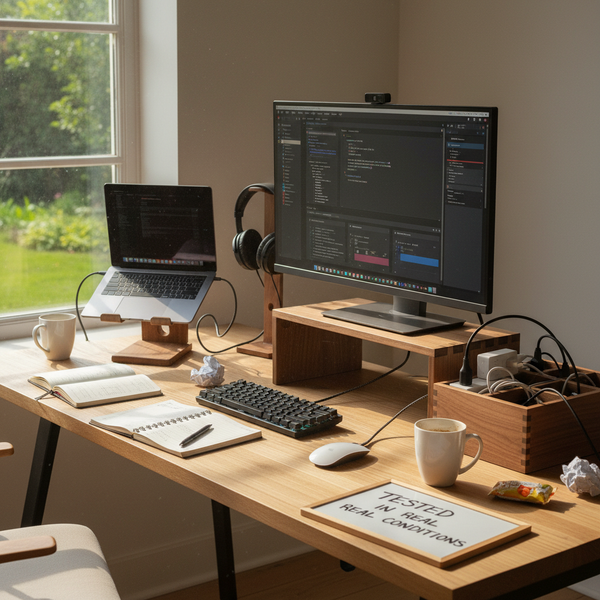
The single biggest variable in how a desk feels is what your eyes land on while you work. Most modern setups in 2026 are glass, anodized aluminum, plastic, and screen — high-contrast, cold-toned, with nothing to soften the edges. After eight hours that visual texture starts to feel like the inside of a laptop bag, and it's a quiet contributor to the end-of-day fatigue most people blame on the work itself.
The fix isn't a full redesign. It's introducing one or two pieces of solid wood into the daily-touch zone of the desk — the area within arm's reach where your eyes land while you think, type, or take a phone call. A walnut monitor stand, a small coaster, a paperweight. Surface area matters less than placement. The right wooden objects in the right spots change the perceived temperature of an entire workspace.
This guide walks through the five pieces we use to do that transformation, with specs, photos, and a decision matrix at the end to help you build a minimalist wooden desk setup that fits your current desk rather than fighting it.
At a glance — five-piece transformation
| Item | Price | Wood | Visual role | Footprint |
|---|---|---|---|---|
| Walnut Monitor Stand | $89.00 | American walnut | Anchors the visual center | 50 × 22 × 6 cm |
| Red Oak Monitor Stand | $89.00 | North American red oak | Brightens warm or Scandinavian rooms | 50 × 22 × 6 cm |
| Walnut Dual Monitor Stand | $109.00 | American walnut | Anchors a wide workspace | 80 × 22 × 6 cm |
| Walnut Cookie Coaster | $22.99 | American walnut | Warmth in the touch zone | Ø 10 × 1.2 cm |
| Wood Paperweight | $29.00 | Mixed hardwood | Quiet object, calm focus | 7 × 7 × 3 cm |
Why wood, specifically
Texture is the variable most modern desk setups ignore. A glass desktop, a metal keyboard, a plastic monitor bezel — all three feel similar to the touch, all three reflect light the same way, all three age by collecting fingerprints and small scratches that are visible but not characterful.
Solid wood breaks every one of those rules. It's warm to the touch, even immediately after pulling out of an air-conditioned room. It diffuses light instead of reflecting it. It ages by darkening, by picking up a small patina at the points your hands touch most — which is the opposite of how synthetic materials age. After a year of use, a walnut coaster doesn't look worn; it looks owned.
The shift from "office that gets used" to "office that feels lived-in" usually comes from two or three small wood objects, not from large ones. A monitor stand provides the visual anchor. A coaster and a paperweight do the rest of the work.
1. Walnut Splicing Wood Monitor Stand — the visual anchor
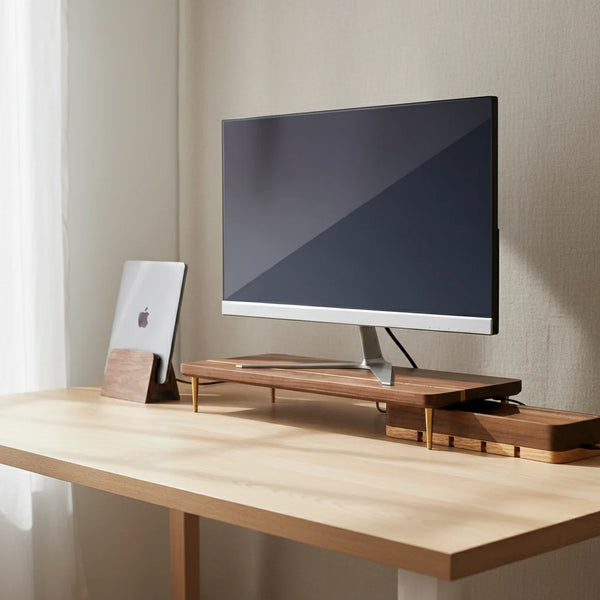
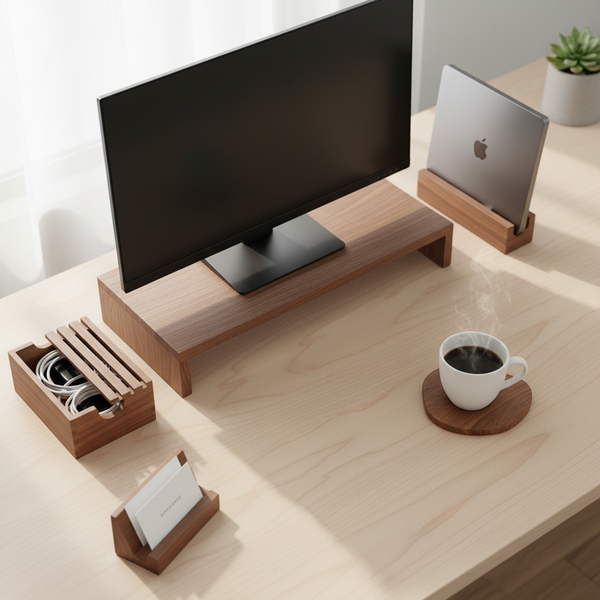
The single biggest piece in this transformation is the monitor stand. Its job isn't just ergonomic (though it solves the screen-too-low problem at the same time) — it's that it places a 50 × 22 cm rectangle of warm walnut directly behind the screen you stare at for eight hours a day. Every time your eyes leave the screen, they land on wood instead of the desk surface, the wall, or the back of the monitor.


Specs. 50 × 22 × 6 cm, solid American black walnut, approximately 1.6 kg, rated for displays up to 27" / 12 kg. Splicing pattern across the top face — six rectangular blocks with alternating grain orientation.
Transformation effect. Replaces a flat, often-overlooked surface (the area behind the monitor) with a piece of natural material that reads as a deliberate design choice. Within a week, the rest of the desk starts to feel like it's missing things — which is the right kind of friction; it tells you what to add next.
Where to place it. Centered on the desk, slightly forward of the back edge to give the cables underneath some breathing room. Slide a closed keyboard or a slim notebook into the gap underneath when you need surface space.
Companion piece. The additional monitor riser leg set adds 6 cm or 8 cm of height — useful for taller users.
2. Red Oak Splicing Wood Monitor Stand — for paler rooms
The walnut stand reads as anchoring and grounding — perfect for rooms with black furniture, anthracite paint, or anything that needs depth. For warmer rooms, lighter walls, or Scandinavian-style setups where the dominant tone is already pale, red oak does the same structural job with a brighter face.


Specs. Same dimensions as the walnut version (50 × 22 × 6 cm), same 12 kg load rating, same splicing pattern. The visual difference is the species — red oak runs honey-pale with prominent grain rays, walnut runs dark chocolate-brown with finer grain.
Transformation effect. Adds warmth to a desk where the dominant tone is already cool (white walls, light oak floors, pale fabric upholstery). The red oak picks up daylight and softly amplifies it — particularly noticeable in rooms with north-facing windows.
How to choose between walnut and oak. Hold a piece of each against your wall. The species that contrasts more is usually the one to pick — same-tone wood disappears into a pale room, opposing-tone wood becomes the visual anchor you wanted.
3. Walnut Dual Monitor Stand — for the wide setup
If your work involves two monitors side by side — common for developers, designers, traders, anyone managing multiple data streams — a single wide stand reads better than two separate stands. It gives the desk a continuous horizontal anchor instead of two parallel ones, and the visual quietness compounds.


Specs. 80 × 22 × 6 cm, solid American walnut, supports two 24" displays (combined load up to about 18 kg). Same splicing top pattern, scaled across the wider face — three blocks per side with the joint at the visual midpoint.
Transformation effect. Replaces what's often the busiest part of a working desk (the cable nest between two monitors) with a clean wooden surface. The 80 cm of continuous walnut quiets the workspace in a way that two separate stands can't.
Use case. Two 24" monitors at the back edge, central gap for a webcam mount or a small object (the wood paperweight sits neatly there). If your monitors are larger than 24" each, measure the combined width plus 4 cm clearance before ordering.
4. Walnut Wooden Cookie Cup Coaster — warmth in the touch zone
A coaster is one of the few desk objects you touch with bare hands twenty times a day. That makes it the highest-leverage point for adding "natural touch" to a workspace — much higher per square centimetre than the monitor stand, even though the stand is far more visually prominent.


Specs. Ø 10 × 1.2 cm, solid walnut, six carved chip-shaped divots on the top face that act as drainage channels for cold-mug condensation. Untreated raw wood — no varnish to yellow or peel under hot mugs.
Transformation effect. Adds warmth at the exact spot your hand visits most often — the coffee or water mug. After two months, the coaster develops a slightly darker patina around the edge where your fingers grip it most. That's the kind of detail you don't see in catalogue photos but notice every day in your peripheral vision.
Why the cookie shape. It signals deliberate humor without being precious. Guests pick it up and turn it over without asking. The divots are functional, not decorative — they channel condensation away from the mug bottom, which means the coaster never sticks to the mug when you lift it.
5. Wood Paperweight — the quiet object
A paperweight is the rare object that does its job by being heavy and present, not by doing anything active. On a workspace that doesn't actually have loose paper anymore (most don't, in 2026), the paperweight is the calm-focus object — a thing you hold while thinking, that grounds your eye at the front-left of the desk, that gives your hand somewhere to land between sentences.


Specs. 7 × 7 × 3 cm cube-form solid hardwood block, finished raw. Around 200 g — heavy enough to feel substantial in the hand, light enough to lift one-handed without thinking.
Transformation effect. Acts as a visual full-stop on the desk — the kind of small dense object that lets the eye rest. Without one, the eye tends to drift across the desk surface looking for something to settle on. With one, attention has somewhere to land.
Use case. Front-left or front-right of the desk, between the keyboard and the desk edge. If you keep occasional loose paper (receipts, notes, business cards), it does the literal paperweight job too — but its primary job is being a quiet object.
How to choose — decision matrix
| Your situation | Start with |
|---|---|
| Dark walls, anthracite or black furniture | Walnut Monitor Stand — anchors with depth |
| White walls, pale floor, Scandinavian style | Red Oak Monitor Stand — warm but bright |
| Two monitors side by side | Walnut Dual Monitor Stand — one wide anchor |
| A glass or aluminum desk that feels cold | Cookie Coaster + Paperweight — warmth in touch zones |
| Workspace that needs calm focus | Paperweight first — small visual anchor |
| You also want cable order | See our companion guide on essential desk accessories |
Order of priority for transformation. If you can only add one piece: the monitor stand (largest visible change). Two pieces: stand + coaster (visual anchor + daily-touch warmth). Three pieces: add the paperweight as the calm-focus object. The dual stand or red oak alternative replace the walnut stand in specific contexts; they're not additions.
Care — keeping the transformation looking right
Daily. Wipe with a barely-damp microfiber cloth, dry immediately.
Twice a year. Food-safe mineral oil or a beeswax-based wood conditioner. Apply with a lint-free cloth, sit ten minutes, buff off. Walnut darkens slightly each time — this is the patina that signals a kept object.
Avoid. Silicone furniture sprays (block future oiling), citrus cleaners or vinegar (acid etches the surface), prolonged direct sunlight (UV lightens walnut, darkens oak).
Repair scratches. Pencil eraser for surface scuffs. One drop of mineral oil rubbed in with a fingertip for deeper scratches. Damp cloth + warm iron for 5-10 seconds to lift dents.
FAQ
How do wooden desk accessories enhance a workspace? They add tactile warmth to a setup dominated by glass, metal, and plastic. The cumulative effect is a workspace that feels lived-in rather than transactional — which lowers the visual fatigue most people associate with long screen days.
What is a minimalist wooden desk setup? Two or three solid-wood objects placed in high-leverage spots: a monitor stand (visual anchor), a coaster (daily-touch warmth), optionally a paperweight (calm focus). Avoid more than five wood pieces; beyond that the wood starts to read as theme rather than texture.
Walnut or red oak — which is better for desk accessories? Walnut is darker, denser, ages by deepening in color. Best with black, anthracite, brass. Red oak is paler, ages by warming slightly. Best with white walls, light floors, Scandinavian palettes. Pick the species that contrasts with your wall color.
Can I mix walnut and red oak in the same setup? Yes, but with intention. Pick one as the dominant tone (the stand) and use the other only as an accent (e.g., the ruler). Mixing them in equal proportions reads as indecisive.
Are these accessories real solid wood? All five pieces in this guide are solid hardwood — no veneer, no MDF, no plywood core. Species is listed explicitly on every product page.
Do they require maintenance? Very little. Wipe daily, oil twice a year. That's it. Solid hardwood is one of the lowest-maintenance desk materials available.
Will the wood warp over time? Solid hardwood acclimates to your room's humidity in the first few weeks, then stays stable. Avoid placing pieces directly over a heating vent or in a window where they alternately bake and cool.
Are these good gifts? Particularly the cookie coaster and the paperweight, which are the most giftable single items — functional, photograph well, and tend to be objects the recipient wouldn't buy for themselves.
Do you ship internationally? Yes, to most countries. Rates and lead times calculate at checkout. EU shoppers can use our French sister store craft-kitties.fr for faster delivery.
A workspace that feels different
The five pieces above aren't a complete transformation — they're the starting kit. Beyond them, layer in what your specific desk needs based on the desk accessories you actually need or our broader 5 Best Wood Desk Accessories 2026 selection.
Browse the desk accessories collection for the full catalogue, or the wooden monitor stand collection if you're starting from the screen outward.
A workspace should feel like somewhere you want to spend the day. A few small pieces of solid wood, placed deliberately, are usually the difference.