At a glance
- Keep the key group supported while you identify which part, if any, responds to the magnet.
- Attraction at one ring component does not establish that the whole set will stay attached.
- Ask for the intended contact area and use a tray if retention or limits are unclear.
A key set can appear to “stick” at one point and still slide off a hook. Separate magnetic attraction from retention: first identify what part responds, then ask whether the hook is designed to hold that component in that position. Keep the keys supported throughout. Never hang an unknown load or drop the set to see what happens.
Identify the hook, variant, and contact area
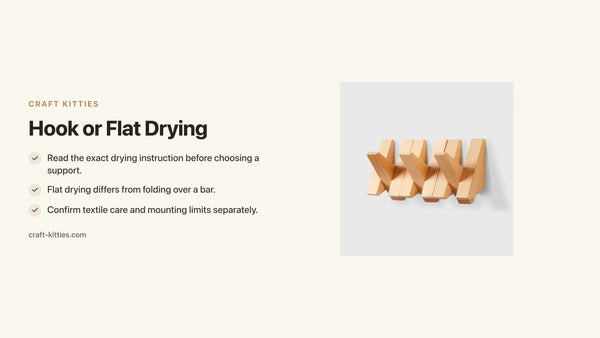
Start with the exact product model and variant. The listing describes a Beech Wood Magnetic Wall Hook, but variant names include walnut and beech variants in single- and multi-hook options; the title alone is not enough to identify what you own. Look at the product record or packaging and ask the maker where a key is intended to touch. Do not assume a hook arm folds, that the magnet mounts the hook to a wall, or that a visible wood surface contains the magnet.
Keep the keys in your hand or on a padded surface. If the maker identifies a contact area, approach it with one small part of the keyring while continuing to support the rest of the set. Do not pull downward, swing the keys, stack magnets, glue anything, or try to load-test the wall attachment. The product listing describes the hook as magnetic and identifies product variants; it does not document a maximum load or every key-ring geometry.
Record attraction and retention as different observations
A key ring may combine alloys, coatings, shapes, and separate pieces. The keys themselves may behave differently from the ring or fob. Write down which component you presented, whether any attraction was observed, and whether the group remained supported by your hand. Do not infer the metal composition from color or a stainless label.
The British Stainless Steel Association explains that magnetic response differs by stainless-steel family and condition. That means the source can explain why material identity matters; it cannot identify the alloy of a particular key or ring. See the BSSA overview of magnetic stainless steels.
Use a no-drop decision matrix
| Observation | What to document | What it does not prove | Maker question | Conservative fallback |
|---|---|---|---|---|
| No attraction noticed | Hook SKU, key part presented, orientation | That no other key or ring component can respond | Which contact area is intended? | Place keys in a catchall tray |
| One small ring component attracts | Component and position, while holding the group | That the entire set will stay retained | Is this the designed contact part? | Keep the set supported elsewhere |
| Rounded contact seems uncertain | Whether contact remains stable while supported | A vertical load or safe holding force | What shape and contact are intended? | Use a conventional hook or tray |
| Attraction occurs but keys slip | Which part contacts and where slip begins | That the magnet or hook has a known capacity | What retention limit and use are documented? | Stop using it for that key group |
| Product limit or mounting unclear | Exact variant and visible installation details | Wall strength, installation integrity, or load rating | What mounting and load instructions apply? | Do not hang the keys until clarified |
These are possible cases, not results from tests performed on the product. If the answer is uncertain, do not progress from “I noticed attraction” to “this is safe to hang.” They are different statements.
Do not convert magnet pull figures into a hook rating
K&J Magnetics describes its pull-force measurements as a straight pull from a large, flat, thick steel plate; geometry and steel thickness affect the measurement. That context cannot establish vertical keyring retention, a hook’s wall mounting, or a Craft Kitties load limit. Read K&J’s explanation of steel thickness and magnetic fields for the narrow measurement point. Do not use a calculator or product spec from another magnet to assign a safe weight to this hook.
Choose storage that does not depend on uncertainty
If the contact area is unknown, the key set slips, or the maker cannot confirm intended use and limits, use a conventional key hook or tray. Keep the keys in a place that does not require a guess about magnetic response. Our wooden wall hook guide covers other entryway layouts; necklace organization ideas cover jewelry rather than key retention. A tray can provide a simple landing spot while you confirm product details.
The safest record is descriptive, not numerical. Note the exact hook variant, the component presented, whether the key group stayed supported by your other hand, and any slipping or uncertain contact. Do not estimate a pull force from how “strong” the attraction felt. A magnetic field interacting with a flat steel plate is not the same geometry as a small rounded ring near a hook, and neither observation establishes how the hook is mounted into a wall.
If the product has multiple hooks, do not assume that the stated quantity means every key can be distributed across them at a known load. The listing evidence does not give a per-hook rating. Keep the key group in a bowl or tray while you ask the maker. If the keys are needed frequently, choose the storage method that makes them easy to retrieve without depending on an unverified magnetic contact point.
A bulky fob, several rings, and a flat key do not present the same shape to a contact point. Describe the item in plain terms rather than assigning a material or load value: “small ring attracts while held; fob and keys remain supported in hand.” The maker can then clarify whether the product is intended for that contact, without you putting the item at risk.
If you cannot identify the exact hook variant from its packaging, ask the seller or maker before trying any attraction observation. The product may have several finish and hook-count variants, while no load or retention limit is documented here for any of them.
The documented status should remain unknown until the maker answers, even if a small ring component appears to stick momentarily.

Description
FAQs
If the key ring sticks, is the full key set safe to hang?
No conclusion about full-set retention follows from one component attracting. Keep the set supported and ask whether that component is the intended contact point and what the maker documents.
Can I test by hanging one key first?
Do not suspend an unknown load or allow keys to fall. Use only the maker’s stated method, keeping the key group supported during any observation.
Does “stainless steel” mean a key will be magnetic?
Not necessarily. Magnetic response depends on the steel family and condition; appearance or a broad material label does not identify a specific key’s behavior.
Can I add a stronger magnet or glue to improve the hook?
No. Do not add or stack magnets, glue parts, or modify mounting. Use another storage method until the maker clarifies the design.