At a glance
- Treat rinsing, temporary drying, and dry storage as three separate stages.
- Follow the brush maker’s instructions for the exact media and model; check ferrule and handle before storage.
- A clean, empty wood holder may park compatible fully dry handles only after you confirm fit.
A rinsed brush is not ready for a wooden pen holder just because the bristles look clean. Separate the wet-care stage from drying, then separate drying from storage. Identify the brush’s maker and media first, follow those instructions, and record what remains wet or uncertain. A desk cup can be a dry-storage option for compatible handles; it is not a place to dry wet brushes.
Identify the brush before following a care routine
Read the handle, packaging, or purchase record for the maker and exact brush line. Record the media it was used with—such as watercolor or acrylic—only if you know. If the maker or brush material is unknown, leave it unknown and ask before applying cleaning or drying advice. Do not transfer oil-brush solvent or fire-risk procedures to a watercolor or acrylic brush; those are different care questions outside this guide.
Winsor & Newton’s acrylic-brush guidance recommends removing excess water, checking that ferrules and handles are dry, and storing its acrylic brushes only when completely dry, bristles upward. Its watercolor guidance separately discusses removing excess water, reshaping, drying, and storage after complete drying. Read Winsor & Newton’s acrylic brush guide and watercolor brush care. Apply each only to the relevant brush family; they do not provide a universal drying time or guarantee that damaged bristles will recover.
Move from rinsing to a temporary drying position
After rinsing, follow the actual maker’s method for removing excess water and reshaping the bristles. Do not force the tip into a point if it resists, press hard on the ferrule, or use a cloth treatment that the maker does not recommend. Place the brush in a temporary position that follows its instructions and does not let it rest in water or rub against other tools. Keep wet bristles and drips away from the wooden holder.
Check three components separately before you consider storage: the bristles, the ferrule where bristles meet the handle, and the handle itself. A brush can look dry at the tip while moisture remains near the ferrule or on the handle. Use visual and touch checks only as allowed by the maker; do not use heat, a dryer, a radiator, or a fixed number of hours to force a result. If the maker says completely dry, treat any uncertainty as “not yet confirmed.”
Keep a handover record for each brush
Use the table to track the transition from wet care to storage. The examples are hypothetical and do not describe tests performed on a specific brush.
| Brush/model/media | Maker drying instruction | Current wet component | Temporary appropriate drying position | Dry-storage criterion | Unresolved damage |
|---|---|---|---|---|---|
| Named acrylic brush, maker confirmed | Follow that line’s excess-water, ferrule/handle, and upright-storage directions | Bristles look damp; ferrule not yet checked | Temporary position that follows maker care and keeps bristles clear | Store only when the maker’s complete-dry condition is met | None observed; not a performance result |
| Named watercolor brush | Follow the watercolor maker’s rinse, reshape, dry, and storage steps | Handle feels damp after rinse | Keep separate from the wood cup while drying as directed | Confirm brush is fully dry before returning to a holder | Tip shape uncertain; ask maker if needed |
| Brush family unknown | Instruction not verified | Moisture location not confirmed | Keep out of wood storage while identifying model | No storage decision until care source is known | Unknown; contact seller or maker |
| Brush with visible loose bristles | Use care instructions, but do not force reshaping | Ferrule or bristle condition uncertain | Set aside in a safe temporary place | Do not treat as ready for routine storage | Ask maker whether damage needs assessment |
Keep a short log with the brush ID, date rinsed, care source checked, and which areas you inspected. The date is a reference, not a drying-time guarantee. If a brush has not met its maker’s storage criterion, leave it in the temporary drying position and check again according to the maker’s instructions.
Store only compatible, fully dry handles
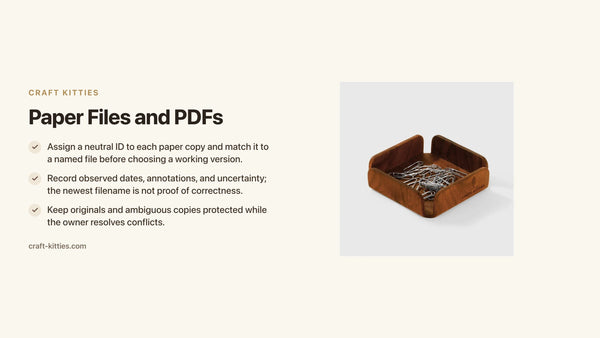
The walnut and red oak pen holder is described as a desk organizer, but no usable inner dimensions or brush count are documented in the available product information. Measure the actual handle length and diameter, then compare with the holder’s usable opening. Do not infer interior capacity from the product photo or assume that a wide ferrule will pass through the opening. The holder is not a specialized brush-drying rack, soaking cup, archival object, or chemical container. See the pen holder listing; ask the maker about dimensions and care if fit or moisture exposure is unclear.
Use a clean, empty, dry holder only after all brush surfaces meet the relevant maker’s dry-storage criterion. Place compatible handles without forcing them and keep brush tips from pressing against the bottom or neighboring tools. If the holder becomes damp, remove tools and follow the product maker’s finish-care instructions. Do not add water, cleaning fluid, or oil to the wooden organizer.
Separate brush drying from ordinary desk organization
A brush that is still drying needs a temporary position consistent with its own instructions. A holder that organizes dry pens and handles solves a different task. Do not leave wet brushes standing in a wood cup overnight or use the cup as an improvised rinse vessel. If there is no suitable temporary drying space, create one using an accessory specifically recommended by the brush maker; do not change the brush routine to fit the organizer.
Our walnut pencil holder guide and wooden pen holder guide discuss organizer forms and desk use. They do not provide brush-specific drying procedures. Keep the media and model-specific advice from Winsor & Newton separate from general holder descriptions.
Stop when the brush or care source is uncertain
If you cannot identify the medium, a ferrule appears loose, bristles are damaged, or moisture remains in an area you cannot check, do not place the brush in the wooden holder. Ask the brush maker what to inspect and which storage position applies. If the brush was used with an unknown substance, do not choose a solvent based on guesswork. This procedure is for ordinary rinsed brushes where the maker’s water-care instructions are known.
Make the storage handoff easy to repeat
Keep a separate row in the care note for each brush rather than one blanket “brushes dry” check. A large handle, a different ferrule, or a brush used with another medium may not follow the same maker instructions. If you share the desk, mark only that the tool is still drying; do not let someone return it to the dry cup because it looks clean. When it is ready, move it once to the measured dry-storage position and update the note. If the next rinse happens before the current brush is fully dry, keep that wet brush in its temporary position and preserve the dry tools separately.

Description
FAQs
How long should a rinsed brush dry before it goes in the holder?
There is no universal time in this guide. Follow the exact maker’s storage criterion and check the bristles, ferrule, and handle; do not infer dryness from elapsed time alone.
Can I dry a wet brush inside a wooden pen cup?
No. Keep wet brushes out of the wood holder. Use a temporary drying position recommended for that brush and store it only when the maker’s dry condition is met.
Should every brush be stored bristles-up?
Do not assume that. Winsor & Newton gives guidance for specific brush families; check the exact maker and model before choosing an orientation.
What if I cannot identify the brush material or media?
Leave it unknown, keep it out of the wood holder while wet, and ask the seller or maker for the correct care instructions.