How Does a Wood Monitor Stand Prevent Text Neck? The 2026 Field Guide
Text neck — sometimes called tech neck — is the slow accumulation of cervical strain caused by looking down at a screen for hours every day. It rarely arrives as a sudden injury. It builds up across weeks of forward head posture, the kind of low-grade pain that you notice on Tuesday afternoon, ignore by Wednesday, and recognize as chronic by the following month. The mechanical cause is almost always the same: a screen placed below eye level, forcing the neck to flex downward to read it. Fix the screen height, and you remove the source of the load.
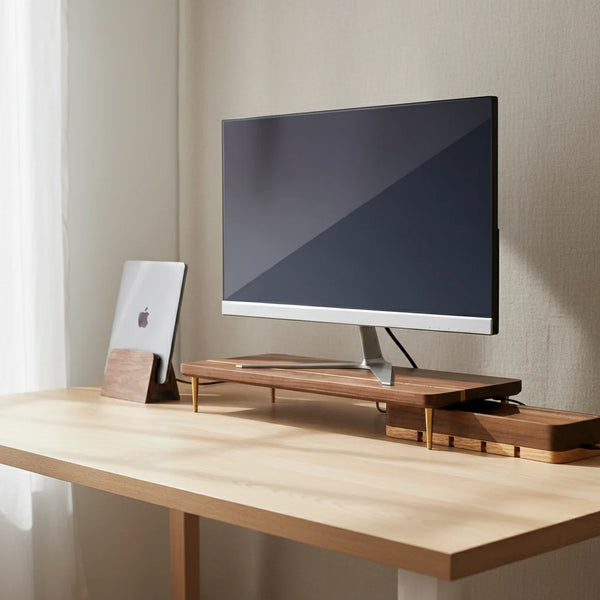
A wood monitor stand is one of the simplest tools that does this work. By lifting an external display or a laptop to the height where the top edge meets your line of sight, it returns your neck to a neutral position — the position your cervical spine evolved to spend most of its time in. Solid walnut, beech, or oak handles the load indefinitely, looks intentional rather than clinical, and adds about 6 cm of height in one stable piece. The geometry is the entire point. Material choice is secondary, except in one respect we will come back to: solid hardwood damps keyboard noise and stays visually quiet on a desk in a way that pressed metal or plastic does not.
This guide is part of our 2026 desk-setup cluster, anchored by the pillar article on ergonomic desk setup. It covers exactly how a wood monitor stand prevents text neck, the science of cervical load and forward head posture, the five walnut accessories that finish the job, a comparison table, a decision matrix, a one-hour setup routine, the mistakes that quietly undo a good setup, and an FAQ built from the questions readers ask most.
What is text neck
Text neck is a postural overuse condition caused by repeatedly tilting the head forward to look at a phone, laptop, or low-mounted monitor. The clinical literature describes a cumulative load on the cervical spine and the muscles between the shoulder blades, which over time produces stiffness, soreness, tension headaches, and in severe cases nerve compression that radiates into the arms. The condition is mechanical, not mysterious: the further forward your head tilts, the more weight your neck has to hold up, and the harder the supporting muscles work to keep your skull balanced.
The reason text neck has become a 2026 problem rather than a 1996 problem is that screens have moved closer to where the hands rest. A phone is held in the hand, a laptop sits on the lap or the desk, and a fixed monitor often comes mounted at a height that suits factory shipping, not the eyes of the person who will use it for eight hours a day. The screen pulls the gaze downward; the gaze pulls the head forward; the head pulls the neck out of neutral. Repeated thousands of times a week, that small motion becomes the dominant input to the cervical spine.
The science of forward head posture and cervical load
A neutral adult head weighs roughly 10 to 12 pounds (4.5 to 5.5 kg). When the head sits balanced on top of the spine, the cervical muscles do very little work — gravity passes through the spine, not across it. Once the head tilts forward, the math changes quickly. Research compiled by Dr. Kenneth Hansraj and published in 2014 (still widely cited in the 2020s clinical literature on screen ergonomics) estimated cervical load at the following angles: a 15-degree tilt produces about 27 pounds of force on the cervical spine, a 30-degree tilt about 40 pounds, a 45-degree tilt about 49 pounds, and a 60-degree tilt — the classic posture of someone reading a phone in their lap — about 60 pounds. The Cleveland Clinic's 2023 review of tech neck cites very similar numbers and notes that the muscles between the shoulder blades work overtime to compensate, which is why people with text neck often describe upper-back burning rather than direct cervical pain.
Multiply those numbers by the duration of a workday. A knowledge worker who spends six hours at a screen with a 30-degree forward tilt is asking the cervical spine to carry 40 pounds for 21,600 seconds across the day. That load does not produce an injury you can point to on an X-ray after one week. It produces a slow tightening of the suboccipital muscles, a forward drift of the shoulders, a flattening of the natural cervical curve, and eventually the dull pain pattern that brings people into physical therapy clinics by the thousand. The fix is to remove the forward tilt — not to strengthen muscles to carry more load, but to stop asking them to carry the load at all. Raising the screen to eye level is the most direct intervention available, and it works the same day you do it.
How exactly does a wood monitor stand prevent text neck
A wood monitor stand prevents text neck through geometry. The standard wood stand from our studio adds 6 cm (about 2.4 in) of height under an external display. For an average-height user with a 24 to 27 in monitor sitting on a 75 cm desk, that 6 cm lift is the difference between a top edge that sits at chin level and a top edge that sits at eye level. The neck stops flexing forward, the cervical spine returns to neutral, and the load on the supporting muscles drops back toward the 10 to 12 pound baseline.
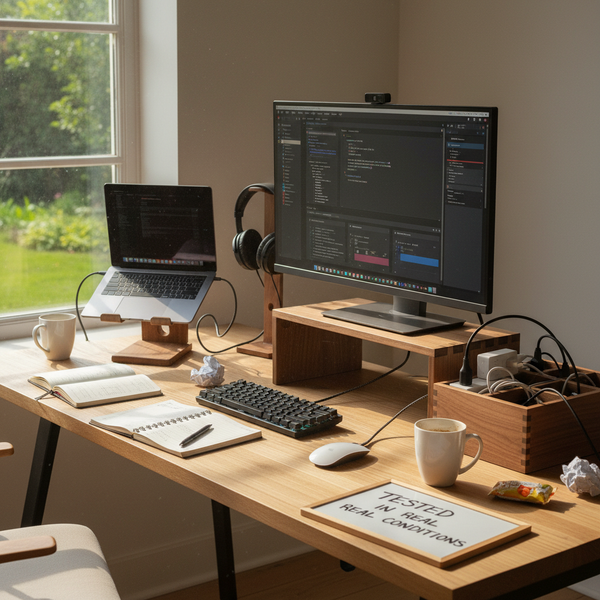
The wood part of the equation matters in three smaller ways. First, solid hardwood is dimensionally stable. Unlike a particle-board riser or a thin metal sheet, a 4 cm thick walnut stand does not bow under the weight of a 30-inch monitor and does not creak when you adjust a cable. Second, wood damps vibration and acoustic noise — keyboard typing and mouse clicks travel less, which is a small but real comfort gain over eight hours. Third, the visual quietness of warm walnut keeps the eye relaxed; a bright reflective surface or a busy printed pattern under the screen would compete with the screen content for attention and create a subtle visual fatigue.
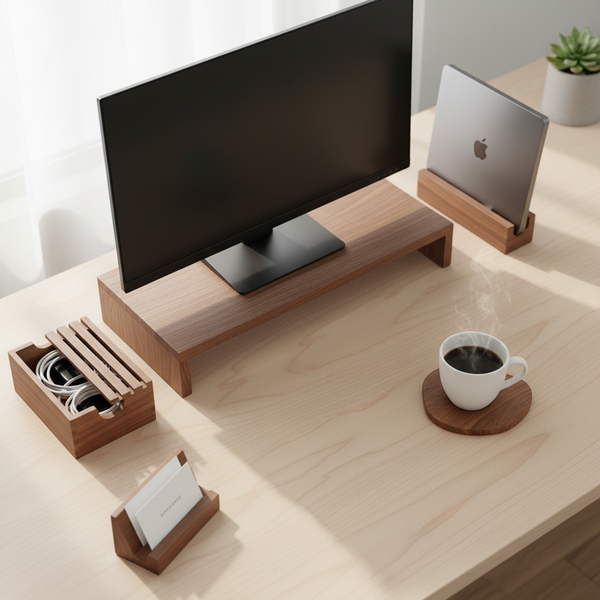
For taller users — anyone over about 6 feet (183 cm) — a single 6 cm lift is often not enough. In that case, an additional monitor riser leg adds another 4 cm under the existing stand, bringing total lift to 10 cm. For laptop-only setups, where the screen and keyboard are joined and cannot be separated, the lift logic still applies, but it requires an external keyboard and mouse so the laptop can rise without dragging the typing position with it. A vertical laptop stand is the cleaner solution in that case — it holds the laptop closed and out of the line of sight, while a separate external monitor sits on the wood stand at eye level.
The 5 walnut accessories that prevent text neck
These five items were selected from our desk accessories collection because each one removes a specific mechanical cause of text neck — screen too low, laptop in the way, cables crossing the work surface, monitor stand not tall enough for a 6-footer. Solid walnut, restrained design, and a clear job each.


Comparison table
| Accessory | Price | Material | Text-neck cause solved | Best for |
|---|---|---|---|---|
| Walnut Monitor Stand | $89.00 | Solid walnut | Screen below eye level (15–30° forward tilt) | External 24–32 in display, 5'6"–6'0" users |
| Additional Riser Leg | $12.50 | Solid walnut | Stand still too low after primary lift | Tall users (6 ft +) |
| Vertical Laptop Stand | $67.00 | Solid walnut | Laptop on desk creating a second low screen | MacBook + external display (clamshell) |
| Cord Organizer Box | $46.00 | Solid walnut | Visual chaos pulling head down to check cables | Power strip + USB hub |
| Walnut Desk Organizer | $54.00 | Solid walnut | Small items scattered low, repeated head dips | Notebook, pens, phone, AirPods |
Decision matrix — which piece prevents text neck first
You don't need all five accessories at once to start fixing text neck. Buy in the order that matches the symptom pattern you actually have.
| If your symptom is… | Buy first |
|---|---|
| Neck stiffness from looking down at a desktop display | Walnut Monitor Stand |
| Upper-back burning from working on a laptop screen flat on the desk | Vertical Laptop Stand + external keyboard |
| Stand sits at the right height for your spouse but too low for you (6 ft +) | Additional Riser Leg |
| Tangle of visible cables pulling your eyes (and head) downward | Cord Organizer Box |
| Constant head dips to find pens, phone, notebook in random spots | Walnut Desk Organizer |
Step-by-step — install a wood monitor stand correctly
Set aside thirty minutes. Going through the steps in order matters; each step's outcome is the input to the next.
1 — Measure your seated eye height (5 min). Sit at your desk in your normal working posture, feet flat on the floor, back against the chair. Look straight ahead at the wall and have someone mark the height of your eyes on the wall behind the monitor, or use a tape measure from the floor to the corner of your eye. Write it down. This is the target height for the top edge of the screen.
2 — Measure the current top-of-screen height (3 min). Without moving the monitor, measure from the floor to the top edge of the screen. The difference between this number and your seated eye height is the lift you need.
3 — Choose the lift (2 min). If the gap is 4–7 cm, a walnut monitor stand alone (6 cm) will fix it. If the gap is 8–10 cm, add an additional riser leg (+4 cm). If the gap is larger, you likely also need to lower the chair — the cause is partly that your eyes sit too high relative to the desk.
4 — Install the stand (10 min). Clear the desk under the monitor. If the monitor is on a fixed arm, you may not need a stand — just adjust the arm. If the monitor is on its native foot, slide the stand under the foot, then tilt the monitor back about 10 degrees so the bottom edge sits slightly closer to you than the top. This 10-degree backward tilt is the most overlooked detail and makes the screen comfortable for reading text at eye level.
5 — Test the position (5 min). Sit upright, look at the screen for two minutes. The top edge should be exactly at your seated eye height — not above, not below. Your neck should feel like it is doing nothing. If you feel any tilt up or down, adjust the stand placement or add a riser leg.
6 — Route the cables (5 min). Use the walnut cord organizer box to hide excess length and the power strip. Cables should now travel to the back edge of the desk without crossing the work surface.
For more detail on related questions — exactly how high a monitor stand should be, or whether monitor stands actually help posture — see our companion guides on how high a monitor stand should be and whether monitor stands are good for posture.
Common mistakes that quietly undo a wood monitor stand setup
Even a correctly installed wood monitor stand stops working if any of these four mistakes creep in. Check the list once a month.
Stand too low for the user. A 6 cm lift is calibrated for an average-height user with a standard 75 cm desk. If you are 6 ft 2 in (188 cm) with a 27 in monitor, the top of the screen will still sit about 3 cm below your eye level. Add an additional riser leg — the geometry costs you twelve dollars and finishes the fix.
Monitor tilted forward instead of backward. A small backward tilt of about 10 degrees lets the top edge of the screen sit slightly farther from your eyes than the bottom edge, which matches the natural geometry of the eye scanning text from top to bottom. A monitor tilted forward (bottom closer to the desk than top closer to the desk) defeats the purpose of the lift — it forces the eyes downward and the head follows.
Laptop placed in front of the monitor. When a laptop sits on the desk in front of an elevated monitor, the laptop screen and keyboard pull the eyes back down to a 30-degree forward tilt — exactly the angle the monitor stand was supposed to remove. Either run the laptop clamshell on a vertical stand or move it off to the side and ignore its screen during the workday.
Chair height drifted over time. Office chairs slowly lose their height adjustment if multiple people sit in them. After someone else has used your chair, reset the seat to the height where your feet rest flat on the floor and your eyes meet the top edge of the screen. A monitor at the right height only prevents text neck if the rest of the body is also at the right height to meet it.
FAQ — text neck and wood monitor stands
1 — How exactly does a wood monitor stand prevent text neck? By lifting the top of the screen to your seated eye level. With the screen at eye level, your neck stays in a neutral position instead of tilting forward 15 to 30 degrees, which is the mechanical cause of text neck. A standard wood stand adds about 6 cm of height — enough for most users on a standard desk. The material matters less than the geometry, though solid walnut is dimensionally stable and visually quiet.
2 — Is text neck the same as tech neck? Yes. The two terms describe the same condition — neck pain and forward head posture caused by extended screen use — and are used interchangeably in clinical literature. Some sources use "text neck" for phone-induced cases and "tech neck" for any screen, but the underlying mechanics are identical.
3 — Can a wood monitor stand fix text neck I already have? It can stop the input that caused it, which is usually enough for mild to moderate cases. Once the neck is no longer flexing forward eight hours a day, the muscles between the shoulder blades relax and the suboccipital tightness gradually resolves over two to six weeks. For chronic cases lasting more than three months, or for any case with nerve symptoms like arm numbness, see a physical therapist alongside fixing the screen height.
4 — How high should the top of my monitor be exactly? At your seated eye level. Sit upright in your chair, look straight ahead, and the top edge of the screen should be at the height of your eyes — not above, not below. For an average user on a 75 cm desk with a 24 to 27 in monitor, that usually means lifting the screen by about 6 cm, which is what a standard walnut monitor stand delivers.
5 — How much weight does forward head posture put on my neck? A neutral adult head weighs 10 to 12 pounds. At a 15-degree forward tilt, the load on the cervical spine rises to about 27 pounds. At 30 degrees, about 40 pounds. At 45 degrees, about 49 pounds. At 60 degrees — phone in lap — about 60 pounds. These numbers are widely cited in clinical reviews including the Cleveland Clinic's 2023 guide to tech neck.
6 — Will a wood stand work better than a cheap plastic riser? The ergonomic effect is identical at the same height — geometry is geometry. Wood adds three smaller benefits: it stays dimensionally stable under load, it damps keyboard noise, and it looks calm on a desk so the eye is not distracted by the surface under the screen. For an eight-hour daily setup, those small gains compound. For occasional use, a plastic riser does the ergonomic work.
7 — I only have a laptop. Can a monitor stand still help? Yes, but you need to add an external keyboard and mouse. If you put a laptop on a stand without separating the keyboard, the keys end up too high and your shoulders hunch up. The cleaner solution for laptop-only setups is a vertical laptop stand plus an external keyboard, with the laptop running clamshell mode connected to a separate monitor on a wood stand.
8 — How long until I notice the difference? Most people feel less neck stiffness within the first day. The dull upper-back burning that comes from holding a forward head all day usually resolves within one to two weeks. Chronic tightness that has been building for months can take four to six weeks to fully release, especially if combined with daily neck stretches.
9 — What exercises should I add alongside a wood monitor stand? Three simple movements help most cases: chin tucks (5 reps, 3 times a day) to retrain the deep cervical flexors; shoulder blade squeezes (10 reps, twice a day) to release the upper back; and a doorway pec stretch (30 seconds each side) to counter the forward shoulder rotation that accompanies text neck. None replace the screen-height fix — they reinforce it.
10 — Can children get text neck from school tablets? Yes, and the load is proportionally higher because children's heads are larger relative to their body weight. Pediatric physical therapy literature published in 2022–2024 has documented increased cervical complaints in school-aged children since the shift to tablet learning. The same fix applies: lift the screen to eye level, take breaks every 20 minutes, and if possible add an external keyboard.
11 — Do wood monitor stands hold heavier ultrawide monitors? A solid walnut monitor stand of standard size handles displays up to about 32 in and 11 kg without flex. For larger 34 or 38 in ultrawides, check the specific load rating on the product page — most ultrawides under 12 kg sit safely on a solid hardwood stand if the foot of the monitor rests centered on the surface.
Approfondir — connected guides in this cluster
This article is one of eleven spokes in our 2026 ergonomic desk cluster. The pillar piece covers the full ergonomic setup; the spokes go deep on individual elements.
- Pillar: The importance of an ergonomic desk setup
- Related: Are monitor stands good for posture?
- Related: How high should a monitor stand be?
- Browse: Desk accessories collection
Closing — start with the screen
If text neck is your main complaint, raise the screen first. Everything else — the chin tucks, the pec stretches, the standing desk, the new chair — only works once the input load drops. A walnut monitor stand at the right height removes the input load on the first day, and your neck stops being asked to carry 27 to 40 pounds of forward-tilted head weight for the rest of the workday. The other accessories in this guide make the fix durable. The stand is the lever that does the work.
When you're ready, browse the full desk accessories collection or start with the single piece that returns the most ergonomic value per dollar — the walnut monitor stand.