At a glance
- Count visiting coats before guests arrive.
- Assign existing spaces and name an overflow owner.
- Check every borrowed item on departure.
When more guests arrive than there are open coat hooks, a small entryway needs a temporary plan. Count the coats you expect, identify the storage spaces that are already safe to use, and decide who will manage overflow and return each item. That keeps the doorway usable without guessing how many coats a rack can hold or adding a last-minute fixture.
The goal is a short-lived arrangement for a particular visit. It is different from deciding how many hooks a household needs every day. Do not overload a rack, remount it for an event, or assume that a hook’s appearance reveals its load limit. Follow the product maker’s stated instructions and use another existing storage place when the available hooks are full.
Count coats and open spaces before arrival
Before the visit, estimate how many outer layers guests are likely to bring and count the hooks that are genuinely free. “Free” means no daily bag or coat must be pushed aside, and the existing owner has agreed to use another spot during the visit. Do not count a hook that is loose, damaged, hard to reach, or already occupied by a wet item.
Check the nearby options that already exist: a closet rail, a bedroom hook, a sturdy chair back, or a designated room where a host can keep garments together. The location should not block the door, stairs, kitchen work area, or route through the entry. Avoid using a delicate chair, unstable door, or unapproved wall fixture as emergency storage.
Assign an owner to each overflow path
For every location, decide who will guide the garment there and who will bring it back when the guest leaves. A host may collect coats and return them from a bedroom closet; another household might let guests use a named closet themselves. Keep the process simple enough that people know where to look without opening several rooms.
If coats must remain in a room guests do not enter, tell them where to hand the item over. Do not mix guest coats with household laundry or items that could stain or snag them. If a coat is wet, keep it separate from dry coats and from papers or wood surfaces until you know the care directions for the garment and the storage location.
| Arrival owner | Actual available place | Overflow fallback | Departure return check |
|---|---|---|---|
| Host takes each coat at the door | Confirmed open guest hook | A named closet rail with clearance, if the host has approved it | Host asks who owns each remaining garment before guests leave |
| Guest hangs their own coat | Clearly identified open hook | A specific spare room or closet the guest can access | Guest checks the hook and fallback location before departure |
| Several coats arrive together | Counted open hooks only | Host-directed room with a stable existing rail or chair | Host checks the list against the people leaving |
| Wet outerwear arrives | Separate spot that can tolerate the garment’s care needs | Keep it apart from dry guest items; ask the owner if uncertain | Return it to its owner and check for damp items left behind |
This plan does not establish a universal spare-hook count. It accounts for the spaces you actually have and the garments you actually expect. If no safe fallback exists, tell guests before arrival that coats need to stay with them or make another arrangement; do not invent capacity by squeezing extra hangers onto a rack.
Keep the doorway usable during the visit
After the first coat is placed, look at the door swing and walking path. The entry should still allow people to enter and leave without weaving around a pile or brushing against damp sleeves. Keep bags, umbrellas, and shoes in separate places if they would crowd the coat route.
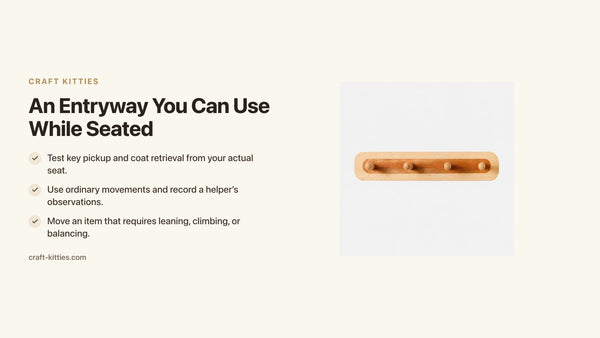
If you use a wall hook rack, follow its specific installation and use directions. The two-tone beech and walnut hook rack is listed in 4-, 5-, and 6-hook versions with rail widths of 320, 400, and 480 mm. Width does not prove how much weight each hook or mounting point can bear. The rack is an option to consider for an everyday entryway, not a reason to exceed the maker’s stated limits at a gathering.
For a permanent coat-ownership system, our coat rack organization guide covers assigning regular places. For a small-room layout, see how to organize a small entryway. This article deals with temporary overflow and who returns a garment after one visit.

Description
Make the departure check visible
As guests leave, check the planned locations rather than relying on memory. Ask whether anyone has a coat stored away from the entry, and return each garment to its owner. If an item remains, contact the guest using your normal household process; do not assume a similar color or style identifies the owner.
If a host has borrowed a closet or chair, return that space to its usual use. Remove any temporary paper label and move wet items according to their owner’s care directions. If moisture reached the wall or furniture, keep dry belongings away and follow the affected surface maker’s care instructions.
Review the plan after the visit
If overflow felt confusing, note exactly what happened: the number of coats, which location ran out, whether guests knew where to go, and who had to retrieve items. Use those observations for the next gathering. They may suggest clearing one existing closet shelf or explaining the route in advance; they do not automatically mean the home needs a larger rack.
If you are considering a different fixture, measure the wall area and note the actual installation conditions. Ask the maker or installer for required hardware and load limits. The USDA Forest Products Laboratory explains that finish choices affect appearance, protection, and cleanability, so ask the organizer maker for finish-specific care when a garment is damp. The National Park Service’s wood-object guidance also treats loose dust as abrasive; clean a sound surface gently and stop if a cloth snags. These sources inform care, not hook capacity.
FAQ
How many guest coats can a small hook rack hold?
Use the rack only within its documented instructions. The number of visible hooks and the rail width do not establish a safe load. Count available spaces in your own setup and plan a separate fallback.
Should guests use a bedroom closet for overflow?
That can work if the host has approved the space and made it easy to find. Assign someone to guide coats there and return them before departure.
Can I hang extra coats from one hook?
Do not assume that one hook can safely carry more than the maker specifies. Use an existing alternate location rather than adding garments beyond documented use.
What if a guest’s coat is wet?
Keep it separate from dry coats and surfaces that may be affected by moisture. Ask the owner to follow the garment’s care instructions, and investigate if the entryway itself stays damp.