At a glance
- Draw both routes before changing storage.
- Walk through arrivals one person at a time and record each conflict.
- Try a different order before adding a fixture.
When two people use a narrow entryway at once, the problem may be the sequence of movements rather than a lack of storage. One person reaches for keys while the other crosses the door; a coat sleeve and bag meet in the same small space. Map the route, rehearse an ordinary arrival and departure without adding weight or testing a mounted fixture, then record what blocks the path.
This is a household walkthrough, not a measured safety standard. Use the actual door, floor, and furniture, and stop if either person feels unsteady. The purpose is to learn whether a different order or an existing alternate location reduces a collision in your home.
Draw the entry before moving objects
On paper, sketch the doorway, door swing, closest wall, nearby furniture, and the route each person takes from the threshold. Mark where keys, shoes, coats, and bags are picked up or put down. Keep the drawing approximate; it is a planning aid, not a scaled floor plan or building-code check.
Use labels for Person A and Person B without assuming one is always the host or first home. Note who arrives first, who needs to pass, and whether either person must stop to remove shoes or collect a bag. If a child, pet, or mobility aid uses this route, account for that ordinary movement too, but do not ask anyone to join a trial that could be unsafe.
Rehearse one movement at a time
Begin with the entry as it is usually arranged. Ask Person A to enter and move to the usual key or coat location. Then have Person B cross through the same route. Pause after each step and write down whether someone waited, turned sideways, reached around a moving door, or had to move an object.
Repeat with the people in the opposite order. Keep the movements ordinary and unhurried. Do not load hooks, tug on mounted storage, or use the rehearsal to test a rack’s strength. If the entry is too tight to rehearse safely, use the paper sketch and observe the next routine arrival from a clear position instead.
| Person A waits or picks up | Person B crosses | Obstacle observed | Alternate order to try |
|---|---|---|---|
| Person A enters and pauses to place keys | Person B comes through the door | Door swing and key stop occupy the same patch | Person A steps fully inside before reaching for keys |
| Person A removes a coat | Person B passes toward another room | Sleeve or bag narrows the path | Person B waits until the coat is on its assigned place |
| Person A collects shoes or bag | Person B leaves | Both reach toward the same floor area | Person B exits first, then Person A gathers belongings |
| Person A holds the door | Person B retrieves a coat | The open door blocks the usual hook approach | Person B waits for the door to close before retrieving the coat |
The table records observed conflicts, not an ideal sequence for every household. If the alternative order makes the route calmer, agree on a simple cue such as “keys after the doorway clears.” If it does not, try a different existing location for one item and observe again.
Change one location or one step at a time
Do not redesign the entry before you know what conflicts. First test whether the key tray can move to an already accessible surface. Then repeat the walkthrough. If the coat hook is the point of interference, test a temporary alternate coat location without changing the mounted rack. One change at a time lets you tell whether the movement improved or merely shifted the obstacle.
Keep the passage clear during every trial. A basket or temporary chair can create a new obstruction, so use only furniture that is stable and already belongs in a safe location. If no arrangement works, pause and consider asking an installer or qualified professional to assess the space before adding storage.
Consider storage after you understand the route
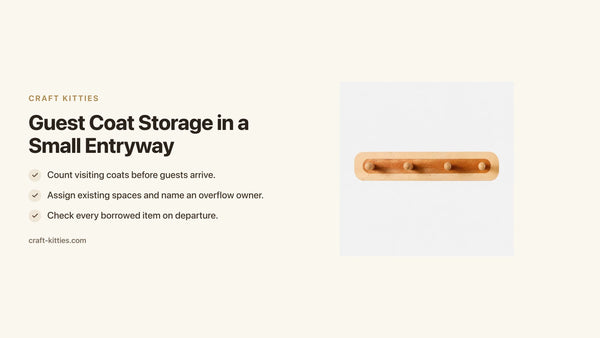
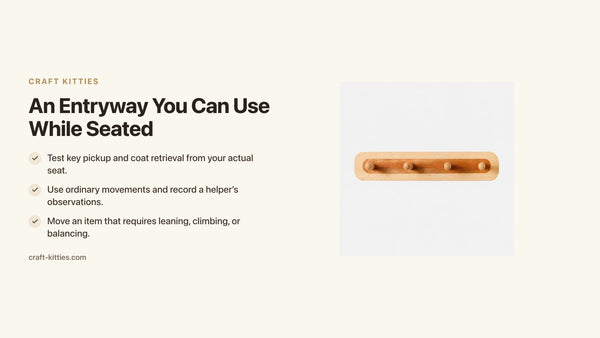
Wall storage can free floor space, but it still occupies a reach area and may affect how people pass one another. A two-tone beech and walnut hook rack is listed in 4-, 5-, and 6-hook widths of 320, 400, and 480 mm. The wall hook rack listing provides those widths; it does not specify a safe mounting height, projection, or load limit for your wall. Ask the maker or installer for the missing information before deciding where it belongs.
If the rack is already installed, do not pull on it as part of the movement check. Use a paper outline or tape on the wall nearby to visualize a proposed location, while respecting the door and passage. For broader entryway storage principles, see organizing a coat rack and organizing a small entryway. Those guides consider the fixture and room; this one looks at two people’s paths through the same narrow zone.

Description
Review a conflict without blaming the person
Describe the exact overlap rather than saying one person is “in the way.” For example: “When the door is held open, the other person cannot reach the coat hook.” That identifies a layout or sequence to change. The issue may be a door swing, object placement, or timing rather than anyone moving incorrectly.
If either person uses a mobility aid or has a balance concern, do not ask them to repeat a movement that feels unsafe. A clinician, occupational therapist, or qualified accessibility professional can help with individualized access questions. This walkthrough cannot determine compliance or certify an entryway.
Keep surfaces and mounted items within their care directions
When a wooden organizer is part of the layout, inspect it visually and follow its maker’s instructions. The USDA Forest Products Laboratory notes that finish selection relates to appearance, protection, and cleanability; do not assume every wood finish takes the same cleaner. The National Park Service explains that dust is abrasive and should be collected rather than rubbed over wood. Those sources support cautious care, not a conclusion about how much a hook can hold.
If a clean, soft tool snags on a finish or a mounted item appears loose, stop and ask the maker or installer. Never make a loaded movement trial to estimate capacity.
FAQ
How do two people share a very narrow entryway?
Map the routes and test one ordinary arrival or departure at a time. Record where one person waits or changes direction, then try a different order with the space otherwise unchanged.
Should one person always enter first?
There is no universal order. The useful sequence depends on which task is happening and where the door, key spot, and coat storage are located. Agree on a cue only after you have tried it safely.
Can I test a wall rack by pulling on it?
No. Do not use the walkthrough to test a mounted fixture’s strength. Follow its installation instructions and ask the maker or installer about documented mounting and load limits.
Will moving storage solve every collision?
Not necessarily. The conflict may come from door swing or timing. Try a different sequence or a temporary alternate location before buying or mounting anything.