At a glance
- Check the exact marker model and its maker’s storage instructions before choosing cup or tray.
- Pilot and edding horizontal-storage advice is model-family guidance, not a universal rule.
- A tray can park capped tools only if the measured space fits; it is not a drying-prevention case.
A pencil cup makes tools easy to see, but it may not be the right storage position for every marker. The correct orientation depends on the exact product and its manufacturer’s instructions. Inventory the markers you own, check the labels and model-specific guidance, then keep the tools whose instructions differ from the cup in a separate, clearly identified location.
Inventory each tool and its instructions
Write down the brand, model or product family, whether the cap is present, and any maker instructions about position or temperature. Do not sort by color or marker shape alone. If a label is missing, mark the model unknown and ask the manufacturer rather than borrowing instructions from a similar-looking pen.
Pilot and edding are useful examples, not universal rules. Pilot’s FAQ gives capped horizontal storage guidance for its markers; edding recommends horizontal, room-temperature storage for the markers covered by its advice and explains that nib-up storage can delay ink readiness. Read the Pilot FAQ and edding marker storage guidance, then check the precise marker family you own.
Compare the instruction with the space available
A shallow tray may hold one capped marker horizontally if the actual tool fits without pressure. Measure the usable space and the marker’s longest dimension; do not infer internal clearance from the tray’s outside measurements. A pencil cup can remain appropriate for tools whose own maker permits upright storage. The decision is per product, not “markers always flat” or “markers always upright.”
| Tool/model | Maker wording/source | Cap check | Prescribed orientation | Actual space available | Unresolved question |
|---|---|---|---|---|---|
| Pilot marker family named on label | Record exact FAQ statement for that family | Cap present and secure | Horizontal only where that advice applies | Measure tray before use | Does guidance cover this exact model? |
| edding marker model | Record its product-family instructions | Cap present | Horizontal at room temperature where edding specifies | Check whether a flat tray has enough usable length | What if model number is unreadable? |
| Ballpoint or pencil | Different tool type; use its own maker guidance | Check closure if applicable | Do not transfer marker guidance automatically | Cup may work if it fits safely | Is this actually a marker requiring special orientation? |
| Unlabeled felt-tip | Manufacturer instruction unknown | Cap state recorded | Do not guess | Keep separate pending identification | Can the maker identify it from packaging/photo? |
The rows are hypothetical examples, not product tests or a claim that a tray prevents drying. If a tool is uncapped, damaged, leaking, or hard to identify, follow its maker’s guidance and keep it away from papers and finished surfaces.
Use organizers for parking, not performance claims
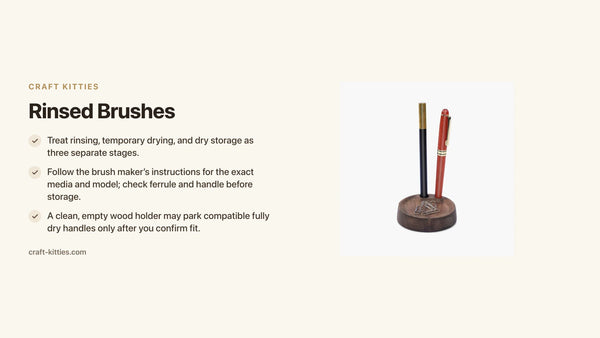
The walnut pen tray listing gives 210 × 76 × 20 mm overall and says it stores pens, pencils, glasses, and small items. Those outside dimensions do not prove an internal compartment size or specialized marker-case function. The walnut-and-red-oak pen holder is described as a desk organizer but does not establish a tool count or orientation. See the pen tray and pen holder listings; measure the actual marker and usable space before assigning a home.
Our walnut pencil holder guide and oak pen holder guide cover organizer styles. They do not replace storage instructions for a specific marker.
Keep a small orientation key by the cup
If different tools have different storage directions, make a short key from the actual instructions: model, storage position, cap requirement, source, and date checked. Place it beside the organizer, not on a marker surface. When you buy a refill or replacement model, check its instructions again instead of assuming the orientation carries over.
Do not use a universal “tip-down” recovery technique, solvent, refill recipe, or drying test. If the tool stops writing, consult its own maker support. Avoid shaking or warming it unless the manufacturer specifically says to do so.
Recheck after you change the tool mix
When you buy a refill, receive a different model, or move tools between home and work, review storage instructions again. A manufacturer may recommend different positioning for different marker lines. Record the source URL or manual name beside the model so a future user can repeat the check. Do not transfer Pilot guidance to edding or vice versa, and do not transfer marker advice to ballpoints or pencils.
If your desk does not have a suitable horizontal space for one marker, keep it in the maker-recommended packaging or ask the manufacturer what to do. Do not force a tool into a shallow tray or lay it across an unstable edge. If a cap is missing or the marker has leaked, keep it away from papers and ask its maker how to handle that exact product.
This orientation audit is useful because the cup may look organized while storing each tool differently from its instructions. Choose the organizer after the instruction is known, not the other way around.
Record the exact wording, not a remembered shortcut
When a maker uses terms like “store horizontally” or “cap securely,” copy the instruction into your tool list with the model name and source. Avoid shortening it to “all markers flat,” because that erases the product boundary and may not apply to another line. If the instructions conflict with the space available, ask the maker about that exact model rather than selecting a compromise orientation.
A shallow tray can make a horizontally stored marker easier to locate, but use only the measured space available and keep the cap on. The listing’s outer dimensions do not show usable internal width. If a marker does not fit without bending, pressure, or overhang, choose another approved location. A pencil cup remains available for other tools whose makers permit upright storage; you do not need to reorganize every pen to solve one marker’s storage need.
Recheck the labels after tools are replaced so a new marker does not inherit its predecessor’s instructions by mistake.

Description
FAQs
Should every marker lie flat?
No. Use the exact maker’s instructions for each model. Pilot and edding provide examples that apply to specified marker families, not every marker or ballpoint.
Can I leave all markers in a pencil cup?
Only if each tool’s maker permits the orientation and the cap is in good condition. Separate markers with different instructions.
Will a shallow tray keep a marker from drying?
No such performance is established. It can serve as a parking place for a capped tool if the measured usable space fits.
What if I cannot find the model number?
Record the marker as unidentified and ask the maker using its packaging or a photo. Do not apply a neighboring product’s storage rule by guess.