At a glance
- Biophilic design is about real materials, not decoration — solid wood ages and breathes, printed "nature themes" do not
- Start with one surface: a cleared nightstand or dresser with a single wood piece does more than five half-measures
- Ring holders in beech, walnut or red oak: the smallest biophilic upgrade with the highest daily visibility
Every design trend eventually produces a cheap version of itself. Biophilic décor is no exception: the shelves are full of faux-wood resin trays, plastic "terracotta" pots and printed-linen pillows that gesture at nature without containing any. The irony is that the actual idea behind biophilic design is not about buying more things — it is about replacing synthetic surfaces with materials that have a living origin and behave accordingly. Real wood grain shifts with light. Stone is cold in January and warm in July. Linen breathes. None of these effects can be printed onto plastic.
This guide is about doing it honestly. Not turning your apartment into a greenhouse, not chasing an aesthetic — just understanding what biophilic design actually asks of a room, why it works, and what the smallest effective moves look like in practice. The ring holders we make in our studio happen to be a useful case study: a single solid beech or walnut cone on a nightstand demonstrates the biophilic principle at its most compressed.
What biophilic design actually means (and what it does not)
The term comes from biologist E.O. Wilson's concept of biophilia — the hypothesis that humans carry an evolved affinity for the natural world, shaped by millennia of living outdoors. Biophilic design is the application of that principle to built environments: rooms and workplaces designed to maintain a perceptible connection to nature even when windows are small and urban views are the norm.
In practice, this cashes out as six categories of intervention: the presence of real natural materials, living plants or water, natural light and airflow, organic shapes (curves and irregularities rather than perfect right angles), sensory variation (texture you can touch, surfaces that warm and cool), and visual complexity that mimics the patterns found in natural environments. Research in environmental psychology — notably studies by Rachel and Stephen Kaplan on attention restoration, and Roger Ulrich's work on stress recovery — has consistently found that spaces incorporating these elements lower cortisol levels, reduce self-reported stress and support sustained focus.
What it does not mean: a bohemian maximalism with every shelf covered in trailing ivy and dried pampas grass. It does not require a particular style. Japandi, organic modern, Scandinavian minimalism and even certain contemporary interiors can all be biophilic if they use honest materials with integrity. The test is not visual — it is material. Is the wood real? Is the linen natural fiber? Is the plant alive?
Why real wood is the cornerstone of the approach

Among all natural materials used in interior spaces, solid wood is the one with the broadest range of sensory effects. Its grain is a record of actual growth — no two boards are identical, which provides the visual complexity that natural environments deliver and perfectly uniform synthetic surfaces cannot. It is warm to the touch even at room temperature. It absorbs and releases humidity slowly, which contributes the faint, pleasant smell associated with wood rooms. And it ages: rather than degrading from peak condition, a well-cared-for piece of solid wood develops patina and deepens in tone over years.
The species choice matters. Beech — the wood in our ring holder cone set — is pale, fine-grained and calm. It reads warm without being heavy, which makes it particularly effective in bedrooms and dressing spaces where the goal is to soften rather than anchor. Walnut has a deep, tobacco-brown tone with a tight, fine grain: it introduces richness and a sense of material quality without requiring visual effort. Red oak is lighter in color, with a bolder, more prominent grain that brings energy — better suited to living rooms and workspaces than to bedrooms, where that visual activity can compete with rest.
The relevant distinction for any purchase is solid versus veneered. A veneered piece has a thin slice of real wood glued over a core of MDF or particleboard. The surface may look similar for a year; the behavior diverges quickly. Veneered edges chip at repeated contact. MDF cores swell when exposed to the humidity fluctuations of a kitchen or bathroom. Solid wood does neither — it moves slightly with humidity but recovers, and cut edges reveal the same grain as the face. In a biophilic context, this is not a minor detail: the material honesty is part of the effect.
The three layers: materials, plants, light
Most successful biophilic rooms work through layering rather than a single dominant move. The three layers that deliver the most consistent results are natural materials, living plants and natural light — in that order of reliability.
Materials first, because they are permanent. A solid beech ring holder on the nightstand, a stone soap dish on the bathroom shelf, a linen throw on the armchair — these are present and perceptible every day, in every season, regardless of whether you water them or whether the day is sunny. They provide the baseline sensory connection that the living and light layers then enhance.
Plants second, because they add movement, color variation and the unmistakable cue of a living organism — but they require maintenance. The biophilic effect of a plant is real and well-documented; the effect of a neglected, yellowing plant is negative. The practical guidance is to start with fewer, easier species (ZZ plants, snake plants, pothos) rather than trying to maintain a diverse collection that will inevitably lose members. One healthy, well-placed plant outperforms six struggling ones.
Light third, because it is often the most constrained variable. Natural light varies by apartment, orientation and season in ways you cannot control. What you can control is how you work with what you have: mirrors positioned to bounce light across the room, sheer curtains that diffuse without blocking, artificial light sources with warm color temperatures (2700-3000K) for the hours when daylight is absent. The goal is not uniform brightness but the rhythm of light across a day — the same rhythm that natural environments provide.
Starting small: the nightstand as a test case
The nightstand is the best room in the house to start a biophilic practice, for a simple reason: it is the surface you see first in the morning and last at night. Whatever sits on it enters your visual field at your most and least alert — and because it is usually small and enclosed, it responds to a single well-placed object more dramatically than a large room would.
The biophilic nightstand has three principles. First, clear it. A cleared surface with one natural object is more effective than a crowded surface with several. The visual complexity needs to come from the object itself — its grain, its shape, its imperfections — not from accumulation. Second, choose real. One solid beech cone holding two rings gives you tactile texture, warm color, visible grain and an organic shape in a footprint smaller than a phone. Third, make it functional. The biophilic element that you interact with daily — touching it, using it, placing something on it — builds a more sustained sensory connection than a purely decorative piece you look at but never handle.
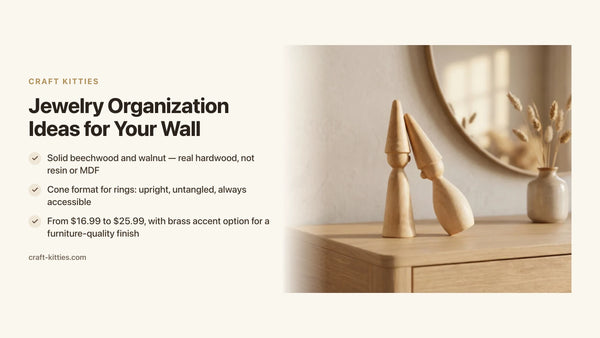
This is the principle our beechwood ring holder cone set was designed around: a functional object in real solid beech that lives on a nightstand, is handled twice a day, and provides a biophilic touchpoint at a scale ($16.99) and footprint that removes every barrier to starting.

Description
When to reach for walnut: richness over warmth
Beech is the right choice when the room already has warmth and you want calm. Walnut is the right choice when the room has neutrals — white walls, gray concrete, light stone — and you want depth. The deep brown, fine-grained character of solid walnut introduces richness without adding visual noise: it reads as furniture-grade material at a scale small enough to place on a shelf.
The walnut ring holder with a solid brass base adds a second material dimension. Brass, like wood, is a naturally occurring material that ages with character: it will oxidize slowly over years into a slightly deeper, more complex tone that neither looks accidental nor requires polishing. The combination of walnut and brass is a biophilic move in the materials sense — two honest, aging materials alongside each other, rather than chrome or resin that stay frozen in their factory finish forever.
For a bedroom that already has warm wood flooring or warm-toned linen, the walnut and brass combination tends to disappear into the room in the best possible way: it belongs, rather than standing out. In a bedroom with white or pale walls and neutral textiles, it provides exactly the contrast needed.

Description
The couple's surface: pairing and visual symmetry
One of the less obvious biophilic principles is bilateral symmetry — the pattern most commonly found in living organisms, from leaves to faces. A pair of identical or closely matched objects on a surface activates this recognition at a low level: the eye reads it as natural, organized without being rigid, coherent without effort.
This is why a pair of ring holders on a shared nightstand or dresser works better than one: the pairing creates the visual rhythm without requiring additional décor. The walnut cone set of two provides this at $18.99 — two matched cones in solid walnut that together form a cohesive display. Placed on a cleared surface, they suggest intention and care: the kind of surface that says the room was arranged, not assembled by accident.
A pair also solves the practical problem of two people sharing a surface. Individual cones can be sized and positioned for each person without compromising the shared visual language — same wood, same grain, different ring collections.

Description
Room-by-room: where biophilic moves have the highest return
The instinct is often to start in the living room, where guests will notice. In practice, the highest return on a biophilic intervention is usually in the rooms you spend the most time in unobserved — bedroom, home office, bathroom. These are the spaces where environment has the most consistent effect on your daily state, and where a small natural object will be encountered repeatedly rather than occasionally.
Bedroom: nightstand and dresser. A solid wood ring holder and a stone or ceramic dish for small items clear the surface of plastic and introduce two natural material cues. Pair with a linen or cotton duvet in a warm neutral. Avoid: too many plants, which introduce care demands and can disrupt sleep quality in small, poorly ventilated rooms.
Home office: desk surface and bookshelves. A solid wood pen holder, a wood or stone paperweight, a small live plant in a ceramic pot. The goal is to interrupt the visual field of screens with a natural focal point — something to rest the eyes on during breaks.
Bathroom: soap dish, wooden accessories, a small plant suited to humidity (pothos, asplenium, peace lily). The bathroom benefits enormously from real wood because the baseline material palette — ceramic, chrome, glass — has zero biophilic content. A single wooden object changes the register of the whole room.
Entryway: a tray or holder in real wood for keys and daily objects. The entryway sets the sensory expectation for the home — arriving to a natural material rather than a plastic tray establishes the register before you even remove your coat.
Description
Description
The comparison: biophilic ring holders by use case
| Model | Price | Wood | Finish | Best for |
|---|---|---|---|---|
| Beechwood Cone Set | $16.99 | Solid beech | Natural wax | Warm rooms, first biophilic piece |
| Walnut + Brass Base | $25.99 | Solid walnut | Natural wax + brass | Neutral or cool rooms, statement piece |
| Walnut Set of 2 | $18.99 | Solid walnut | Natural wax | Shared surfaces, couples, symmetry |
Decision matrix — which ring holder for which room
| Your situation | The right pick |
|---|---|
| First biophilic piece, warm or neutral room | Beechwood Cone Set — pale, calm, immediate |
| Cool palette (white walls, gray floors), want depth | Walnut + Brass Base — rich tone, two aging materials |
| Shared nightstand or dresser | Walnut Set of 2 — visual symmetry, matched grain |
| Gift for someone who values honest materials | Walnut + Brass Base — reads as considered, not generic |
| Jewelry display that needs to look styled in photos | Beechwood Cone Set — pale wood photographs cleanly |
Mistakes that undercut biophilic interiors

Mixing real and synthetic on the same surface. A solid wood ring holder next to a plastic "marble-effect" tray and a faux-terracotta candle creates cognitive dissonance — the eye notices the inconsistency even when the brain does not name it. The real wood begins to read as an accident rather than an intention. The rule is simple: on any given surface, everything should be real or everything should be neutral. Mixing registers undercuts both.
Overloading with nature-themed objects. Biophilic design does not mean maximalism with a leaf motif. Three terracotta pots, two wooden signs and a trailing plant can produce a room that looks busy and themed rather than genuinely natural. Less is always more: one solid wood piece, well-placed on a cleared surface, does more for a room than six nature-inspired accessories competing for attention.
Choosing wood look over wood. This is the single most common mistake. A "wood-look" vinyl floor, a "wood-effect" resin tray, a "walnut-finish" MDF shelf — none of these deliver the sensory effects that make biophilic design work. The grain is a photo. The surface does not warm. It does not breathe. Paying $8 for a printed-wood tray and $17 for a solid beech ring holder sounds like a cost difference; the experiential difference is categorical.
Starting in the wrong room. The living room gets decorated for guests; the bedroom and home office shape your daily state. A biophilic investment in the space where you spend the most time, alone, returns more per dollar than the same investment in a room that functions primarily for occasional social use.
How to shop for biophilic home decor honestly
Four questions that separate a genuine biophilic piece from a nature-themed decoration:
Is the material what it claims to be? Real wood should say the species: beech, walnut, oak, ash. "Wood-effect", "wood-look", "natural finish" are signal phrases for veneered or printed surfaces. If the description avoids naming the species, it usually has a reason.
Does the object have an organic dimension? Organic shapes — cones, irregular curves, forms that echo natural growth patterns — contribute to the biophilic effect in ways that right-angled boxes in wood cannot, regardless of the material. A turned wooden cone is biophilically more effective than a square wooden box of the same species.
Is it something you will touch? The tactile dimension is central to the biophilic effect. An object behind glass or on a high shelf delivers visual texture but no tactile cue. A ring holder that you pick up and set down twice a day delivers both.
Does it replace something synthetic? Biophilic design is most effective as a replacement strategy, not an addition strategy. Adding a wooden ring holder to a surface already covered in plastic organizers produces a weaker effect than clearing the surface and placing only the wood piece. The biophilic move is subtraction followed by addition.
Care and aging: what natural materials ask of you
Solid wood requires almost no maintenance beyond not mistreating it. The wax finish on our ring holders sheds dust with a dry cloth, resists the light humidity of a bedroom or bathroom, and does not require periodic oiling or re-waxing under normal conditions. What accelerates wear is standing moisture — a wet piece of jewelry left directly on wood for days, or a bathroom surface consistently pooling water. The practical standard is: dry the object before placing it back, and wipe the wood surface if something wet rests on it.
Over years, solid beech lightens further in UV exposure. Solid walnut deepens. These are not defects — they are the aging behavior of real wood, which is part of the biophilic appeal. A piece of furniture with patina reads as lived-in in the best sense; a piece of plastic that has yellowed reads as worn out. The difference in the aging trajectory is itself a material argument for genuine wood.
Brass, when present, oxidizes slowly. Polishing is a personal choice, not a maintenance requirement. Many people prefer the aged brass tone to the factory-bright finish — it is a more honest material, in the same way that aged leather or waxed canvas carries its history without looking damaged.
Conclusion — one surface, one real material, one decision
The entry point to biophilic home decor is not a whole-room project. It is clearing one surface and replacing one plastic object with a real wood one. A nightstand with a solid beech ring holder and nothing else competing for attention demonstrates the principle at its smallest scale: grain you can see, warmth you can feel, a functional object you handle daily. From there, the practice scales naturally — one surface at a time, one material swap at a time.
Our ring holder collection brings together pieces in solid beech, walnut and red oak — real hardwoods, cut from real grain, finished to age rather than degrade. The beechwood cone set is where most people start, at $16.99. The walnut and brass holder is where the room already has a point of view and wants reinforcing. The walnut set of two solves the shared surface without ceremony.
You can also find our ring holders on Etsy, where 243 customers have shared their experience — a useful place to see the pieces in real rooms before deciding.
FAQ — biophilic home decor
1 — What is biophilic home decor? Biophilic home decor is the practice of integrating natural elements — real wood, living plants, stone, natural light and organic shapes — into interior spaces to support wellbeing. The underlying principle is that humans have an evolved need for connection with the natural world, and that spaces which reflect this reduce stress and improve focus over time. It is a design philosophy, not a style.
2 — How do I start with biophilic design on a small budget? Start with one solid wood object in a room you already use every day — a ring holder on the nightstand, a tray on the dresser. Real wood at $17–26 is the most effective single biophilic upgrade per dollar: it introduces grain, warmth and tactile texture simultaneously, where a printed wood-effect piece delivers none of those cues.
3 — Does biophilic design work in small apartments? Yes, and often better than in large ones. Small spaces respond visibly to a single well-placed natural object because there is less competing visual noise. The key is restraint: one solid wood piece on a cleared surface does more for a small room than five mismatched nature-themed objects piled together.
4 — What is the difference between biophilic decor and just buying plants? Plants are one layer of biophilic design, not the whole of it. The full approach layers real materials (wood, stone, linen), living elements (plants), natural light and organic shapes together. A room with three plants and otherwise synthetic surfaces delivers a weaker biophilic effect than one with fewer plants but consistent use of real wood and natural textiles across every surface.
5 — Can biophilic decor actually reduce stress? Research in environmental psychology consistently shows that exposure to natural materials and views of nature lowers cortisol and supports attention restoration. While no single object is a clinical intervention, the cumulative effect of surrounding yourself with real materials — across the surfaces you encounter every day — is well-documented and measurable.
6 — What wood species work best for biophilic home decor? Beech, walnut and red oak are the three species with the highest impact in interior spaces. Beech is pale and warm, with a fine, consistent grain that reads as calm. Walnut is deep brown with a tight grain that adds richness to cool rooms. Red oak is lighter, with a bolder grain that brings visual energy. All three are solid hardwoods — not veneered board — which matters because real wood ages with character while veneer chips and swells.
7 — Is biophilic design the same as Japandi? They overlap but are not identical. Japandi blends Japanese wabi-sabi and Scandinavian minimalism, and frequently incorporates biophilic elements (real wood, neutral linen, ceramics). Biophilic design is the broader philosophy — it can specialements itself through Japandi, organic modern, boho or any style that uses honest natural materials without greenwashing.
8 — How do I avoid making biophilic décor look cluttered? Replace one synthetic object at a time with a real natural one: swap a plastic organizer for a solid wood tray, a chrome fixture for a wooden one. Each swap tightens the room. The goal is fewer objects, each genuinely made of natural material — not more objects with a nature motif.