At a glance
- Write plant-specific instructions from the species, recent care, and actual growing-pot access.
- Record what observation triggers water instead of assigning an automatic schedule.
- Keep the removable growing pot and wood exterior dry; do not improvise a reservoir or wick.
A desk plant care handover should let someone check the plant without guessing. List the actual species, recent care, usual location, and how the growing pot is accessed. Then describe what observation calls for a check or action, and what the caretaker should not change. Do not assume every plant tolerates the same number of days without attention.
Inventory the plants and their current setup
Give each plant a short ID and write its species as listed. If the name is unknown, say so. Record the light conditions, typical room location, last watering date if known, and the actual growing pot used. Note whether it has a removable nursery pot, visible drainage, or an inaccessible base. Do not assume a decorative ceramic insert drains merely because it is ceramic.
The RHS holiday-care advice explains that watering depends on plant and conditions and distinguishes succulent needs; it discourages repotting into reservoir systems solely for a brief absence. Read RHS holiday care for houseplants. The RHS growing guide is useful for recording species-specific conditions, not for making a universal schedule.
Write a handover a helper can follow
Separate instructions into “check,” “do if condition is met,” and “do not change.” A plant that should be checked is not necessarily a plant that should be watered. Use observable language, such as “check the growing medium according to this plant’s care notes” rather than “water whenever leaves look low.” If the right action is unclear, name the person or plant expert to ask; do not add a guessed remedy.
| Plant ID | Normal check | What triggers water | How growing pot is accessed | What not to change | Uncertainty or escalation |
|---|---|---|---|---|---|
| Plant A, name copied from label | Inspect medium and visible leaves on agreed check date | Only condition in its species guidance | Lift nursery pot only if it comes out freely | Do not water on a fixed daily timer | Ask owner if the medium reading is unclear |
| Plant B, succulent per label | Check the plant and medium according to its care instructions | Follow its specific guidance, not the schedule for A | Keep pot in its normal position; note whether base is visible | Do not add a wick or reservoir | Ask a plant specialist if condition changes |
| Plant C, identity uncertain | Observe without disturbing roots | No trigger can be written until identified | Access not confirmed | Do not repot or improvise watering | Contact owner for the name and care history |
These are hypothetical entries; adapt them using the real plant’s care source and owner’s instructions. Never hand a helper a fabricated watering interval. If a plant requires a more specific routine than the caretaker can safely follow, ask for someone experienced or arrange appropriate plant care.
Keep the plant and decorative pot separate in wet care
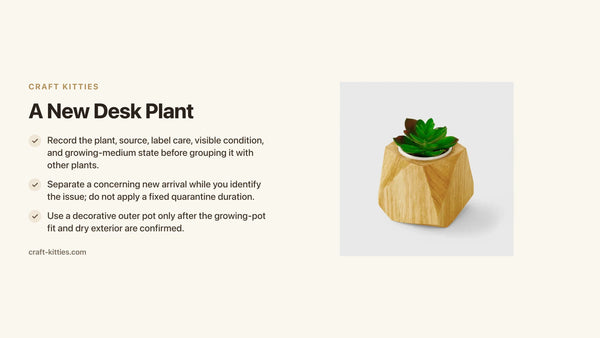
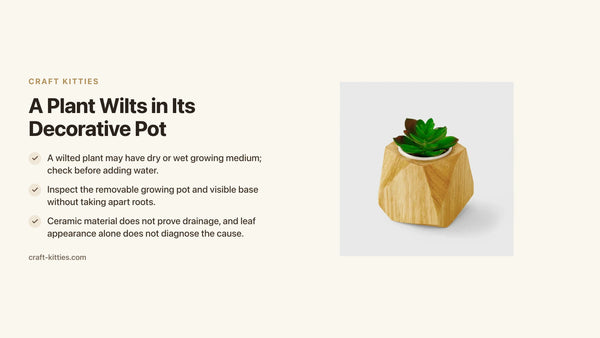
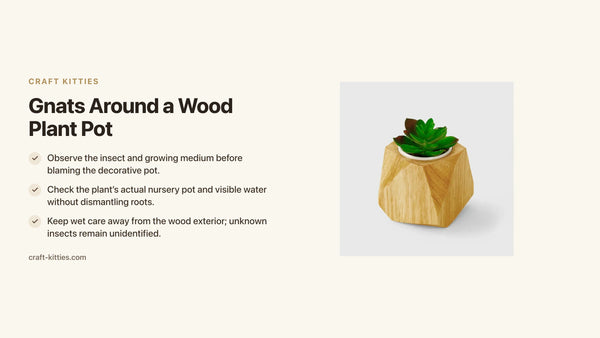
If a removable nursery pot is designed to lift out, perform watering and drainage according to that plant’s instructions away from the wooden outer pot. Return it only when the exterior is dry and there is no visible trapped water. Do not water bare soil directly in the wood planter or make a DIY wick, reservoir, or self-watering arrangement. The rubberwood planter listing describes an inner ceramic cup, but it does not establish that cup’s drainage, reservoir function, or compatibility with every plant. See the product listing for its stated dimensions and description.
Account for cooler and warmer conditions without overpromising
A cooler room and lower light may change a plant’s water needs; a warmer or brighter location may change them differently. The RHS holiday guidance gives context for these differences and for succulents, but it cannot predict how long your individual plant will remain healthy. Do not promise a plant will survive a particular absence. If you do not know the conditions during the trip, place that uncertainty in the handover and ask for plant-specific guidance before leaving.
For desk placement ideas, see our biophilic home décor guide and walnut pencil holder guide; those pages are not watering instructions.
Make the handover usable in one glance
Put the plant ID beside its care note and keep the instructions short enough to read during the check. Separate what the caretaker must do from what they must not do. For example: “Check Plant A on the agreed day; inspect the medium per its label; water only if the stated condition is met; do not add water to the decorative outer pot.” If an action cannot be described without guessing, write “ask owner” instead.
Before leaving, verify that the caretaker knows where the actual nursery pot can be set while checking, and that it can be returned without forcing it into the outer container. Do not stage water in a tray or set up a wick. If nobody can safely access the growing pot, explain that limitation and arrange a suitable person or expert rather than changing the plant’s setup at the last minute.
The handover is not a survival promise. Keep expectations grounded in species and conditions, and allow the caretaker to escalate if the plant looks different from the baseline.
Confirm that the instructions match the actual plant
Before leaving, compare each written note with the plant label, growing pot, and last-known care. If the plant is not the one named, or a container changed, update the handover. Avoid relying on memory or a general room schedule. A caretaker should be able to match the ID on the note to the correct plant without moving several pots.
Specify where the helper can safely place a removable nursery pot while inspecting it, and whether they should return it immediately or ask first. Only include this step if the insert is designed to come out freely. If it is tight, heavy, or supports the plant in an unknown way, write “do not remove; contact owner.” Do not instruct the person to tip water from the wood planter unless its actual design and the plant instructions confirm that step.
A handover succeeds when the caretaker can follow it and knows when to stop. It does not need to predict every condition during the absence; it needs to make uncertainty visible and identify a responsible contact.

Description
Leave a blank for any condition the caretaker cannot judge. A handover should not pressure someone to water when the plant name or medium state is unknown. Tell them to pause and contact the owner if the written trigger does not match what they see.
FAQs
Can I water every plant before leaving?
Do not apply one treatment to every plant. Use each plant’s care needs and current medium condition; watering decisions depend on species and conditions.
Should I move the plant into a self-watering setup for a short trip?
Do not repot or improvise a reservoir solely for a brief absence. Follow species-specific guidance and the RHS holiday-care context.
Can a caretaker pour water into the wood planter?
No. Use the plant’s actual growing pot and keep wet care away from the wooden exterior. Confirm how the inner cup works before use.
What if the species or last watering is unknown?
Record that uncertainty and ask the owner or a plant expert. Do not fill the gap with a universal schedule.