At a glance
- The dresser top and the nightstand are the two highest-return surfaces to declutter — clear them first
- Solid beechwood or walnut pieces stay out permanently; plastic bins disappear into drawers within days
- A ring holder cone separates and displays jewelry in under five seconds — the organizer that builds its own habit
Most decluttering guides open with a dramatic before-and-after and a challenge to empty every drawer in a weekend. The approach tends to produce a brief sense of accomplishment followed by a slow return to the previous state — because the containers chosen are cheap, invisible, and easy to push aside.
The real mechanism behind lasting visual calm is different: put one object on a surface that is attractive enough to stay there permanently, and the habit builds itself. The dresser that has a solid wood ring holder cone set in the corner stays cleaner than the dresser that has a clear plastic bin — because the cone earns its place, and the bin does not. This article is a room-by-room guide to exactly those swaps: the low-effort changes that carry visual weight out of proportion to their size.
Why most decluttering fails within two weeks
The standard decluttering approach treats the problem as one of volume: too many things, not enough space. Remove the things, the problem resolves. But most homes do not have a volume problem — they have a system problem. The items that accumulate on surfaces do so because there is no designated home that is close enough, visible enough, and satisfying enough to use consistently.
The psychology behind this is well-documented. Habits form around cues, and the cue needs to be present. A plastic organizer pushed to the back of the drawer is not a cue — it is an extra step. A walnut cone sitting on the dresser in open view, on the other hand, is the first thing the hand reaches for when a ring comes off. The decluttering that holds is the kind built on objects that stay out, not on systems that require active maintenance.
This is why the choice of container matters as much as the act of decluttering itself. A cheap organizer teaches you that the system does not matter. A piece that is genuinely pleasing to look at teaches you the opposite — and the difference between the two states, over months, is whether the dresser surface stays clear or slowly fills again.
The highest-return surface in any home: the dresser top
If you could only tackle one surface, it would be the dresser top. It is the first surface seen in the morning and the last seen at night. It collects the objects that come off the body at the end of the day — rings, watches, earrings, wallet, keys — and in most bedrooms it collects them without any system at all, so they accumulate in a loose pile that grows until it is sorted every few days.
The dresser-top declutter requires exactly three things: a ring holder for jewelry, a small tray for everyday carry items (watch, wallet, keys), and the discipline to leave everything else in a drawer. Not a dozen organizers, not a labeling system — two objects and a rule.
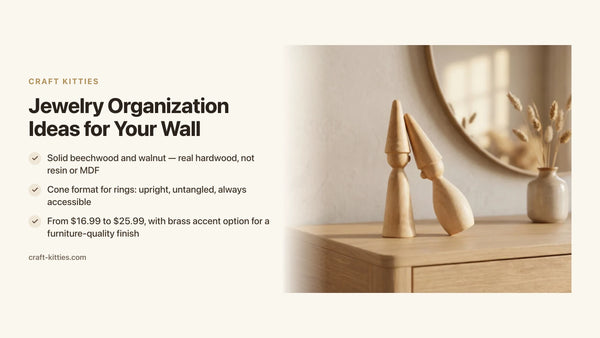
The reason a cone-style ring holder works better than a dish for this surface is separation. On a flat dish, rings rest against each other and tangle; finding a specific ring means picking through all of them. On a tapered solid wood cone, each ring sits at a different height and is immediately visible. Taking a ring off at night and sliding it onto the cone takes two seconds; retrieving the right ring in the morning takes the same. The system requires no thought, which is precisely why it holds.
Cone versus flat tray: the first decision for jewelry organization

The jewelry organization market splits between two formats: the cone (or finger) style, and the flat dish or tray. Both keep rings off the surface. They behave very differently in daily use.
A flat tray or dish works for occasional-wear jewelry — earrings, bracelets, necklaces. Items that come out infrequently can tolerate a small amount of searching. For daily-wear rings — the band and engagement ring that come off every night and go back on every morning — a flat surface creates friction. Rings migrate, touch, and scratch each other. Retrieving the right one requires a brief but daily search, which is the kind of micro-friction that erodes habits.
A cone or finger-style holder eliminates that friction entirely. The taper means rings naturally distribute at different heights; each is visible individually without touching the others. The difference in speed is roughly two seconds versus ten, which sounds trivial until multiplied by 365 days. For couples sharing a nightstand, two cones give each person their own anchor — no sorting, no confusion.
The rule of thumb: cone for the rings worn every day, tray for the pieces worn occasionally. For a dresser used by two people, two cones of the same wood and a small shared tray covers the full range.
Solid wood versus resin versus veneer: why material choice determines longevity

In product photography, solid wood, resin, and veneer ring holders look nearly identical. The price difference often looks like a brand markup. It is not.
Resin cones dominate the entry end of the market. Fresh out of the box, a resin cone can photograph beautifully — smooth, uniform, sometimes in colors that real wood cannot match. Over eighteen to twenty-four months of daily handling, the differences compound: UV exposure yellows most resins slightly; scratches read as opaque white marks rather than surface character; the hollow tap when a ring hits the cone becomes more pronounced as the surface wears. It is not a catastrophic failure — it is a slow aesthetic decline that makes the object feel cheap precisely when it has been used enough to feel familiar.
Veneer over compressed wood core (sometimes sold as "wood-look" or "MDF with wood surface") has a related problem at the edges. The top surface looks like real wood; the core is engineered board. Daily handling on a ring holder — the small repeated impacts of a metal band being slid on and off — concentrates wear at the tip and the base, which are exactly where veneer separates from the core first. Within a year the object reads as worn rather than aged.
Solid beechwood (Fagus sylvatica) and solid walnut (Juglans nigra) behave differently. Both are dense, close-grained hardwoods finished with a wax or oil-wax coat that is absorbed into the surface rather than sitting on top. A small scratch on a waxed solid wood cone can be buffed out with a fingertip. The surface that handles daily ring contact for three years develops a slight patina — a deepening of the grain, a warm sheen at the wear points — that reads as use rather than decay. It is the same material logic that explains why a wooden kitchen tool gets more beautiful over a decade and a plastic one gets more worn.
For an organizer that sits on a visible surface and is handled daily, the material is the decision. Solid wood is not a premium — it is the choice that does not need replacing.
The products from our studio
Three ring holder pieces, each in solid hardwood, chosen to cover the main dresser and nightstand contexts: the couple's set in pale beechwood, the solo statement piece in walnut with solid brass, and the walnut pair for two.

Description
The Beechwood Ring Holder Cone Set is the dresser-top answer for two people sharing a nightstand. Two tapered cones in solid pale beechwood sit on a connected base: each person has their own cone, and the set reads as a single intentional object rather than two separate pieces. Beechwood is the lightest of the solid hardwoods in our studio — a tight, consistent grain with a near-white tone that holds its appearance under any light and next to any bedding. At $16.99 for the set, it is also the entry point to solid wood on the dresser, and the piece we suggest most often when the goal is to establish one correct anchor and build the rest of the surface around it.

Description
The Walnut Wood Ring Holder with Solid Brass Base is the statement piece in the lineup. The cone is solid black walnut — deep brown, fine and tight-grained, the hardwood that interior designers reach for when they want one object to carry a room. Beneath it, a weighted solid brass base grounds the cone and adds a quiet warmth that balances the dark walnut without competing with it. The brass is unlacquered and will develop a very slight patina over years of handling, which reads as character on this piece rather than neglect. At $25.99, this is the ring holder that guests notice — and the one most likely to convert a bare dresser corner into a permanent display that holds without effort.

Description
The Wooden Ring Holder Set of 2 in Walnut brings the same solid walnut material of the single-cone statement piece into a pair. Two cones, same grain, same wax finish, sized to sit at matching heights — one on each side of the bed. The walnut grain varies slightly from piece to piece, which means no two sets are identical, but both cones in the pair come from the same wood family so they read as matched even when placed a meter apart. At $18.99 for the pair, this is the walnut version of the beechwood couples' set: a clean, symmetrical solution for shared nightstands in rooms that already have warm-tone wood or brass elements.
Description
As a gift, the beechwood cone set holds particular relevance. A ring holder is the category of object that solves a real daily problem — where does the ring go at night — while remaining visible enough to be noticed and appreciated. The pale beechwood reads acceptably in any room regardless of palette, which makes it the safe choice when the gift-giver does not know the recipient's bedroom décor. Beechwood against dark walls reads as a light accent; beechwood against light walls reads as texture. At $16.99, the set fits comfortably inside a housewarming or wedding gift budget and ships as a set of two — the signal that both people in the household were considered.
Description
For a gift directed at one person rather than a couple — a birthday, a milestone, a solo-household housewarming — the walnut and solid brass cone carries a different register. It is the kind of piece that reads like the recipient curated it, not like someone ordered it online. The brass base gives it a weight and material seriousness that most jewelry organizers at this price do not have. The recipient places it once and does not move it — which is the most useful measure of whether a gift was right.
Comparison table
| Product | Price | Wood | Format | Best for |
|---|---|---|---|---|
| Beechwood Cone Set | $16.99 | Solid beechwood | 2 cones, shared base | Couples, light-palette rooms, entry price |
| Walnut + Brass Base | $25.99 | Solid walnut + brass | Single cone, weighted base | Statement piece, warm-tone rooms, solo use |
| Walnut Cone Set of 2 | $18.99 | Solid walnut | 2 matching cones | Couples, warm-tone rooms, existing wood elements |
Decision matrix — which piece for which situation
| Your situation | The right pick |
|---|---|
| Shared nightstand, light walls or white bedding | Beechwood Cone Set |
| Solo dresser, you want one object to anchor the whole surface | Walnut + Brass Base |
| Shared nightstand, room already has warm wood or brass accents | Walnut Set of 2 |
| Gift — you do not know their bedroom palette | Beechwood Cone Set (safe default across any palette) |
| Gift — design-conscious recipient, solo household | Walnut + Brass Base |
| You want the cleanest two-cone pair at the lowest price | Beechwood Cone Set |
Room-by-room: the other surfaces worth decluttering first
The dresser is the highest-return surface, but the method applies across every horizontal surface in the home. The principle is identical in each room: identify what actually needs to live there, give each category exactly one dedicated home, and make that home visible and attractive enough to use automatically.
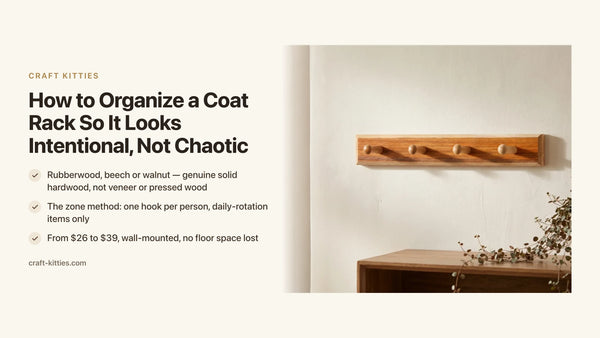
The entryway. The most chaotic surface in most homes is the first one encountered on arrival — whatever is nearest the front door. Keys land there, mail lands there, jewelry often comes off there. The fix is the same as the dresser: one hook for bags and keys, one small tray for mail, and a ring dish or cone for the pieces taken off at the door. Three objects, three categories, one pass.
The bathroom counter. The counter accumulates products that are used daily alongside products used once a month, with no distinction between them. The declutter here is mostly editorial: keep only the items used more than three times a week on the counter, everything else in a drawer or cabinet. A small wooden tray corrals the daily-use items and prevents them from spreading; it also makes the counter easier to wipe down, which maintains the visual calm between deep cleans.
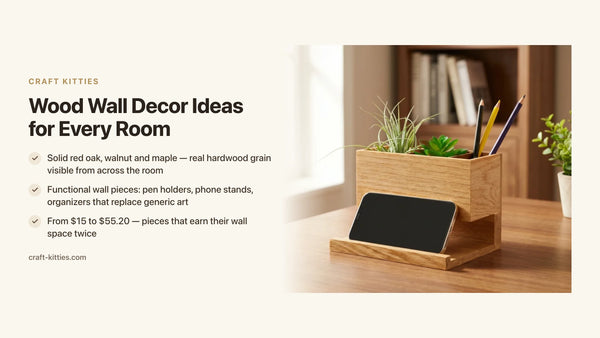
The home office desk. The desk collects paper and cables because there is no friction in adding more. The solution that holds is an in-tray for paper (one slot only, emptied weekly) and a cable management solution that makes routing cables the path of least resistance. A small pen holder in solid wood is the single most effective anchor for a desk that keeps drifting toward disorder — it has a defined footprint and a defined use, which gives the eye a stable reference point against which clutter becomes visible.
The nightstand. The nightstand is the dresser's smaller counterpart and attracts the same category of daily-use item: rings and earrings taken off before sleep, a phone, a glass of water, sometimes a book. The nightstand declutter needs only two objects: one ring holder and one tray or dock sized exactly for the phone. Nothing else lives there permanently.
The one-surface-at-a-time rule
The single most effective technique for making a declutter last is not a product — it is a sequencing rule. Most decluttering attempts fail because they span too many rooms at once, creating a state of partial chaos that feels worse than the original disorder and leads to abandoning the project before any surface is actually finished.
The rule: complete one surface entirely before touching any other. Clear it fully, wipe it down, return only the objects that have earned a permanent place, and then live with it for at least a week before starting the next surface. The week is long enough to confirm the system works in real use and to identify whether any object placed back actually belongs there or was returned by habit rather than necessity.
Starting with the dresser top rather than a closet or a kitchen cabinet applies this rule to the highest-return room in the house. A cleared dresser top creates a visual reference for what the bedroom can look like — which motivates the next surface in a way that starting with a linen closet does not.
Mistakes that undo a good declutter
Buying storage before editing. The instinct on starting a declutter is to buy containers. The correct sequence is the opposite: remove what does not belong on the surface first, then assess what remains, then buy the one or two containers needed to house what stays. Buying containers first guarantees over-buying and creates a second layer of clutter composed entirely of organizers.
Choosing organizers that are too small. A ring holder sized for two rings and a bracelet fills up in week one and stops functioning as a system. Size generously: a cone that holds eight rings will still hold two, and it will not need replacing when life adds three more.
Mixing materials without a thread. A beechwood cone next to a rose-gold metal dish next to a clear acrylic tray reads as accidental rather than curated. Picking one material family — solid wood, or one metal finish — and staying in it gives the dresser top a visual coherence that requires no individual object to be extraordinary.
Abandoning the system during busy periods. A dresser that reverts during a work sprint has not failed — it has identified the weak point. The fix is to remove one object from the surface rather than restart the whole system. The version that holds under pressure is always simpler than the one that only works in calm weeks.
FAQ — decluttering home hacks
1 — What is the easiest room to start decluttering? The bedroom dresser top is the highest-return starting point. It is the first surface seen in the morning and the last at night. Clearing it and replacing loose items with a single tray or ring cone takes under ten minutes and creates immediate visual calm — which motivates tackling the rest of the home.
2 — Why do decluttering efforts fail within weeks? Most decluttering fails because the containers chosen are invisible — cheap plastic bins that get pushed aside rather than used. When the organizer is attractive enough to keep out permanently, it builds a habit automatically. A solid wood ring holder stays on the dresser because it looks intentional; a plastic dish disappears into a drawer.
3 — What is a ring holder cone and how does it work? A ring holder cone is a tapered solid wood form — typically beechwood or walnut — on which rings slide down and stay separated without touching. Unlike a flat dish where rings stack and tangle, the cone keeps each ring individually readable and retrievable in seconds. For couples sharing a nightstand, a set of two cones gives each person their own anchor point.
4 — Solid wood or resin — what is the real difference? Resin cones dominate the low end of the market and look similar in product photos. The difference shows over time: resin yellows slightly under UV, scratches opaquely, and develops a hollow feel. A solid beechwood or walnut cone is dense, wax-finished, and develops a slight patina with handling rather than degrading. If the cone will live on a dresser or nightstand for years, solid wood is the material that holds up.
5 — What should go on a decluttered dresser top? The guideline is three to five intentional objects maximum: one ring or jewelry holder, one functional item (a lamp, a small tray for a watch or phone), and one object of meaning. Anything else goes in a drawer. The goal is not an empty surface — it is a readable one.
6 — How do I stop the entryway from collecting clutter? The entryway collects clutter because it has no dedicated homes for the items that land there on arrival. A hook rack for bags and keys, a small tray for mail, and a ring holder or dish for jewelry taken off at the door solve the problem permanently. Each object needs exactly one landing spot that is visible and within arm's reach.
7 — Do wooden organizers require special care? No. A solid beechwood or walnut piece finished with wax or oil needs nothing more than an occasional wipe with a dry or barely damp cloth. There is no re-oiling ritual, no special product. The finish deepens slightly over the years in a way that reads as aging rather than deterioration — the opposite of plastic.
8 — What is the one-surface-at-a-time rule? Complete one horizontal surface entirely before touching any other: clear it, wipe it, return only the objects with a permanent role, and live with the result for a week. Starting the next surface before finishing the first creates a state of partial disorder that is motivationally harder to recover from than the original clutter.
Where to go next
The ring holder is typically the first solid wood piece added to a bedroom — and rarely the last. Our ring holder collection gathers the full lineup in beechwood and walnut, sized for single use and for couples, with and without a brass base. If the bedroom is the priority, the Beechwood Ring Holder Cone Set is where most people start; the Walnut Wood Ring Holder with Solid Brass Base is where they go when that first piece works. Customers who found us through Etsy — where our studio has collected over 243 reviews — often return directly for pieces for other rooms once the first one holds.
Conclusion — one object, one surface, one permanent change
The decluttering hacks that last are not the ones built on discipline or schedules. They are the ones built on objects that earn their place on the surface and stay there because they are worth keeping out. Start with the dresser top, place a solid beechwood or walnut ring holder cone, and clear everything else. That single change — visible every morning and every night — carries more motivational weight than any checklist. One surface, done well, finished: that is the only sequence that actually works.