At a glance
- Declutter room by room: start with the surfaces you touch every day
- Give each category a fixed home before organizing anything
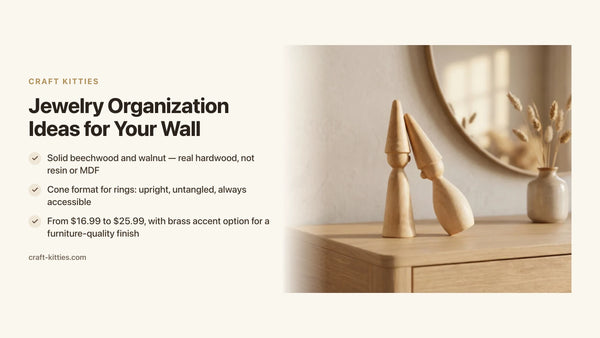
- Solid beechwood and walnut ring holders from $16.99 to $25.99 keep jewelry off the nightstand for good
Most decluttering sessions start with momentum and end with a bag of donations, a slightly tidier bedroom, and the rest of the house unchanged. Not because the intention was wrong, but because the approach was. Whole-house decluttering is not a single act of will — it is a sequence of small, scoped decisions made room by room, surface by surface, in the right order.
This guide gives you that sequence: a room-by-room checklist that tells you exactly what to sort, what question to ask for each object, and what to put in its place so the surface stays clear. It also addresses the part most decluttering advice skips: what happens after the session. Clutter comes back when cleared surfaces have no structure to receive the next wave of small objects. The fix is not more willpower — it is a physical home for every category that tends to drift.
Why most decluttering stalls before it finishes
The two most common points of failure are the wrong starting room and the wrong method within that room.
Starting with a storage room or a garage is a tactical mistake. These spaces are dense, emotionally loaded, and remote from daily life. The effort is high, the visible payoff is low, and the motivation to continue into the kitchen or bedroom afterward is gone. The right starting point is the room where the clutter costs you something every day.
The wrong method is sorting in place: moving things from one surface to another, grouping them differently, organizing around the clutter rather than removing it. It feels productive and produces no real change. The correct method — which applies to every room in this checklist — is to clear the surface completely before making any decision. Empty first, then return only what earns its place.
The room-by-room decluttering checklist

Bedroom: start where the day starts and ends
The bedroom is the right first room because you interact with its surfaces twice a day, every day. A cluttered nightstand is the last thing you see before sleep and the first thing you confront in the morning.
Nightstand checklist:
- Everything off the surface. Everything. Books, glasses, glasses cases, charging cables, cups, hair ties, small change, receipts.
- Keep: the one book currently being read, one lamp, one phone charger if it belongs permanently there.
- Remove: anything that accumulates by inertia — packaging, cables for devices you no longer own, jewelry that has no permanent home.
Dresser top checklist:
- Apply the same empty-first approach.
- Keep: the three to five items you use or wear every day.
- The surface should hold nothing that does not have a designated reason to be there.
The most common dresser-top accumulator is jewelry. Rings, necklaces, earrings removed at the end of the day land wherever the hand drops them — on the corner of the dresser, next to the lamp, inside a dish that already holds two other things. The piece that fixes this is a ring holder: a dedicated cone or stand positioned where you stand when you undress. When the landing spot exists and is visible, the jewelry finds it instead of drifting across the surface.
Our Beechwood Ring Holder Cone Set — a pair of turned cones in genuine solid beechwood — gives couples a shared display that keeps rings visible, separated, and off the dresser.

Description
Entryway: the drop zone that determines the whole house
Every house has a drop zone, whether it was designed as one or not. It is the surface nearest the front door where keys, bags, mail, sunglasses, and small accessories land the moment you walk in. In most homes this surface is either a table that was not intended for this purpose, or there is no surface at all and items land on the floor, a chair, or the stairs.
Entryway checklist:
- Define one surface as the intentional drop zone. Not the kitchen counter, not the nearest chair.
- On that surface, keep only: a key hook or small tray, one charging spot if needed.
- Remove: accumulated mail older than one week, single gloves, shopping bags waiting to be returned, items that belong in another room and never made it.
The logic here is identical to the bedroom. A clear surface is not enough — it needs structure that intercepts the objects before they pile up. A tray or a designated dish for small accessories gives every incoming object a visible, bounded home. When the container fills, you know it is time to sort; the clutter does not silently expand across an open surface.
Bathroom: surfaces that attract more than they should
The bathroom counter is often the most cluttered surface relative to its size. Three categories drive most of it: expired or unused products, duplicates that accumulate when a new product is purchased before the old one runs out, and small accessories — hair ties, bobby pins, jewelry removed before a shower — that have no fixed location.
Bathroom counter checklist:
- Everything off the counter. Check expiration dates as you go.
- Products you use daily: back on the counter, in a logical zone.
- Products you use weekly: in a drawer or cabinet, not on the counter.
- Products you have not used in sixty days: remove.
The jewelry problem reappears here. A ring removed before washing hands or showering needs somewhere to go that is not the edge of the sink. A ring holder next to the faucet — small, permanent, visible — catches the ring before the sink does. This is not decoration; it is routing.
Our Walnut Wood Ring Holder with Solid Brass Base sits on a counter with a presence that matches the care that went into the bathroom — solid walnut, brass that does not tarnish, a base weighted enough to stay put.

Description
Home office desk: the surface that silently expands
A desk accumulates in layers. The first layer is the tools of the work itself. The second is the packaging and cables of those tools. The third is everything that came to the desk because it had nowhere else to go.
Desk checklist:
- Remove everything that is not directly related to the work that happens at this desk.
- Cables: only the ones that connect devices in active daily use.
- Paper: process or file. Nothing sits in a temporary pile for longer than one week.
- Small objects — coins, earbuds, a ring left on the desk when switching tasks — need a designated tray or holder.
A desk ring holder is not a vanity item. It is a routing solution for the moment when you remove a ring to type or to clean your hands and need it back in thirty minutes. Without a designated spot, the ring migrates to the edge of the keyboard, the corner of the monitor stand, a sticky-note stack. With one, it stays in one place until it goes back on your finger.

Description
Living room: less is more, but start with the categories
Living room surfaces — coffee table, console, side tables — accumulate because they are the most used and the least managed. Magazines, remote controls, candles, small decor items, and the secondary overflow of every other room tend to settle here.
Living room checklist:
- Every surface: empty first.
- Keep: the one or two decorative objects that belong there by design, the remote controls, and nothing else.
- Remove: anything that was placed temporarily more than two weeks ago.
- Assign a category to each surface so it has a purpose rather than a general license to hold things.
Kitchen counters: the most reclaimed surface
Kitchen counter clutter follows a predictable pattern: appliances used monthly occupy permanent space, small utensils without a drawer home land beside the stove, and produce or packaging accumulates near the sink.
Kitchen checklist:
- Appliances used less than weekly: to a cabinet.
- Countertop space rule: if it does not earn its place by daily use, it moves.
- Create zones: prep zone clear, sink zone clear, coffee area self-contained.
Storage areas: the last step, not the first
Basements, closets, and garage spaces should be the final areas in the sequence — after all the active living areas have been cleared. Attempting storage areas first creates a false sense of progress while leaving the rooms where daily friction actually lives untouched.
Storage checklist:
- Category by category, not box by box.
- The question for each item: if I needed this and did not know I had it, would I buy it again?
- Donate, discard, or relocate. No box goes back labeled "misc."
The two-question method for every object you touch
Every object in a decluttering session needs only two questions:
1 — Does this object have a fixed, specific home in this house? If not: either give it one right now, or remove it. Objects without a home drift.
2 — Is this object used, displayed intentionally, or held for a specific near-future use? If none of the above: remove it.
These two questions replace the more common and more paralyzing "do I want to keep this?" question. Wanting to keep something and actually using it or displaying it are different things. The two-question method routes objects to their real status faster.
What to do when you find jewelry with no home

Jewelry is one of the most common categories to surface during a bedroom or bathroom declutter because it is the most spatially promiscuous. A single ring can appear on four different surfaces in the same week without anyone carrying it deliberately.
The fix is not a bigger jewelry box — it is a visible, positioned holder for the specific pieces worn daily. A ring holder cone placed at the nightstand or the bathroom counter intercepts the ring at the moments when it comes off: before sleep, before a shower, before washing up. It does not need to hold the entire collection, just the pieces that move twice a day.
For couples decluttering a shared bedroom, a two-cone set serves a second function: each person's daily ring has a dedicated place. No searching on each other's nightstand.
Our Beechwood Ring Holder Cone Set is turned from genuine solid beechwood — the same beech used in fine European furniture, chosen for its tight grain and warm neutral tone that reads clean against any palette.
Description
Choosing the right organizer after you declutter
Decluttering clears the surface. The organizer keeps it clear. This distinction matters because the wrong organizer — too large, too decorative, too provisional-looking — either gets removed when it stops fitting or creates a new category of visual noise.
Three criteria that actually matter when choosing a desk or nightstand organizer:
Scale: The organizer should be smaller than the surface, not fill it. A cone ring holder on a nightstand takes up less space than a paperback book. It holds the ring without claiming the surface.
Material: Solid wood — beechwood, walnut, red oak — stays in place without gripping mechanisms because its own weight provides friction against the surface. Lightweight plastic slides or gets pushed aside. A piece that moves every time something near it moves is not performing its routing function.
Permanence of appearance: An organizer that looks provisional invites provisional use. Solid wood with a natural wax finish or a weighted metal base signals that the object belongs there — which, functionally, it does. The psychology of the organized space is not separate from the design of the objects in it.
Our Walnut Wood Ring Holder with Solid Brass Base is the option when the bathroom or nightstand has already been curated: solid walnut cone, weighted brass base, a profile that does not apologize for taking up space because the space it takes is entirely justified.
Comparison table — ring holders as decluttering tools
| Model | Price | Wood | Best surface | Best for |
|---|---|---|---|---|
| Beechwood Cone Set | $16.99 | Solid beechwood | Nightstand, dresser | Couples, shared bedroom |
| Walnut + Brass Base | $25.99 | Solid walnut | Bathroom counter, nightstand | Statement piece, curated spaces |
| Walnut Cone Set of 2 | $18.99 | Solid walnut | Desk, dresser, nightstand | Dark wood palette, modern aesthetic |
Decision matrix — which ring holder for which room and profile
| Your situation | The right pick |
|---|---|
| Shared bedroom, two daily rings to park | Beechwood Cone Set — $16.99 |
| Bathroom counter with warm metal fixtures | Walnut + Brass Base — $25.99 |
| Home office desk, dark wood palette | Walnut Cone Set of 2 — $18.99 |
| Light Scandinavian or minimal palette | Beechwood Cone Set — neutral grain |
| Gift for someone finishing a declutter | Walnut + Brass Base — the piece that stays |
Mistakes that bring the clutter back
Organizing before decluttering. Buying bins, trays, and organizers for a space before you have removed the excess is how people spend two hundred dollars and end up with the same clutter, neatly contained. Remove first. Then assess what actually needs a home.
Leaving surfaces without a purpose. A surface with no assigned function accepts everything. A nightstand defined as "one book, one lamp, one ring holder, nothing else" resists accumulation because every new object violates the defined structure. The organizer is part of the definition.
Decluttering in one massive session. Decision fatigue is real and it hits hardest in hour three, which is usually when the "keep or donate" threshold starts sliding toward "keep, I'll deal with it later." Two to four hours per room, with a hard stop, preserves the quality of each decision.
Donating too slowly. Bags and boxes waiting to be donated re-enter the house. They get unpacked during a moment of doubt, or moved aside and forgotten until the next session. The donation leaves the house within forty-eight hours of the session — not after the next visit to the donation center feels convenient.
Not assigning a home to the objects that survived. Decluttering that ends with a cleared surface and no system for the objects that remain on it is a temporary improvement. The ring with no permanent spot will be back on the dresser corner within a week. The system is the fix, not the session.
How to maintain a decluttered home without another session
The goal is not to repeat a full decluttering session every six months. The goal is to reduce the accumulation rate enough that the surfaces never return to the state that made the first session necessary.
Three practices that maintain the result:
One in, one out. Every new object that enters the house displaces an existing one. Not as a strict rule, but as a default assumption that interrupts the passive accumulation mode.
Weekly surface reset. Ten minutes on Sunday. Every counter, nightstand, and desk surface returned to its defined state. Objects that have drifted are returned to their homes or removed. This is maintenance, not a session.
A home for every daily-use object before it accumulates. The ring holder, the key tray, the pen cup. These are not decorative choices — they are routing mechanisms. Each one intercepts a category at the moment of highest drift risk and returns it to a fixed point. The home does not have to be beautiful; it has to be specific and visible.
Our Wooden Ring Holder Set of 2 in Walnut — solid walnut, paired cones — positions at the desk corner or dresser top and intercepts the daily ring for as long as the surface is maintained. The walnut darkens slightly with age, the grain remains tight, the weight stays. It is still there when the house needs no sessions at all.
Description
FAQ — decluttering home tips
1 — Where should I start when decluttering my home? Start with the room that causes you the most daily friction — usually the bedroom or the entryway. These two zones affect how you begin and end every day. A single cleared nightstand or a bare entryway surface creates immediate relief and gives you momentum for the rest of the house.
2 — How long does it take to declutter a whole house? A full house takes most people between one long weekend and three focused weeks, depending on how much has accumulated. The realistic approach is not to budget a single marathon day but to assign one room per session — two to four hours each — with a clear stopping point. That pace prevents decision fatigue and keeps the process from stalling.
3 — What is the fastest way to declutter a room? Empty the surface or space completely first, then return only what earns its place. The mistake most people make is sorting in place — moving clutter from one corner to another — rather than starting from zero. A blank surface forces every object to justify its return.
4 — How do I stop clutter from coming back? Give every category of object a fixed home before it accumulates on a surface. Clutter is rarely a willpower problem — it is a routing problem. When rings, keys, or small accessories have no dedicated spot, they land wherever the hand drops them. A ring holder on the nightstand, a tray at the entryway, a pen cup on the desk: each one intercepts a category before it piles up.
5 — Should I declutter before or after organizing? Always declutter first, organize second. Organizing things you do not need is one of the most common ways a declutter session fails — you spend time and money on bins and containers for objects that should have left the house. Remove the excess first, then identify what needs a home.
6 — What should I declutter first in the bedroom? The nightstand and the dresser top. These two surfaces accumulate the most low-value items — expired receipts, charger cables without a device, empty packaging, single earrings. Clearing them takes under thirty minutes and the visual improvement is immediate. A single ring holder on the nightstand then keeps jewelry off the surface for good.
7 — How do I declutter jewelry without losing track of what I own? Lay everything out in one place before making any decisions. You cannot evaluate a jewelry collection that is half in a drawer, half on the nightstand, and half in an old makeup bag. Once it is all visible, the duplicates, the broken pieces, and the pieces you genuinely wear every day become obvious. A cone ring holder keeps the daily pieces on display and accessible — which is how you know they are being used.
8 — Is solid wood better than plastic for desk and bedroom organizers? Solid wood — beechwood, walnut, red oak — stays in place on a surface without gripping mechanisms because its weight provides natural friction. It does not yellow, crack, or lose shape over time the way plastic does. For pieces that live permanently on a nightstand or dresser top, the material choice determines whether the organizer looks intentional or provisional three years later.
Where to go next
If the bedroom and bathroom are the rooms you are starting with, the ring holder collection is the practical next step: solid beechwood and walnut pieces designed for the surfaces where jewelry actually lives, priced to make the decision easy. The Beechwood Ring Holder Cone Set starts at $16.99 for a pair; the Walnut Wood Ring Holder with Solid Brass Base is the $25.99 option when the space has been curated and deserves a piece that matches that care.
If you have arrived here via Etsy, the 243 customers who have reviewed our pieces there are a good reference for how each product actually sits on a nightstand or desk in a real home — worth reading before you choose between beech and walnut.
The short version
Declutter in the right order: bedroom first, storage areas last. Empty every surface before making any decision. Give every daily-use category a fixed home — not a temporary spot, a permanent one. The surface stays clear when the routing system does the work that willpower cannot sustain alone. A ring holder is not a luxury; it is the routing mechanism for the object most likely to drift across five surfaces in a week. Choose the material that will still be there, unchanged, three years from now: solid beechwood or solid walnut, weighted, visible, positioned once.