The hallway is the most walked-through room in the house and usually the least thought-through. Most corridors inherit whatever was on the wall when someone moved in — a generic hook strip, a mirror leaning at an angle, a picture hung without a plan — and stay that way for years while every other room gets attention. The paradox is that the hallway is the first space every guest enters and the last image of the home they carry out. It deserves more than whatever stayed from the last tenant.
The good news: the hallway is also one of the easiest rooms to transform. It is compact, which means one or two wall pieces carry disproportionate visual weight. The right bar, hook rack or shelf in solid wood shifts the entire register of the corridor — from transitional to intentional. This guide works through the logic of what makes hallway wall decor actually succeed, presents the wall pieces from our studio that work in this context, and closes with a decision matrix, installation notes and answers to the questions we hear most often.
At a glance
- Solid red oak, walnut and beech — real hardwood, not printed veneer
- Wall-mounted bars that function as décor: hold scarves, bags and throws without cluttering the floor
- From $22 to $24, with brass or matte black hardware accents
Why the hallway is the hardest room to decorate — and the easiest to fix
The hallway concentrates every decorating constraint at once: narrow footprint, high traffic, poor natural light, no obvious focal point, and the competing demands of looking good and absorbing the chaos of daily arrivals. The result is that most corridors default to minimalism by neglect — people simply do not know what to put on those walls, so nothing goes up.
The fix is simpler than the problem suggests. The hallway does not need furniture — it needs a wall layer. One or two pieces mounted at the right height, in a material that reads as intentional, and the corridor shifts from transitional dead space to the designed introduction to the rest of the home.
The pieces that succeed in hallways share three properties. They sit flat against the wall and project minimally. They serve a function — holding a bag, a scarf, a key — so they earn their wall space. And they are made of a material that ages: solid wood develops character in a hallway the same way it does in a kitchen or bathroom, unlike veneered MDF that chips and yellows.
The case for solid wood in an entryway

There is a practical argument and an aesthetic one. On the practical side, solid hardwood — red oak, walnut, beech — holds fasteners securely, maintains its finish under the daily contact of bags and coats, and does not deform at the corners where a veneer would eventually peel. The hallway is high-traffic; what goes on the wall there is handled more than anything in a bedroom or living room. Material quality matters in proportion to use, and the hallway is one of the highest-use surfaces in the home.
On the aesthetic side, real wood grain does what no printed surface can: it catches light differently across the day, deepens as it ages, and brings a texture that registers as designed rather than generic. A red oak bar in a pale hallway is visually present — you notice it, it anchors the corridor, it gives the eye somewhere to land in a space that otherwise has no natural focal point. A printed wood-effect plastic bar mounted in the same spot disappears or, worse, draws attention to exactly how little thought went into it.
The three species in our lineup give three different readings of the same idea. Red oak is honey-toned with a bold, open grain — the warmest choice, the one that pulls a cold or north-facing hallway toward comfort. Walnut is deep brown with a fine, tight grain; it reads like furniture in a corridor, a strong anchor that says something was deliberately chosen. Beech is lighter and quieter, with an even grain that pairs naturally with brass hardware and a more Scandinavian or Japandi-adjacent sensibility. All three are cut from solid hardwood and finished with a wax or oil coat that handles the humidity and contact of an active entryway.
What actually works on hallway walls
The hallway's main constraint — limited depth — immediately eliminates most furniture-style solutions. Deep shelves, projecting hooks on thick boards, and wall art that extends more than four inches from the surface all tighten an already narrow space. What remains is a short list of formats that genuinely work.
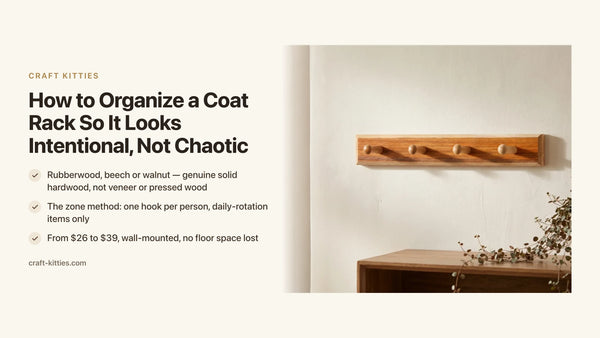
Wall-mounted bars are the most versatile. A bar at 60 to 65 inches hangs a scarf, drapes a reusable bag, keeps a lightweight jacket within reach — all without touching the floor. The bar itself is a visual element: horizontal line, warm wood, clean hardware. It reads as architecture, not storage. In a bathroom, a towel bar holds wet towels; in a hallway, the same format holds the objects of daily life and contributes a material note to an otherwise bare wall.
Layered bars add capacity without adding more anchor points. A double-layer bar in the same footprint as a single bar gives two planes — upper for bags, lower for scarves or a draped throw — while remaining flush to the wall. It is the solution for hallways where hooks would look like a pegboard but where one bar is not quite enough.
Brass hardware as the connecting element. When the wall piece combines solid wood with brushed brass, the hardware does a second decorative job: it echoes any brass in adjacent rooms (a light fixture, a faucet, a door handle), stitching the hallway into the visual thread of the home. This is the difference between a bar that is decoratively neutral and one that actively contributes to a consistent material palette.
The wall pieces from our studio
Four pieces, all in solid hardwood, chosen because they answer the specific conditions of a hallway: wall-flat profile, practical function, real wood that ages rather than deteriorates, and hardware that reads as a finish rather than a fastener.

Description
The square hardwood bar is the most straightforward version of the idea: a clean, solid-wood bar on two wall-mounted brackets, flush to the wall, in red oak or walnut with a wax coat. At 24" wide, it holds a doubled scarf, two lightweight bags or a folded throw. The brackets are simple and recessed enough that the bar reads as a single horizontal element rather than bar-plus-hardware. At $24, it is the entry point to a real wood hallway and the piece we recommend first for corridors that have nothing on the wall yet.

Description
The wood and brass set pairs solid hardwood with brushed brass bracket hardware — the combination that most directly reads as interior design rather than bathroom fixture. The brass here is not a thin plating but a proper hardware finish that holds up to daily contact. At $22, it is actually the lower price point of the two, which makes the decision straightforward: if the hallway or an adjacent room has any warm metal, pick this one.

Description
The arc design is for hallways where the bar needs to work as a visual object, not just a functional one. The brackets describe a curve rather than a corner; the bar sits at the top of the arc and the entire profile reads as a single designed form when mounted on a plain wall. In a corridor with neutral walls, it functions the way a small sculpture would — something worth looking at, something with a shape — without projecting more than a few inches from the surface. Same price point at $24, same solid wood construction, different visual register.

Description
The double-layer bar is the practical solution for hallways that need real capacity without real depth. Two horizontal rails, stacked, in the same wall footprint as a single bar. The upper rail takes bags; the lower one drapes a scarf or throw. The overall appearance from across the corridor is a single, considered wall piece — the layering only becomes apparent up close. At $24 it is the same price as the single bar, which makes the double-layer the default recommendation for any hallway that actually has things to hang.
Description
As a housewarming or home gift, a solid wood wall bar occupies a category of its own: it is used daily, it takes five minutes to install, and it replaces a generic fixture that was never chosen consciously. The walnut version, in particular, photographs well against any wall color — which matters when the recipient will inevitably share it.
Comparison table — four wall bars for hallway and entryway use
| Model | Price | Wood | Hardware | Best hallway use |
|---|---|---|---|---|
| Square hardwood bar | $24.00 | Solid red oak or walnut | Matte black or neutral | First piece, clean and simple |
| Wood & brass rack set | $22.00 | Solid wood | Brushed brass | Warm metal palette, statement piece |
| Arc design bar | $24.00 | Solid wood | Curved wood brackets | Sculptural accent, bare wall focal point |
| Double layer bar | $24.00 | Solid wood | Matte black or neutral | Maximum capacity, minimum wall space |
Decision matrix — which piece for which hallway
| Your situation | The right pick |
|---|---|
| Bare wall, starting from nothing, want one clean anchor | Square hardwood bar — $24 |
| Hallway or adjacent room has brass fixtures, door handles or light fitting | Wood & brass rack set — $22 |
| Plain walls, want the bar to function as a visual object too | Arc design bar — $24 |
| Need real capacity — bags, scarves, throw — in one wall footprint | Double layer bar — $24 |
| Housewarming or home gift that works in any room | Square bar in walnut — versatile, universally useful |
| Narrow corridor, need flat profile and minimal wall projection | Any bar in this lineup — all mount within 3" of the wall surface |
How to style a hallway wall in three moves

The overcrowded hallway and the empty hallway share the same problem: no plan. The three-move approach builds the wall in a sequence that stops at the right point rather than continuing until the wall is full.
Move 1 — The anchor. One wall-mounted bar or hook rack at functional height: 60 to 66 inches from the floor, where an adult hand reaches naturally for a hung bag or coat. This is the piece with the most contact, the one that will be touched every day. Choose it in solid wood and the right hardware for the room; everything else will reference it. Do not put the anchor in the corner — centered on the main wall or directly opposite the front door gives it visual authority.
Move 2 — The layer. A second piece, smaller, above or below the anchor. A floating shelf 8 to 12 inches above the bar creates a small vignette space; a key holder or narrow mirror below it gives the wall depth without clutter. The constraint on this second piece: it should be in the same material family as the anchor. A walnut bar with an oak shelf reads as mismatched; a walnut bar with a walnut shelf reads as a collection. Same species, same hardware finish — the pairing looks considered rather than accumulated.
Move 3 — The detail. One object on the shelf or hanging from the bar, not three. A small ceramic pot, a single framed photograph, a folded linen cloth in a neutral color. The detail tells the eye this space was thought about; it also defines the boundary. If you keep adding objects to the shelf until the surface is full, move 3 has failed. The hallway's visual economy is the same as minimalist design everywhere: the fewer objects, the more each one reads.
Mistakes that age a hallway faster than wear does
Mixing hardware finishes without intent. Brass bar brackets next to a chrome mirror frame and matte black hooks reads as indecision, not eclecticism. Choose one hardware metal and apply it consistently across the two or three pieces in the corridor. If one piece is already there and cannot be changed, the next purchase should match it — not add a third metal to the conversation.
Hanging everything at the same height. A row of objects at identical eye level flattens a wall. Varying height — anchor at arm reach, mirror or shelf 12 inches above, key holder lower — creates visual rhythm that the corridor otherwise lacks entirely.
Using the hallway as overflow storage. A wall bar in an entryway is not a solution for the coat closet being full. Once the bar holds more coats than it has space for, it stops reading as décor and starts reading as the problem itself. The bar should hold what comes off the body on entry — one coat, one bag, a scarf — and the rest needs another solution. The discipline is the hallway's whole design: less, but chosen.
Ignoring the floor. Wall decor in a hallway works in conversation with what is on the floor. A beautiful walnut bar above a cluttered floor of shoes, bags and umbrellas is still a cluttered hallway. The wall piece does not compensate for the floor; the two layers need to be addressed together for the corridor to read as designed. A narrow console or a tray on the floor for shoes addresses the ground layer without claiming much width.
Choosing pieces that project too far from the wall. This is the most common mistake in narrow corridors. A hook rack that projects four inches, a coat stand at the wall's edge, a deep shelf — all of them tighten the passage physically. In a hallway under four feet wide, the maximum comfortable projection for any wall piece is three inches. Wall bars and flat-bracket hook racks stay within that limit; most alternative storage formats do not.
Choosing the wood species for your hallway
The right species depends on two things: the light in the corridor and the wall color.
Red oak is the warmest choice. Its honey tone and bold grain are the most visually active of the three, which works well in north-facing hallways that receive little natural light — the grain catches what light is there and gives the bar presence. Against white or off-white walls, red oak reads as a warm accent; against taupe or greige, it harmonizes rather than contrasting.
Walnut is the statement choice. Deep brown with a fine, tight grain, it stands out clearly against pale walls and reads as furniture-grade rather than fixture-grade. In a hallway with light walls and minimal other decoration, a walnut bar becomes the room's focal point by default — which is exactly what a corridor with nothing else on the walls needs.
Beech (where available in the lineup) offers a lighter, more neutral tone with an even grain that pairs naturally with brass hardware. It suits hallways that already have warm wood furniture in adjacent rooms where adding another bold species would compete rather than coordinate.
The reliable principle across all three: contrast works. The bar should be visible against the wall from across the corridor. If the wood tone matches the wall color closely, the bar disappears visually — which defeats the purpose. The hallway's functional pieces can afford to be subdued in form; in tone, they need to register.
Installing a wall bar in a hallway
The installation takes ten minutes and is simpler than it sounds.
Find the height. For a bar that holds bags and coats, 60 to 66 inches from the floor is the right range. Mark with a pencil and hold the bar at that height to verify before drilling.
Locate the wall type. Most hallway walls are drywall over studs at 16-inch intervals. Mounting into a stud gives the strongest hold; drywall anchors rated for 25 to 30 lbs per point are sufficient for a bar used as décor.
Mark the bracket positions and level them. Trace the screw positions with the bracket held at height, then use a level across both marks before drilling. The most common error is a bar that runs slightly downhill — a level prevents the result that will catch your eye every day.
Mount and test. Drill pilot holes, set anchors if needed, screw brackets flush, drop the bar in. Hang a weighted bag to confirm the hold before loading fully.
FAQ — hallway wall decor ideas
1 — What kind of wall decor works best in a narrow hallway? Flat-to-wall pieces: wall-mounted bars, hooks and shallow shelves that add visual presence without projecting more than a few inches into the corridor. The goal is vertical interest with minimal floor and depth footprint.
2 — Can I use a towel bar as hallway wall decor? Yes, and it is one of the more versatile choices. A solid wood towel bar holds scarves, bags, a lightweight jacket or a throw — it functions and decorates at the same time, reading as intentional décor rather than storage clutter.
3 — Is solid wood or metal better for hallway wall pieces? The best pieces combine both. Solid wood — red oak, walnut or beech — brings warmth and grain texture that painted metal cannot replicate. Brass or matte black hardware adds structure. The combination reads like furniture rather than fixture.
4 — How high should I hang wall decor in a hallway? Functional pieces (bars, hooks): 60 to 66 inches from the floor. Decorative pieces (art, shelf): eye level, approximately 57 to 60 inches to the center. Where pieces serve both roles, err toward functional height.
5 — What colors and materials work in a small hallway? Light-reflecting materials and contrast. A honey-toned red oak bar brightens a narrow space; walnut against a pale wall creates a focused anchor. The wall piece should read clearly against the wall color — if it blends in, it disappears visually and defeats the purpose.
6 — Do I need to hit a stud to hang a wood towel bar? Not necessarily. Drywall anchors rated for 20 to 30 lbs each are sufficient for a bar used as décor. For renters avoiding holes, strong adhesive strips work well when the bar holds lightweight scarves or decoration rather than heavy winter coats.
7 — How do I make a hallway look bigger with wall decor? Keep pieces slim and vertical — they draw the eye upward. One or two intentional pieces with breathing room around them read as designed; several small items crowded together read as clutter. Light wood tones and brass hardware reflect light rather than absorbing it.
8 — Can wood wall pieces handle seasonal humidity changes in an entryway? Solid hardwood handles typical interior conditions without issue. The risk is sustained moisture from dripping wet coats left on the bar day after day. A waxed finish shrugs off brief contact with damp fabric; hanging coats only until they can dry elsewhere is the sensible habit that keeps the finish intact.
9 — What is the difference between red oak, walnut and beech for wall decor? Red oak is honey-toned with bold, open grain — warmest, best for light walls. Walnut is deep brown with a fine, tight grain — reads as furniture, suits pale or neutral hallways. Beech is lighter with a subtle even grain — Scandinavian character, pairs naturally with brass hardware. All three are solid hardwood that age well.
10 — What other pieces pair well with a wood towel bar in a hallway? Pieces in the same species and hardware family: a hook rack, a small floating shelf, a key holder. Two or three pieces in a clear material family read as a designed hallway; six objects in six different materials read as accumulated storage. Less, in the same wood, always wins.
Where to go next
The wall bar is almost always the first piece a hallway gets — rarely the last. Our wood towel bar collection brings together the models covered in this guide alongside related hallway and bathroom pieces in the same red oak, walnut and hardwood families, finished in our studio with the same waxed-wood care. The wall mounted wood towel bar is the straightforward first move; the wood and brass rack set is the answer when the hardware palette already leans warm.
If you found us through Etsy, the same pieces are available there — 243 customers have shared their experience with our wood wall pieces and their reviews are worth reading before you decide between species or hardware finish.
The short version
The hallway does not need a renovation — it needs a wall layer. One solid wood bar at arm height, in a wood species that contrasts with the wall, in the hardware finish that matches whatever metal is already in the corridor. Two or three pieces in the same material family, with breathing room between them, at varying heights. One object on the shelf, not six. The square hardwood bar is the default starting point at $24; the arc design is the choice when the bar needs to be a visual object as much as a functional one; the double layer is the answer when one rail is not enough. Three moves, a level, ten minutes. A hallway that finally looks like it was meant to be there.