At a glance
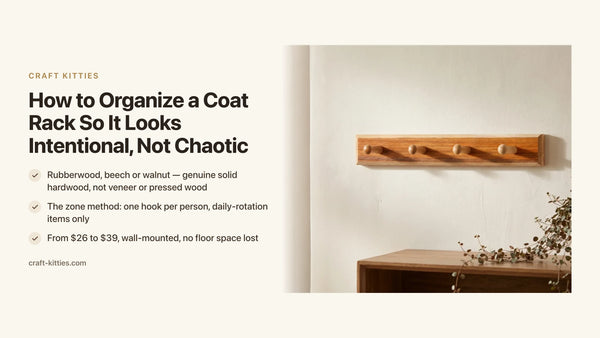
- A wood hook rack is the anchor — mount it first, layer from there
- Mirror at eye level: the single highest-impact move for a small entryway
- From $26 to $39 in solid beech, walnut and rubberwood — done in a weekend
The entryway wall is the first surface you see when you come home and the first impression guests form before they step into any other room. It is also, in most homes, the most neglected wall in the house: a bare stretch of paint interrupted by a builder-grade hook that holds three coats in a knotted pile and a drawer of unclaimed keys somewhere nearby.
The good news is that fixing it does not require a renovation or a decorator. It requires a decision — one clear anchor piece — and a layering logic that builds from function outward. This guide covers exactly that: how to choose the anchor, how to layer around it, what wood and format to use for a hook rack that holds up to daily life, and how to avoid the mistakes that turn an entryway into a corridor of accumulated good intentions.
At a glance
- A wood hook rack is the anchor — mount it first, layer from there
- Mirror at eye level: the single highest-impact move for a small entryway
- From $26 to $39 in solid beech, walnut and rubberwood — done in a weekend
Why the entryway wall is different from every other wall in the house
Every other wall in your home exists to be looked at. The entryway wall exists to be used — coat slung over a hook, keys dropped in a bowl, boots lined up below — and it is judged every time you walk through the door, not once a week when you rearrange the living room.
That difference in use changes everything about how to approach it. A gallery wall looks beautiful until you try to hang a soaking wet parka on it. A narrow console table looks elegant until the mail pile makes it invisible. The design decisions that work in a bedroom or living room fail in an entryway because the space carries functional load around the clock. The anchor piece has to be right first; the aesthetic layer follows.
The other entryway constraint is scale. Most entryways are narrow: a corridor, a foyer, a landing. The wall space is often tall but not wide. Pieces that dominate a large living room wall look reasonable here; clutter accumulates fast when the floor is only four feet wide. The rule that saves most entryways is vertical — build up, not out — and solid wood on the wall is the cleanest way to do it.
The four-layer system for an entryway wall
Experienced interior designers use a layering method that most homeowners apply accidentally, if at all. Applied deliberately, it takes a blank entryway wall from bare to finished in one pass:
Layer 1 — Function. The hook rack. This goes up first, at the right height, in the right spot. Everything else orbits it. Without a functional anchor, the entryway stays a corridor with good intentions.
Layer 2 — Reflection. A mirror at eye level. This is the single highest-impact move you can make in a small entryway: a mirror reflects light, doubles the perceived depth of the space, and gives you somewhere to look before you leave. In a narrow corridor, one well-placed mirror can make the wall feel twice as wide.
Layer 3 — Surface. A narrow shelf or console below the hook rack. This is where the keys live, the mail lands, the candle sits. Without it, everything that should be on a surface ends up on the floor.
Layer 4 — Personality. One piece of art, a framed print, a small plant. This is the layer that makes the space yours rather than a staged photograph. It goes on last, after the functional layers are settled, not before.
Most entryway problems come from skipping layer 1 and going straight to layer 4. The wall looks decorated for a week and then the coats arrive.
Choosing your anchor: what makes a hook rack worth mounting

The hook rack is the single piece of furniture the entryway genuinely cannot do without, which makes it the decision that deserves the most care.
Wood species. A wet winter coat can weigh four to six pounds. Multiply that by four hooks, add a bag or two, and the rack is carrying fifteen to twenty pounds of daily load. Hardwoods — beech, walnut, rubberwood — hold screws and hooks securely under that kind of repeated stress. Softwood or veneered particleboard compresses over time, and hooks start to tilt. The tactile difference is visible: real hardwood has a density and warmth in the hand that painted MDF does not replicate.
Hook count. The calculus is simple: one hook per regular user of the space plus two spares for guests. A couple needs a minimum of four. A family of four needs at least six. The mistake is under-provisioning and forcing coats to double up — that is exactly the pile-up a hook rack was supposed to prevent.
Rail versus board. A rail-style rack mounts on two anchor points and holds hooks that can be repositioned; a board-style rack is a fixed piece with hooks pre-set. Board racks read as more architectural, especially in solid wood with a visible veneer or two-tone grain; rail racks offer more flexibility if your household changes. Both formats work; the choice is visual and practical.
Height. The standard recommendation is 60 to 66 inches from the floor to the top of the hook, keeping the lowest hook within easy reach of an adult and the longest coats off the ground. If children use the entryway, a second lower rail at 36 to 42 inches turns the rack into a system.
The wood species that work in an entryway — and why it matters
An entryway hook rack faces wear that most home furniture does not: daily impact, seasonal humidity as wet coats drip on the wall, and the lateral stress of heavy bags. The wood species is not an aesthetic choice alone; it determines how the piece ages.
Rubberwood is dense, stable and resistant to humidity — a practical advantage in an entryway that sees coats fresh from rain. It does not expand or contract significantly with seasonal temperature changes, which means hooks stay plumb year after year. Paired with a Brazilian or cherry veneer face, it has enough visual warmth to read as a design object rather than a utility bracket.
Walnut is the connoisseur's choice. Its deep brown, fine-grained character sits at the top of hardwood aesthetics and works in almost any color palette — pale walls, dark walls, mid-century schemes, Scandinavian minimalism. As a solid wood, it holds fasteners firmly and takes the surface stress of hanging and retrieving without softening. A walnut hook rack in the entryway tends to be the piece guests notice and ask about.
Beech is lighter in color than walnut, tight-grained and extremely consistent in density. It is the hardwood that furniture makers return to when the design calls for two-tone pairings: beech's natural warmth contrasts cleanly with the deeper brown of walnut, producing a rack that reads as deliberately composed rather than simply functional. A beech-and-walnut combination in the entryway sits in the same visual register as a well-chosen piece of Scandinavian furniture.
The common thread across all three: real solid wood. A rack made of veneered particleboard will look similar in a product photograph and behave differently within twelve months — edges chip, screws loosen, the visual warmth of the veneer face fades when the edges reveal what is underneath.
The five hook racks from our studio, in detail
The four models below cover the main entryway profiles: the household that wants a statement piece, the one working with a tighter budget, the one that values flexibility over form, and the one that wants the cleanest possible wood-only silhouette.

Description
The Brazilian veneer rack is the piece to reach for when the entryway wall needs to hold its own visually. The rubberwood base gives it structural stability under daily load; the Brazilian veneer face gives it the kind of warm, layered grain that reads as furniture rather than hardware. It ships in 4- and 6-hook configurations, with solid metal hooks that have enough clearance for a rolled umbrella or a thick winter parka without crowding the bar. At $39, it is the studio's highest-specification entryway rack.

Description
The cherry veneer variant of the same rack reads warmer and lighter than the Brazilian option. Where the Brazilian veneer brings depth and contrast, cherry brings warmth and brightness — the right call for entryways with natural-light limitations or walls that already lean neutral. The rubberwood core is identical, so the structural performance is the same. The choice between Brazilian and cherry is the choice between two different color conversations with your wall.

Description
The two-tone rack does something none of the other models attempt: it makes the contrast between species the design itself. The beech board and walnut hooks are both real solid hardwood — not veneer over the same substrate, not paint to simulate the difference. The visual tension between the lighter board and the darker hooks is what makes the piece legible from across a narrow corridor. At $26 for a 2-hook configuration, it is also the entry point to solid wood in the entryway without compromise on material.

Description
The walnut boot-profile rack is the minimalist choice. A single solid walnut board, four hooks shaped with a clean boot-profile curve that holds a coat without the hook protruding awkwardly into the space. No rail, no visual interruption, just wood and metal at the correct height. The boot profile also holds bags more cleanly than a standard hook — the curve prevents the strap from slipping. At $28.80, it is the studio's clearest answer to "I want something simple that lasts."
Comparison table — which rack for which entryway
| Model | Price | Wood | Hook config | Best for |
|---|---|---|---|---|
| Rubberwood Brazilian Veneer | $39 | Rubberwood + Brazilian veneer | 4 or 6 hooks | Statement entryway, families |
| Rubberwood Cherry Veneer | $37 | Rubberwood + cherry veneer | 4 or 6 hooks | Warm-toned rooms, red oak floors |
| Beech & Walnut Two-Tone | From $26 | Solid beech + solid walnut | 2 to 6 hooks | Design-forward, entry price |
| Walnut Boot Profile | $28.80 | Solid walnut | 4 hooks fixed | Minimalist look, bag-heavy households |
Decision guide — matching rack to entryway type
| Your entryway situation | The right pick |
|---|---|
| Family of four, winter coats, daily heavy use | Brazilian Veneer, 6-hook |
| Warm-toned room, red oak floors or tan walls | Cherry Veneer, 4 or 6-hook |
| Design-conscious, want the wood contrast to read | Beech & Walnut Two-Tone |
| Minimal aesthetic, mainly bags and light coats | Walnut Boot Profile |
| Tight budget, first upgrade to solid wood | Beech & Walnut, 2-hook — starts at $26 |
How to mount an entryway hook rack: the four-step method
Mounting a hook rack is a 30-minute task if done in the right order. The order matters more than the tools.
Step 1 — Find the studs. Mark the stud positions before doing anything else. A rack carrying coats should anchor into at least one stud; two is better. In a rental or plasterboard wall with no convenient studs, use wall anchors rated for the expected load (minimum 50 lb for a 6-hook rack in a household with heavy coats). Do not rely on drywall alone.
Step 2 — Set the height. The top of the hook should sit between 60 and 66 inches from the floor. Mark the height, then use a level across the full width of the rack before marking the second hole. A rack that is one degree off reads as crooked to anyone walking through the door.
Step 3 — Pre-drill and mount. Pre-drill pilot holes to prevent splitting, particularly close to the ends of the board. Drive the screws slowly and stop before over-torquing — solid wood holds a screw firmly without compression; you do not need to force it.
Step 4 — Check the rack before loading it. Give it a firm lateral pull before hanging anything. If it gives at all, the anchor is insufficient. Better to add a third anchor point now than to find the rack on the floor in February.
Layering around the hook rack: mirror, shelf, art

With the rack mounted, the rest of the entryway wall falls into place by following the four-layer sequence.
Mirror placement. Center the mirror on the wall, not necessarily above the rack — the mirror and the rack can sit side by side on a wide wall. At eye level means the center of the glass at 57 to 60 inches from the floor, which is the same rule used for hanging art. In a very narrow corridor, a tall vertical mirror amplifies the sense of height; a wide horizontal mirror widens a short wall. Match the frame material to the hook rack: a walnut rack pairs with a dark wood or black metal frame; a beech rack suits a lighter or natural frame.
Shelf position. A narrow wall shelf — four to eight inches deep — below the hook rack at around 36 to 40 inches from the floor creates a surface that works for keys, mail, a small tray, a candle. This is the surface that absorbs the daily deposit of pocket contents and keeps it off the floor. It also anchors the composition: rack above, shelf below, the wall reads as organized rather than decorated by accident.
The single art rule. In an entryway, one piece of art is almost always more effective than a gallery wall. The space is narrow and in motion — people are entering and leaving, not sitting and contemplating. One deliberate piece, centered on the wall, provides a focal point without requiring attention. It can be a large print, a framed photograph, a simple botanical illustration. Choose something that faces the front door so it is the first thing you see when you walk in.
Five mistakes that keep entryways looking unfinished
Mounting the rack in the wrong place. The rack should be on the wall that faces you as you enter, or on the wall immediately to the dominant hand's side. A rack on the opposite wall from the door means you walk past it before you can use it — the coats end up draped over the nearest chair.
Choosing the hook count for today's household, not tomorrow's. A 2-hook rack for a couple works until a child arrives, or until each person has a regular coat and an occasional jacket and a school bag. Buy one hook configuration up from what you need today.
Ignoring the height. A rack mounted at 48 inches from the floor requires everyone to reach down for their coat. A rack mounted at 74 inches puts the hooks above eye level and makes loading awkward. The 60-to-66 inch range exists for a reason.
Decorating the shelf before the rack is settled. The shelf becomes an afterthought when it is added after the art and mirror are already in place. Put the shelf in during the functional layer stage, before any decor goes up, so it sets the composition rather than filling in a gap.
Using mismatched materials without a thread. A rubberwood rack, a chrome mirror frame, a black metal shelf bracket and a bamboo tray do not read as eclectic — they read as accumulated. If you are mixing materials, pick one that recurs in every piece. The wood in the hook rack is an easy thread to pull: a walnut rack, a walnut-toned frame, walnut-handled keys, and suddenly the wall looks like a decision was made.
The weekend timeline: how to go from blank to finished in two days
This is not aspirational. A blank entryway wall can be fully decorated in a weekend using the four-layer system, and the order of operations prevents the most common mistakes.
Saturday morning — buy and prep. Order the hook rack before the weekend if possible; it should arrive ready to mount. Gather a stud finder, a level, a drill, appropriate wall anchors and a measuring tape. Identify the wall you are working with and measure the available width.
Saturday afternoon — mount the rack. Follow the four-step mounting method. Let this be the only thing you do on Saturday. Mount it, check it under load, live with it for 24 hours to confirm the height and position feel right before adding anything else.
Sunday — layer. Mirror goes up first. Then the shelf, if you are adding one. Then the single art piece. Stand at the front door and look at the wall before hanging the art: the mirror and shelf already create a composition. The art completes it; it does not start it.
Where to go next
The hook rack is almost always the first piece of a home that switches to solid wood — rarely the last. Our wall hook rack collection gathers the full lineup organized by size and wood family. If the choice is still between the Rubberwood Brazilian Veneer and the Two-Tone Beech & Walnut, the simplest test is to hold a photo of each against a photo of your entryway wall and see which one creates the contrast you want. Most people decide in thirty seconds.
You will also find us on Etsy, where over 243 customers have reviewed our wood pieces and where the two-tone rack regularly draws the comment "more beautiful in person than in the photo."
FAQ — how to decorate an entryway wall
1 — What should I put on an entryway wall? Start with function: a hook rack for coats and bags is the anchor. From there, layer a mirror at eye level, a narrow shelf for keys and mail, and one piece of art or a framed print. Those four elements cover almost every entryway wall and work at any budget.
2 — How high should a coat hook rack be mounted? Between 60 and 66 inches from the floor, which keeps the lowest hook within reach for most adults and keeps long coats off the floor. If children use the entryway regularly, a second lower row at 36 to 42 inches makes the space work for everyone.
3 — What is the rule for hanging art in an entryway? Center the piece at eye level — approximately 57 to 60 inches from the floor to the center of the frame. In a narrow entryway, one larger piece reads better than a cluster of small ones.
4 — Can I decorate an entryway wall without drilling? Yes, for lightweight decor. For hook racks meant to hold real loads — coats, bags, umbrellas — proper wall anchors are the correct choice. The weight of a wet winter coat on an adhesive hook is a different proposition from a decorative print.
5 — How do I make a small entryway feel bigger? A mirror at eye level is the most effective move: it reflects light and doubles the perceived depth. Keep the floor clear by moving all storage to the wall. Warm-toned wood in the hook rack reads as open rather than heavy in tight spaces.
6 — What wood is best for an entryway hook rack? Hardwoods — beech, walnut, rubberwood — hold hooks securely under daily load. Walnut is the most sought-after tone, deep brown with fine grain. Beech is lighter and pairs naturally with two-tone designs. Rubberwood is dense and humidity-stable.
7 — How many hooks do I need in an entryway? One hook per regular user plus two spares for guests. A four-hook rack works for a couple; a six-hook configuration handles a family. If bags and backpacks also live on the rack, add a hook per category.
8 — Should the entryway mirror match the hook rack? They benefit from speaking the same material language, not matching identically. A walnut rack pairs naturally with a dark wood or black metal frame. Coherence reads as intentional; identical matching reads as a showroom.
9 — Is a bench necessary in an entryway? Only if the floor space allows it and if household members sit to remove shoes. In a corridor narrower than five feet, a bench blocks traffic. A hook rack on the wall combined with a small floor mat often solves the entry zone more efficiently.
10 — How do I add personality to a neutral entryway? Through texture and contrast, not quantity. Solid wood against a white wall already introduces warmth and material character. One framed print that means something personalizes the space without clutter. A deliberate blank zone reads as confident, not unfinished.