The word "minimalist" has been attached to so many products — candles, rugs, scented diffusers sold in matte black packaging — that it has started to mean its own opposite: more things, just in a quieter aesthetic. Real minimalism is not a style. It is a decision about what earns space in your home, and what does not.
This article is a practical guide to that decision. Not a mood board, not a list of things to buy. A method: how to read a room, where to start removing, which objects actually earn their place on a clear surface, and why natural material — solid wood, above all — carries warmth in a way that synthetic alternatives cannot replicate at low object-count. Every product referenced here has a function and a material worth explaining. None of them require you to redecorate from scratch.
At a glance
- Real calm comes from surfaces you can see — not from buying more "minimal" things
- Natural materials like solid beechwood and walnut do the warmth work that quantity cannot
- Start with one clear surface, one anchoring object, then repeat room by room
Why minimalism in the home actually works — the psychology
The research is straightforward: visual complexity raises cortisol. The more distinct objects a room holds, the more cognitive load it places on anyone entering it — not because the objects are ugly, but because the brain processes each one as a potential signal requiring attention. A clear surface is not an aesthetic preference; it is a rest.
The counterpoint is equally true: a room with nothing on its surfaces reads as temporary, not calm. A hotel room is not peaceful because it is empty; it is peaceful because every surface is deliberately finished. The objects that remain — a lamp, a carafe, a set of coasters on the bedside table — signal that someone chose each placement. That intentionality is what creates the feeling of calm, not the low object count alone.
Minimalism, practically speaking, is the practice of raising your threshold for what earns a surface. Most objects in most homes are there by default — they arrived, they were placed, and no one has questioned them since. The minimalist edit is not a one-time purge; it is a repeated question: does this object earn its spot through daily use, through genuine visual contribution, or through both? If neither, it does not belong on the surface.
The rooms that read as calm, regardless of their aesthetic vocabulary — Scandi, Japanese, modern farmhouse, transitional — share one structural quality: you can see their surfaces. The style on top of that structure is secondary.
The first rule: start with subtraction, not addition
The single most common mistake in a minimalist home project is buying before clearing. A new set of coasters, a new throw, a new lamp — each of these is purchased with the intention of "simplifying" the room, and each adds to the problem until the existing layer is addressed first.
The reliable sequence is: remove first, assess what remains, then decide whether anything needs to be added. In most rooms, the answer is that very little needs adding at all — the room improves visually with less, without replacement.
A practical starting point: choose the surface that bothers you most. The coffee table covered in remotes, chargers, coasters from three different sets, a magazine from three months ago, and a candle that has never been lit. Clear it entirely. Put everything on the floor. Wipe the table. Sit back and look at it for a moment.
Then put back only what you use every day. In the living room, that is usually: a coaster set for drinks, perhaps a book you are actively reading, a remote control. Everything else goes somewhere purposeful — a drawer, a shelf, a bag for donation — or it goes away. The table that results from this process is not bare. It is legible. And a legible surface is the foundation of every minimalist room that actually works.
Natural materials: why wood does the work that synthetic cannot
A minimalist room with few objects places enormous visual weight on the objects it keeps. A plastic coaster set is not just functional; it is one of the few things on the table. What it is made of matters more than it would in a crowded room.
This is the practical argument for natural materials in a minimal home. Solid wood — beechwood, walnut, red oak — carries grain, tone variation, and texture that no synthetic material replicates convincingly at low object-count. A clear surface with one solid beechwood coaster set on it reads as calm and finished. The same surface with a plastic or silicone coaster set reads as sparse and unresolved. The difference is entirely material.

Beechwood and walnut are the two ends of the material spectrum in our wood coasters collection. Beechwood is lighter — a warm honey tone with a tight, clean grain that works against white, off-white and light gray surfaces. It brightens without competing. Walnut sits deeper — rich brown, fine grain, the wood that interior designers default to when they want a single surface element to carry the room's visual anchor. Against a light wall or table, walnut creates contrast without adding noise.
Both are solid wood. Not veneer, not wood-look laminate, not printed wood-effect resin. The distinction matters practically: solid wood develops a patina over years of use, which means it ages toward beauty rather than away from it. A veneer chips at the edge after daily contact with mugs. A solid beechwood or walnut coaster takes the same contact and becomes more itself over time.

Description

Description
Room by room: the minimalist edit
Minimalism applied room by room moves faster than trying to declutter a whole home in a single weekend. Each room has a primary surface — the one surface that reads first when you enter — and that surface is where the edit starts.
Living room: the coffee table rule
The coffee table is the visual center of most living rooms. What sits on it is what the room communicates. The minimalist rule for coffee tables is one of the clearest in interior design: anchor first, ornament second, never both at equal weight.
An anchor is a functional object that earns daily use — a coaster set, a book currently being read, a candle lit at least twice a week. An ornament is a decorative object without daily function — a sculptural piece, a tray with objects in it, a bowl of nothing. In a minimalist room, the anchor wins. One set of solid wood coasters, consistently used and in the right material, does more for a coffee table than any decorative arrangement.
The rule extends to what surrounds the coffee table. Floor lamps with a single clean line, a sofa in one solid color, shelving with intentional gaps — these frame the table without competing with it. The instinct to fill every shelf is the instinct to resist. Empty space on a shelf is not unfinished; it is the room breathing.
Bedroom: the nightstand test
The nightstand is the most used surface per square inch in the house. Most nightstands accumulate: phone, charger, water glass, book, lamp, second book, hand cream, hair tie, receipt. The result is a surface that triggers mild stress every morning and evening — the moments when calm matters most.
The nightstand test is simple: everything on the surface must be used before sleeping or immediately upon waking. Phone (yes), lamp (yes), water glass (yes), coaster under the water glass (yes — the wood protects the surface and eliminates the white ring that accumulates otherwise). Receipt from three weeks ago: no. Book you finished reading: moved to the shelf.
A solid wood coaster on the nightstand is a small detail with a specific function: it keeps the surface clean under the glass, it adds one piece of natural material to a space where you spend a third of your life, and it eliminates the nightly question of where to set the glass down. That specificity — the object that solves a precise, daily problem with nothing redundant — is what minimalist home decor actually looks like in practice.
Kitchen and dining: the counter clarity rule
Kitchen countertops are the horizontal surfaces most resistant to minimalist discipline. Appliances accumulate because they are used frequently; spices, oils, and condiments migrate out of cabinets; mail and keys land there because it is the surface closest to the door.
The counter clarity rule: only the appliances used three or more times per week earn permanent counter space. Everything else goes into a cabinet. A toaster used every morning: stays. A juicer used twice in January: cabinet. The gain is not aesthetic alone — a clear counter is also significantly faster to clean, which compounds over hundreds of mornings.
For the dining table, the minimalist rule mirrors the coffee table: one anchor, no ornament competing with it. A set of coasters in a consistent material — beechwood or walnut, same shape — signals that the table is ready for use. A cluttered centerpiece signals that the table is a surface and not a place.

Entryway: the first and last impression
The entryway is the room most people skip in a home edit, because it is small and because it is used fast. That speed is precisely why it matters: every departure and every arrival happens there. An entryway that reads as calm — a hook for keys, a place for shoes, a surface with nothing unnecessary on it — sets the tone for everything that follows.
The minimalist entryway works with vertical space. A wall-mounted hook system instead of a freestanding rack. A shelf above the door height for rarely-used items. The floor: clear. The surface nearest the door: one object, consistently in place. Nothing accumulates.
The coaster as a minimalist case study
The coaster is worth examining in some detail, because it illustrates the minimalist ideal more precisely than larger objects do. A coaster is simultaneously functional (it protects the surface), material (it introduces texture and tone), and social (it signals that the table is prepared for guests). Three functions, one object, zero redundancy.
The choice of material, shape, and number within a set matters more in a minimal room than it would in a cluttered one, because the coaster set is one of the few objects on the surface. A mismatched set — three different materials, two different sizes, none of them chosen deliberately — reads as accidental in a room with nothing else competing for attention. A consistent set in solid wood, same shape, same finish, reads as decided.
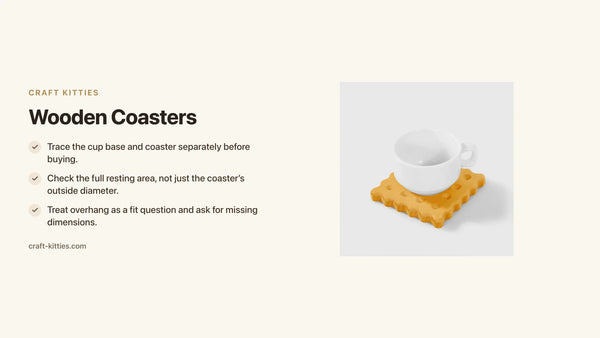
The cookie shape used in our beechwood cookie coaster set and walnut coasters comes from a design decision: a shape with a scalloped edge that is recognizably geometric without being rigid. Against a square table, the rounded edge softens. Against a round table, the scallops echo without mirroring exactly. The shape does not compete with the table; it completes it.
At $22.99 per set, both the beechwood and walnut versions carry a price-to-material ratio that holds up plainly. These are solid hardwood pieces — beech is one of the densest of the European hardwoods, walnut one of the most sought-after North American species — cut, shaped and finished to a surface quality that makes the material visible rather than hiding it under paint or laminate. Solid wood at this price point means the object earns its place on a clear surface without requiring justification.
What to look for (and avoid) in minimalist home accessories
The three-question test for any object
Before any object earns a surface in a minimalist home, it should answer three questions satisfactorily:
Does it have a daily or near-daily function? If the honest answer is "it looked nice in the store," that is not a function. A coaster set has a daily function: it goes under every drink, every time. A sculptural vase with no flowers in it has no daily function and borrows its legitimacy from the flowers that never arrive.
Does its material hold up at low object-count? In a room with thirty objects on a shelf, a plastic coaster is invisible. In a room with three objects on a coffee table, the material reads clearly. Natural wood, ceramic, linen, stone — these materials carry visual weight through texture that synthetic materials do not. When the count drops, material quality rises in importance.
Is it a single, coherent piece or a collection of small things? One set of four matching coasters reads as one object. Four different coasters from four different sources read as four separate choices, none of which were made together. In a minimal room, coherence within a set matters more than individual piece quality.
What to actively avoid
Multiples of the same category in different materials: two coaster sets in two different materials competing on the same table. Pick one set, one material, retire the other.
Objects that require maintenance to look minimalist: a white linen throw that shows every crease, a marble tray that stains with every ring, a succulent that dies if not watered precisely. Minimalism in daily life means objects that age gracefully with normal use, not objects that require management to stay presentable.
Placeholder decor: candles in holders that are never lit, books stacked by color that no one reads, a bowl of smooth rocks from a hotel gift shop. These objects signal an intention toward minimalism without fulfilling it. They occupy surface space and require dusting. Replace them with one real object that gets used.
Comparison: beechwood vs. walnut coasters for a minimalist home
| Criterion | Beechwood Cookie Set | Walnut Cookie Set |
|---|---|---|
| Price | $22.99 | $22.99 |
| Wood species | Solid beechwood — European hardwood | Solid walnut — North American hardwood |
| Tone | Warm honey, light and bright | Deep brown, rich and quiet |
| Grain | Tight, fine — clean reading at distance | Fine, straight — disappears into the surface |
| Best surface pairing | Dark tables, charcoal or taupe surfaces | White, marble, light oak tables |
| Minimalist use case | Brightens a dark or moody room | Anchors a light, neutral room |
Decision guide: which piece for which room and surface
| Your room / surface | The right pick |
|---|---|
| Light, neutral living room — white walls, marble coffee table | Walnut cookie coasters — contrast anchors the table |
| Dark or moody living room — charcoal walls, dark furniture | Beechwood cookie coasters — honey tone brightens |
| Bedroom nightstand — light oak or white bedside table | Walnut coasters — material contrast, quiet presence |
| Kitchen island or dining table — warm wood tones | Beechwood coasters — harmonizes with warm wood grain |
| Home office desk — clean, task-oriented surface | Either set — the coaster manages the drink, keeps the desk clear |
Caring for solid wood pieces in daily use
Solid beechwood and walnut require less maintenance than most people expect, precisely because they are solid rather than veneered. A veneer — even a thick one — fails at the edges under repeated moisture contact; solid wood takes the same contact and, if finished correctly, remains intact and improves over time.
The maintenance protocol for a waxed or oil-finished solid wood coaster is minimal: wipe with a dry or barely damp cloth after use. No harsh cleaners, no soaking, no dishwasher. The finish does the protective work; daily wiping removes the residue before it accumulates. Once or twice a year, a light application of food-safe wood wax or mineral oil refreshes the surface and extends the life of the piece by years.
The aesthetic argument for maintenance is the aging argument: a solid wood piece that is cared for develops a patina — a slightly deeper tone, a surface that has been touched and used — that makes it more beautiful over time, not less. This is the opposite of every synthetic alternative, which degrades from the moment of purchase. For a minimalist home, where each object carries more weight precisely because there are fewer of them, the aging trajectory of the material matters.
Mistakes to avoid when starting a minimalist home edit
Decluttering one room while the rest accumulates. The instinct is to tackle the living room first because it is visible, while ignoring the bedroom, the entryway, and the hallway closet. The problem is displacement: objects removed from the living room often end up on the bedroom floor or in the closet — same volume, less visible. The edit needs to address categories across all rooms, not rooms in isolation.
Buying "minimalist" products before clearing. A matte black minimalist storage box is still a box. A curated selection of marble trays is still five additional objects. The first move is always subtraction; what to add (if anything) becomes clear only after the subtraction reveals what the room actually needs.
Choosing contrast for its own sake. A walnut coaster set on a walnut table in a room full of walnut furniture does not read as minimalist — it disappears. Contrast creates legibility, which is what makes a clear surface actually feel clear. One piece of lighter or darker wood on a surface of the opposite tone reads as intentional; the matching tone reads as an accident.
Ignoring the floor. Surfaces at eye level get attention; floors accumulate. Cables, bags, shoes, books stacked vertically on the floor — these register peripherally but add continuously to the room's visual noise. A minimalist room with clear tables and a cluttered floor has not finished the edit.
Where to go next
The wood coasters collection gathers the pieces designed for exactly this kind of deliberate surface — natural materials, consistent shapes, sizes that work for coffee tables, nightstands, kitchen islands and desks. If you are starting the minimalist edit from the coffee table, either the beechwood set or the walnut set serves as the anchor that makes the cleared surface feel finished rather than empty.
We have over 240 reviews on Etsy from customers who made the same starting move — one real wood piece on one clear surface — and found it easier to keep the rest of the room clear once the anchor was in place.
Frequently asked questions
1 — What is the easiest minimalist home decor change to make first? Clear one surface completely — a coffee table, a kitchen counter, a nightstand. Remove everything, wipe it down, then put back only what you use daily. That single action resets how the whole room reads. From there, choose one object that earns its place: a plant, a candle, a set of real wood coasters. The rest follows naturally.
2 — How do I make a minimalist home feel warm, not cold? Warmth in a minimal space comes from natural materials, not from quantity of objects. Solid wood, linen, stone and ceramic carry texture that reads as lived-in even on a bare surface. One solid beechwood or walnut coaster set does more for a room's warmth than a dozen decorative knick-knacks stacked on a shelf.
3 — What is the difference between minimalist and bare? Bare means nothing on surfaces, which reads as unfinished or transient. Minimalist means every object is chosen deliberately — each piece carries its weight visually or functionally, and nothing sits there by default. A well-chosen wood coaster set on a clean coffee table is minimalist. An empty table with no anchor is just bare.
4 — Do minimalist rooms need to be neutral-colored? No. Neutrals make restraint easier because they do not compete with each other. But the principle is contrast and intention, not palette. A deep walnut coaster on a white tabletop creates more visual interest than a neutral-on-neutral setup, and still reads as calm because there are no competing elements around it.
5 — Are wood coasters a good minimalist home accessory? Yes — and for a precise reason. A solid wood coaster does three things at once: it protects the surface, it anchors the table visually, and it introduces natural material texture. That triple function is the minimalist ideal: one object, multiple purposes, nothing redundant.
6 — How many decorative objects should a minimalist home have? There is no fixed number — the rule is that each object must justify its presence. In practice, three to five meaningful pieces per room (a plant, a coaster set, one framed item, one textile) is a range that reads as intentional rather than stripped-down or cluttered. Start by removing rather than by counting, then add back only what you genuinely miss.
7 — What furniture works best in a minimalist living room? Low-profile furniture with clean lines and solid construction: a sofa in a single solid fabric, a coffee table with visible legs, shelving that goes high rather than wide. Avoid furniture with decorative carved details or mixed materials — each piece should read as one clear material and one clear form.
8 — How do I start decluttering without getting overwhelmed? Start with one category across the whole house rather than one room. Books, cables, decorative objects, kitchen countertop appliances — pick one category, gather every item in it, and decide by function: does this earn daily use? If not, it goes. Working category by category surfaces duplicates faster than room-by-room decluttering does.