At a glance
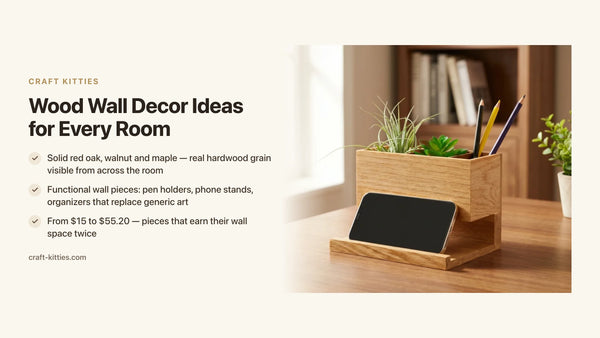
- Solid walnut, red oak and beech — real hardwood, not veneered MDF
- Three zones solve 90% of home office clutter: daily carry, tools, cables
- $39–$46, pieces that work as furniture not just containers
A cluttered desk is not an attention problem or a discipline problem. It is a container problem: most small home offices have no system for where things land, so everything lands everywhere. The result is a surface covered in objects that each belong to a different category — charging cables looped around a pen, keys next to a notebook, earbuds sharing space with a stapler. Nothing is lost, exactly, but nothing is easy to find either, and the visual noise makes the whole setup feel heavier than it needs to.
The fix is not to buy more storage. It is to give each category a single, defined place and make that place visible enough that putting things away is less effort than putting them down randomly. That is what a good desk organizer actually does: it makes the default behavior the organized behavior.
The trouble is that most desk organizers solve the problem on a spreadsheet — they have compartments, they hold things — but fail in daily use. Plastic bins warp after a year of sun exposure. Wire mesh trays collect dust in the grid. Veneered MDF chips at the corners within months. This guide cuts through that category and focuses on what works: solid hardwood organizers that earn their place on a desk because they function well and look like they belong there. Three pieces, one system, a different desk.
Why most desk organization fails within three months

The most common desk organization mistake is treating clutter as a volume problem — too much stuff — when it is almost always a behavior problem: no defined place means no reason to put things in the right spot. The object that lands on the desk corner becomes a permanent resident within two days. Multiply that by cables, stationery, small accessories and daily-carry items, and the surface fills without anyone deciding to fill it.
The second failure mode is friction. An organizer that requires you to open a lid, unfold a compartment or move something else to access what you want is an organizer you will stop using. The best containers for a desk are open, shallow, and visible: you can put things in and take things out in one motion, which means the barrier to staying organized is near zero.
The third failure is aesthetic. A plastic tray in a home office that doubles as a living space reads as office equipment. It signals "this is a work zone" even when you want the room to feel calm. Solid hardwood organizers signal the opposite: they read as furniture, which means they make the desk feel like a considered surface rather than a workstation that landed in your living room by accident.
Understanding these three failures is more useful than any organization tip, because once you identify which failure you have — no system, too much friction, wrong visual language — the solution becomes obvious.
The three-zone framework for a small desk
A small home office desk typically has between 24 and 40 inches of usable surface width. That is not much room, and every container you add competes for it. The framework that works is to limit yourself to three zones, each with a dedicated purpose, and choose one container per zone.
Zone 1 — Daily carry. Phone, keys, earbuds, a watch, a USB drive: the objects that live on your body away from the desk and need a landing spot when you sit down. Without a defined zone, these scatter across the entire surface. A valet tray — ideally a two-tier model — collects them in one footprint, separates flat items from three-dimensional ones, and makes the daily-carry pile visible in one glance.
Zone 2 — Writing tools and stationery. Pens, a highlighter, scissors, a small ruler: the category most people over-store. Three to five tools used daily is the realistic number for most people. A pen tray with modest depth holds what you actually use without inviting everything you own. The tray also makes the tools visible — you grab what you need without sorting through a cup.
Zone 3 — Cables and charging. This is the zone that creates the most visual noise. A cable organizer box handles the power strip, adapters and loose cables as a single enclosed system, removing them entirely from visible desktop space. For the one or two active cables you reach for daily, a small clip at the desk edge keeps them routed without a tangle.
Three zones, three containers, a defined place for every category. What does not fit in one of the three zones likely does not belong on the desk.
Solid wood versus alternatives: what changes in practice

The desk organizer category is dominated by veneered MDF and injection-molded plastic, both of which are inexpensive and look acceptable in product photography. Daily use tells a different story. Veneered MDF chips at the exposed corners — the precise spots that take the most contact — within the first few months. Once the veneer lifts, the particleboard core is visible, and the object reads as damaged even when it is structurally intact. Plastic trays attract fingerprint gloss and surface smudges that read as dirt at a glance; over years, UV exposure yellows white or clear plastics in ways that cannot be reversed.
Solid hardwood ages differently. Walnut (Juglans nigra) develops a warm patina over time; red oak's bold grain absorbs minor surface marks naturally; beech stays pale and clean with minimal upkeep. All three are denser and stiffer than veneered board, which means corners and edges hold their shape under daily contact. The finish — typically an oil or wax coat — wipes clean with a dry cloth and can be refreshed once a year without sanding or professional refinishing.
The practical difference over three to five years is significant: a solid hardwood organizer looks the same or better than the day it arrived; a veneered MDF equivalent looks noticeably worse. That durability gap is the primary argument for the price difference — not aesthetics alone, but economics across a typical product lifespan.
Across the three species in our lineup, the visual logic is consistent: walnut against light desks and white walls, where its deep brown tone creates contrast; red oak in darker setups or rooms with cooler tones, where its honey warmth lifts the palette; beech in any setting, where its neutral pale tone functions as a clean baseline. Durability and maintenance are equivalent — the choice is about what the desk needs visually.
The Hardwood 2-Tier Valet Tray — the daily-carry anchor

Description
The two-tier format solves a specific problem that a single flat tray cannot: it separates daily-carry items by volume. Flat objects — a business card, a folded receipt, a sticky note, a thin USB drive — disappear under keys and a phone in a single-layer tray. The lower compartment of this model keeps them visible and reachable; the upper tier holds the three-dimensional items (keys, earbuds case, a watch) without stacking them.
The solid hardwood construction matters for a piece that gets this much daily handling. Keys landing in a plastic tray create a noise and a scratch pattern over weeks; in a solid wood tray, the same contact is absorbed quietly and leaves no visible trace. The two-tier form also means the tray occupies roughly the same footprint as a single-layer model while doubling the organized capacity — relevant on a small desk where horizontal surface is the constraint.
At $39.00, this is the first piece to place on a desk that has no organizational system at all. It addresses the most disorganized zone — where daily-carry items scatter — without requiring any other changes. Once Zone 1 is solved, the friction of adding Zones 2 and 3 drops considerably.
The Walnut Cable Organizer Box — making cables disappear

Description
Cable clutter is the category that most people attempt to solve with cable ties and clips — tools that contain cables but do not hide them. The result is an organized tangle rather than a clean surface. The cable organizer box takes a different approach: it is a closed enclosure, not a routing system. The power strip, the laptop charger brick, the monitor adapter and any loose cables all go inside. The lid closes. The desk shows a walnut box.
Solid walnut was the right material choice for this piece specifically because the box sits on the desk or directly below it where the room sees it. A plastic enclosure in the same position reads as infrastructure; a walnut box reads as a considered object. The grain of Juglans nigra — fine, tight, deep brown — holds its visual weight in any setup without demanding attention.
At $46.00, it is the highest-priced piece in this system, and the one with the largest visible impact. Most people who add a cable box to their desk report that it changes the whole reading of the setup more than any other single change — not because cables are the worst organizational problem, but because they are the most visually loud one. Removing them completely, rather than managing them, is a different category of solution.
The box accommodates standard power strips and typical adapter sizes; the lid is hinged rather than removable, so accessing the contents does not require clearing the surface.
The Walnut Pen Tray — precision for Zone 2

Description
The pen cup is the default storage choice for writing tools, and it has a structural problem: depth. When pens stand vertically, you cannot identify them without picking them up one by one. The pen tray fixes that by keeping tools flat, visible and accessible in one motion. You see what you have; you reach for what you need.
The walnut construction — solid Juglans nigra, oil-finished — suits this piece because it lives in direct eyeline. A pen tray sits in the foreground of every work session; its grain and color are part of the desk's visual baseline. Solid walnut at $39.00 reads as furniture at that scale, which is what makes it integrate naturally into a home office that also functions as a living space.
The tray's dimensions are intentionally modest: it holds the three to six tools you use daily without inviting the entire stationery drawer. That constraint is a feature. An overfull pen tray defeats the visual purpose of a tray; the goal is 20 to 30 percent empty margin, which is what makes the tray look organized rather than merely contained. The tray imposes that discipline by not having room for the tools you reach for once a month.
What does not belong on a desk: the items clutter gets blamed for
Most desk clutter audits reveal that a significant portion of surface objects have no business being there at all. A printer that prints twice a month, reference books consulted quarterly, cables for devices currently in a drawer, a charger for a device that lives in another room — all of these take up desk real estate because they have no other designated place, not because they are actively needed.
The three-zone framework forces this conversation: if an object cannot be assigned to daily carry, writing tools or active cables, it probably belongs in a drawer, on a shelf or somewhere else entirely. The organizers described in this guide do not create space for extra objects; they define space for the right objects. That distinction matters because buying more containers to manage more stuff is the mistake that keeps a desk cluttered despite continuous reorganization effort.
A useful test before any desk audit: remove everything, keep the desk empty for 30 minutes of actual work, and put back only the items you reached for. What remains on the desk after that session is what actually belongs there. What stays in the pile off to the side probably belongs somewhere else. Do that audit before buying any organizer — it determines how many containers you need and what size, rather than letting a purchase decision drive the system.
Setting up the three-zone system: a practical sequence
Reorganizing a desk works better as a sequence than as a simultaneous overhaul. The sequence that creates the least disruption:
Step 1 — Clear the surface completely. Everything off the desk, into a temporary pile. Resist the urge to sort while clearing — sorting and clearing at the same time creates partial progress that is easy to abandon.
Step 2 — Place the valet tray first. Identify where your phone and keys naturally land when you sit down. Put the tray there. Load it with daily-carry items only — not pens, not cables, not anything that belongs to a different zone.
Step 3 — Add the pen tray. Place it in the zone closest to your dominant hand, within reach without leaning. Load it with three to six tools you use in a typical session. Leave at least two empty slots visible — that margin is what makes the tray look organized.
Step 4 — Place the cable box last. Run all active cables through the box before routing the working ends to their devices. The box position is typically on the floor behind the desk, on a low shelf below the surface, or on the desk itself if the box's footprint is acceptable in the setup.
Step 5 — Audit the remaining pile. Everything left over from the initial clear either belongs in a drawer, on a shelf or somewhere else entirely. The desk's surface is now allocated; the pile is the question, not the answer.
The sequence takes 20 to 30 minutes for most small home offices. The result is a system that has a defined place for every category, which means the default behavior becomes the organized behavior.
Comparison table
| Organizer | Price | Wood | Zone | Best for |
|---|---|---|---|---|
| Hardwood 2-Tier Valet Tray | $39.00 | Solid hardwood | Daily carry | First organizer on a bare desk |
| Walnut Cable Organizer Box | $46.00 | Solid walnut | Cables & adapters | Biggest single visual impact |
| Walnut Pen Tray | $39.00 | Solid walnut | Writing tools | Replacing an overfull pen cup |
Decision matrix — which piece to start with
| Your situation | Start here |
|---|---|
| Desk feels chaotic, no organizational system at all | 2-Tier Valet Tray — anchor the daily-carry zone first |
| Cables are the primary visual problem | Walnut Cable Box — single move, largest impact |
| Pen cup is overflowing and unruly | Walnut Pen Tray — imposes the right constraint |
| Desk lives in a shared / living room space | Walnut Cable Box + Valet Tray — read as furniture not office gear |
| Building a complete system from scratch | All three pieces — one per zone, full system at $124.00 |
| Gift for a home office worker | 2-Tier Valet Tray — useful from day one, neutral on desk setup |
Mistakes that keep a desk cluttered despite buying organizers
Buying organizers before auditing what belongs on the desk. More containers solve a container problem; they do not solve a too-much-stuff problem. If there are 40 pens on the desk, a pen tray will not make the desk look organized — it will just concentrate the problem into a smaller footprint. The audit comes before the purchase.
Choosing containers by category count, not daily-use frequency. A pen tray sized for 20 pens when you use 4 is oversized; it will fill to capacity within a week because objects expand to fill available space. Choose containers that hold slightly less than you think you need — the constraint creates discipline.
Mixing material languages on a small surface. A walnut tray next to an acrylic container next to a wire mesh holder reads as accidental. On a small desk, every object is in close visual proximity. Choosing two or three pieces in the same material family — solid walnut throughout, or solid red oak throughout — creates coherence that makes the whole desk read as intentional rather than assembled.
Solving the surface without solving the floor. Cables that run from the cable box to devices still need to be routed. A cable that crosses the floor visibly because there is no clip or channel at the desk edge undermines the cable box's impact. Address routing and containment together.
Reorganizing without a maintenance ritual. The best desk system degrades within two weeks without a reset habit. A 90-second end-of-day reset — keys in the tray, pens in the tray, cable on the hook — is the entire maintenance requirement. That habit is more durable than any organizational system.
FAQ — office clutter solutions for home offices
1 — What is the fastest way to reduce desk clutter? Surface audit first, containers second. Remove everything, put back only what you touch daily, assign each category to one container. A two-tier valet tray for daily carry plus a cable box for wires removes roughly 70 percent of visible clutter for most setups. The system does not need to be complete before it starts working.
2 — Does a wooden organizer stay cleaner than a plastic one? Solid hardwood is more forgiving visually: minor smudges disappear against grain texture, while smooth plastic shows fingerprints in full detail. Maintenance is a dry wipe either way. The longer-term difference is durability — solid hardwood does not chip or yellow over years, which means it reads as clean even after heavy daily use.
3 — Red oak, walnut or beech — which species for a desk? Walnut (Juglans nigra) is deep brown with fine grain — the furniture-quality option that reads calm and premium. Red oak is honey-toned with bold grain — it brightens darker setups. Beech is pale with tight grain — the Scandi-clean neutral. All three are equivalent in durability and maintenance; the choice is purely about what contrast the desk needs.
4 — How do I hide cables on a small desk? A cable organizer box is the single highest-impact move: it contains the power strip, adapters and loose cables inside a closed enclosure. Pair it with a small clip at the desk edge for the one or two active cables you reach for daily. No drilling required. The box solution removes cables from the visual field entirely rather than organizing them at a lower height.
5 — How many items should a desk organizer hold? Fewer than you think. A pen tray used correctly holds three to six tools, not twenty. A valet tray holds daily-carry items, not everything from your pockets for the past month. The 20 to 30 percent empty margin rule applies: if the container looks full, it is probably overloaded. Empty space in a container is what makes a desk look organized.
6 — Is a valet tray useful on a desk? Yes — specifically for the daily-carry pile. Phone, keys, earbuds, a watch, a small accessory: without a defined zone these scatter across the entire desk surface. A two-tier valet tray collects them in one footprint with a visual separation between flat items and three-dimensional ones. It also functions as a leaving-the-desk checkpoint: if the tray is empty when you stand up, you have everything you need.
7 — How do I maintain a solid walnut or red oak organizer? A dry cloth for daily cleaning; a barely damp cloth for stickier residue. Avoid alcohol-based wipes, which strip the oil or wax finish. Once or twice a year, food-grade mineral oil applied and wiped off keeps the grain from drying. No sanding, no specialist products — hardwood is low-maintenance by design.
8 — What is the difference between a cable box and a cable tray? A cable tray (wire mesh or plastic, usually under-desk) routes cables in transit and keeps them off the floor but leaves them visible. A cable organizer box is a closed enclosure that removes the power strip and adapters from the visual field entirely. For a desk in a visible room, the box is the stronger solution: it eliminates the visual noise rather than lowering it.
9 — Can these organizers work in a shared or living-room desk? Solid hardwood organizers are specifically suited to shared spaces because they read as furniture rather than office equipment. A walnut tray or cable box on a living-room desk integrates with the room's visual language in a way that plastic or wire organizers do not. The design-conscious audience our desk organizer collection is built for tends to use their desk in shared spaces — this is a primary reason for the material choice, not an afterthought.
Where to go next
The three pieces described here cover the foundational three zones of a small home office. The broader desk organizer collection includes pieces for edge cases — deeper trays for larger stationery sets, additional valet configurations, complementary accessories for desks with more surface to work with. All pieces are in the same solid hardwood families (walnut, red oak, beech) and the same finished style, so adding to the system later does not require a visual reset.
The Walnut Pen Tray and Hardwood 2-Tier Valet Tray are also the most requested gift choices in the collection — they are useful from day one and neutral enough to work on any desk setup. Customers who found us through Etsy (243 reviews) regularly note that the pieces photograph as furniture in a room, not as office accessories — which is precisely what makes them work in a shared space.
The short version
A cluttered home office desk is almost always a container problem, not a stuff problem. The three-zone framework — daily carry in a valet tray, writing tools in a pen tray, cables in an enclosed box — addresses the three categories that create the most visual noise, with one container each. Solid hardwood lasts where veneered MDF fails, integrates into a living space where plastic reads as infrastructure, and maintains its visual quality over years rather than months. Start with the piece that solves your most visible problem: the 2-Tier Valet Tray if daily-carry items scatter, the Walnut Cable Box if cables dominate the visual noise. Either move changes the desk. Both moves change the room.